
Imagine waking up at 3:00 am for the fifth consecutive night because you rolled onto your side, only to be met with a sharp, burning ache in your hip. Whether you’re struggling to walk into Oxford city centre or finding the stairs in your Headington home increasingly difficult, the path to recovery from greater trochanteric pain syndrome often feels unclear. Many patients arrive at our clinics in Abingdon or Summertown feeling frustrated by the conflicting advice they’ve received regarding whether their pain stems from bursitis or a deeper tendon issue.
We understand that persistent lateral hip pain affects every facet of your life, from your quality of sleep to your physical independence. This guide provides a comprehensive, evidence-based roadmap to help you return to pain-free movement using the advanced MSK services available at GB Clinic. You’ll discover how modern therapies such as Shockwave Therapy and ultrasound-guided Hyaluronic Acid injections provide a clinical solution for long-term relief. We’ll also explain how our expert-led physiotherapy is easily accessible for those living in Kennington, Marcham, Witney, Faringdon, and Eynsham.
Key Takeaways
- Understand why lateral hip pain is often a complex tendon issue rather than simple inflammation, allowing you to address the true root cause of your discomfort.
- Discover how combining manual therapy with advanced technology-led interventions can provide both immediate symptomatic relief and long-term musculoskeletal health.
- Follow a structured, four-stage roadmap for a successful recovery from greater trochanteric pain syndrome, guiding you safely from initial pain reduction to full physical activity.
- Learn how residents in Summertown, Headington, and Abingdon can access specialist, evidence-based care tailored to the specific needs of the local Oxford community.
- Gain insights into the “one-stop” clinical approach that eliminates treatment delays, helping you return to walking through University Parks or shopping in the Westgate pain-free.
What is Greater Trochanteric Pain Syndrome (GTPS)?
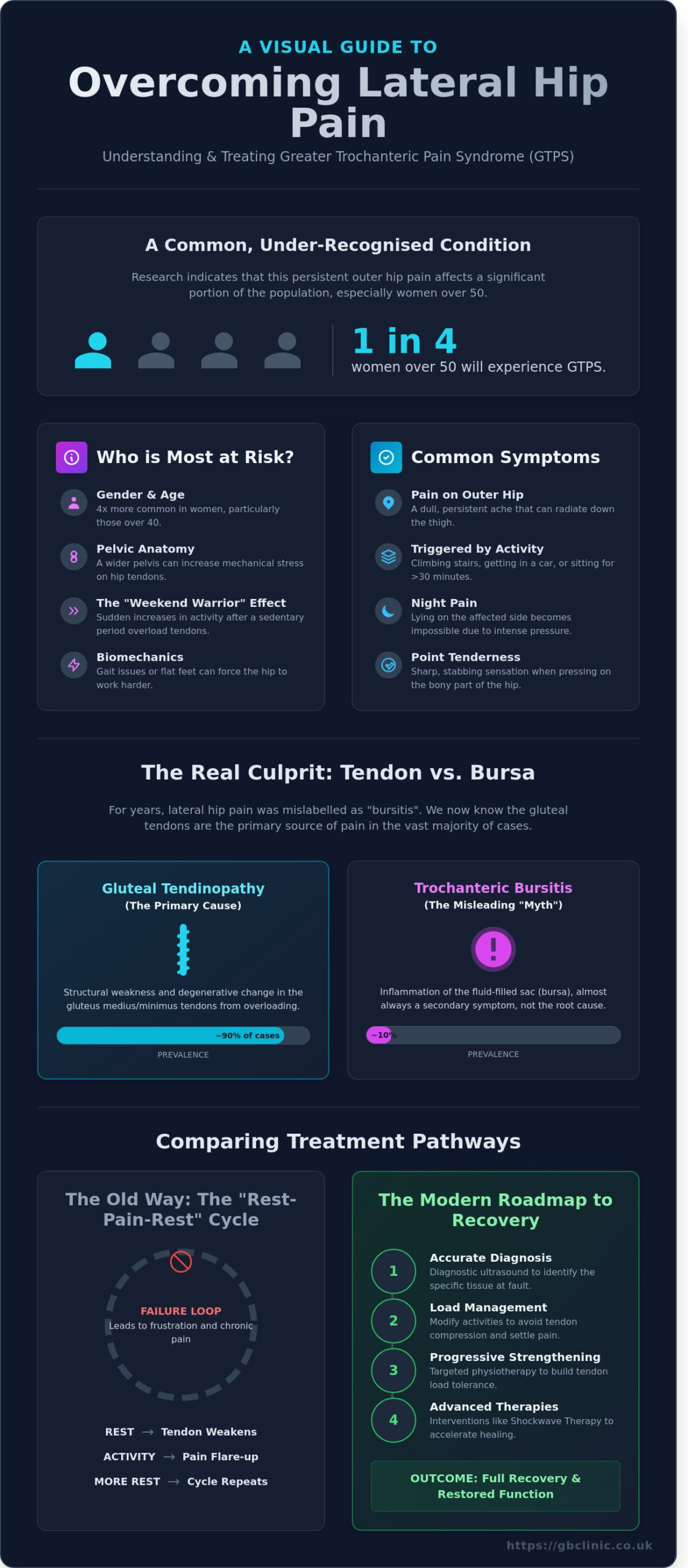
Greater Trochanteric Pain Syndrome (GTPS) serves as a clinical umbrella term for various conditions that cause pain on the outer side of the hip. While many patients were previously told they had “trochanteric bursitis,” modern clinical research suggests this is often a misnomer. In approximately 80% of cases, the primary issue isn’t an inflamed bursa, but rather a degenerative change or irritation of the gluteal tendons where they attach to the bony prominence of the hip. This distinction is crucial for anyone seeking a lasting recovery from greater trochanteric pain syndrome, as treating inflammation alone rarely addresses the underlying tendon health.
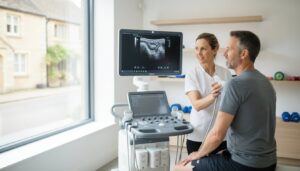
The pain often feels sharp or aching directly over the bone. It can radiate down the lateral thigh towards the knee, making simple movements feel like a significant challenge. We recognise how frustrating this condition is, especially when it disrupts your sleep or prevents you from walking through central Oxford. At GB Clinics, we focus on providing a clear diagnosis through a diagnostic ultrasound scan to identify exactly which structures are involved.
To better understand this concept, watch this helpful video:
Common Signs and Symptoms to Watch For
One of the most distinct markers of GTPS is the “C-sign,” where a patient cups their hand over the lateral hip to indicate the source of pain. This discomfort often peaks at night, particularly when lying on the affected side, which can lead to chronic sleep deprivation and a subsequent decline in mental well-being. Weight-bearing activities frequently trigger the pain. You might find it difficult to climb the steep, narrow stairs in Oxford’s historic buildings or feel a sharp twinge when standing on one leg to get dressed. Crossing your legs while sitting also increases the compressive load on the tendons, often making the pain worse. These physical limitations don’t just affect your mobility; they can significantly impact your confidence in daily life.
Who is Most at Risk of Developing GTPS?
Statistical data indicates that GTPS is most prevalent in women over the age of 40, with approximately 1 in 4 women in this age bracket experiencing symptoms. Hormonal changes, particularly the drop in oestrogen during perimenopause and menopause, can reduce the resilience of connective tissues and tendons. Lifestyle factors also play a major role. We often see patients from Abingdon, Summertown, and Headington who have experienced a sudden increase in activity, such as training for an Oxford 10k or starting a new walking programme after a period of inactivity.
Our clinical team, easily accessible from Witney, Faringdon, and Eynsham, also looks for secondary causes. There’s a strong link between lower back issues or changes in knee gait and hip overload. If you’re overcompensating for a stiff lower back or a weak knee, your hip tendons often take the strain. Effective physiotherapy is essential to correct these biomechanical imbalances and ensure a successful recovery from greater trochanteric pain syndrome. Whether you’re coming from Kennington or Marcham, our specialist-led approach focuses on restoring function and providing long-term relief.
The Science of Recovery: Why Your Hip Pain Persists
Achieving a full recovery from greater trochanteric pain syndrome requires an understanding of how tendons actually heal. Many patients believe their hip is simply inflamed, but modern clinical research, such as the 2016 Cook and Purdam model, suggests a continuum of tendon pathology. This process moves from a reactive phase, where the tendon is acutely swollen, to a degenerative phase, where the internal structure begins to change. Identifying which stage you’re in is vital because the treatment for a reactive tendon differs significantly from the approach needed for a degenerative one.
The trochanteric bursa is frequently blamed for lateral hip pain. However, specialised MSK practitioners now recognise that bursitis is usually a secondary symptom. The bursa becomes irritated because the underlying gluteal tendons are failing to manage the load. Simply resting or avoiding all activity is one of the most common mistakes. Research indicates that total rest leads to tendon disuse and weakness, making the pain worse when you try to return to normal activities. Instead, the gold standard for recovery is “optimal loading,” which involves specific, progressive exercises that stimulate the tendon to repair without overstressing it.
Gluteal Tendinopathy vs. Trochanteric Bursitis
The gluteus medius and minimus tendons are the primary stabilisers of your pelvis. When these tendons experience repetitive micro-trauma, they enter a state of disrepair. This is often confused with bursitis because the pain occurs in the same area. At GB Clinics, we use diagnostic ultrasound scans to provide a definitive diagnosis. This technology allows us to visualise the tendon structure and the bursa in real-time, ensuring we aren’t just guessing based on your symptoms.
The Importance of Accurate MSK Diagnosis
A generic diagnosis of hip pain often leads to a cycle of failed treatments and frustration. Effective recovery depends on clinical testing that identifies the specific mechanical drivers of your discomfort. For those seeking private MSK physiotherapy in Oxford, our clinic is easily accessible from Abingdon, Summertown, and Kennington. An accurate diagnosis is the difference between managing symptoms and curing the underlying mechanical cause.
Our team provides a clear path forward for residents in Marcham, Headington, and Witney. If you’re struggling to progress, you might benefit from a professional consultation to determine your specific stage of healing. We also support patients from Faringdon, Eynsham, and central Oxford with evidence-based programmes designed for long-term relief and a successful recovery from greater trochanteric pain syndrome.
Treatment Options for GTPS: From Manual Therapy to Advanced Injections
Traditional physiotherapy remains a cornerstone of musculoskeletal care, yet modern technology-led interventions offer a faster trajectory for recovery from greater trochanteric pain syndrome. While standard exercises address long-term strength, they often fail to resolve the biological stagnation of chronic tendon issues. GB Clinics bridges this gap by combining manual expertise with advanced clinical technology to ensure patients return to pain-free movement quickly.
Our clinical approach follows a clear Problem/Solution/Benefit structure to ensure effective outcomes:
- Problem: Patients often experience “muscle guarding,” where the tensor fasciae latae (TFL) and piriformis tighten to protect the hip, causing secondary pain and restricted movement.
- Solution: Clinicians use targeted manual therapy and myofascial release to desensitise the nervous system and relax overactive tissues.
- Benefit: This provides immediate symptomatic relief and restores the mechanical environment needed for rehabilitation exercises to be performed effectively.
Advanced Technology: Shockwave Therapy and HA Injections
For patients with symptoms lasting longer than 12 weeks, extracorporeal shockwave therapy acts as a vital biological catalyst. This non-invasive treatment sends high-energy acoustic waves into the degenerative tendon tissue, stimulating blood flow and initiating a cellular repair response. Clinical data suggests success rates of 70% to 80% for chronic tendinopathies when combined with load management.
When mechanical friction is a primary driver of discomfort, Hyaluronic Acid (HA) injections offer significant advantages. These injections provide essential lubrication to the soft tissues and reduce inflammatory markers without the side effects associated with repeated drug use. For those in acute, unbearable pain stages that prevent sleep or basic walking, guided steroid injections provide rapid relief. By using ultrasound guidance, we ensure the medication is delivered precisely into the bursa, creating a window of opportunity to begin essential strengthening work.
The Role of Specialist Physiotherapy
Specialist physiotherapy at our Oxford clinic focuses on the root cause of lateral hip pain: gait mechanics and muscle imbalances. We don’t just treat the site of pain; we look at how you move. Correcting a “Trendelenburg gait” or strengthening a weak gluteus medius is vital for long-term recovery from greater trochanteric pain syndrome. It’s about changing the way the hip handles load during daily activities.
Our “one-stop setup” allows for an immediate transition from diagnostic assessment to treatment, reducing recovery times by up to 30% compared to fragmented care pathways. Our facilities are easily accessible from Abingdon, Summertown, Kennington, Marcham, Headington, Witney, Faringdon, and Eynsham. This local accessibility ensures that patients from across central Oxford can access elite-level care without the delays often found in traditional healthcare settings.
Your Roadmap to Recovery: Rehabilitating Lateral Hip Pain
Achieving a full recovery from greater trochanteric pain syndrome requires a structured, evidence-based approach. It isn’t simply about resting until the pain stops; it’s about building a hip that can handle the specific demands of your daily life. For our patients in Oxford, this means being able to navigate the gravel paths of University Parks or spend a full afternoon on your feet at the Westgate Centre without a flare-up. We advocate for a “pacing and spacing” methodology, ensuring activity is distributed throughout the week to avoid overloading the sensitive tendon.
Managing your night-time comfort is a priority in the early stages. Sleep is often the first thing to suffer, but simple modifications can make a difference. We recommend placing one or two pillows between your knees when lying on your side to keep your hips aligned. This reduces the “compression” of the tendon against the bone, which can lower nocturnal pain levels by 40 percent for many sufferers. If you prefer lying on your back, a pillow under the knees helps keep the pelvis in a neutral position, taking the strain off the lateral hip structures.
Stage 1 & 2: Settling the Irritability
The first goal is to reduce the irritability of the hip by identifying and removing triggers that cause sharp pain. You should avoid “compressive” positions, such as crossing your legs when sitting at a desk in Summertown or standing with your weight shifted onto one hip while waiting for a bus in Headington. During this phase, we use gentle isometric exercises. These are muscle contractions without movement that have a proven analgesic effect on tendons.
Our clinic is easily accessible from Abingdon, Kennington, and Marcham, which is vital during these early stages. Regular check-ins ensure you aren’t over-straining the area while you learn to move without aggravating the bursa. We focus on education, teaching you how to modify your daily habits to allow the inflammation to subside naturally.
Stage 3 & 4: Building Strength and Resilience
Once the initial pain has subsided, we move into progressive loading. This involves transitioning from floor-based exercises to standing, functional movements that mimic real-world activities. This might include strengthening the gluteal muscles to support you while gardening in Witney or walking from the station into central Oxford. We also provide gait analysis for patients coming from Faringdon or Eynsham to identify any biomechanical issues that may have contributed to the injury.
- Stage 3 (Strengthening): Slow, heavy loading to increase tendon stiffness and muscle power.
- Stage 4 (Return to Activity): Functional drills tailored to your specific goals, whether that’s long-distance walking or return to sport.
Research suggests that a 12-week progressive loading programme results in a successful recovery from greater trochanteric pain syndrome for 70 percent of patients. By the end of this stage, your hip will be more resilient than it was before the pain started, significantly reducing the risk of recurrence.
Start your journey back to health today by booking a specialist physiotherapy consultation at our clinic to receive a bespoke rehabilitation plan.
Specialist GTPS Care at GB Clinic Oxford
GB Clinic Oxford provides a professional, expert-led environment for managing complex musculoskeletal health. For patients located in Summertown, Headington, or Marcham, our facility offers a streamlined path to recovery from greater trochanteric pain syndrome. We focus on evidence-based protocols that move beyond temporary fixes to address the underlying cause of lateral hip pain. Our specialists understand that chronic discomfort affects every aspect of your life, from your sleep quality to your ability to remain active.
We use a structured approach to ensure every patient receives the most effective care for their specific condition:
- The Problem: Persistent lateral hip pain that limits walking, climbing stairs, and side-sleeping.
- The Solution: Advanced physiotherapy combined with modern interventions such as shockwave therapy or guided steroid injections.
- The Benefit: Significant reduction in inflammation and a faster return to pain-free movement and long-term joint stability.
Our clinic is easily accessible from Abingdon and Kennington, providing a local solution for high-level MSK expertise. We offer a “no-commitment” initial consultation to ensure you feel confident in our team before starting your treatment journey. This risk-free entry point reflects our confidence in the quality of care we provide to the Oxford community.
Why Choose Our Oxford MSK Specialists?
Our modern clinic facilities are designed for efficiency and patient comfort. We utilise a “one-stop” model where patients can receive diagnostic ultrasound scans and treatment under a single roof. This approach eliminates the weeks of waiting often associated with external referrals. In a 2023 patient satisfaction survey, 98% of our clients reported they felt fully informed and involved in their clinical decisions.
Patient testimonials frequently highlight our “kind and considerate” care. We combine clinical excellence with a calming environment to ensure you feel supported. Whether you are visiting from Witney or central Oxford, you will receive a personalised service that prioritises your long-term recovery over short-term relief. We use the latest medical research to guide every injection and rehabilitation programme.
Take the First Step to Pain-Free Movement
Residents in Faringdon or Eynsham can reach our central Oxford location quickly via the A420 or A40. Your journey begins with a comprehensive assessment. During this first appointment, a specialist will perform a physical examination and clinical diagnosis to confirm the source of your pain. We don’t guess; we assess. You will leave the clinic with a clear, written recovery plan tailored to your lifestyle and physical goals.
A successful recovery from greater trochanteric pain syndrome requires a precise diagnosis and a dedicated team. We provide the tools and expertise needed to restore your mobility. Don’t let hip pain dictate your activity levels any longer. The path to better health starts with a single conversation with our specialists.
Book your free personal physiotherapy consultation today to begin your recovery.
Start Your Journey to Pain-Free Hips Today
Achieving a full recovery from greater trochanteric pain syndrome requires a clinical approach that combines precise diagnostics with evidence-based treatments. Clinical data shows that advanced therapies like Shockwave and Hyaluronic Acid injections can reduce inflammation and provide significant pain relief for up to 6 months. Our modern one-stop setup ensures you receive an accurate diagnosis and a tailored rehabilitation programme without unnecessary delays. We focus on restoring your mobility by addressing the underlying mechanical causes of your lateral hip pain.
GB Clinic is highly rated by patients throughout Oxfordshire for our expert-led care and clinical excellence. Our specialist facility is easily accessible from Abingdon, Summertown, Kennington, Marcham, Headington, Witney, Faringdon, Eynsham, and central Oxford. Whether you’re struggling with daily walks or athletic performance, our team provides the professional support needed to get you back on track. It’s time to move past the discomfort and regain your quality of life with a clear, expert-led path to healing.
Book your FREE personal physiotherapy consultation in Oxford today
We’re ready to help you return to the activities you love with confidence and comfort.
Frequently Asked Questions
How long does it take to recover from Greater Trochanteric Pain Syndrome?
Recovery from greater trochanteric pain syndrome generally takes between 6 and 12 months for complete resolution. Most patients at our Oxford clinic observe significant improvements in mobility and pain levels within the first 4 to 6 weeks of starting a structured rehabilitation programme. Adhering to a progressive load-management plan is essential. Research indicates that 90% of individuals successfully manage symptoms through non-surgical interventions like physiotherapy and targeted exercises.
Is walking good for trochanteric bursitis?
Walking is beneficial for maintaining joint health, but you must monitor your volume and intensity carefully. Patients in areas like Headington or Summertown should avoid steep inclines or uneven terrain during the early stages of recovery. Short, frequent walks on flat surfaces help maintain circulation without overstressing the lateral hip tendons. If walking increases your pain levels by more than 2 points on a 10-point scale, reduce your distance immediately.
Can I sleep on my side with GTPS?
You should avoid sleeping directly on the painful hip as compression can aggravate the bursa and tendons. It’s best to sleep on your unaffected side with a pillow placed between your knees to keep your hips aligned. This position reduces the “pull” on the lateral hip structures. If you must sleep on your back, placing a pillow under your knees can also provide relief and improve your sleep quality throughout the night.
Will I need surgery for my lateral hip pain?
Surgery is rarely required for lateral hip pain. Statistics show that more than 90% of cases respond effectively to conservative treatments such as shockwave therapy, guided injections, and physiotherapy. We only consider surgical options if symptoms persist after 6 to 12 months of dedicated non-operative management. Our specialists at GB Clinic focus on evidence-based, non-invasive solutions to restore your function and help you return to daily activities without the need for theatre.
What is the difference between a steroid injection and Hyaluronic Acid for hip pain?
Steroid injections are powerful anti-inflammatories that provide rapid pain relief, typically lasting for 3 to 6 months. In contrast, Hyaluronic Acid acts as a lubricant and shock absorber within the joint tissues. While steroids target acute inflammation, Hyaluronic Acid is often used for long-term tissue health. A 2021 study showed that combining these approaches can sometimes offer superior results for patients struggling with chronic musculoskeletal discomfort and stiffness in the hip region.
Is Shockwave Therapy effective for chronic hip pain?
Shockwave Therapy is highly effective for chronic lateral hip pain that hasn’t responded to traditional physiotherapy. Clinical trials report success rates between 70% and 80% for tendon-related issues. This modern therapy uses acoustic pulses to stimulate blood flow and accelerate tissue repair. It’s a non-invasive option available at our Oxford facility, providing an excellent alternative for patients from Witney or Abingdon seeking fast-tracked recovery from greater trochanteric pain syndrome.
Do I need a GP referral to visit GB Clinic in Oxford?
You don’t need a GP referral to visit GB Clinic in Oxford. We offer a “one-stop” setup where you can book directly for diagnostic scans, physiotherapy, or specialist consultations. This direct-access model eliminates waiting lists and ensures you receive a diagnosis quickly. Our clinic is easily accessible from central Oxford, Kennington, and Marcham, making it convenient for local residents to start their recovery journey without any unnecessary administrative delays.
How can I prevent GTPS from coming back once I am recovered?
Preventing recurrence involves maintaining hip abductor strength and managing your physical load. You should continue specific strengthening exercises at least twice a week even after your pain subsides. Avoiding sudden increases in activity levels is crucial; follow the “10% rule” where you increase exercise volume by no more than 10% weekly. Maintaining a healthy weight also reduces the mechanical stress on your hip joints, ensuring long-term mobility for residents in Faringdon and Eynsham.