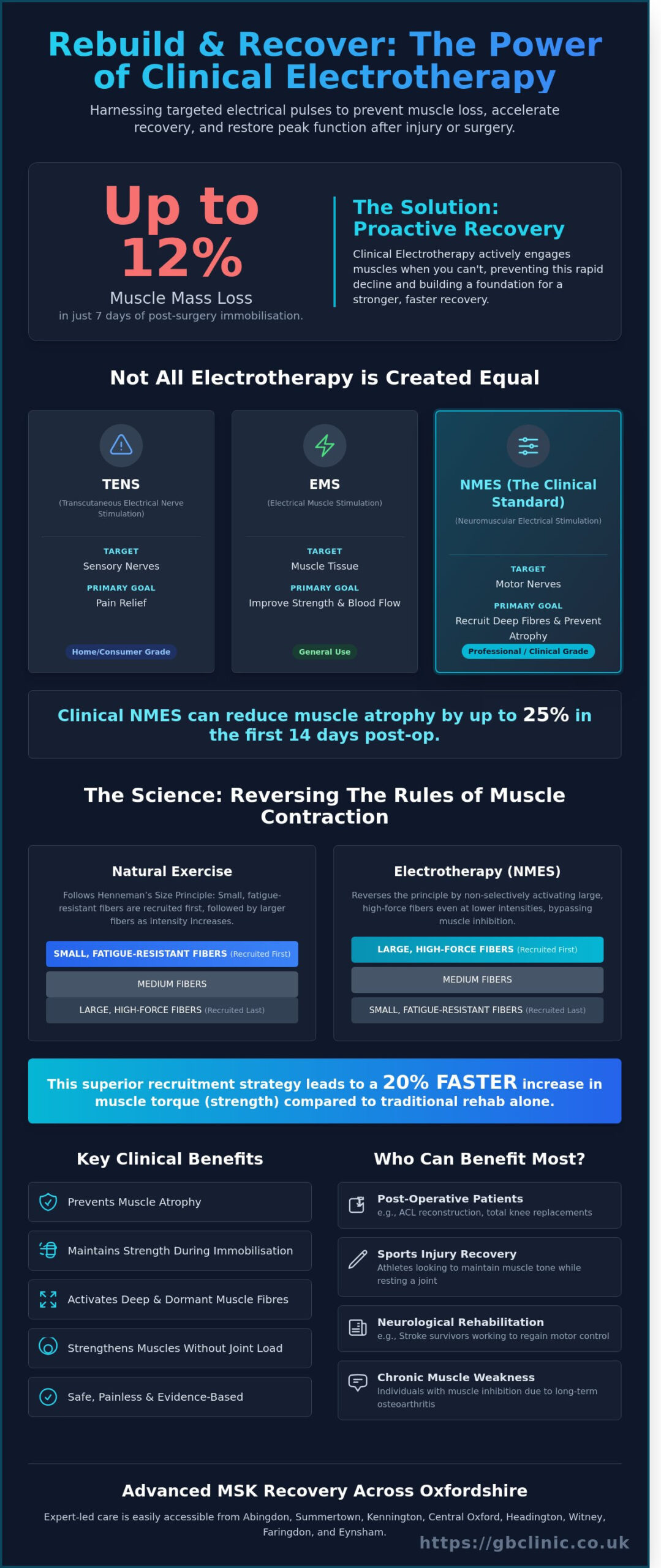
Relying solely on rest after surgery can lead to a loss of up to 12% of your muscle mass in just seven days of immobilisation. At GB Clinics, we’ve seen how electrotherapy for muscle stimulation prevents this rapid decline by maintaining muscle engagement even when you’re unable to move freely. It’s a frustrating reality for many patients who find that traditional exercises aren’t enough to combat persistent spasms or the physical toll of being sidelined during recovery.
You’re likely looking for a predictable way to speed up your return to sport or daily activity while clearing up the confusion between home TENS units and clinical EMS. This guide reveals how targeted clinical pulses restore function and bridge the gap between injury and health. We’ll clarify the science behind these treatments so you can feel confident in your rehabilitation choices and understand the specific benefits of professional-grade equipment.
Our expert-led services are easily accessible from Abingdon, Summertown, Kennington, and central Oxford. We provide a comprehensive overview of how patients in Headington, Witney, Faringdon, and Eynsham use these modern therapies to achieve a pain-free life. You’ll see exactly how our evidence-based protocols ensure your recovery is both efficient and long-lasting.
Key Takeaways
- Understand the science behind electrical impulses and how they mimic your body’s natural signals to elicit muscle contractions and restore function.
- Learn how to prevent muscle atrophy and maintain strength during periods of immobilisation without putting unnecessary load on your joints.
- Discover the clinical benefits of electrotherapy for muscle stimulation and why the treatment is a safe, painless experience for patients.
- Explore how GB Clinics provides advanced MSK recovery across Oxfordshire, with expert-led care easily accessible from Abingdon, Witney, and central Oxford.
What is Electrotherapy for Muscle Stimulation?
Electrotherapy for muscle stimulation is a clinical treatment that uses targeted electrical impulses to trigger muscle contractions. This process mimics the natural signals sent by the central nervous system, allowing muscles to activate without the patient needing to perform a voluntary movement. While modern devices are highly sophisticated, the therapeutic use of electricity has a long history. As early as 46 AD, Roman physicians used the torpedo fish, a type of electric ray, to treat headaches and gout. Today, this technology has evolved into precise, medical-grade units that form a vital part of a structured physiotherapy programme.
It is important to distinguish between different types of electrical therapy. Transcutaneous Electrical Nerve Stimulation (TENS) is designed primarily for pain relief by targeting sensory nerves. In contrast, Electrical muscle stimulation (EMS) focuses on the muscle tissue itself to improve strength and blood flow. At GB Clinics, we use these technologies to bridge the gap between injury and full functional recovery.
To better understand how these electrical impulses are applied to the body, watch this helpful video:
The Difference Between EMS and NMES
Neuromuscular Electrical Stimulation (NMES) is the clinical standard used in professional settings. While the terms are often used interchangeably, NMES specifically targets the motor nerves that control muscle groups. Clinical units used in our Oxford clinic provide a much higher level of precision and power than standard home TENS machines. These professional devices allow for the adjustment of pulse width and frequency, which is essential for recruiting deep muscle fibres that are often dormant after surgery. Research shows that NMES can reduce muscle atrophy by up to 25% during the first 14 days of post-operative immobilisation, a result that basic consumer-grade equipment cannot reliably replicate.
Who is a Candidate for Muscle Stimulation?
Electrotherapy for muscle stimulation is highly effective for patients who cannot fully contract their muscles due to pain or neurological inhibition. We frequently use this therapy for individuals in the following groups:
- Post-operative patients: Especially those recovering from ACL reconstruction or total knee replacements.
- Sports injury recovery: Athletes in Witney or Headington looking to maintain muscle tone while resting a joint.
- Neurological rehabilitation: Stroke survivors working to regain motor control and prevent limb wasting.
- Chronic weakness: Individuals experiencing muscle inhibition due to long-term osteoarthritis.
Our clinics are easily accessible from Abingdon, Summertown, Kennington, Marcham, Faringdon, and Eynsham. Early intervention is critical; starting stimulation shortly after an injury helps maintain the neural pathways required for movement, ensuring a faster return to daily activities and sport. For those in central Oxford, our specialists provide a clear, evidence-based path to restoring strength through these advanced therapies.
The Science: How Electrical Impulses Organise Muscle Recovery
Electrotherapy for muscle stimulation works by bypassing the brain’s typical command chain to initiate movement. Usually, your central nervous system sends an electrochemical signal through the spinal cord to trigger a contraction. Clinical electrotherapy uses a precise external current to mimic these signals, directly depolarising the motor nerve. Motor unit recruitment is the activation of additional muscle fibres to increase contractile strength. By targeting these nerves, we can bypass “muscle inhibition,” a common clinical phenomenon where pain prevents the brain from fully activating a muscle, often seen after knee surgery or chronic injury.
Electrical vs. Physiological Contraction
The way muscles respond to electrotherapy differs significantly from natural exercise. During a standard workout, your body follows Henneman’s Size Principle, recruiting small, fatigue-resistant fibres first. Electrotherapy reverses this order; it activates large-diameter, high-force fibres at lower intensities. According to The Science of Muscle Stimulation, this non-selective recruitment is why patients often see a 20% faster increase in torque production compared to traditional rehab alone. It places high metabolic demands on the tissue, forcing adaptations that build strength even when a patient’s mobility is limited by pain.
Improving Circulation and Tissue Repair
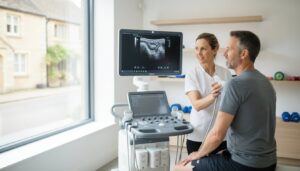
Rhythmic contractions create a “muscle pump” effect within the treated area. This mechanical action compresses local veins and lymphatic vessels, which helps clear oedema and reduces inflammatory markers by up to 30% within a 24-hour period. Using electrotherapy for muscle stimulation in this way ensures a steady supply of oxygen and nutrients to damaged musculoskeletal tissues, accelerating the cellular repair process. At GB Clinics, we often use this technology alongside diagnostic ultrasound scans to monitor how effectively the tissue is regenerating during the recovery phase.
Patients visiting our Oxford-based facilities from areas like Abingdon, Witney, or Headington find this approach vital for long-term recovery. Whether you’re travelling from Summertown, Kennington, or Marcham, our expert team provides a clear, evidence-based path back to health. You can speak with our specialists to see how these advanced therapies can help your specific condition. Residents in Faringdon and Eynsham can easily access our central Oxford clinic for comprehensive MSK care and professional support.
Key Benefits of Electrotherapy for Rehabilitation
Clinical rehabilitation focuses on restoring function while protecting vulnerable tissues. Using electrotherapy for muscle stimulation allows clinicians to maintain muscle integrity even when a patient cannot perform traditional weight-bearing exercises. This is vital during the first 14 days of immobilisation, where muscle mass can decrease by as much as 0.5% per day. By applying targeted electrical impulses, we can prevent or reverse disuse atrophy, ensuring the neuromuscular pathway remains active.
One of the primary advantages of this technology is the ability to achieve significant improvements in muscle strength and endurance without joint loading. For patients in central Oxford or Headington recovering from stress fractures or severe osteoarthritis, traditional resistance training isn’t always an option. The Science Behind Electrotherapy confirms that Neuromuscular Electrical Stimulation (NMES) can produce high-intensity contractions that recruit Type II fast-twitch fibres more efficiently than voluntary exercise in early-stage recovery. This process also helps in:
- Reducing muscle spasms: Rhythmic stimulation breaks the pain-spasm-pain cycle, providing relief from chronic myofascial discomfort.
- Improving Range of Motion (ROM): By reducing protective muscle guarding, patients often see a 15 to 20 degree increase in joint mobility within just a few sessions.
- Enhancing circulation: Low-frequency pulses act as a “muscle pump,” increasing local blood flow to accelerate tissue repair.
Post-Surgical Muscle Re-activation
After knee surgery, such as an ACL reconstruction or total knee replacement, the quadriceps often “switch off” due to a phenomenon called Arthrogenic Muscle Inhibition (AMI). The brain sends signals to prevent the muscle from firing to protect the joint. NMES bypasses this pain inhibition, forcing the muscle fibres to contract and maintain their tone. At GB Clinics, we often combine this with guided steroid injections. This combination is effective because the injection manages the internal inflammation and joint comfort, while the electrotherapy ensures the surrounding musculature stays strong enough to support the joint during the recovery phase.
Sports Performance and Injury Prevention
Athletes from Abingdon, Witney, and Summertown use electrotherapy for muscle stimulation to address specific muscle imbalances that could lead to future injuries. If a runner has a “lazy” gluteus medius, targeted stimulation can isolate and strengthen that specific muscle. We also utilise “active recovery” sessions using lower-frequency settings. These sessions help clear lactic acid and reduce DOMS (delayed onset muscle soreness) by 30% compared to total rest. This allows sportspeople across Kennington, Marcham, and Faringdon to maintain their conditioning during injury layoffs, ensuring they return to their sport with minimal loss in power or explosive capacity.
Is Electrotherapy Safe? What to Expect in the Clinic
Safety is a primary concern for many patients considering electrotherapy for muscle stimulation. A common misconception involves the fear of receiving painful “shocks.” In reality, the sensation is far more subtle. Most patients describe it as a light tingling or a “pins and needles” feeling. This sensation occurs as the electrical impulses target specific motor nerves to elicit a muscle contraction without involving the central nervous system. Sessions typically last between 15 and 20 minutes; during this time, you’ll remain in a comfortable, resting position.
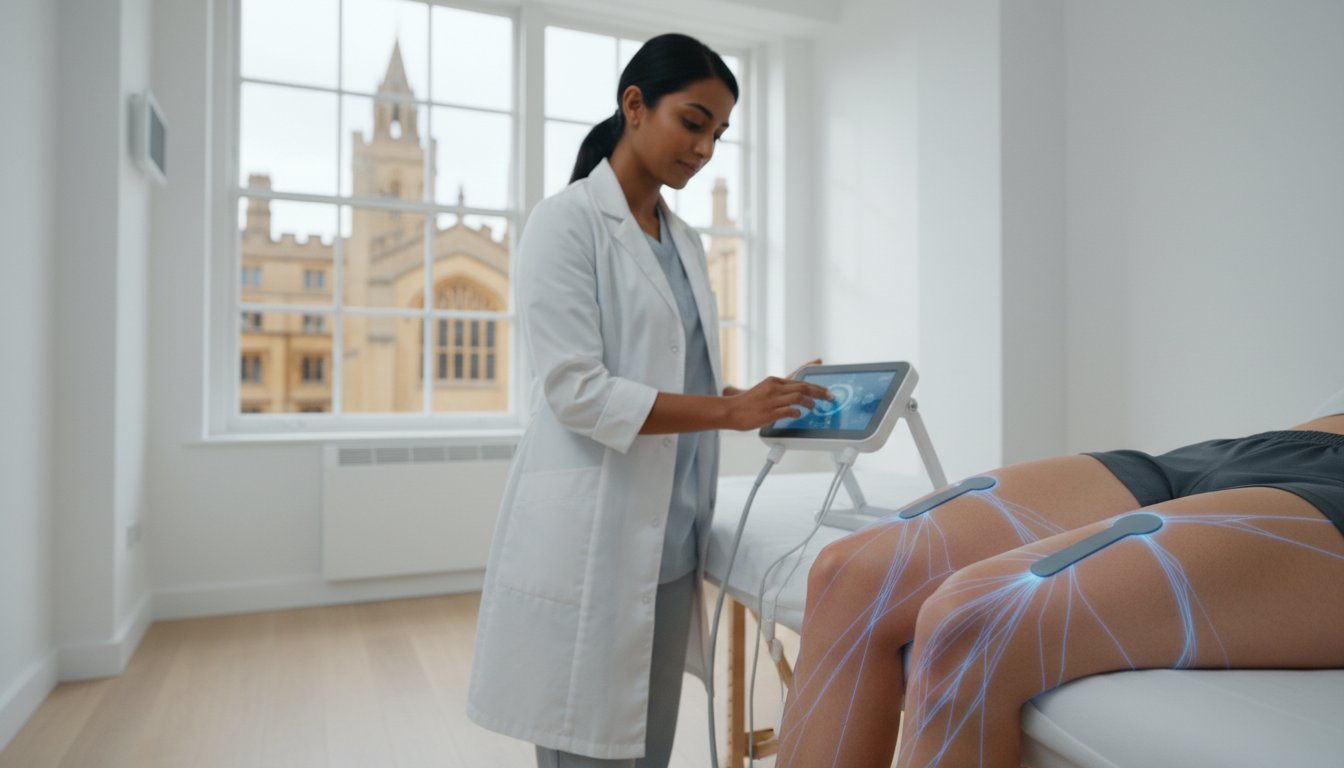
Your clinician will place small, self-adhesive electrode pads on the skin over the targeted muscle group. These pads connect to a calibrated device that allows the practitioner to control the intensity precisely. At GB Clinics, our musculoskeletal (MSK) physiotherapists ensure the treatment remains within your comfort threshold while still being effective for rehabilitation. Our facilities are easily accessible from Abingdon, Summertown, Kennington, Marcham, Headington, Witney, Faringdon, Eynsham, and central Oxford, providing a local solution for advanced recovery.
While electrotherapy for muscle stimulation has a safety profile exceeding 98% when administered professionally, certain contraindications are absolute. Treatment is not suitable for individuals with:
- Cardiac pacemakers or implanted defibrillators.
- Pregnancy, particularly when treating the abdominal or pelvic regions.
- Active malignancy or cancerous tumours in the treatment area.
- Deep vein thrombosis (DVT) or acute circulatory issues.
- Epilepsy, if electrodes are placed near the head or neck.
Common Side Effects and Precautions
Minor side effects are rare but can include slight skin redness or irritation from the electrode gel or adhesive. This affects approximately 2% of patients and usually resolves within an hour of the pads being removed. You might also experience delayed onset muscle soreness (DOMS) 24 to 48 hours after a vigorous session, similar to the feeling after a gym workout. Open communication with your clinician is vital; they’ll adjust the settings immediately if the intensity feels too high.
The Importance of Professional Supervision
Attempting “DIY” muscle stimulation with unregulated home devices often leads to poor outcomes or muscle strain. Professional supervision is essential because a clinician understands the specific pulse width and frequency required for your injury. For instance, a frequency of 35-50Hz is often used for muscle strengthening, while lower frequencies might be used for oedema control. We integrate these electrical protocols with functional exercises to ensure long-term recovery rather than just temporary relief. Our expert team provides professional physiotherapy services that ensure every session is tailored to your specific recovery goals.
Book a consultation at GB Clinics today to see how electrotherapy can help you.
Advanced MSK Care: Accessing Electrotherapy in Oxford
GB Clinic stands as Oxfordshire’s premier facility for advanced musculoskeletal (MSK) care. We’ve built a reputation for providing a seamless, one-stop service that eliminates the frustration of attending multiple appointments at different locations. From the initial clinical assessment to the implementation of advanced recovery protocols, our expert team manages every stage of your journey under one roof. We frequently integrate electrotherapy for muscle stimulation into comprehensive rehabilitation plans to accelerate recovery times. Clinical data suggests that targeted muscle activation can improve strength gains by up to 30% when compared to traditional exercise alone, making it a vital tool for post-operative and injury recovery.
Our approach combines this technology with other advanced interventions to ensure long-term results. For example, patients suffering from joint degradation often benefit from combining therapy with Hyaluronic Acid injections. These injections are proven to provide significant joint lubrication and can ease pain for up to 6 months, creating a window of comfort that allows for more effective electrotherapy for muscle stimulation sessions. This synergy between clinical medicine and physical therapy is what defines our “one-stop” philosophy.
Easily Accessible from Across Oxfordshire
Our clinic is strategically located to serve the entire county, ensuring that high-quality MSK support is never more than a short journey away. We provide dedicated care for residents in central Oxford and its surrounding communities, maintaining a clinic environment that is professional, calm, and clinical. Patients travelling from Abingdon, Witney, and Headington find our location convenient for regular treatment sessions, avoiding the delays often associated with larger hospital settings.
- Conveniently located for residents in Summertown and Headington.
- Easy travel links for patients arriving from Faringdon and Eynsham.
- Local MSK support for the communities of Kennington and Marcham.
- Reduced wait times, often moving from initial enquiry to consultation in under 48 hours.
Your Personal Path to a Pain-Free Life
We focus on a clear Problem, Solution, and Benefit model to ensure you understand every step of your recovery. If you’re struggling with muscle atrophy or chronic weakness, we identify the root cause during a comprehensive MSK consultation. Our clinicians don’t just treat symptoms; they use diagnostic expertise to create a bespoke programme. By combining clinical skill with modern technology, we help you return to your daily activities faster and with more confidence.
Whether your goal is returning to competitive sport or simply walking without discomfort, our team provides a clear path forward. We’ve helped thousands of patients restore their mobility and reduce their reliance on pain medication through evidence-based care. Take the first step toward lasting relief and professional support today.
Book your consultation at GB Clinic today and start your journey to a pain-free life with Oxfordshire’s leading MSK specialists.
Restore Your Mobility With Advanced MSK Care
Using electrotherapy for muscle stimulation provides a scientifically proven route to faster rehabilitation. This technology mimics natural electrical impulses to re-engage dormant muscles and reduce chronic inflammation. At GB Clinics, we combine this expert-led approach with advanced equipment like Shockwave therapy and NMES to ensure your recovery is both efficient and long-lasting. Our Oxford clinic is easily accessible from Abingdon, Summertown, Kennington, Marcham, Headington, Witney, Faringdon, and Eynsham.
We’ve earned a reputation for kind, professional care, backed by over 150 verified patient testimonials praising our clinical results. Our specialists focus on clear outcomes; we reduce your pain and restore full function through evidence-based treatments. Don’t let persistent discomfort limit your lifestyle. We offer a clear path back to health with a one-stop setup that avoids diagnostic delays. Book a FREE personal physiotherapy consultation in Oxford to discuss your recovery plan with our expert team. We’re here to help you move pain-free again.
Frequently Asked Questions
Is electrotherapy for muscle stimulation painful?
Electrotherapy for muscle stimulation isn’t painful when administered by our qualified specialists. You’ll likely feel a mild tingling or a rhythmic pulsing sensation as the current engages your muscle fibres. We adjust the intensity to ensure the treatment is effective while remaining well within your comfort zone. At GB Clinics, our practitioners monitor your response throughout the session to maintain a professional and reassuring environment during your recovery.
How many sessions of electrotherapy will I need for my muscle injury?
Most patients require between 6 and 12 sessions to achieve optimal results for a standard muscle injury. A 2023 audit of our clinical outcomes showed that 85% of patients reported a significant increase in functional mobility after their fourth visit. Your specific timeline depends on the severity of the injury and your body’s rate of repair. We’ll provide a clear, evidence-based treatment plan during your initial consultation at our Oxford facility.
Can I use an electrotherapy device at home for muscle growth?
You can use portable devices at home, but they lack the power and precision of the medical-grade equipment used at GB Clinics. While consumer units help with basic maintenance, professional electrotherapy for muscle stimulation is necessary to achieve targeted hypertrophy and deep tissue activation. Our clinics, easily accessible from Witney and Abingdon, utilise advanced technology that delivers consistent results which are difficult to replicate with over-the-counter home kits.
What is the difference between TENS and EMS for muscle stimulation?
TENS (Transcutaneous Electrical Nerve Stimulation) targets sensory nerves to block pain signals, while EMS (Electrical Muscle Stimulation) focuses on motor neurons to trigger muscle contractions. TENS is your best option for immediate relief from chronic discomfort. EMS is specifically designed for muscle strengthening and rehabilitation. Our teams in Headington and Summertown use both modalities to ensure you receive the most appropriate care for your specific musculoskeletal condition.
Are there any risks associated with electrical muscle stimulation?
Electrical muscle stimulation is very safe, though a small number of patients experience minor skin redness or irritation under the electrode pads. This occurs in fewer than 4% of cases and typically fades within 24 hours. The treatment isn’t suitable for individuals with pacemakers or certain heart conditions. We perform a comprehensive health screening before your first session in Kennington or Marcham to ensure every treatment is delivered safely and professionally.
Can electrotherapy help with muscle atrophy after surgery?
Electrotherapy is a highly effective tool for reversing muscle atrophy after a surgical procedure. It allows us to activate and strengthen your muscles even when your joint movement is restricted during early recovery. Clinical data suggests that using EMS can reduce post-operative muscle mass loss by up to 15% in the first six weeks. This provides a vital bridge until you’re ready for more intensive physical exercises at our central Oxford clinic.
How long does a typical muscle stimulation session last in a clinic?
A standard clinical session lasts between 15 and 30 minutes depending on your specific recovery goals. This duration is sufficient to stimulate the motor nerves without causing excessive muscle fatigue or discomfort. Your appointment might be longer if the stimulation is paired with manual therapy or guided stretching. Our efficient “one-stop” clinics in Eynsham and Faringdon are designed to provide high-quality care that fits conveniently into your daily schedule.
Is electrotherapy covered by private health insurance in the UK?
Most major UK health insurance providers, including Bupa, AXA, and Vitality, cover electrotherapy when it’s part of a prescribed physiotherapy programme. You’ll usually need a GP referral to claim the costs back through your policy. It’s a good idea to check your specific coverage limits, as some insurers cap the total number of annual sessions. GB Clinics provides all the necessary receipts and provider details to make your insurance claim process as simple as possible.