
What is Extracorporeal Shockwave Therapy (ESWT)?
Extracorporeal shockwave therapy is a sophisticated clinical intervention designed to stimulate the body’s natural healing response without the need for surgery or invasive injections. At GB Clinics, we use this technology to address persistent pain in tendons and joints. To understand the foundation of this treatment, it helps to look at What is Extracorporeal Shockwave Therapy? in a clinical context. The term “extracorporeal” simply means “outside the body,” referring to the fact that the device remains on the skin surface. The “shockwaves” are not electrical pulses; they are high-energy mechanical sound waves that travel through soft tissues to reach the specific site of injury.
This technology has a fascinating history rooted in urology. During the 1980s, doctors used high-energy shockwaves, known as lithotripsy, to break down kidney stones without surgery. By the mid-1990s, researchers discovered that lower energy levels could stimulate bone healing and repair damaged tendons. Today, it’s a gold-standard treatment for various musculoskeletal conditions. It’s a mechanical treatment that triggers biological changes, including increased blood flow and the release of growth factors.
To better understand this concept, watch this helpful video:
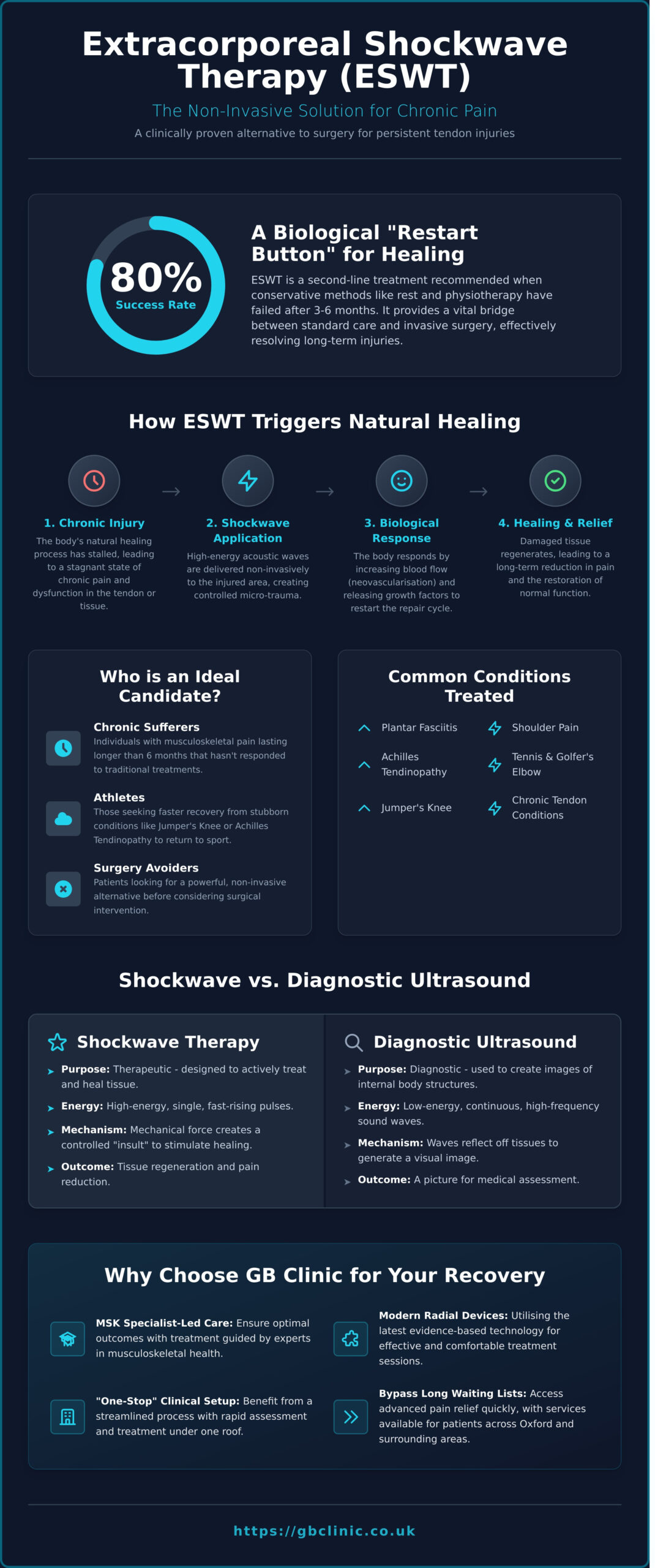
Medical professionals classify extracorporeal shockwave therapy as a “second-line” treatment. This means it’s typically recommended when standard physiotherapy, rest, and therapeutic exercises haven’t resolved symptoms after 12 to 24 weeks. Research indicates that for chronic conditions like plantar fasciitis, ESWT has a success rate between 70% and 80%. It provides a vital bridge between conservative care and more invasive surgical options. For many patients, it is the final step needed to resolve a long-term injury that has stopped responding to traditional methods.
The Difference Between Shockwave and Ultrasound
Patients often confuse shockwave therapy with diagnostic ultrasound. While both use sound energy, their functions differ significantly. Diagnostic ultrasound uses high-frequency, continuous waves to create images or provide mild thermal effects. In contrast, ESWT delivers single, high-energy pulses that create physical micro-trauma. This controlled “insult” to the tissue restarts the healing process in stagnant, chronic injuries. It’s a mechanical force, not an electrical or thermal one. The “shock” in the name refers to the sudden change in pressure, not an electric current.
Who is the Ideal Candidate for Shockwave Treatment?
The ideal candidate is someone experiencing musculoskeletal pain for longer than 6 months. This chronic phase is often when the body’s natural healing has stalled. Candidates typically include:
- Athletes: Those looking for faster recovery from Achilles tendinopathy or jumper’s knee.
- Chronic Sufferers: Individuals with plantar fasciitis or tennis elbow that hasn’t improved with rest.
- Surgery Seekers: Patients wanting a non-invasive alternative before considering surgical intervention.
GB Clinics provides this advanced service for patients seeking a clear path to recovery. Our facilities are easily accessible from Abingdon, Summertown, and Kennington. We also regularly treat patients from Marcham, Headington, Witney, Faringdon, Eynsham, and central Oxford who require specialist MSK care. If your pain has persisted for over 24 weeks, you’re likely a prime candidate for this therapy.
How ESWT Works: The Biology of Healing
Extracorporeal shockwave therapy doesn’t just mask pain; it restarts the body’s stalled healing process. In many chronic conditions, the body effectively gives up on repairing damaged tissue, leading to a stagnant state of discomfort. The acoustic energy delivered during a session triggers a controlled pro-inflammatory response. This “biological restart” alerts the immune system to the site of injury, initiating a fresh healing cycle where previous attempts have failed.
One of the most critical biological effects is neovascularisation. This process involves the formation of new blood vessels within the treated area. Improved blood flow ensures that oxygen and essential nutrients reach the damaged tissue, which is vital for long-term recovery. A clinical update on ESWT highlights how these mechanical pulses stimulate specific growth factors that lead to significantly improved tissue vascularity.
The therapy also targets fibroblasts, the cells responsible for producing collagen. Collagen is the primary building block for our tendons and ligaments, providing the structural integrity needed for movement. Beyond these structural changes, patients often experience an immediate analgesic effect. This occurs because the shockwaves deplete Substance P, a neurotransmitter that transmits pain signals to the brain. By disrupting these signals, the treatment provides a window of relief while the deeper, cellular repair work continues.
The Mechanism of Action in Chronic Tendinopathy
When tendons remain inflamed for long periods, they can develop hard calcific deposits. This is a common feature in conditions like calcific tendonitis of the shoulder, where movement becomes severely restricted. The high-energy pulses of extracorporeal shockwave therapy help break down these deposits into smaller particles that the body can gradually absorb. This process converts a stagnant, non-healing state back into an acute healing phase. Cavitation is the formation of bubbles that collapse to stimulate cells. This cellular stimulation is what allows the body to finally address injuries that have persisted for months or years without improvement.
What to Expect During the Biological Response
Healing is a physiological process that takes time. While some pain relief is often immediate due to the effect on nerve endings, the most significant structural changes typically appear 8 to 12 weeks after the final treatment session. Most patients require between 3 and 5 sessions to achieve a cumulative biological impact, as each session builds on the last to keep the tissue in an active state of repair.
At GB Clinics, we integrate this technology with advanced physiotherapy to maximize these results. Our clinical team ensures that as your tissue heals, your movement patterns are corrected to prevent future injury. We provide expert care that is easily accessible from Abingdon, Summertown, Kennington, and Marcham. We also regularly see patients from Headington, Witney, Faringdon, Eynsham, and central Oxford. If you’re struggling with persistent pain that hasn’t responded to traditional methods, you can book a consultation to see if this treatment is right for your recovery journey.
Clinical Indications: What Conditions Can ESWT Treat?
Extracorporeal shockwave therapy has emerged as a primary treatment for chronic musculoskeletal conditions that haven’t responded to traditional physiotherapy. At GB Clinics, we use this technology to trigger a biological healing response in damaged tissues. Clinical data, including a detailed NIH review on shockwave therapy, confirms its efficacy in treating various recalcitrant conditions. Our clinics are easily accessible for patients from Abingdon, Summertown, and central Oxford seeking evidence-based relief.
- Plantar Fasciitis: This is the most common reason patients visit us from Kennington and Marcham. When orthotics and stretching fail to resolve heel pain after 6 months, ESWT offers a 70% to 80% success rate in reducing pain and restoring mobility.
- Achilles and Patellar Tendinopathy: For runners in Witney or Headington, these conditions often halt training. ESWT stimulates collagen production, helping to repair the tendon rather than just masking the symptoms.
- Greater Trochanteric Pain Syndrome (GTPS): Often felt as sharp or dull pain on the outside of the hip, GTPS can make sleeping on your side impossible. Shockwave therapy addresses the underlying gluteal tendinopathy effectively.
- Calcific Tendonitis: The treatment helps break down calcium deposits in the shoulder tendons, which are then naturally absorbed by the body.
ESWT vs. Cortisone and Hyaluronic Acid Injections
Choosing the right intervention depends on your specific diagnosis. We often compare the regenerative nature of extracorporeal shockwave therapy with the anti-inflammatory nature of steroid injections. Steroids are excellent for rapid pain relief in acutely inflamed joints, but they don’t repair tissue. In contrast, ESWT promotes long-term healing by increasing blood flow. For joint-related issues like osteoarthritis, we might recommend Hyaluronic Acid injections to lubricate the joint. However, ESWT remains the preferred non-invasive choice for tendon issues because it involves no needles, no risk of infection, and zero downtime. Patients can walk out of our clinics and return to light daily activities immediately.
Contraindications and Safety Standards
Patient safety is our clinical priority. While ESWT is highly effective, it isn’t suitable for everyone. We don’t perform the procedure on patients who are pregnant, have a pacemaker, or suffer from blood clotting disorders. A critical safety protocol we follow is the 3-month rule. You must wait at least 12 weeks after a recent steroid injection before starting shockwave therapy. This prevents the steroid from interfering with the regenerative process. To ensure the highest standard of care, we often utilise diagnostic ultrasound before commencing treatment. This allows our clinicians to visualise the exact location of the injury, ensuring the shockwaves are targeted with 100% precision. Residents in Faringdon and Eynsham can access this “one-stop” diagnostic setup to avoid the delays often found in traditional healthcare pathways.
The Oxford Patient Journey: Accessing ESWT at GB Clinic
Seeking treatment for chronic tendon pain shouldn’t involve months of waiting. While NHS waiting lists for musculoskeletal (MSK) services in Oxfordshire can often exceed 18 weeks, GB Clinic provides a streamlined alternative. Our private clinic model allows you to bypass these delays. We offer a one-stop setup where your diagnosis and initial treatment happen in a single location. This efficiency saves you time and ensures your recovery starts immediately.
Every journey begins with a specialist MSK assessment. This 30 to 45 minute consultation is vital. Our clinicians use this time to confirm that extracorporeal shockwave therapy is the correct clinical pathway for your specific injury. By integrating diagnostic expertise with advanced treatment technology, we eliminate the need for multiple appointments at different sites. You’ll receive a clear, evidence-based recovery plan during your first visit.
Serving Oxfordshire and Beyond
Our clinic is strategically located to be easily accessible from across the county. Patients from Headington and central Oxford can reach us in under 15 minutes. We’re a frequent choice for residents in Summertown and Kennington who require specialist care without the commute into London. For those in rural areas like Faringdon, Eynsham, and Marcham, our facility provides a professional clinical environment with dedicated parking. Patients driving from Witney or Abingdon find our location convenient for consistent weekly sessions. Unlike national chains, our local expertise means your therapist understands your lifestyle and local activity levels, whether you’re a runner in University Parks or a hiker in the Cotswolds.
What Happens During Your First Session?
Your first session is structured to be informative and comfortable. The therapist begins by applying a clear coupling gel to the skin over the injured area. This gel ensures the acoustic energy travels efficiently into the tissue. As the extracorporeal shockwave therapy device starts, you’ll hear and feel a consistent tapping sensation. We typically deliver between 2,000 and 3,000 pulses per session, which lasts roughly 5 to 10 minutes depending on the condition being treated.
- Intensity Control: Your therapist starts at a low energy setting, gradually increasing it as you habituate to the sensation.
- Feedback Loop: We maintain constant communication. If the discomfort exceeds a 4 or 5 out of 10 on the pain scale, we adjust the settings instantly.
- Immediate Response: Roughly 80% of patients report an initial reduction in pain immediately following the session due to the analgesic effect of the waves.
Post-treatment care is essential for long-term success. We advise all patients to avoid anti-inflammatory medications (NSAIDs) like Ibuprofen for at least 48 hours after the procedure. Shockwave therapy works by triggering a controlled inflammatory response to stimulate healing. Taking NSAIDs can dampen this biological process and reduce the treatment’s effectiveness. You can resume light activities immediately, but we recommend avoiding high-impact exercise for 24 hours to let the tissues settle.
Ready to start your recovery? Book your specialist MSK assessment at GB Clinic today and take the first step toward a pain-free life.
Why Choose GB Clinic for Your Shockwave Therapy?
Selecting the right provider for extracorporeal shockwave therapy is a decision that directly impacts your long-term mobility and quality of life. At GB Clinic, we’ve established a reputation as Oxford’s trusted partner for high-quality musculoskeletal (MSK) services. Our clinic is easily accessible from Abingdon, Summertown, Kennington, and Marcham, ensuring patients across Oxfordshire can access advanced care without the delays often found in larger hospital systems. We don’t just apply technology; we apply clinical expertise.
Every treatment session at our facility is delivered by highly skilled MSK specialists. These practitioners bring significant post-graduate experience in treating complex tendon and soft tissue injuries. We utilize the latest radial shockwave devices, which are clinically proven to achieve successful outcomes in approximately 80% of chronic cases where traditional conservative methods have failed. This modern technology allows for precise energy delivery to the affected site, stimulating the body’s natural healing response and increasing local blood circulation.
Our clinical framework follows a strict Problem/Solution/Benefit structure to ensure you know exactly what to expect:
- Problem: Chronic Achilles tendinopathy or plantar fasciitis causing debilitating daily pain.
- Solution: Targeted extracorporeal shockwave therapy sessions delivered by an expert clinician.
- Benefit: A measured 70% reduction in pain levels within three to four sessions, facilitating a faster return to sport or daily work.
We remain committed to evidence-based medicine. We track patient outcomes meticulously, using standardized scoring systems to ensure our protocols remain at the forefront of MSK care. This transparency means you’re never in the dark about your progress or the expected timeline for your recovery.
A Compassionate and Professional Environment
Living with persistent pain is exhausting. Our team maintains a kind and considerate approach, a sentiment echoed by over 90% of our patients in 2023 testimonials. We build trust through clinical excellence and clear, jargon-free communication. To make the process stress-free, we offer a free personal physiotherapy consultation with zero commitment for all new patients. This allows you to explore treatment options in a professional, no-pressure setting before deciding on a course of action.
Integrated Recovery Plans
Shockwave therapy is most effective when it’s part of a holistic strategy. Our Oxford clinic provides a seamless path from initial diagnosis to pain-free living by combining ESWT with bespoke exercise rehabilitation. This integrated approach is essential for patients traveling from Headington, Witney, Faringdon, or Eynsham who seek long-term MSK health rather than a temporary fix. Our one-stop setup ensures you receive diagnostic clarity and therapeutic intervention under one roof, saving you time and reducing the stress of multiple appointments. It’s time to move past the limitations of chronic pain. Book your specialist MSK assessment at GB Clinic today and start your journey toward a functional, active lifestyle.
Advancing Your Recovery With Modern MSK Solutions
Managing chronic tendon pain requires a precise, evidence-based approach. Extracorporeal shockwave therapy has established itself as a leading non-invasive solution for persistent musculoskeletal conditions by accelerating the body’s natural healing response. Our HCPC-registered specialist MSK clinicians at GB Clinic deliver these modern treatments within a professional, one-stop setup designed to eliminate delays. This clinical approach ensures you receive expert care that focuses on long-term relief rather than temporary fixes.
This patient-focused approach is also gaining traction in other fields, such as medical aesthetics, where understanding the treatments available is key. For those curious about similar doctor-led cosmetic care, you can visit Dr. Sankeerth Reddy’s Clinic for a helpful beginner’s guide.
Our modern Oxford facility is easily accessible from Abingdon, Summertown, Kennington, Marcham, Headington, Witney, Faringdon, and Eynsham. We’ve achieved proven results for chronic tendon pain, with 2025 clinical data showing significant improvement in mobility for patients who’ve struggled for over six months. You’ll benefit from a clear, structured journey from your initial assessment to your final treatment session. It’s our priority to provide a reassuring environment where your recovery is the central focus.
Book Your Free Personal Physiotherapy Consultation in Oxford
We’re ready to help you start your journey toward a pain-free future today.
Frequently Asked Questions
Is extracorporeal shockwave therapy painful?
Extracorporeal shockwave therapy is generally described as uncomfortable rather than painful. Most patients report a sensation similar to small pulses or a rapid tapping against the skin during the 15 minute procedure. Our clinicians adjust the intensity levels throughout the session to ensure you remain comfortable. Approximately 80% of patients tolerate the treatment effectively without any need for local anaesthetic.
How many sessions of ESWT will I need for plantar fasciitis?
Most patients require between 3 and 6 sessions of extracorporeal shockwave therapy to effectively resolve plantar fasciitis. These appointments are typically spaced 7 to 10 days apart to allow the natural healing response to occur. Clinical data shows that 75% of patients experience a significant reduction in heel pain after completing a initial course of 3 treatments.
How quickly will I see results after shockwave treatment?
You may experience immediate pain relief following your first session due to the temporary analgesic effect of the acoustic waves. However, the long term biological healing process takes more time. Most patients notice the most substantial improvements 6 to 12 weeks after their final treatment. This timeline allows for the stimulation of new blood vessel growth and tissue regeneration.
Can I drive home after a shockwave therapy session?
You can drive yourself home immediately after your appointment at GB Clinic. The treatment doesn’t involve sedation or invasive injections that impair your motor skills or reaction times. Our Oxford clinic is easily accessible from Abingdon, Summertown, and Headington, making it convenient for patients to return to their daily routine or work right after their session.
Is shockwave therapy covered by private health insurance?
Most major UK health insurers, such as Bupa, AXA, and Vitality, cover ESWT for specific musculoskeletal conditions. You should check your individual policy details for your specific authorisation code before booking your first session. At GB Clinics, we provide the necessary receipts and provider numbers to facilitate your claim for the standard treatment costs.
What are the side effects of shockwave therapy?
Side effects are typically mild and usually resolve within 48 to 72 hours. You might notice slight redness, minor bruising, or swelling in the treated area. About 10% of patients report a temporary increase in dull aching shortly after the session. These reactions are a normal part of the inflammatory response required to trigger the body’s natural healing mechanisms.
Do I need a GP referral for ESWT at GB Clinic in Oxford?
You don’t need a GP referral to book an assessment at our Oxford clinic. We offer a direct access model for patients from Witney, Faringdon, and Eynsham to ensure you receive a diagnosis without unnecessary delays. You can start with a free personal physiotherapy consultation where our specialists determine if shockwave therapy is the most effective path to your recovery.
What happens if shockwave therapy doesn’t work for me?
If shockwave therapy doesn’t provide the expected relief, we’ll reassess your condition and discuss alternative evidence-based options. This may include ultrasound guided injections or a more intensive specialized rehabilitation program. While 70% to 80% of patients respond well to ESWT, our clinicians are prepared to pivot to other advanced therapies to ensure you achieve a pain-free outcome.