
The persistent, dull ache at the front of your knee is a familiar and frustrating sensation for many active individuals. This discomfort, which often worsens when you run, squat, or use stairs, can leave you feeling worried about a more serious injury and uncertain about the right course of action. This condition is known as patellofemoral pain syndrome, and it is one of the most common causes of knee pain we treat. Gaining a clear understanding of the issue is the essential first step toward effective and lasting relief.
This comprehensive guide has been created by our clinical experts to provide you with a clear path to recovery. We will explain the underlying biomechanical causes of patellofemoral pain syndrome, help you accurately identify its symptoms, and detail the most effective, evidence-based treatments available to restore pain-free movement. Our objective is to empower you with the knowledge to not only manage your current symptoms but also to prevent the pain from returning, allowing you to get back to the activities you enjoy with confidence.
Key Takeaways
- Understand that your knee pain is rarely from a single incident but a combination of factors including overuse, muscular imbalances, and your unique biomechanics.
- An accurate diagnosis is the critical first step to effectively treating patellofemoral pain syndrome and ruling out other potential knee conditions.
- Successful treatment follows a structured, two-phase approach: first managing the immediate pain, then correcting the underlying mechanical issues for lasting relief.
- Long-term prevention depends on a targeted rehabilitation plan designed to build specific strength, flexibility, and motor control around the knee joint.
What Is Patellofemoral Pain Syndrome (Runner’s Knee)?
Patellofemoral Pain Syndrome (PFPS) is a broad term used to describe pain originating from the front of your knee, in and around the kneecap (patella). It is one of the most common causes of knee pain we see in our clinics, affecting a wide range of individuals. While frequently called ‘runner’s knee’ due to its high incidence among runners, this condition is by no means exclusive to athletes. It can affect anyone whose daily activities place repetitive stress on the knee joint, from office workers who sit for long periods to active individuals who enjoy cycling or hiking.
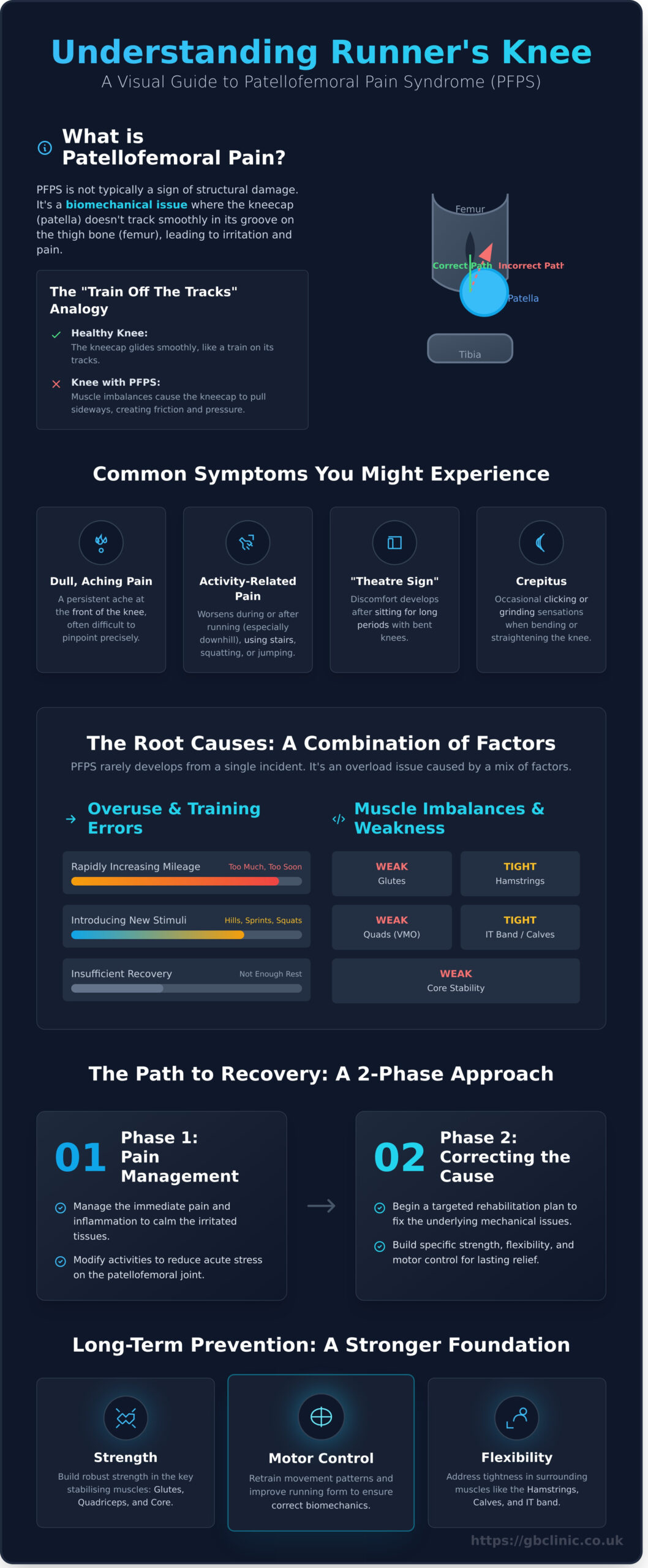
Crucially, Patellofemoral Pain Syndrome is most often an issue of faulty biomechanics and excessive stress, not a sign of structural damage like a tear or arthritis. It occurs when the kneecap fails to track correctly within its groove on the thigh bone (femur). To simplify this, imagine your kneecap as a train and the groove as its tracks. When functioning correctly, the train glides smoothly. With PFPS, muscle imbalances or poor alignment cause the train to veer off course, creating friction, pressure, and irritation on the underlying cartilage.
Understanding the Anatomy of Your Kneecap
Your kneecap, or patella, is a small bone embedded within the quadriceps tendon. This tendon connects your powerful thigh muscles to your shin bone (via the patellar tendon) and the patella acts as a fulcrum to increase its leverage. On the underside of the patella is a layer of smooth cartilage, designed to reduce friction as it glides within a V-shaped channel on your femur called the trochlear groove. The stability and smooth movement of this patellofemoral joint are essential for pain-free function.
Common Symptoms You Might Experience
The presentation of PFPS can vary, but patients typically report a combination of the following symptoms. An accurate diagnosis from a qualified practitioner is essential to rule out other conditions and create an effective treatment plan. Key indicators include:
- A persistent, dull, aching pain felt at the front of the knee, which can be difficult to pinpoint precisely.
- Pain that intensifies during or after activities that load the knee, such as running (especially downhill), descending stairs, squatting, or jumping.
- Discomfort that develops after sitting for extended periods with the knees bent, often referred to as the ‘theatre sign’ or ‘moviegoer’s knee’.
- Occasional clicking or grinding sensations (known as crepitus) when you bend or straighten your knee. This sound is not always associated with pain but indicates friction in the joint.
If these symptoms sound familiar, it is important to seek a professional assessment to begin your path to recovery and prevent the condition from worsening.
The Root Causes: Why Is Your Knee Pain Happening?
Patellofemoral pain syndrome rarely develops from a single, isolated incident. Instead, it is typically the result of several contributing factors that overload the patellofemoral joint. These factors, which can be intrinsic (related to your body’s structure) or extrinsic (related to your training), combine to disrupt the smooth tracking of your kneecap (patella) within its groove on the thigh bone (femur). This poor tracking leads to irritation, inflammation, and the characteristic pain at the front of the knee.
Overuse and Sudden Training Changes
For runners, one of the most common triggers is doing too much, too soon. The structures around the knee require time to adapt to increased loads. When this adaptation period is bypassed, irritation is a common result. Key training errors include:
- Rapidly increasing mileage or intensity: A sudden jump in distance or speed without a gradual build-up.
- Introducing new stimuli: Adding hill repeats or strength exercises like deep squats without allowing the body to adjust.
- Insufficient recovery: Not allowing enough rest between demanding running sessions for tissue repair and strengthening.
Muscle Imbalances and Weakness
Your knee does not operate in isolation. It is part of a complex kinetic chain, and weakness or tightness in surrounding muscle groups can directly impact patellar tracking and place excessive stress on the joint. Our physiotherapists frequently identify:
- Quadriceps weakness: Particularly in the vastus medialis obliquus (VMO), the teardrop-shaped muscle on the inside of the thigh responsible for stabilising the kneecap.
- Weak gluteal muscles: Weak hip abductors and extensors can cause the thigh to rotate inwards during running, altering knee alignment.
- Muscle tightness: Tight hamstrings, iliotibial (IT) band, or calf muscles can pull on the patella, disrupting its normal movement.
- Poor core stability: A weak core reduces overall control of the lower limbs, leading to inefficient movement patterns that overload the knee.
Biomechanical and Anatomical Factors
Finally, your individual anatomy and movement patterns can predispose you to this condition. A thorough assessment of these elements is vital, as understanding them is a key component in the clinical diagnosis of patellofemoral syndrome and guides the most effective treatment plan. Common factors include:
- Foot mechanics: Overpronation, where the foot rolls excessively inward upon landing, can cause a chain reaction that affects knee alignment.
- Patellar alignment: Some individuals have a kneecap that naturally sits higher (patella alta) or is tilted, making it more susceptible to tracking issues.
- Q-angle: A wider pelvis, more common in females, can increase the angle at which the femur meets the tibia, placing greater lateral force on the patella.
Getting a Clear Diagnosis: How We Identify PFPS
Knee pain can arise from numerous sources, which is why an accurate diagnosis is the essential first step toward effective recovery. Simply assuming you have “runner’s knee” without a thorough assessment can lead to ineffective treatment and prolonged discomfort. A precise diagnosis of patellofemoral pain syndrome ensures that your recovery plan targets the true underlying cause of your symptoms. It is the foundation upon which a successful strategy for treatment for runner’s knee is built, allowing for a targeted and efficient return to pain-free activity.
At our clinic, we rely on a comprehensive clinical assessment rather than immediately turning to imaging. The diagnosis is primarily based on your personal history and a detailed physical examination conducted by one of our specialists.
The Clinical Examination Process
Your appointment begins with a detailed discussion to understand the specifics of your condition. We will then conduct a hands-on examination of the knee joint. This process involves:
- Discussing your symptoms: We listen carefully as you describe when the pain started, what activities make it worse (like running, climbing stairs, or sitting), and what provides relief.
- Palpation of the knee: Our specialist will gently press on different areas around your kneecap and surrounding structures to pinpoint the exact location of tenderness.
- Provocative tests: We may perform specific movements, such as compressing the patella or resisting knee extension, to assess how the kneecap moves and to reproduce your symptoms in a controlled way.
Movement and Gait Analysis
How you move provides vital clues about the root cause of your pain. We observe your biomechanics by asking you to perform simple movements like walking, squatting, or jogging on a treadmill. This analysis helps us identify contributing factors such as poor foot posture, hip muscle weakness, or a tendency for your knee to collapse inwards (known as knee valgus). Pinpointing these issues is critical for developing a rehabilitation plan that corrects the problem, not just the symptoms.
The Role of Diagnostic Imaging
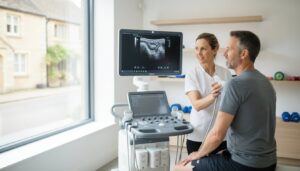
For a typical case of patellofemoral pain syndrome, imaging like an X-ray or MRI is not usually required for diagnosis. However, if your history or examination suggests another issue, imaging can be a valuable tool. It helps us rule out other conditions such as osteoarthritis, stress fractures, or significant cartilage damage. In cases where a tendon or soft tissue injury is suspected, a diagnostic ultrasound scan can provide a clear, real-time view of the structures without radiation exposure.
Effective Treatment Pathways for Patellofemoral Pain
Successfully treating patellofemoral pain syndrome requires a structured, two-phase approach: first, manage the immediate pain and inflammation, and second, address the underlying biomechanical causes. While initial steps can be taken at home, long-term recovery is most effectively achieved with professional guidance. With a consistent and personalised plan, the prognosis is excellent, though runners should expect a recovery timeline ranging from several weeks to a few months.
Immediate Pain Relief: First-Line Strategies
The initial goal is to calm the irritated tissues around the kneecap. This involves a combination of modifying activities and reducing inflammation. Key strategies include:
- Activity Modification: Instead of complete rest, focus on “relative rest.” This means reducing running volume and intensity, and avoiding aggravating activities like deep squats or running downhill.
- Ice Application: Applying an ice pack for 15-20 minutes after activity can help manage pain and swelling.
- Short-Term Medication: Over-the-counter anti-inflammatory medications (like ibuprofen) can provide temporary relief, allowing you to engage more comfortably in rehabilitation.
- Taping: Techniques such as McConnell taping can help improve patellar tracking and provide immediate pain reduction during movement.
Core Physiotherapy Interventions
The cornerstone of effective, long-term recovery is a targeted exercise programme designed by a specialist. Physiotherapy moves beyond temporary fixes to correct the root cause of the pain. A comprehensive plan will be built around strengthening key muscle groups-particularly the glutes and quadriceps-and improving flexibility in tight structures like the hamstrings and IT band. Our expert physiotherapy services in Oxford provide a detailed assessment to create a rehabilitation plan tailored to your specific needs. Your physiotherapist may also use manual therapy to release tight soft tissues and improve joint mobility.
Advanced Treatment Options for Persistent Pain
For persistent cases of patellofemoral pain syndrome that do not resolve with conservative care, other options may be considered. It is important to note that these are not first-line treatments. Shockwave therapy may be beneficial if there is an associated patellar tendinopathy. Injections are not a primary treatment for PFPS itself; however, if significant inflammation of the underlying fat pad is a key pain driver, a guided steroid injection can effectively reduce this inflammation, facilitating progress in physiotherapy. Surgery, such as a lateral release, is reserved as a last resort and is very rarely required.
Rehabilitation and Prevention: Building a Stronger Foundation
Once the initial, acute pain has subsided, the focus shifts to a structured rehabilitation programme. The primary goal is not simply to alleviate current symptoms but to address the underlying biomechanical faults that contributed to your patellofemoral pain syndrome in the first place. This phase is about building long-term strength, flexibility, and neuromuscular control to prevent recurrence. For lasting success, consistency with your rehabilitation exercises is crucial.
Key Strengthening Exercises for Knee Stability
A targeted strengthening programme is fundamental to improving how the patella tracks within its groove. By reinforcing key muscle groups, you create a stable support system for the knee joint during high-impact activities like running. A specialist can guide your form, but core exercises include:
- Quadriceps Strengthening: Exercises like terminal knee extensions help engage the vastus medialis oblique (VMO), a key muscle for patellar stability.
- Hip and Glute Strengthening: Clamshells, glute bridges, and lateral band walks are essential for controlling femoral rotation and preventing the knee from collapsing inwards.
- Core Stability: Planks and bird-dog exercises improve trunk control, which translates to a more stable and efficient running gait.
Stretching and Flexibility for Pain Relief
Muscle tightness around the knee, hip, and ankle can place excessive strain on the patellofemoral joint. A regular flexibility routine helps to restore balanced mechanics and reduce tension. Focus on gentle, sustained stretches held for at least 30 seconds.
- Key Stretches: Target tight hamstrings, quadriceps, and hip flexors, as these groups directly influence knee alignment.
- Foam Rolling: Use a foam roller on the iliotibial (IT) band, quadriceps, and calf muscles to release myofascial restrictions.
- Ankle Mobility: Improving dorsiflexion (the ability to pull your toes toward your shin) can reduce compensatory stress on the knee joint.
Long-Term Prevention Strategies
Integrating preventative habits into your training is the key to remaining pain-free. Addressing patellofemoral pain syndrome is an ongoing process of smart training and consistent self-care. To protect your knees for the long term, consider the following:
- Appropriate Footwear: Ensure your running shoes are not worn out and are suitable for your foot type. A gait analysis can determine if orthotics may be beneficial.
- Proper Training Protocol: Always include a dynamic warm-up and a post-run cool-down with stretching. Avoid sudden increases in mileage or intensity; adhere to a gradual progression.
- Maintain Your Routine: Continue with your core strength and flexibility exercises 2-3 times per week, even after your pain has resolved.
A generic plan provides a starting point, but a tailored assessment will yield the most effective results. Don’t let knee pain hold you back. Book a consultation today for a personalised recovery plan designed by our specialists.
Your Path to Recovery from Patellofemoral Pain
Understanding patellofemoral pain syndrome is the first step towards recovery. As we have explored, this common knee condition often stems from biomechanical imbalances, and a precise diagnosis is essential for effective, long-term relief. The most crucial takeaway is that a structured, personalised rehabilitation plan focusing on strengthening and movement correction provides the most reliable foundation for overcoming pain and preventing its return.
At GB Clinic, our specialist-led team is dedicated to providing a clear path to recovery. We utilise advanced therapies, including diagnostic ultrasound, to ensure an accurate diagnosis before creating a personalised, evidence-based treatment plan tailored to your unique needs. Do not let knee pain dictate your life. Take the first step towards effective, lasting relief today.
Book your personal physiotherapy consultation in Oxford and let our experts guide you back to pain-free movement. With the right support, you can restore function, build resilience, and return to the activities you love.
Frequently Asked Questions About Patellofemoral Pain Syndrome
How long does patellofemoral pain syndrome take to heal?
The recovery timeline for patellofemoral pain syndrome varies significantly, typically ranging from six weeks to several months. Factors influencing healing include the severity of the condition, adherence to a structured rehabilitation programme, and underlying biomechanical issues. A tailored physiotherapy plan focusing on strengthening the quadriceps and hip muscles is crucial for managing symptoms and facilitating a durable, long-term recovery. Early and consistent engagement with treatment yields the most effective results.
Can I continue to run or exercise with runner’s knee?
It is generally advisable to cease running and other high-impact activities that aggravate your knee pain to allow inflammation to reduce. However, complete rest is often counterproductive. We recommend modifying your activity to low-impact exercises such as swimming or cycling. A physiotherapist can guide you on specific strengthening exercises that support recovery without causing further irritation. Your pain should be your guide; any activity that causes discomfort should be avoided until you are assessed by a professional.
Is patellofemoral pain syndrome the same as chondromalacia patellae?
While often used interchangeably, these terms describe different conditions. Patellofemoral pain syndrome (PFPS) is a clinical diagnosis describing pain at the front of the knee, typically caused by biomechanical issues. Chondromalacia patellae, however, is a structural diagnosis referring to the actual softening or damage of the cartilage under the patella. While chondromalacia can be a source of PFPS, many individuals with PFPS have normal cartilage. An accurate diagnosis requires a thorough clinical assessment.
What is the best type of footwear or running shoe for PFPS?
There is no single best shoe for everyone with patellofemoral pain, as the ideal choice depends on your individual foot mechanics and running gait. We recommend a professional gait analysis to determine if you require a neutral, stability, or motion-control shoe. Generally, footwear with adequate cushioning to absorb impact and sufficient support to control pronation can help reduce stress on the patellofemoral joint. In some cases, custom or off-the-shelf orthotics may also be advised.
When should I see a specialist for my anterior knee pain?
We advise consulting a specialist, such as a physiotherapist or sports medicine doctor, if your knee pain does not improve after one to two weeks of rest and activity modification. You should also seek professional assessment if the pain is severe, significantly impacts your daily activities, or is accompanied by symptoms like locking, instability (“giving way”), or significant swelling. An early and accurate diagnosis is essential for developing an effective treatment plan and preventing the condition from becoming chronic.
Will a knee brace help with patellofemoral pain?
A knee brace or patellar strap can provide temporary relief for some individuals by helping to improve the tracking of the kneecap and offload the joint during activity. While it can be a useful tool for managing symptoms, it is not a long-term solution. A brace should be used in conjunction with a comprehensive rehabilitation programme designed to address the root causes of the pain, such as muscle weakness or imbalances. Relying solely on a brace will not resolve the underlying issue.