
Living with persistent joint pain can be a significant challenge, making the search for an effective non-surgical solution a priority. When exploring modern therapies, many patients find themselves considering two leading options: Platelet-Rich Plasma and Hyaluronic Acid. Understanding the fundamental differences between a prp injection and an HA treatment is crucial for selecting the most appropriate and effective care for your specific condition, such as knee osteoarthritis.
Your blood’s platelets act as the body’s first responders to injury. When tissue is damaged, they rush to the site to initiate clotting and release potent growth factors. These growth factors signal other cells to begin rebuilding and repairing the damaged tissue. A standard prp injection significantly amplifies this natural response by delivering a much higher concentration of platelets-and therefore growth factors-directly to the source of pain. It is like sending a highly specialised and reinforced repair crew to the exact location of a problem, providing the essential tools needed to rebuild damaged tendons, ligaments, or cartilage. This same regenerative mechanism is also why PRP is popular in aesthetic medicine; you can read more about its other applications.
For patients managing complex health needs alongside joint recovery, particularly those with mobility challenges that make travel difficult, it’s also important to consider all aspects of care. In cases where specialized treatment for issues like chronic wounds is required, it can be helpful to explore Advanced Mobile Wound Care Services options that bring expert care directly to your home.
This guide provides a clear, detailed comparison to eliminate confusion. We will explain precisely how each injection works, the conditions they are proven to treat, and the factors to consider when making your choice. By outlining the benefits and processes of both treatments, we aim to provide you with the confidence and information needed to discuss the best path forward with your specialist at our Oxford clinic, moving you closer to sustained pain relief and restored mobility.
Key Takeaways
- A PRP injection harnesses your body’s own platelets to stimulate natural tissue repair and reduce inflammation from within.
- Hyaluronic Acid (HA) injections work differently, acting as a lubricant and shock absorber to cushion the joint and ease pain.
- The right treatment is determined by your specific diagnosis-whether your joint requires healing support or improved lubrication.
- An accurate diagnosis from a specialist is the critical first step before considering any injection, ensuring the treatment plan is tailored to you.
Understanding Platelet-Rich Plasma (PRP) Injections: Healing from Within
Platelet-Rich Plasma (PRP) therapy is a modern regenerative treatment designed to harness your body’s innate healing capabilities. The procedure involves taking a small sample of your own blood, processing it in a centrifuge to concentrate the platelets, and then precisely injecting this solution into the injured area. These platelets are critical for healing, as they contain hundreds of proteins called growth factors. The primary goal of a Platelet-Rich Plasma (PRP) injection is not to simply mask pain, but to stimulate and accelerate tissue repair at a cellular level, promoting long-term recovery for conditions like tendon injuries, ligament sprains, and early-stage osteoarthritis.
To better understand the science behind this treatment for joint pain, this video offers a helpful explanation:
How Does PRP Work?
Your blood’s platelets act as the body’s first responders to injury. When tissue is damaged, they rush to the site to initiate clotting and release potent growth factors. These growth factors signal other cells to begin rebuilding and repairing the damaged tissue. A standard prp injection significantly amplifies this natural response by delivering a much higher concentration of platelets-and therefore growth factors-directly to the source of pain. It is like sending a highly specialised and reinforced repair crew to the exact location of a problem, providing the essential tools needed to rebuild damaged tendons, ligaments, or cartilage.
Who is an Ideal Candidate for PRP?
PRP therapy is a versatile treatment, but it is particularly effective for individuals with specific musculoskeletal conditions. At GB Clinic, we find it offers significant benefits for patients who meet the following criteria:
- Patients with chronic tendon injuries: This includes conditions that have not responded to traditional treatments, such as tennis elbow (lateral epicondylitis), golfer’s elbow, Achilles tendinopathy, and patellar tendinopathy.
- Individuals with mild to moderate osteoarthritis: For patients in the earlier stages of joint degeneration, PRP can help reduce pain, improve function, and potentially slow the progression of the condition.
- Those seeking a biological treatment: As PRP uses your body’s own resources, it is an excellent option for patients who wish to avoid steroid injections or are looking for a more natural approach to healing.
Understanding Hyaluronic Acid (HA) Injections: Lubricating for Relief
Hyaluronic Acid (HA) is a naturally occurring, gel-like substance that is a key component of the synovial fluid within your joints. Its primary role is to act as a lubricant and shock absorber, allowing for smooth, pain-free movement. In joints affected by osteoarthritis, however, the concentration and quality of this natural HA diminish over time. This breakdown leads to increased friction between cartilage surfaces, inflammation, and the characteristic pain and stiffness associated with the condition. HA injections directly address this deficiency by introducing a concentrated, medical-grade formulation of this vital substance back into the joint capsule, offering a different pathway to relief than a regenerative prp injection.
How Does Hyaluronic Acid Work?
Often referred to as viscosupplementation, this treatment works by supplementing your body’s natural synovial fluid. The injection helps to restore the lubricating and cushioning properties of the joint, which in turn reduces friction and allows the bones to glide more smoothly over one another. This improved mechanical function can significantly decrease pain during activities like walking or climbing stairs. Furthermore, HA has demonstrated anti-inflammatory properties that help to reduce swelling and calm the joint environment. This mechanism is focused on improving the joint’s environment rather than stimulating tissue repair, which is the primary goal of a prp injection. To understand the specifics of our treatment approach, you can learn more about our clinic’s Hyaluronic Acid (HA) injections.
Who is an Ideal Candidate for HA?
Hyaluronic acid injections are a highly effective treatment for a specific group of patients seeking to manage their joint pain without immediate surgery. This treatment is often recommended for:
- Patients experiencing mild to moderate osteoarthritic pain and stiffness, particularly in the knee joint.
- Individuals who have not found sufficient relief from more conservative treatments, such as oral painkillers, topical creams, or a structured physiotherapy programme.
- Those seeking a safe and effective way to achieve temporary pain relief, improve daily function, and potentially delay the need for more invasive procedures like joint replacement surgery.
Head-to-Head Comparison: Key Differences Between PRP and HA
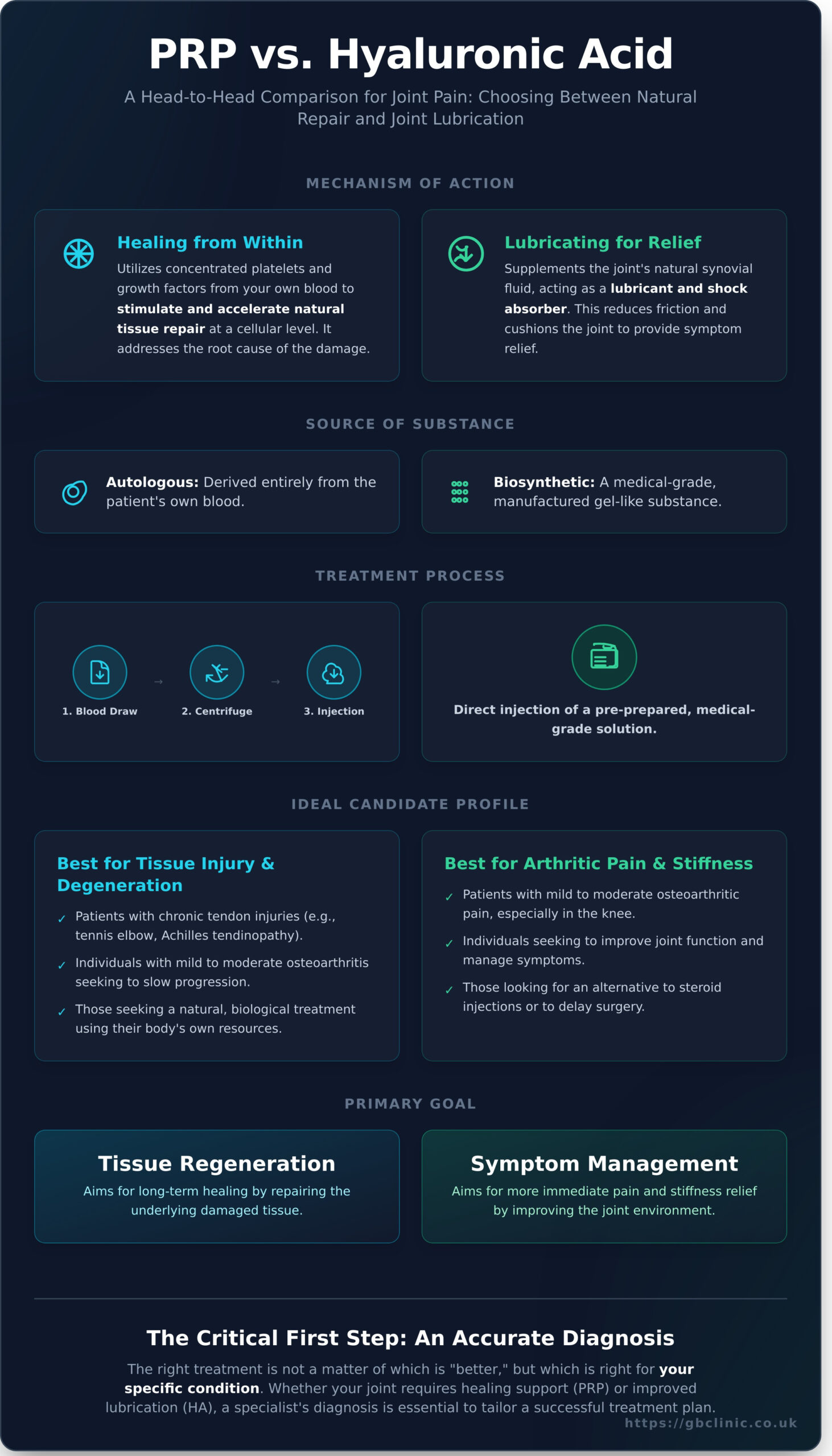
To help you understand which treatment may be more suitable for your condition, this section provides a direct comparison between Platelet-Rich Plasma (PRP) and Hyaluronic Acid (HA). The fundamental difference lies in their approach: a PRP injection is a biological therapy designed to stimulate healing, whereas HA is a medical device that provides lubrication and cushioning. Furthermore, PRP is autologous (derived from your own blood), while HA is a synthetically produced substance that mimics the natural fluid in your joints.
| Feature | Platelet-Rich Plasma (PRP) | Hyaluronic Acid (HA) |
|---|---|---|
| Primary Goal | Stimulate tissue healing & regeneration | Provide lubrication & pain relief |
| Source | Autologous (your own blood) | Synthetic (lab-produced) |
| Onset of Relief | Slower (weeks to months) | Faster (days to weeks) |
| Duration of Effect | Potentially long-lasting if healing occurs | Typically 6 to 12 months |
| Commonly Used For | Tendon/ligament injuries, early osteoarthritis | Mild to moderate knee osteoarthritis |
Mechanism of Action: Healing vs. Symptom Relief
PRP therapy works by harnessing your body’s own healing capabilities. The concentrated platelets release powerful growth factors that signal local cells to repair and regenerate damaged tissues like cartilage, tendons, and ligaments. These bioactive components of PRP aim to address the root cause of the pain for long-term tissue health improvement. In contrast, Hyaluronic Acid acts as a viscosupplement. It restores the lubricating and shock-absorbing properties of the synovial fluid within the joint, reducing friction and inflammation. Its goal is more focused on immediate to mid-term pain relief and improved function.
Best-Suited Conditions and Treatment Goals
The choice between a PRP injection and HA depends heavily on your specific diagnosis and treatment objectives. PRP is often recommended for soft tissue injuries such as tennis elbow, Achilles tendinopathy, and rotator cuff tears, where the primary goal is to heal the damaged tissue. HA, on the other hand, is a well-established and NICE-approved injection treatment for managing the symptoms of mild to moderate knee osteoarthritis. An accurate diagnosis from a specialist is essential to guide this decision.
Onset of Action and Duration of Effect
Patients typically experience pain relief from HA injections relatively quickly, often within a few days to weeks. The effects are consistent and proven to last for several months, typically between 6 and 12, after which the treatment may need to be repeated. PRP has a slower onset, as your body requires time to respond to the growth factors and initiate the healing process. Noticeable improvements may take several weeks to a few months, but because the goal is true tissue repair, the results can be significantly longer-lasting.
The Patient Journey: What to Expect from Your Injection at GB Clinic
At GB Clinic, we believe a successful outcome begins with a clear, structured, and transparent process. Your journey to pain relief is a partnership between you and our clinical team, designed to ensure you receive the most effective treatment for your specific condition. Below is a step-by-step guide to what you can expect when you visit us.
Step 1: Initial Consultation and Diagnosis
Your journey starts with a thorough assessment by one of our specialist clinicians. To achieve an accurate diagnosis, we use a diagnostic ultrasound scan to visualise the underlying tissue and pinpoint the exact source of your pain. This crucial first step allows us to determine if an injection is the right course of action and, if so, which type will provide the most benefit for your injury.
Step 2: The Injection Procedure
Whether you are receiving a Hyaluronic Acid or a PRP injection, the procedure is performed with the utmost precision. If PRP is recommended, a small sample of your blood is taken and placed in a centrifuge to concentrate the healing platelets. For all injections, the target area is cleaned, and a local anaesthetic is applied to minimise discomfort. We then use live ultrasound guidance to deliver the injection directly to the affected area, ensuring maximum accuracy and effectiveness.
Step 3: Post-Injection Care and Rehabilitation
Effective recovery extends beyond the treatment room. Following your injection, you will receive clear aftercare instructions, which typically involve a short period of rest and avoiding strenuous activities. To achieve the best possible long-term results, your treatment is integrated with a tailored specialist physiotherapy programme. This comprehensive approach helps restore strength, improve mobility, and support your long-term recovery.
This integrated pathway of diagnosis, precise treatment, and structured rehabilitation is designed to help you achieve lasting relief and return to the activities you enjoy. Ready to start your journey to recovery? Book a consultation at our Oxford clinic.
Making the Right Choice for Your Joint Health and Recovery
Choosing between PRP and Hyaluronic Acid injections is a significant decision in your journey to overcome joint pain. While HA primarily provides lubrication and cushioning for conditions like osteoarthritis, PRP harnesses your body’s own healing mechanisms to repair tissue and reduce inflammation. The most effective treatment depends entirely on your specific diagnosis, the severity of your condition, and your long-term recovery goals.
At GB Clinic, our expert clinicians in musculoskeletal medicine provide a thorough assessment to determine if a prp injection or another treatment is right for you. To ensure precision and safety, all injections are performed under high-resolution ultrasound guidance. Our integrated care model combines these advanced injections with expert physiotherapy, creating a comprehensive plan for lasting relief and improved function.
To find clarity and begin your recovery, we invite you to Book Your Personalised Consultation in Oxford to Discuss Your Treatment Options. Taking this step is the start of your path towards a more active, pain-free life.
Frequently Asked Questions
Are PRP and Hyaluronic Acid injections painful?
Patient comfort is our priority. Before the procedure, a local anaesthetic is administered to numb the treatment area, significantly minimising any pain. Most patients report feeling only a sense of pressure or mild, temporary discomfort during the injection itself. At our clinic, we use ultrasound guidance to ensure precise placement, which further enhances both the effectiveness of the treatment and the comfort of the experience for our patients.
How many injections will I need for my condition?
The required number of injections is tailored to your specific condition, its severity, and your individual response to treatment. For Hyaluronic Acid, a course often involves 1 to 3 injections spaced several weeks apart. Similarly, PRP therapy typically consists of a series of 1 to 3 injections to achieve optimal results. A comprehensive consultation with one of our specialists will determine the most effective treatment plan for your long-term recovery.
What are the potential risks or side effects of these injections?
Both PRP and HA injections have an excellent safety profile. The most common side effects are minor and temporary, such as mild pain, swelling, or bruising at the injection site. Because a PRP injection uses your own blood, the risk of an allergic reaction or disease transmission is eliminated. The risk of more serious complications, such as infection, is extremely low when the procedure is performed by an experienced clinician using sterile techniques.
How do PRP and HA compare to traditional steroid injections?
Steroid injections provide rapid, powerful anti-inflammatory effects but may offer only short-term relief and can potentially degrade cartilage with repeated use. In contrast, Hyaluronic Acid provides lubrication and cushioning to the joint for longer-lasting pain management. PRP is a regenerative treatment designed to stimulate your body’s natural healing processes to repair damaged tissue, addressing the underlying cause of pain rather than only managing symptoms.
Is the cost of PRP or Hyaluronic Acid covered by private medical insurance?
Coverage for these advanced injections varies widely among UK private medical insurance providers. Hyaluronic Acid is often covered for specific conditions like knee osteoarthritis. The availability of cover for PRP is growing but is not yet standard across all policies. We strongly recommend you contact your insurer directly to confirm the details of your plan. Our administrative team can provide the necessary documentation to support your claim.
Can PRP and Hyaluronic Acid injections be used together?
Yes, combining PRP and Hyaluronic Acid is an advanced therapeutic option that can produce synergistic effects. This combination therapy leverages the joint lubrication and cushioning properties of HA with the powerful regenerative potential of PRP’s growth factors. This dual-action approach can enhance pain relief and promote a more robust healing environment within the joint. Your clinician will determine if this combined protocol is appropriate for your condition.
How long does the recovery take after a PRP or HA injection?
Downtime is minimal for both procedures. Following an HA injection, most patients resume normal activities within 24-48 hours, though we advise avoiding strenuous exercise for a few days. After a PRP injection, you may experience a temporary increase in soreness for 2-3 days as the natural inflammatory healing response begins. We typically recommend a brief period of relative rest before commencing a structured physiotherapy programme to maximise results.