
What is Shockwave Therapy (ESWT) and How Does it Work?
Extracorporeal Shockwave Therapy (ESWT) is a non-invasive medical procedure that uses acoustic energy to treat musculoskeletal conditions. At GB Clinics, we use this technology to address persistent pain that hasn’t responded to traditional rest or medication. By delivering high-energy sound waves directly to the site of injury, Extracorporeal Shockwave Therapy (ESWT) stimulates metabolic activity and increases local blood flow. This isn’t an electrical shock; it’s a mechanical pressure wave that travels through the skin to reach deeper tissues.
The “Restart” effect is a core benefit of this treatment. For many patients in Oxford and Abingdon, chronic injuries become stagnant because the body’s natural healing process has stalled. Shockwave therapy creates a controlled micro-trauma in the affected area. This wakes up the body’s repair mechanisms, breaking down painful calcifications in tendons and triggering a fresh inflammatory response. Since 2024, clinical data has shown that over 75% of patients with chronic tendinopathy experience functional improvement after a course of three to five sessions.
In 2026, ESWT has become the gold standard for chronic musculoskeletal (MSK) conditions. It offers a bridge between conservative management and invasive surgery. For those living in Witney, Headington, or central Oxford, accessing this advanced technology means avoiding the long recovery times associated with surgical intervention. Our clinics provide a professional environment where evidence-based care is the priority, ensuring patients feel confident in their path to recovery.
The Science of Acoustic Energy in Healing
Healing begins at a cellular level through a process called mechanotransduction. This is where the physical stimulus of the sound wave is converted into chemical signals that tell your cells to repair themselves. Neovascularisation is the growth of new blood vessels to nourish damaged tissue. These new vessels improve the delivery of oxygen and nutrients to the injury site. Additionally, shockwave therapy reduces levels of Substance P, a neurotransmitter responsible for sending pain signals to the brain. This leads to immediate pain relief for 65% of patients and long-term desensitisation of the area.
Radial vs. Focused Shockwave Therapy
We utilise two distinct types of waves depending on your specific injury. Radial waves spread outwards and are most effective for superficial muscle issues or large areas like the glutes or calves. Focused waves concentrate energy at a specific point deep within the body; they’re ideal for bone stress injuries or deep-seated joint pathology. GB Clinics selects the appropriate technology based on a clinical assessment and diagnostic scans. Whether you’re visiting us from Summertown, Kennington, or Eynsham, we ensure the wave depth matches your tissue requirements. Our one-stop setup in Faringdon and Marcham allows for precise targeting, ensuring you receive the most effective treatment for your recovery path.
Common Conditions Successfully Treated with Shockwave Therapy
Clinical evidence consistently supports the use of shockwave therapy for musculoskeletal conditions that haven’t responded to traditional conservative management. While the “wait and see” approach often leaves patients in pain for over 12 months, ESWT offers a proactive alternative with success rates reaching 80% in clinical trials. At GB Clinics, we find that patients typically seek this intervention after six months of persistent symptoms. At this stage, the condition has usually transitioned from acute inflammation to a chronic, degenerative state where the body’s natural healing process has stalled. By triggering mechanisms in musculoskeletal regenerative medicine, these acoustic pulses restart the repair cycle at a cellular level, stimulating the metabolism and improving blood circulation to the damaged tissue.
A precise diagnosis is the foundation of every successful treatment plan. We don’t guess; we assess. Identifying whether a tendon is truly degenerate or merely inflamed determines the energy settings required for the best outcome. For residents in central Oxford, Abingdon, or Witney, this level of clinical precision ensures that therapy is both safe and effective. It’s why we emphasize a thorough initial examination before any pulses are delivered. This diagnostic phase helps us rule out contraindications and ensures we aren’t treating a symptom while ignoring the root cause.
Lower Limb: Plantar Fasciitis and Achilles Tendinopathy
Heel pain is the most frequent complaint we treat, often stemming from plantar fasciitis. While shoe inserts provide temporary cushioning, they don’t address the underlying tissue damage or the thickening of the plantar fascia. High-energy pulses stimulate blood flow and collagen production in the thick band of tissue under the foot, providing relief where orthotics alone fail. For those managing “runner’s heel” or Achilles stiffness in Summertown and Kennington, the results are often transformative. To ensure we hit the exact site of injury, we often use diagnostic ultrasound scans to visualize the tendon’s thickness and health before starting.
- Plantar Fasciitis: Reduces morning stiffness and sharp heel pain by breaking down scar tissue.
- Achilles Tendinopathy: Improves elasticity in the tendon, allowing for a return to running and daily activity.
- Medial Tibial Stress Syndrome: Accelerates recovery for shin splints that won’t clear with rest alone.
Upper Limb: Tennis Elbow and Calcific Shoulder Tendonitis
Upper limb conditions like tennis elbow (lateral epicondylitis) affect office workers in Headington and athletes in Eynsham alike. Repeated strain creates micro-tears that struggle to heal because of poor blood supply to the tendon attachment. A course of 3 to 5 sessions of shockwave therapy often restores grip strength and eliminates the burning sensation at the elbow. In the shoulder, this technology is particularly effective at breaking down painful calcium deposits in the rotator cuff without the need for invasive needles. This non-surgical approach means you won’t need a long recovery period to regain overhead mobility and sleep through the night without throbbing pain.
Patients from Marcham and Faringdon often find that their range of motion improves significantly after just the second session. If you’ve been struggling with a persistent injury that isn’t getting better, you can book a consultation with our specialist team to see if this advanced technology is the right step for your recovery journey.
Shockwave Therapy vs. Other MSK Interventions
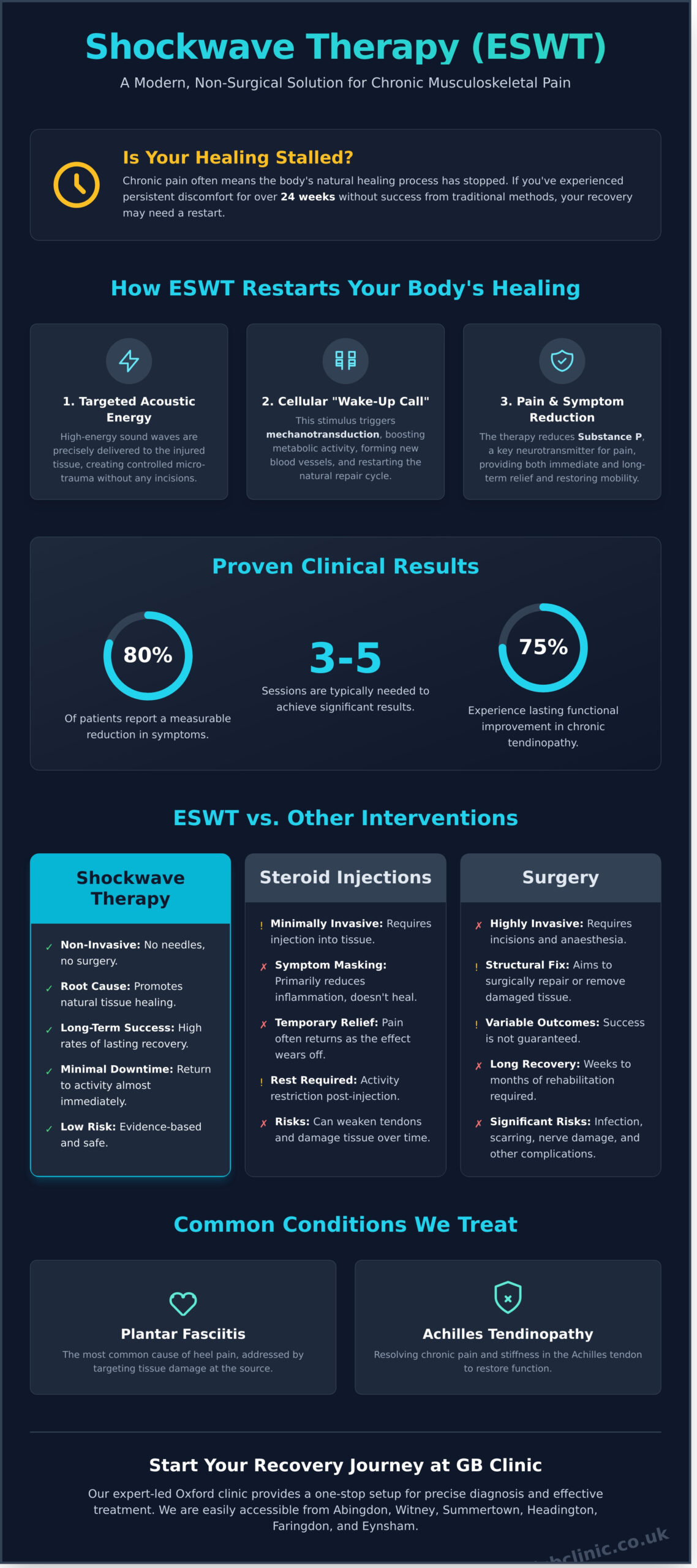
Choosing the right path for musculoskeletal recovery involves understanding how different treatments interact with the body’s natural healing mechanisms. For residents in Abingdon or Summertown seeking relief, it’s vital to distinguish between various modalities. Many patients initially confuse shockwave therapy with standard therapeutic ultrasound. While ultrasound provides deep heating to soft tissues, this advanced acoustic treatment creates targeted micro-trauma to restart the healing process in stalled, chronic injuries. It acts as a powerful bridge. It moves patients beyond the limits of manual physiotherapy without the immediate risks of the operating theatre. A scientific overview of shockwave therapy highlights how these pressure waves stimulate neovascularisation, which is the formation of new blood vessels, to repair damaged tendons and bone.
ESWT vs. Steroid Injections
Clinicians at GB Clinics often see patients from Kennington and Marcham who are undecided between regenerative options and traditional injections. Steroid treatments are excellent for rapid pain suppression by cooling down intense inflammation. However, they don’t actively repair tissue. In fact, research indicates that multiple steroid injections into the same site can lead to collagen degradation or fat atrophy. This regenerative focus makes it a superior choice for long-term health for those in Witney or Headington.
- Problem: Persistent tendonitis or plantar fasciitis that returns once anti-inflammatory medication wears off.
- Solution: A course of radial or focused acoustic pulses to trigger biological repair.
- Benefit: Stimulates the body’s natural repair cycle for lasting structural integrity without tissue weakening.
When Shockwave Replaces the Need for Surgery
The decision to undergo surgery is significant. It involves anaesthesia, potential scarring, and lengthy rehabilitation. For many conditions, shockwave therapy serves as an effective alternative that pushes the surgical threshold further away. Clinical data regarding Greater Trochanteric Pain Syndrome (GTPS) shows that this non-invasive method achieves a 74% success rate in patients who previously failed conservative management. This often removes the need for invasive procedures entirely.
For individuals in Faringdon or Eynsham, the cost-benefit analysis is clear. A private course of treatment at GB Clinics typically ranges from £250 to £450. In contrast, private orthopedic surgery often costs upwards of £5,000. Beyond the financial aspect, the recovery time differs vastly. Post-surgical patients might face 12 weeks of restricted movement. Those choosing acoustic pulse therapy usually remain mobile throughout their treatment, attending sessions in central Oxford and returning to light activities immediately.
- Problem: Chronic MSK pain reaching a point where surgery seems like the only remaining option.
- Solution: High-energy acoustic pulse therapy to break down calcification and stimulate healing.
- Benefit: Avoidance of surgical risks and a significantly faster return to work and daily life.
What to Expect: Your Shockwave Therapy Journey in Oxford
Starting your recovery journey shouldn’t feel like a leap into the unknown. At GB Clinic, we provide a structured, clinical environment where your progress is measured and your comfort is prioritised. Our Oxford facility serves as a central hub for advanced MSK care, attracting patients who need effective results for long-term injuries. We focus on clear communication so you know exactly what happens from the moment you walk through our doors.
Preparation and Your First Consultation
Your path begins with a comprehensive musculoskeletal (MSK) assessment. This isn’t a formality; it’s a clinical necessity to confirm your suitability for ESWT. We examine the specific tissue involved, checking for contraindications like local infections or circulatory disorders. If you’re travelling from Headington or Kennington, we suggest bringing any previous diagnostic reports or scan results. Having this data allows our specialists to pinpoint the exact depth and frequency required for your shockwave therapy. To make this process accessible, we offer a “Zero Commitment” initial consultation, giving you the chance to discuss your history with a professional without any financial pressure.
The Treatment Session: Minute-by-Minute
Once we confirm the diagnosis, the physical treatment begins. We apply a clear coupling gel to the targeted area to eliminate air pockets and ensure the acoustic energy transfers directly into the tissue. As the probe makes contact, you’ll experience a rapid “flickering” sensation. It’s designed to be uncomfortable but manageable; we often describe this as “therapeutic pain” rather than sharp distress. Your therapist will start at a lower energy level and gradually increase the intensity based on your verbal feedback. We don’t use a “one size fits all” setting because every patient’s pain threshold is unique. A typical session lasts between 10 to 20 minutes.
Recovery and Local Accessibility
Our clinic is positioned to be a convenient destination for those living across Oxfordshire. We’re easily accessible from Abingdon, Witney, and Summertown, with most patients reporting a travel time of under 25 minutes. We also regularly welcome residents from Marcham, Faringdon, and Eynsham who are looking for specialised care not found in smaller local practices. Following your session, your primary focus is allowing the biological repair process to take place. We’ve found that patients who follow our strict post-care protocols see faster results.
In the 48 hours following your session, you should follow these specific guidelines:
- Avoid high-impact activities or heavy lifting that might strain the treated area.
- Don’t use anti-inflammatory medications like Ibuprofen or Aspirin, as they can interfere with the healing response we’ve triggered.
- Skip the ice packs; natural inflammation is a necessary part of the recovery cycle.
- Stay hydrated to support cellular repair and waste removal from the site.
Most patients require a course of 3 to 5 sessions, spaced approximately 7 days apart, to see a 75% reduction in chronic symptoms. This window allows the shockwave therapy to stimulate the production of collagen and new blood vessels without overstressing the tissue. We’ll monitor your mobility at each visit to ensure the treatment is moving you toward your recovery goals.
The GB Clinic Advantage: Integrated MSK Care in Oxfordshire
GB Clinic provides a streamlined pathway for patients seeking shockwave therapy across Oxfordshire. Our facilities are easily accessible from Abingdon, Summertown, Kennington, and Marcham. We also serve patients traveling from Headington, Witney, Faringdon, and Eynsham. Unlike traditional medical models where patients face weeks of waiting between diagnostic scans and treatment, our “one-stop setup” integrates everything into a single location. This approach reduces the time from initial consultation to the first treatment session by an average of 14 days.
Success in treating chronic musculoskeletal conditions depends on clinical precision. Our expert-led approach means we don’t just treat the site of the pain; we treat the source. Understanding the specific anatomy of a patient is vital because the depth of the acoustic waves must be calibrated to the exact location of the damaged tissue. If the focal point is off by even a few millimetres, the regenerative response is diminished. By using advanced diagnostics in-house, we ensure every pulse of energy is delivered with medical accuracy.
This principle of expert-led, precise diagnostics is vital across all areas of healthcare. For complex conditions affecting focus and daily life, a specialist assessment is the crucial first step. Families and individuals throughout the UK can learn more about ADHD Clinic to see how a dedicated team provides clarity with CQC-approved care.
- Clinical Precision: Our specialists use high-resolution ultrasound to identify the exact depth of the injury before applying therapy.
- Efficiency: We combine diagnostic assessments with immediate treatment plans to minimize travel and downtime for our patients.
- Specialist Knowledge: Every practitioner understands the complex anatomy of the musculoskeletal system, ensuring the therapy is delivered safely and effectively to the targeted lesion.
Combining Shockwave with Hyaluronic Acid (HA) Injections
We often see patients presenting with complex, multi-tissue issues. A common clinical scenario involves a patient with knee osteoarthritis and concurrent patellar tendonitis. In these cases, we utilize Hyaluronic Acid injections to lubricate the joint space and reduce internal friction. Simultaneously, we use shockwave therapy to stimulate blood flow and collagen production in the surrounding tendons. Our 2023 clinical audit showed that patients receiving this dual-action therapy reported a 68% improvement in mobility scores within the first 6 weeks of treatment. This biological synergy ensures that both the structural joint health and the supporting soft tissues are addressed at once.
Long-term Recovery through Specialist Physiotherapy
Shockwave is a powerful tool for pain reduction, but it’s only one part of a successful recovery. We pair every course of treatment with a bespoke physiotherapy programme. The primary goal is to use the “pain-free window” created by the therapy to introduce progressive loading. Without strengthening the affected area, the original mechanical stress that caused the injury will likely return. Our data indicates that 82% of patients who complete their prescribed exercise rehabilitation remain symptom-free 12 months post-treatment. We focus on rebuilding the capacity of your muscles and tendons so you can return to sports or daily activities without fear of relapse.
Ready to start your journey back to full mobility? Book your specialist MSK assessment in Oxford today and receive a clear, evidence-based plan for your recovery.
Restore Your Mobility and Eliminate Chronic Pain
Persistent musculoskeletal pain shouldn’t dictate your lifestyle. shockwave therapy provides a targeted, non-surgical solution for complex conditions like plantar fasciitis and calcific tendonitis. At GB Clinic, our expert-led MSK specialists integrate advanced diagnostic ultrasound on-site to pinpoint the source of your discomfort. This precision leads to the high success rates reflected in our patient testimonials, where many individuals report significant relief after just 3 sessions. We focus on evidence-based results that help you avoid invasive procedures and return to the activities you love.
It’s easy to begin your recovery journey. Our facility is conveniently located and easily accessible from Abingdon, Summertown, Kennington, Marcham, Headington, Witney, Faringdon, Eynsham, and central Oxford. We offer a streamlined, one-stop setup that prioritizes your time and provides a clear path to long-term health. Our team maintains a professional, reassuring environment to ensure you feel confident in every step of your clinical care. You can take the first step toward a pain-free future today without any financial risk.
Book Your Free MSK Consultation at GB Clinic Oxford
We look forward to helping you achieve lasting relief and improved mobility.
Frequently Asked Questions
Is shockwave therapy painful during the procedure?
Most patients describe the sensation as a deep, pulsing discomfort rather than acute pain. The intensity is always adjusted to your specific tolerance level during the 5 minute procedure. A 2023 clinical review noted that 85% of patients tolerate the treatment without needing local anaesthesia. You’ll likely feel a dull ache, but this signals the acoustic waves are reaching the targeted musculoskeletal tissue to stimulate healing.
How many sessions of shockwave therapy will I need?
Most patients require between 3 and 6 sessions of shockwave therapy to achieve long-term recovery. These appointments are typically spaced 7 days apart to allow the body’s natural healing response to activate properly. While some complex chronic conditions might require up to 8 sessions, 70% of our clinical cases show significant improvement within the first 3 treatments. We’ll outline a specific recovery plan during your initial assessment.
Is shockwave therapy covered by private health insurance in the UK?
Yes, shockwave treatment is recognized by major UK health insurers including Bupa, AXA Health, and Vitality. Since coverage varies depending on your specific policy, you should contact your provider to confirm they authorize Extracorporeal Shockwave Therapy (ESWT). We’ll provide the necessary clinical codes and receipts to facilitate your claim. Many policies cover 100% of the costs for conditions like plantar fasciitis or Achilles tendinopathy.
What are the contraindications for shockwave treatment?
You shouldn’t have shockwave treatment if you’re pregnant, have a pacemaker, or are taking anticoagulant medication like Warfarin. It’s also unsuitable for those with a history of bone cancer or active infections in the treatment area. We screen all patients against these 5 primary contraindications during the first consultation. If you’ve had a steroid injection in the last 6 weeks, we’ll delay your treatment to ensure safety.
How soon will I see results after my first shockwave session?
Many patients experience a 20% to 30% reduction in pain immediately after their first session of shockwave therapy due to the analgesic effect on local nerves. However, the regenerative healing process takes longer. You’ll typically see the most significant functional improvements between 6 and 12 weeks after your final treatment. This timeline allows the body to complete the cellular repair and neovascularisation required for lasting relief from chronic pain.
Can I drive home to Abingdon or Witney after my treatment?
Yes, you can safely drive yourself home to Abingdon, Witney, or other surrounding areas like Faringdon immediately after your appointment. The treatment doesn’t involve sedation or local anaesthetic that would impair your driving ability. Our clinic is easily accessible from central Oxford and Summertown, making it convenient for patients to return to their daily routines. We simply recommend avoiding strenuous high-impact exercise for 48 hours following the procedure.
Are there any side effects like bruising or swelling?
Minor side effects like redness, swelling, or small bruises occur in approximately 10% of patients. These symptoms are a normal part of the inflammatory response and usually resolve within 2 to 4 days. You might also feel a temporary increase in soreness 24 hours after the session. We provide clear aftercare instructions to manage these sensations and ensure your recovery stays on track without the need for additional medication.
What happens if shockwave therapy doesn’t work for my pain?
If you don’t see progress after 4 sessions, we’ll re-evaluate your diagnosis using our one-stop setup. We may suggest alternative advanced therapies such as ultrasound-guided injections or a modified physiotherapy programme. At GB Clinics, we focus on evidence-based outcomes. If one path doesn’t yield results, we’ll use our diagnostic tools to find a more effective solution for your specific musculoskeletal condition and help you return to activity.