

Persistent joint or tendon pain can significantly impact your quality of life, making everyday activities a challenge. When other treatments have not provided sufficient relief, steroid injections offer a powerful, targeted solution to reduce inflammation and pain directly at the source. We understand that considering any new procedure brings important questions about its effectiveness, the experience itself, and how long the benefits will last. Feeling fully informed is the first step toward taking control of your recovery.
When dealing with complex issues in the feet and ankles, consulting a specialist can provide a clear diagnosis and a comprehensive treatment plan. A dedicated expert like Mr Ramsay Refaie Foot and Ankle Surgeon can determine if steroid injections are the most suitable approach for conditions such as these.
This complete guide provides the clear, expert-led information you need. We will explain precisely how steroid injections work to alleviate pain and restore mobility, the specific musculoskeletal conditions they are proven to treat, and what you can expect during and after the procedure. Our goal is to equip you with the knowledge to confidently decide if this treatment is the right path forward for you, helping you return to the activities you enjoy without discomfort.
Key Takeaways
- Understand how steroid injections deliver powerful, targeted anti-inflammatory medicine to the direct source of your pain.
- Learn what to expect during the procedure, from the initial expert assessment to the injection itself, to feel prepared for your treatment.
- Gain a clear perspective on the benefits and potential risks to help you make an informed decision about your pain management.
- Discover why an injection is most effective as part of a comprehensive recovery plan designed to achieve long-term relief.
What Are Steroid Injections and How Do They Work?
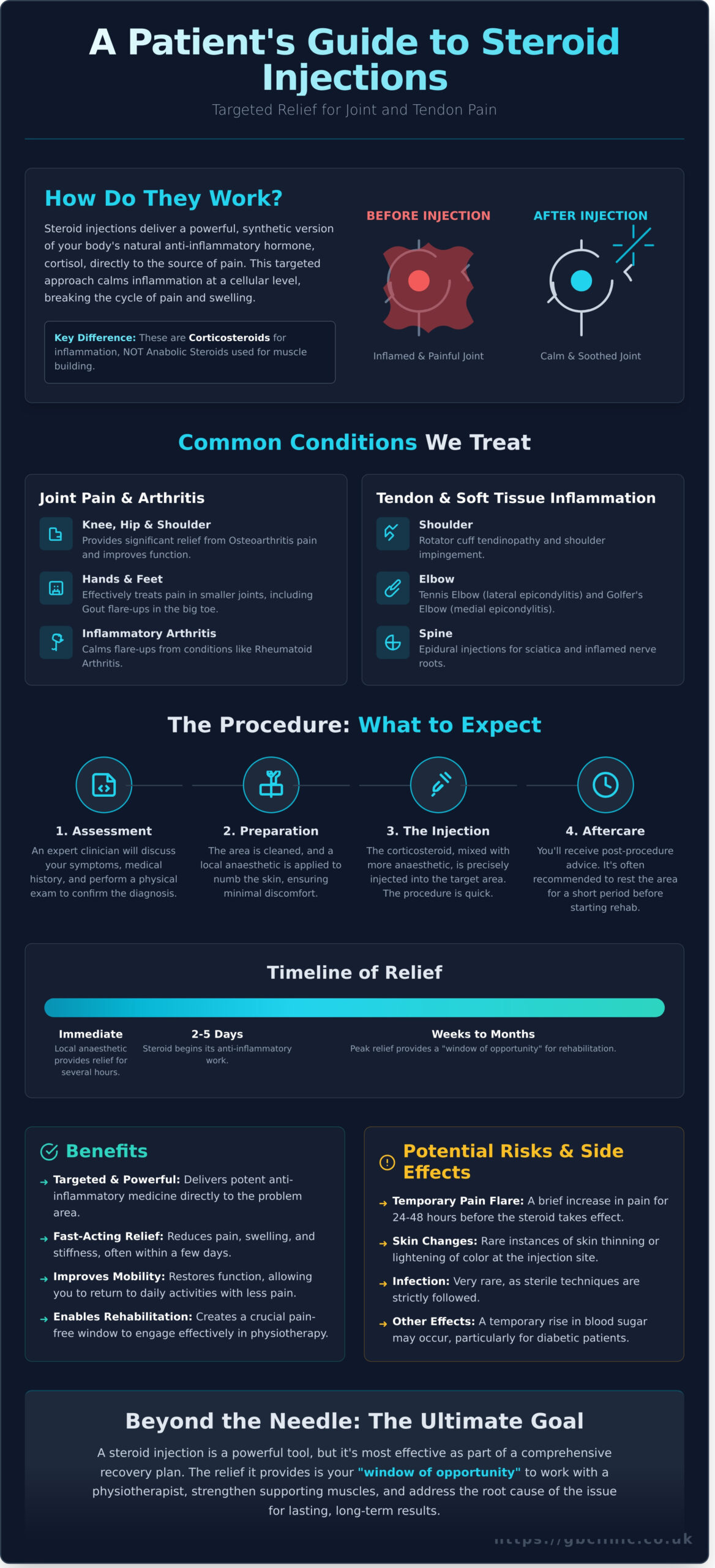
Steroid injections are a highly effective, targeted treatment designed to deliver powerful anti-inflammatory medication directly to the source of your pain. The medication used is a synthetic version of cortisol, a corticosteroid hormone naturally produced by your body to manage stress and inflammation. By administering this medication directly into a painful joint, tendon sheath, or other soft tissue, we can achieve a higher concentration at the site of injury than is possible with oral medication. This targeted approach leads to more significant and faster relief from debilitating symptoms.
It is important to clarify that these are not the same as anabolic steroids, which are sometimes used illicitly for muscle building. The primary purpose of therapeutic steroid injections is to significantly reduce inflammation. As inflammation subsides, associated symptoms like pain, swelling, and stiffness are also alleviated. This relief provides a crucial ‘window of opportunity’, enabling you to engage more effectively in physiotherapy and other rehabilitation exercises to address the root cause of your condition and achieve lasting, long-term recovery.
To better understand how this treatment works, particularly for common conditions like back pain, the following video offers a helpful overview:
The Science of Reducing Inflammation
Inflammation is your body’s natural response to injury, but when it becomes chronic, it causes persistent pain, damages tissue, and restricts movement. Corticosteroids work by calming this overactive immune response at a cellular level. They suppress the production of various inflammatory chemicals, which in turn reduces local swelling, heat, and irritation around nerves and joints. For complex conditions affecting the spine, a procedure like an Epidural steroid injection delivers this medication directly to the inflamed nerve roots causing sciatica. While the injection does not heal the underlying mechanical issue, it effectively breaks the cycle of pain and inflammation, allowing the body to recover and making physical therapy more productive.
Types of Corticosteroids Used
Our clinicians select the most appropriate medication based on your specific diagnosis, the location of your pain, and your overall medical history. The goal is always to use the lowest effective dose to achieve the desired outcome. Common types of corticosteroids used in our clinic include:
- Methylprednisolone (e.g., Depo-Medrone)
- Triamcinolone (e.g., Kenalog)
The duration of action and potency varies between these medications. In almost all procedures, the corticosteroid is mixed with a local anaesthetic (like lidocaine) to provide immediate pain relief that lasts for several hours. This offers instant comfort while the steroid begins its anti-inflammatory work, which typically takes a few days to reach its full effect.
Common Conditions Treated with Steroid Injections
Steroid injections are a highly effective, targeted treatment for a wide range of musculoskeletal conditions. By delivering powerful anti-inflammatory medication directly to the source of pain and inflammation, they provide significant relief and can improve mobility, helping patients return to their daily activities. The treatment is versatile and used to manage both acute injuries and chronic conditions affecting joints, tendons, and nerves.
Joint Pain and Arthritis
One of the most common applications is in the management of inflammatory joint conditions. When arthritis causes a joint to become painful, swollen, and stiff, an injection can calm the inflammation, reduce pain, and restore function. This approach is effective for both large and small joints throughout the body.
- Osteoarthritis: Commonly used to manage pain and improve function in the knee, hip, and shoulder.
- Inflammatory Arthritis: Provides relief from flare-ups associated with conditions like rheumatoid arthritis.
- Gout: Can rapidly calm the intense pain and swelling of a gout attack, particularly in the big toe.
- Small Joint Pain: Effectively treats pain in the smaller joints of the hands and feet.
Tendon and Soft Tissue Inflammation
Inflammation of tendons (tendinopathy) and the fluid-filled sacs that cushion joints (bursitis) also responds very well to this treatment. As leading medical resources explain, Injectable Corticosteroids work by reducing the swelling and irritation in these soft tissues, which is the primary cause of pain. Common conditions include:
- Shoulder: Rotator cuff tendinopathy, subacromial bursitis, and frozen shoulder (adhesive capsulitis).
- Elbow: Lateral epicondylitis (tennis elbow) and medial epicondylitis (golfer’s elbow).
- Hip: Trochanteric bursitis, which causes pain on the outside of the hip.
- Foot and Ankle: Plantar fasciitis and Achilles tendinopathy.
Nerve-Related Pain
In some cases, pain is caused by a nerve being compressed or irritated by surrounding inflamed tissue. Our targeted steroid injections can effectively treat these conditions by reducing the local inflammation, thereby relieving pressure on the nerve. Two common examples are Carpal Tunnel Syndrome in the wrist and Morton’s Neuroma in the foot. These are highly treatable conditions where an injection can provide rapid and lasting relief.
The Procedure: What to Expect at Our Oxford Clinic
At our Oxford clinic, your journey towards pain relief is structured around three key principles: precision, safety, and patient comfort. We have refined our procedure for administering steroid injections to ensure you receive the most effective care, from initial diagnosis through to post-treatment support. Our expert-led process is designed to build your confidence and deliver tangible results.
Step 1: Consultation and Diagnosis
Every treatment begins with a thorough assessment to understand your condition fully. This includes a detailed discussion about your symptoms, pain levels, and medical history, followed by a physical examination of the affected joint or tissue. To achieve an exact diagnosis, we frequently use a state-of-the-art diagnostic ultrasound scan. This advanced imaging allows our clinicians to see the underlying structures in real-time, confirming the source of your pain and ensuring a steroid injection is the most appropriate and beneficial treatment for you.
Step 2: The Ultrasound-Guided Injection
Once your diagnosis is confirmed, the injection procedure can take place. The area is first cleaned with an antiseptic solution, and a local anaesthetic may be applied to numb the skin and minimise discomfort. Using live ultrasound imaging, our specialist guides the needle with pinpoint accuracy directly to the site of inflammation. This ultrasound-guided technique is the gold standard in modern practice, offering significant advantages:
- Enhanced Accuracy: Delivers the medication precisely where it is needed most.
- Improved Safety: Helps avoid sensitive structures such as nerves and blood vessels.
- Better Outcomes: Increases the likelihood of a successful, pain-relieving result.
The injection itself is completed swiftly, typically in just a minute or two.
Step 3: After the Injection
Following the procedure, our team will provide clear aftercare instructions to help you achieve the best possible outcome. It is common to experience a temporary flare-up of pain for 24-48 hours as the local anaesthetic wears off and before the steroid begins to work. We advise resting the treated area for a couple of days and avoiding strenuous activity. Most patients, as outlined in this informative Johns Hopkins Medicine guide to corticosteroid injections, begin to experience significant pain relief within two to seven days. A personalised follow-up plan, often involving physiotherapy, will be discussed to help restore function and support your long-term recovery.
Benefits, Risks, and Realistic Outcomes
Making an informed decision about your treatment involves understanding both the significant advantages and the potential risks. At GB Clinic, we ensure our patients have a clear and realistic picture of what to expect from corticosteroid injections. The primary goal is to provide targeted relief that facilitates your broader recovery plan.
Key Benefits of Steroid Injections
When administered for an appropriate condition, the benefits of a steroid injection are substantial. The treatment is designed to deliver a powerful anti-inflammatory medication directly to the source of your pain, providing targeted relief that oral medications often cannot match.
- Rapid and Powerful Relief: Most patients experience a significant reduction in both pain and swelling, often within a few days of the procedure.
- Improved Function and Mobility: By alleviating inflammation, the injection can restore movement in a stiff or painful joint, allowing you to return to daily activities with greater comfort.
- Minimally Invasive Procedure: The treatment is performed quickly and safely in our clinic, requiring no hospital stay and minimal downtime.
- A Bridge to Long-Term Recovery: For many, steroid injections can delay or even eliminate the need for more invasive procedures like surgery by creating a crucial window for effective physiotherapy.
Potential Side Effects and Risks
While generally very safe, it is important to be aware of potential side effects. The risk of complications is low when the procedure is performed by an experienced clinician using modern techniques.
- Common, Temporary Effects: Some patients may experience a brief “post-injection flare,” a temporary increase in pain for 24-48 hours. Minor skin discolouration or thinning at the injection site can also occur.
- Less Common Risks: There is a very small risk of infection. Repeated injections into the same area, particularly into a tendon, can potentially cause weakening over time.
- Systemic Effects: It is rare, but the steroid can have a wider effect, such as a temporary rise in blood sugar levels for diabetic patients.
At GB Clinic, we minimise these risks by using ultrasound guidance to ensure precise needle placement and adhering to strict sterile protocols for every procedure.
How Long Does the Relief Last?
The duration of pain relief varies significantly between individuals and depends on the condition being treated. Relief can last anywhere from several weeks to many months.
It is crucial to view this period of reduced pain not as a permanent cure, but as a valuable opportunity. The goal is to use this time to engage fully with an effective rehabilitation programme, strengthening the affected area and addressing the root cause of the problem. To ensure patient safety and tissue health, there are established limits on how frequently injections can be administered to a single area, a guideline our specialists strictly follow.
Beyond the Needle: The Role of Injections in Your Recovery Plan
It is crucial to view steroid injections not as a final cure, but as a strategic tool within a broader recovery plan. Their primary function is to provide powerful, targeted relief from pain and inflammation. By effectively breaking this debilitating cycle, the injection creates a vital period where the underlying cause of your condition can be properly addressed through other essential therapies, paving the way for long-term recovery.
A Window of Opportunity for Physiotherapy
The significant pain relief provided by an injection makes meaningful rehabilitation possible. For many patients, severe pain is the main barrier to performing the exercises needed for recovery. Our expert physiotherapy team uses this window to help you strengthen the affected area, improve mobility, and correct underlying issues such as muscle weakness or poor biomechanics. This integrated approach is key to achieving more durable, long-term outcomes.
Comparing Steroids with Other Injections
While steroid injections are highly effective for rapid inflammation control, they are one of several advanced options available at our clinic. Your clinician will discuss the most appropriate choice for your specific condition. Other common injectable treatments include:
- Hyaluronic Acid (HA) Injections: Often used for osteoarthritis, these injections help lubricate the joint, easing pain and improving function over a longer period.
- Platelet-Rich Plasma (PRP) Injections: This therapy uses a concentration of your own blood platelets to stimulate and accelerate the body’s natural healing processes in injured tendons, ligaments, or joints.
The right choice depends entirely on your diagnosis, the severity of your symptoms, and your recovery goals.
Your Personalised Treatment Pathway at GB Clinic
At GB Clinic, we do not believe in a one-size-fits-all solution. Your recovery journey begins with an accurate diagnosis, leading to a treatment plan tailored specifically to you. This pathway may involve a carefully selected injection to manage symptoms, combined with specialist manual therapy and a prescribed exercise programme. Our focus is always on your complete and lasting recovery, restoring function and helping you return to a pain-free life. To learn more about how we can create a personalised plan for you, contact our team today.
Take Control of Your Recovery with Expert Care
In summary, steroid injections are a highly effective treatment for reducing the inflammation and pain associated with many musculoskeletal conditions. They provide a crucial window of relief that, when combined with a structured physiotherapy programme, can lead to significant long-term recovery. The success of the treatment relies heavily on precise application and its role within a wider, personalised care plan.
At GB Clinics, our experienced clinicians are dedicated to this integrated approach. We use advanced ultrasound guidance to deliver steroid injections with maximum accuracy and safety, ensuring the medication targets the precise source of your pain. This procedure is a key component of a comprehensive strategy we design with you, incorporating specialist physiotherapy to help you regain strength and mobility.
If you are ready to take the next step towards lasting pain relief, we invite you to Book Your Consultation for an Ultrasound-Guided Steroid Injection. Let our team provide the expert care you need to move forward with confidence.
Frequently Asked Questions About Steroid Injections
Is a steroid injection painful to receive?
Most patients report only minor, brief discomfort, similar to a standard vaccination. To ensure your comfort, the procedure is performed by an experienced clinician, and a local anaesthetic is often combined with the steroid medication. This numbs the area almost immediately. At our clinics, we use ultrasound guidance to ensure precise placement of the needle, which further minimises discomfort and improves the treatment’s effectiveness. The entire process is very quick.
How many steroid injections can I have in one year?
The number of injections is carefully considered to maximise benefits while minimising risks. As a general guideline, it is not recommended to have more than three steroid injections into the same joint or soft tissue area within a 12-month period. Exceeding this limit can increase the risk of side effects, such as weakening of tendons or cartilage. Your clinician will assess your specific condition and medical history to create a safe and effective treatment plan for you.
How quickly can I return to work or sport after an injection?
Recovery is typically very swift. Most individuals with desk-based jobs can return to work the same day. However, it is crucial to rest the treated area for the first 24-48 hours to allow the medication to work effectively. We advise avoiding strenuous exercise, heavy lifting, or high-impact sports for at least one week. Your clinician will provide specific, personalised aftercare instructions based on the area treated and your usual activities to ensure a smooth recovery.
What is the difference between a steroid injection and a hyaluronic acid injection?
The primary difference lies in their mechanism of action. A steroid injection is a powerful anti-inflammatory treatment designed to rapidly reduce pain, swelling, and inflammation caused by conditions like arthritis or tendonitis. In contrast, a hyaluronic acid (HA) injection, often called a ‘lubricant’ injection, aims to restore the natural cushioning and lubricating properties within a joint, primarily for osteoarthritis. It works to improve joint function and provide longer-term pain relief.
Will a steroid injection cure my arthritis or tendonitis?
Steroid injections are not a cure for chronic conditions like osteoarthritis or tendonitis. Their purpose is to provide significant and rapid relief from symptoms, primarily pain and inflammation. By reducing these symptoms, the injection can create a crucial window of opportunity for you to engage more effectively in a physiotherapy and rehabilitation programme. This combined approach is key to achieving long-term improvement in function and managing your condition successfully.
Are there any people who should not have a steroid injection?
Yes, certain conditions may make steroid injections unsuitable. Individuals with an active infection in or around the treatment area, a known allergy to corticosteroids or local anaesthetics, or poorly controlled diabetes should avoid these injections. We also exercise caution with patients who have bleeding disorders or are pregnant. A thorough medical history is always taken during your consultation to ensure the procedure is safe and appropriate for you.
What are the signs of a complication after a steroid injection?
While serious complications are rare, it is important to be aware of the signs. A temporary increase in pain and swelling, known as a ‘post-injection flare,’ can occur but should subside within 48 hours. However, you should seek immediate medical advice if you experience increasing redness, significant swelling, warmth at the injection site, or develop a fever. These could be signs of an infection, which requires prompt medical attention.