

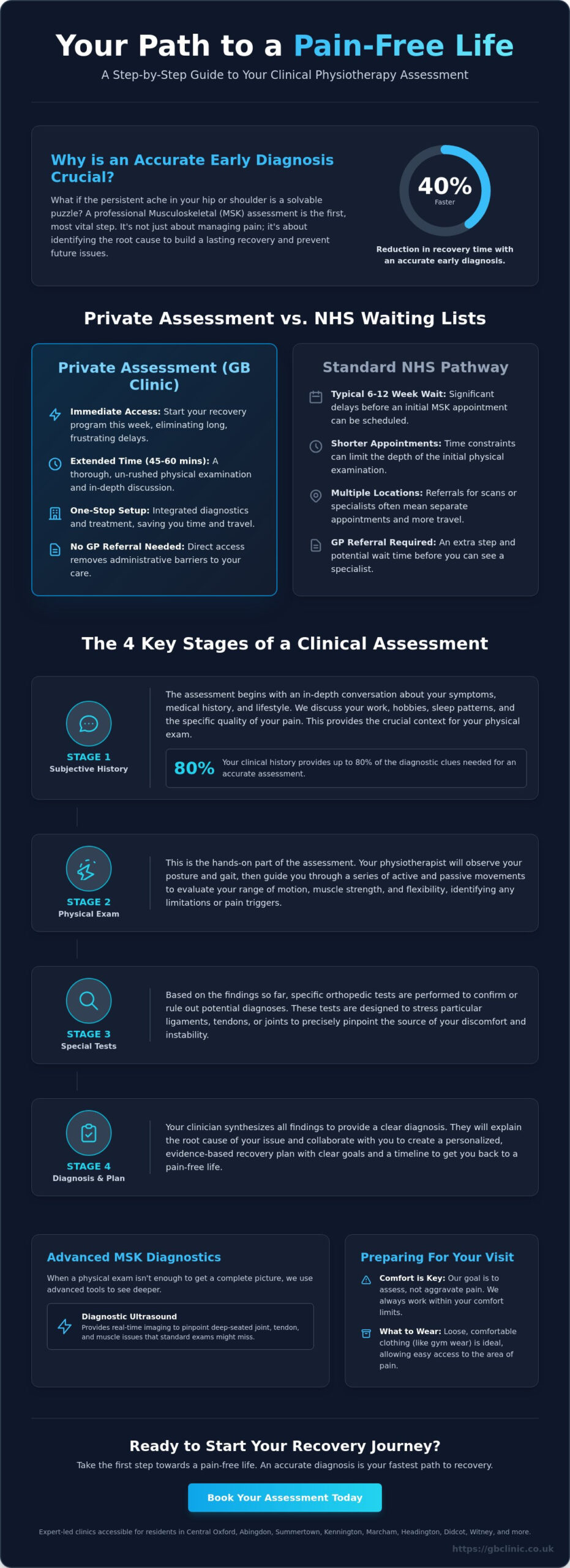
What if the persistent ache in your hip or shoulder isn’t a permanent fixture, but a solvable puzzle that simply requires the right clinical lens? If you’re currently managing musculoskeletal pain, you likely agree that waiting months for an NHS appointment in Central Oxford is a frustrating barrier to your health. You want to understand exactly what happens during a physiotherapy assessment before you commit to a treatment plan, especially if you’re anxious about physical manipulation or confused about whether you need a scan. Recent 2023 clinical data suggests that an accurate early diagnosis can reduce recovery times by up to 40%, making that first step vital.
This guide promises to walk you through your clinical consultation, from physical movement tests to advanced diagnostic options like Hyaluronic Acid injections. We’ll preview the entire process to ensure you feel confident and informed about your path to recovery. Whether you’re visiting us from Abingdon, Summertown, or Kennington, our expert-led clinics provide the professional care you need. We’ve made high-quality MSK services accessible for residents in Marcham, Headington, Farmoor, and Eynsham, as well as those in Didcot, Witney, Faringdon, and West Oxford. Our goal is to provide a clear diagnosis and a bespoke plan that helps you return to a pain-free life.
Key Takeaways
- Understand how a professional MSK evaluation identifies the root cause of your pain, with expert clinics easily accessible from Abingdon, Summertown, and Central Oxford.
- Gain clarity on what happens during a physiotherapy assessment, including the critical transition from discussing your medical history to analyzing functional movement patterns.
- Discover the role of advanced diagnostic ultrasound in pinpointing deep-seated joint issues that standard physical examinations might not fully reveal.
- Learn how to prepare for your consultation in Didcot, Witney, or Headington to ensure an accurate exam while maintaining your comfort throughout the process.
- Explore how clinical findings are transformed into a personalised recovery plan designed to restore mobility and provide long-term relief from musculoskeletal discomfort.
What is a Physiotherapy Assessment and Why is it Essential?
A physiotherapy assessment is a comprehensive clinical evaluation of your musculoskeletal (MSK) system. It goes beyond a simple check of a localized injury. For residents in Summertown or Headington, this professional diagnostic process identifies the root cause of pain rather than just masking symptoms. It’s the essential foundation for long-term recovery. Without this detailed look at your body’s mechanics, you risk re-injury or chronic complications. Patients often ask what happens during a physiotherapy assessment when they first arrive at our clinic, expecting a brief talk, but they quickly discover it’s a deep dive into their physical health.
When you understand what happens during a physiotherapy assessment, you realize it’s a structured medical investigation. The process involves a detailed movement assessment to analyze kinematics and identify how different parts of your body interact. This level of scrutiny is what prevents a minor strain in a Marcham athlete from becoming a permanent limitation. By focusing on the root cause, we ensure that the relief you feel isn’t just a temporary pause in pain, but the start of a sustainable return to activity.
The Goals of Your Initial Consultation
The primary objective is to establish a clinical baseline for your strength and range of motion. We look for “red flags” that might indicate a need for urgent medical intervention or specific diagnostic scans. By using a Problem/Solution/Benefit framework, we tailor the plan to your specific lifestyle. If you live in Central Oxford and struggle with back pain (Problem), our targeted physiotherapy (Solution) aims to return you to your daily routine without discomfort (Benefit).
Why Oxford Patients Choose Private Assessment Over NHS Waiting Lists
Accessing care quickly is a priority for patients in Didcot, Witney, and Faringdon. NHS waiting lists for MSK services in Oxfordshire typically span 6 to 12 weeks. Private assessments eliminate this delay, providing immediate access to specialists who can start your recovery program the same week.
- Extended Time: You receive longer appointment slots, usually 45 to 60 minutes, allowing for a thorough physical examination that isn’t rushed.
- One-Stop Setup: Private clinics often integrate diagnostics and treatment, saving travel time for those in Kennington, Farmoor, or Eynsham.
- Direct Access: You don’t need a GP referral to begin your recovery journey in West Oxford or Abingdon, which removes another layer of administrative delay.
Choosing a private assessment means you aren’t just a number on a list. It’s a choice for quality, depth, and speed. Whether you’re dealing with a sports injury or age-related wear and tear, getting an expert opinion early is the most effective way to protect your future mobility.
The 4 Key Stages of a Clinical Physiotherapy Assessment
A clinical assessment at GB Clinics is a structured, evidence-based process designed to identify the precise source of your discomfort. Understanding what happens during a physiotherapy assessment helps reduce anxiety and prepares you to participate actively in your recovery. Our clinicians follow a rigorous four-stage protocol to ensure no detail regarding your musculoskeletal health is overlooked.
Stage 1: The Subjective History (The Talk)
The assessment begins with an in-depth conversation about your symptoms and lifestyle. If you’re commuting into Central Oxford or working from a home office in Summertown, your physiotherapist will ask specific questions about your desk ergonomics and sitting habits. We examine your sleep patterns, as poor rest can amplify pain signals and slow tissue repair. We also discuss your hobbies, whether you’re a runner in Abingdon or a cyclist in Witney, to understand the physical demands placed on your body. You’ll be asked to describe your pain quality; sharp sensations often point to different issues than dull, heavy aching. Your clinical history often provides 80% of the diagnostic clues required for an accurate assessment.
Stage 2 & 3: The Physical and Special Tests
Once the history is established, we move to physical observation. We analyze your posture and gait, which is particularly relevant for patients from Headington or Didcot dealing with walking difficulties. The clinician will guide you through Range of Motion (ROM) testing for specific joints like the shoulder or knee to identify where movement becomes restricted or painful. To add clinical depth, we use palpation; this involves physical touch to locate tissue inflammation, swelling, or myofascial trigger points.
Special clinical tests are then used to assess joint stability, muscle strength, and nerve function. For residents in Faringdon or Eynsham who are active in local sports, we might perform specific tests for shin splints or ligament laxity. These tests provide a clear picture of what happens during a physiotherapy assessment to differentiate between simple muscle strains and more complex mechanical failures. During this phase, your clinician may refer to the NHS guidelines on what to expect during physiotherapy to ensure your care aligns with national standards of excellence.
Stage 4: Diagnosis and Planning
The final stage involves a clear explanation of our findings. We don’t use vague terms; we provide a clinical diagnosis and explain the underlying mechanics of your injury. Whether you’ve come to us from West Oxford, Kennington, or Marcham, we’ll agree on a bespoke recovery path together. This plan outlines the number of sessions required, the specific therapies to be used, and the expected timeline for your return to full function. If you’re ready to begin your journey back to health, you can book a specialist physiotherapy consultation at our Farmoor clinic today.
Advanced MSK Diagnostics: When a Physical Exam Isn’t Enough
Traditional physical examinations provide vital clues, but they can’t always confirm the exact state of internal tissues. During a typical session, a clinician uses manual tests to stress ligaments or tendons. However, deep-seated joint issues often remain hidden behind layers of muscle. To address this, GB Clinic integrates a diagnostic ultrasound scan directly into the consultation process. This technology allows our specialists to look beneath the skin in real-time, providing an immediate visual confirmation that a standard physical exam cannot offer. For patients visiting from Abingdon, Didcot, or Marcham, this means leaving the clinic with a definitive diagnosis rather than a working hypothesis. Understanding what happens during a physiotherapy assessment becomes much clearer when you can see your own anatomy on a screen.
Ultrasound Scans vs. Standard Physical Tests
Physical tests rely heavily on patient feedback and the clinician’s palpation. A scan adds objective, visual data to the process. For instance, when investigating medial knee soreness, an ultrasound can clearly distinguish between a meniscus tear, localized inflammation, or fluid buildup. This level of certainty is essential for competitive athletes in West Oxford or Witney who need a precise recovery timeline. We don’t rely on guesswork when a clear image can provide the answer.
- Accuracy: Identifies the exact grade of a muscle or ligament tear.
- Efficiency: Reduces the need for multiple follow-up appointments by getting it right the first time.
- Precision: If the scan reveals significant inflammation, your specialist might recommend transitioning from a manual assessment to a guided steroid injection.
This ensures the medication is delivered exactly where it’s needed, which significantly improves outcomes compared to traditional injections. It’s a streamlined approach that saves time for busy residents in Central Oxford and Faringdon.
Identifying Complex Conditions
Advanced diagnostics are particularly effective for conditions like Greater Trochanteric Pain Syndrome (GTPS) or complex shoulder impingements. These conditions often present with overlapping symptoms that confuse traditional testing. Residents from Summertown, Headington, and Kennington benefit from this clinical precision. By seeing the injury clearly, we can tailor your private MSK physiotherapy in Oxford to target the specific tissue involved. This clarity eliminates the trial-and-error approach often found in general practice. Patients from Farmoor and Eynsham find that this diagnostic clarity leads to more effective treatment plans and faster long-term recovery. It’s a vital part of what happens during a physiotherapy assessment at a specialist clinic, ensuring every patient receives a bespoke path to health.
Addressing Common Concerns: Will it Hurt and What Should I Wear?
Many patients arrive at our clinics feeling anxious that their first session will be physically aggressive or painful. This is a common misconception. At GB Clinics, we view the initial evaluation as a collaborative diagnostic process. Our clinicians use evidence-based techniques to understand your musculoskeletal health without causing unnecessary distress. While we must move the affected area to understand your limitations, our approach is always professional, measured, and guided by your feedback.
Practical preparation is key to a successful visit. We ask all patients to wear or bring shorts and a t-shirt. This clothing is essential because it allows your physiotherapist to clearly observe muscle activation, joint alignment, and skin changes in the affected area. It’s difficult to assess a knee or hip accurately through thick denim or restrictive leggings. For residents visiting from rural areas like Farmoor or Marcham, we provide private changing facilities to ensure you can travel comfortably and change upon arrival.
We believe high-quality care should be accessible. That’s why we offer a “zero commitment” approach to your first consultation. This risk-free entry point allows you to discuss your symptoms with an expert and understand what happens during a physiotherapy assessment before deciding on a long-term treatment plan. It reflects our confidence in our clinical outcomes and our patient-first philosophy.
Preparing for Your Appointment
To get the most out of your session, please bring any previous MRI or X-ray results and a current list of medications. If your injury relates to running or sports, bring the footwear you typically use. During the exam, we may ask you to perform specific movements that slightly “provoke” your symptoms. This isn’t done to cause pain, but to identify the exact mechanical trigger of your discomfort. Our “brilliant and calming” practitioners, as described in 2023 patient testimonials, specialize in managing patient anxiety during these diagnostic tests.
Accessibility and Locations Across Oxfordshire
Reaching our clinics is straightforward, regardless of where you live in the county. Patients traveling from Witney, Faringdon, or Kennington will find our locations well-connected by major A-roads. We provide dedicated parking and excellent transport links for those visiting our Central Oxford or West Oxford facilities. Whether you are commuting from Didcot, Abingdon, Summertown, Headington, or Eynsham, our clinics are designed as a one-stop setup to save you time. We proudly serve the entire Oxfordshire community with professional MSK care that restores mobility and reduces pain.
If you’re ready to start your recovery, you can learn more about our advanced physiotherapy services and how we tailor treatments to your specific needs.
Take the first step toward a pain-free life by booking your professional consultation at GB Clinics today.
From Assessment to Action: Your Personalised Path to Recovery
Once your physical examination is complete, we move from diagnosis to a structured recovery roadmap. Understanding what happens during a physiotherapy assessment is the first step in replacing uncertainty with a clear clinical plan. We use a Problem, Solution, and Benefit framework to ensure you understand exactly why a specific treatment is recommended. For example, if we identify restricted joint mobility in your hip, the solution may involve targeted mobilisations, with the direct benefit of restoring your natural walking gait and reducing daily discomfort.
Your recovery plan typically integrates manual therapy with bespoke exercise rehabilitation. We don’t just provide a generic list of movements; we design exercises that fit into your daily routine, whether you are commuting from Abingdon or working in Central Oxford. Most patients begin to see a reduction in acute pain within 14 to 21 days, while significant improvements in tissue strength and long-term mobility usually occur over a 6 to 12-week period.
Specialised Recovery Options in Oxford
For some conditions, standard exercise alone isn’t the fastest route to relief. If our assessment identifies advanced knee or hip osteoarthritis, Hyaluronic Acid Injections can be a game-changer. These injections act as a lubricant for the joint, often providing pain relief for up to 6 months. For those suffering from chronic tendon issues like plantar fasciitis or Achilles tendinopathy, we may recommend Shockwave Therapy. This advanced treatment uses acoustic pulses to stimulate healing in stubborn tissues that haven’t responded to traditional care.
Follow-up sessions are vital to this process. We use these appointments to monitor your progress, adjust the intensity of your exercises, and ensure your recovery stays on track. It’s a dynamic process that evolves as your strength improves.
Booking Your Assessment Today
Taking the first step toward a pain-free life shouldn’t be complicated. GB Clinic offers a “one-stop” setup, meaning you won’t be passed from pillar to post. From the initial data gathered during what happens during a physiotherapy assessment to advanced imaging or injections, everything is handled by our expert team in one location. This efficiency is why we’re the trusted choice for residents across Summertown, Headington, Witney, and Didcot.
We make our specialist services accessible to everyone in the region, including those in Kennington, Marcham, Farmoor, Eynsham, Faringdon, and West Oxford. You don’t need to live with persistent MSK pain when expert help is available right on your doorstep.
Book your specialist physiotherapy assessment at GB Clinic today and start your journey back to full mobility with a team that prioritises your long-term health.
Start Your Recovery Journey in Oxfordshire Today
Understanding what happens during a physiotherapy assessment removes the uncertainty often associated with musculoskeletal pain. At GB Clinics, our expert-led MSK specialists provide a clear roadmap to recovery through a targeted four-stage clinical evaluation. We combine traditional physical exams with advanced one-stop diagnostics, including Ultrasound and Shockwave Therapy, to ensure your diagnosis is accurate from the start. Our patients consistently describe their experience as calming and professional, reflecting our commitment to evidence-based care and clinical excellence.
We’ve made our specialist services accessible for residents throughout the county. Whether you’re traveling from Abingdon, Witney, or Didcot, or you’re based in Central Oxford, West Oxford, or Summertown, our clinics provide convenient, local support. We also serve patients from Kennington, Marcham, Headington, Farmoor, Eynsham, and Faringdon, ensuring expert help is never far away. Don’t let persistent discomfort limit your lifestyle; it’s time to regain your mobility with a personalised treatment plan designed for long-term results.
Book Your Specialist Physiotherapy Assessment in Oxford
We look forward to helping you return to the activities you love with confidence and ease.
Frequently Asked Questions
Do I need a GP referral for a private physiotherapy assessment in Oxford?
You don’t need a GP referral to book a private physiotherapy assessment at GB Clinic. Our clinics across Oxfordshire, including locations serving Abingdon and Didcot, accept self-referrals for all musculoskeletal conditions. This direct access model ensures you receive expert care without the wait times often associated with primary care pathways. It’s a streamlined process designed to accelerate your recovery journey through immediate clinical intervention.
How long does a typical physiotherapy assessment last at GB Clinic?
A typical physiotherapy assessment at GB Clinic lasts between 45 and 60 minutes. This specific timeframe allows our specialists to conduct a thorough physical examination and discuss your medical history in detail. Whether you’re visiting us from Summertown or Central Oxford, we ensure enough time to establish a clear diagnosis and create a personalized treatment plan during this first session to ensure long-term recovery.
What should I wear to my first physiotherapy appointment?
You should wear loose, comfortable clothing that allows easy access to the area being examined. For example, bring a pair of shorts for knee or hip issues, or a vest top for shoulder assessments. Patients traveling from Witney or Headington often find that wearing gym attire simplifies the physical testing and movement analysis required to identify the source of their discomfort during the clinical evaluation.
Will the physiotherapist be able to diagnose my pain during the first session?
Yes, our clinicians aim to provide a clear clinical diagnosis during your first session. Understanding exactly what happens during a physiotherapy assessment is key to feeling prepared for this diagnosis. We use evidence-based tests to identify the root cause of your pain. For residents in Faringdon or Eynsham, this immediate clarity helps in starting the correct rehabilitation or advanced injection therapy without unnecessary delays.
Is a physiotherapy assessment painful if I am already in significant discomfort?
Our therapists prioritize your comfort and won’t perform maneuvers that cause unnecessary distress. While some physical tests are necessary to assess your range of motion, we adapt our techniques based on your current pain levels. Patients from Kennington and Marcham report that our clinical approach is gentle yet thorough, focusing on identifying triggers without exacerbating existing inflammation or causing additional physical stress.
Can I get an ultrasound scan during my initial assessment?
Yes, we offer diagnostic ultrasound scans as part of our comprehensive musculoskeletal service. If your clinician determines a scan is necessary, it can often be performed during your initial visit to our Oxfordshire facilities. This “one-stop” setup is particularly beneficial for patients from West Oxford or Farmoor who require rapid results and a data-led approach to guide their specific recovery plan.
What is the difference between a physiotherapy assessment and a sports massage?
A physiotherapy assessment is a clinical diagnostic process used to identify underlying medical conditions and structural issues. In contrast, a sports massage focuses specifically on soft tissue manipulation to relieve muscle tension. Knowing what happens during a physiotherapy assessment helps you understand that we look at joint mechanics, nerve function, and muscle strength to solve the problem, rather than just providing temporary relief.
Are your Oxfordshire clinics accessible for those with limited mobility?
All our Oxfordshire clinics are designed with accessibility in mind for patients with limited mobility. Whether you’re visiting from Central Oxford or the surrounding villages, we provide ground-floor access or lift facilities to ensure a stress-free experience. Our goal is to make expert care available to every member of the community, ensuring that physical barriers don’t prevent you from accessing high-quality treatments for your recovery.