

The constant, debilitating pain of a frozen shoulder can make simple daily tasks, such as dressing or reaching for a high shelf, feel impossible. When conventional treatments like painkillers and physiotherapy have not provided the relief you need, it is natural to feel frustrated and uncertain about the path forward. Fortunately, there is a highly effective, minimally invasive procedure designed to directly address the source of this stiffness and pain.
This patient’s guide provides a clear and comprehensive overview of shoulder hydrodistension for frozen shoulder, a specialist treatment that offers a tangible solution for restoring mobility and comfort. We will explain the treatment process in detail, from the initial consultation to the recovery phase, so you can make an informed decision about your care. Our goal is to provide you with the information needed to understand how this procedure can significantly reduce your pain, improve your range of motion, and help you return to your daily activities without the need for invasive surgery.
Key Takeaways
- Learn how a targeted injection works from the inside to gently stretch the tight shoulder capsule, directly addressing the source of pain and stiffness.
- Understand the patient journey for shoulder hydrodistension for frozen shoulder, a minimally invasive procedure typically completed in under 20 minutes.
- Discover why the injection creates a crucial window of opportunity for movement and how physiotherapy is essential for achieving lasting results.
- Identify the specific stages of frozen shoulder where this treatment is most recommended to help you determine if it is the right solution for you.
Understanding Frozen Shoulder (Adhesive Capsulitis)
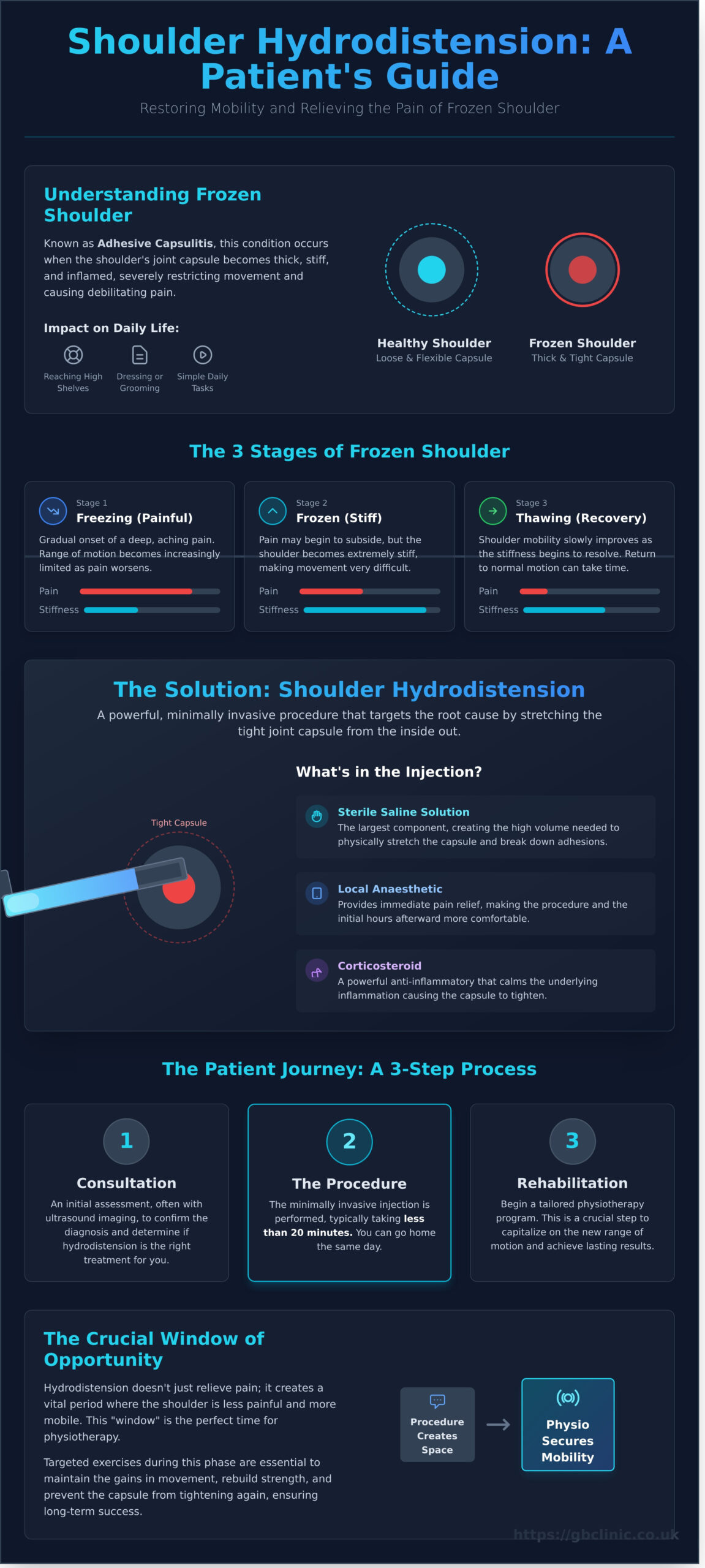
Frozen shoulder, known clinically as adhesive capsulitis, is a condition characterised by significant pain and stiffness in the shoulder joint. It occurs when the strong connective tissue surrounding the shoulder joint—the capsule—becomes thick, stiff, and inflamed. This tightening of the capsule severely restricts the shoulder’s range of motion, making even simple movements difficult and painful.
To better understand the anatomy involved and the goal of treatment, this short animation is a helpful resource:
The condition typically progresses through three distinct stages, each with its own set of symptoms. The duration of these stages can vary significantly from person to person.
- The Freezing Stage (Painful): This initial stage is marked by a gradual onset of a deep, aching shoulder pain. As the pain worsens, the shoulder’s range of motion becomes noticeably limited.
- The Frozen Stage (Stiff): During this stage, the pain may begin to subside. However, the shoulder becomes increasingly stiff, and movement becomes extremely difficult.
- The Thawing Stage (Recovery): The shoulder’s mobility slowly begins to improve. The complete return to normal or near-normal strength and motion can take a considerable amount of time.
Why Does Frozen Shoulder Happen?
The exact cause of primary (or idiopathic) frozen shoulder is not fully understood, meaning it can develop without any apparent reason. For a more detailed medical overview, you can refer to this guide on Understanding Frozen Shoulder (Adhesive Capsulitis). However, several risk factors are known to increase your likelihood of developing the condition, including being female and between the ages of 40 and 60. Secondary frozen shoulder can develop after a shoulder injury, surgery, or prolonged immobility. It is also more common in individuals with certain medical conditions, most notably diabetes.
The Impact on Daily Life
The loss of shoulder mobility can have a profound impact on your quality of life. Everyday tasks that were once simple, such as reaching for an item on a high shelf, fastening a seatbelt, or even brushing your hair, can become challenging and painful. This constant struggle, combined with chronic pain, often leads to significant frustration and can affect your emotional well-being. It is this debilitating impact that makes finding an effective and efficient treatment, such as shoulder hydrodistension for frozen shoulder, so important for restoring function and comfort.
What is Shoulder Hydrodistension? A Powerful, Targeted Solution
Shoulder hydrodistension, also known as high-volume capsular distension, is a minimally invasive, non-surgical procedure designed to directly address the root cause of a frozen shoulder. Unlike treatments that only manage symptoms, this procedure works from the inside out. The core concept is to gently and precisely stretch the tight, restrictive shoulder joint capsule using a sterile fluid, thereby restoring movement and reducing pain.
The procedure involves injecting a large volume of fluid into the glenohumeral joint (the main shoulder joint). This therapeutic mixture contains three key components:
- Sterile Saline Solution: The largest component, used to create the volume needed to physically stretch the contracted joint capsule.
- Local Anaesthetic: Provides immediate pain relief during and shortly after the procedure, making the process more comfortable.
- Corticosteroid: A powerful anti-inflammatory medicine that works to reduce the underlying inflammation within the joint.
This dual-action approach is what makes shoulder hydrodistension for frozen shoulder so effective. It simultaneously provides a mechanical stretch to break down adhesions while the corticosteroid calms the inflammation that causes them. This is a significant advantage over a standard guided steroid injection, which primarily targets inflammation without physically stretching the capsule.
How Hydrodistension Breaks the Cycle of Pain
The pain and stiffness of a frozen shoulder are caused by a vicious cycle of inflammation and capsular contraction. In cases of Adhesive Capsulitis (Frozen Shoulder), the capsule thickens and tightens, severely limiting movement. Hydrodistension directly intervenes by using the large volume of saline to physically expand and stretch these adhesions, creating more space in the joint. The local anaesthetic offers immediate comfort, while the corticosteroid provides sustained relief by reducing the inflammation responsible for the capsule’s thickening.
The Importance of Ultrasound Guidance
At GB Clinics, every hydrodistension procedure is performed under real-time ultrasound guidance. This advanced imaging is critical for success. It allows our specialist to watch the needle on a screen as it enters the body, ensuring the injection is delivered with absolute precision into the small space of the joint capsule. This not only dramatically increases the effectiveness of the treatment but also enhances safety by avoiding sensitive surrounding structures like nerves and blood vessels. Using our state-of-the-art diagnostic ultrasound scans ensures the highest standard of care and optimal patient outcomes.
The Hydrodistension Procedure: A Step-by-Step Patient Walkthrough
Understanding what to expect during your appointment can significantly ease any apprehension. The entire shoulder hydrodistension for frozen shoulder procedure is designed to be as comfortable and efficient as possible, typically lasting only 15-20 minutes from start to finish. Our goal is to provide a clear, calm experience guided by our specialist clinicians. The procedure is grounded in robust clinical evidence, with studies on the efficacy of hydrodilatation in frozen shoulder supporting its use in restoring mobility and reducing pain.
Before the Procedure: Consultation and Preparation
Your journey begins with a thorough assessment to confirm your diagnosis of adhesive capsulitis (frozen shoulder). During this consultation, your clinician will review your medical history to ensure this treatment is appropriate for you. On the day of your appointment, we recommend wearing loose, comfortable clothing that allows easy access to your shoulder. There are no other specific preparations required.
During the Procedure: What to Expect
Your comfort and safety are our primary concerns. The process is straightforward and meticulously performed:
- Positioning: You will be asked to lie down comfortably on an examination table, allowing the clinician optimal access to your shoulder joint.
- Ultrasound Guidance: We use a high-resolution ultrasound scanner to precisely identify the shoulder capsule. This advanced imaging ensures the injection is delivered to the exact target area for maximum effectiveness.
- Numbing the Area: The skin over your shoulder will be thoroughly cleaned. A local anaesthetic is then administered to completely numb the skin and deeper tissues, ensuring you feel minimal discomfort.
- The Injection: Once the area is numb, a fine needle is gently guided into the joint capsule. You will then feel a sensation of pressure or fullness as the sterile saline, local anaesthetic, and steroid solution is injected to stretch the capsule.
Immediately After the Procedure
Following the injection, your shoulder may feel heavy, full, or numb for a few hours due to the local anaesthetic. This is a normal and temporary sensation. It is crucial to begin gentle mobilisation exercises almost immediately, as instructed by your clinician. This helps to maximise the benefits of the stretched capsule. For the first 24-48 hours, you should avoid any heavy lifting or strenuous activity but continue with your prescribed gentle movements to maintain your new range of motion.
Recovery and Rehabilitation: The Key to Lasting Success
The hydrodistension procedure is a powerful intervention, but it is the first step, not the final one. The injection creates a crucial ‘window of opportunity’ by physically stretching the tight shoulder capsule and delivering anti-inflammatory medication directly to the source of pain. To achieve lasting success, this newfound space and comfort must be utilised immediately through a structured rehabilitation programme. This follow-up care is essential to restore movement, build strength, and prevent the stiffness from returning.
Your Physiotherapy Programme
A dedicated physiotherapy programme is designed to capitalise on the increased mobility you will experience after the injection. Your physiotherapist will provide a personalised plan focused on restoring your shoulder’s function safely and effectively. The goals are to improve your range of motion and gradually rebuild strength in the supporting muscles.
Your initial exercises will be gentle and focused on movement, such as:
- Pendulum swings: Using gravity to gently move the shoulder joint without muscle engagement.
- Wall walks: Using your fingers to slowly ‘walk’ your hand up a wall to improve forward elevation.
- Gentle stretches: Targeted movements to lengthen the shoulder capsule and surrounding muscles.
Your physiotherapist plays a vital role in guiding your progress, ensuring you are advancing at an appropriate pace without causing over-exertion. Consistency with these prescribed exercises is paramount, as it prevents the capsule from tightening again. At GB Clinics, we provide comprehensive physiotherapy services in Oxford to guide every step of your recovery journey.
Long-Term Outcomes and Success Rates
Clinical evidence demonstrates that shoulder hydrodistension for frozen shoulder, when combined with a structured physiotherapy programme, has a high success rate in significantly reducing pain and restoring function. For the majority of patients, the benefits are long-term, leading to a permanent resolution of symptoms once the rehabilitation phase is complete.
While some improvement is often felt within days, a realistic timeline for substantial recovery is typically several weeks to a few months of consistent physiotherapy. In a small number of particularly severe or persistent cases, a second procedure may be recommended to achieve the optimal outcome.
Is Shoulder Hydrodistension the Right Treatment For You?
Deciding on the most effective treatment for frozen shoulder requires a careful evaluation of your specific symptoms, the stage of your condition, and your overall health. While shoulder hydrodistension for frozen shoulder is a highly effective procedure, it is most beneficial for certain patient profiles. The ultimate decision should always be made following a thorough assessment by a musculoskeletal specialist.
A professional consultation is essential to confirm your diagnosis, typically with a diagnostic ultrasound scan, and to develop a treatment plan tailored to your needs. This ensures you receive the most appropriate and effective care to restore movement and reduce pain.
Who Benefits Most from Hydrodistension?
Shoulder hydrodistension is often recommended when conservative treatments have not delivered the desired results. It is particularly effective for individuals who are experiencing significant functional limitation. The ideal candidates typically include:
- Patients in the ‘frozen’ stage (Stage 2): This is when the shoulder is exceptionally stiff and range of motion is severely limited. Hydrodistension directly targets the tight, contracted capsule to create space and improve mobility.
- Individuals who have not responded to other treatments: If you have already tried a course of physiotherapy, oral anti-inflammatory medications, or a standard corticosteroid injection without significant improvement, hydrodistension offers a more targeted and potent alternative.
- Those with diabetes: Frozen shoulder can be more common, severe, and resistant to treatment in patients with diabetes. Hydrodistension can be a particularly valuable intervention for this group.
Potential Risks and Side Effects
Shoulder hydrodistension is considered a very safe procedure, especially when performed by an experienced clinician using ultrasound guidance. The use of real-time imaging ensures the injection is delivered with precision, significantly minimising risks. However, as with any injection-based procedure, there are potential side effects.
Common and temporary effects include a feeling of fullness in the shoulder or a brief increase in discomfort for 24-48 hours after the procedure. More significant risks are rare but can include infection, bleeding, or temporary nerve irritation. At GB Clinics, we adhere to strict sterile techniques to virtually eliminate the risk of infection. By understanding your medical history and using precise ultrasound guidance, we ensure the procedure is as safe and effective as possible.
The best way to understand if this treatment is right for you is through a professional assessment. We can discuss the benefits and any potential risks in the context of your specific condition.
Find out if you’re a candidate. Book your free consultation today.
Your Path to Restored Shoulder Mobility
Living with a frozen shoulder can be debilitating, significantly limiting your daily activities and causing persistent pain. As we’ve explored, shoulder hydrodistension for frozen shoulder offers a powerful, minimally invasive solution designed to directly address the stiffened joint capsule. This procedure, when combined with a structured physiotherapy programme, can effectively break the cycle of pain and stiffness, paving the way for lasting recovery and improved quality of life.
At GB Clinics, we specialise in providing comprehensive care for musculoskeletal conditions. Our expert-led hydrodistension procedures are performed under advanced ultrasound guidance for maximum precision and safety. We believe in a complete approach, combining this proven alternative to surgery with expert physiotherapy to ensure you achieve the best possible outcome. If you are ready to regain control and restore your shoulder’s function, we invite you to take the next step.
Book a Consultation with Our MSK Specialists in Oxford to discuss your treatment options and begin your journey towards a pain-free future.
Frequently Asked Questions About Shoulder Hydrodistension
Is the shoulder hydrodistension procedure painful?
The procedure is performed using a local anaesthetic to numb the shoulder area and minimise discomfort. Most patients report feeling a sensation of pressure or fullness as the fluid is injected, but significant pain is not typical. Any soreness following the procedure is usually mild and can be effectively managed with over-the-counter pain relief. Our clinicians are highly experienced in ensuring patient comfort throughout the treatment.
How quickly will I see results after hydrodistension?
Many patients feel some immediate pain relief from the local anaesthetic and steroid. However, the main benefit—a significant improvement in your range of motion—typically develops over the following one to six weeks as the joint capsule is stretched. To achieve the best possible outcome, it is crucial to follow the procedure with a structured physiotherapy programme designed to restore strength and full, pain-free movement.
What are the potential risks or side effects of shoulder hydrodistension?
Shoulder hydrodistension is a very safe procedure, particularly when performed under ultrasound guidance to ensure accuracy. Potential side effects are uncommon and generally minor. These may include temporary pain or bruising at the injection site, a feeling of heaviness in the arm, or a short-term flare-up of symptoms. More serious risks, such as infection or nerve damage, are extremely rare. Your clinician will discuss all potential risks with you beforehand.
How many hydrodistension treatments will I need for my frozen shoulder?
For the vast majority of patients, a single hydrodistension treatment is sufficient to achieve a significant and lasting improvement. The procedure is designed to provide a “step-change” in pain and mobility, which is then secured through follow-up physiotherapy. In very persistent or severe cases, a second procedure may be considered after several months, but this is not the standard protocol for treating frozen shoulder.
Can I drive myself home after the procedure?
We strongly advise against driving yourself home immediately after your appointment. The local anaesthetic will cause temporary numbness and may cause a feeling of weakness in your arm, which can affect your ability to control a vehicle safely. For your safety, please arrange for a friend or family member to drive you, or plan to take a taxi. You can typically resume driving the following day.
What is the difference between a normal steroid injection and hydrodistension?
A standard corticosteroid injection delivers a small volume of medication to reduce pain and inflammation within the joint. In contrast, shoulder hydrodistension for frozen shoulder is a more targeted procedure. It involves injecting a much larger volume of sterile saline, local anaesthetic, and steroid to physically stretch and expand the tightened, stiff joint capsule. This mechanical stretching is the key to restoring range of motion, which a simple steroid injection alone cannot accomplish.
Will my frozen shoulder come back after the treatment?
Recurrence of frozen shoulder in the same shoulder after a successful treatment is very uncommon. The combination of the hydrodistension procedure and a comprehensive physiotherapy programme is designed to provide a long-term resolution by restoring normal joint mechanics. Following the recommended rehabilitation plan is essential for preventing a return of stiffness and ensuring a complete recovery from your symptoms.