
What is Greater Trochanteric Pain Syndrome (GTPS)?
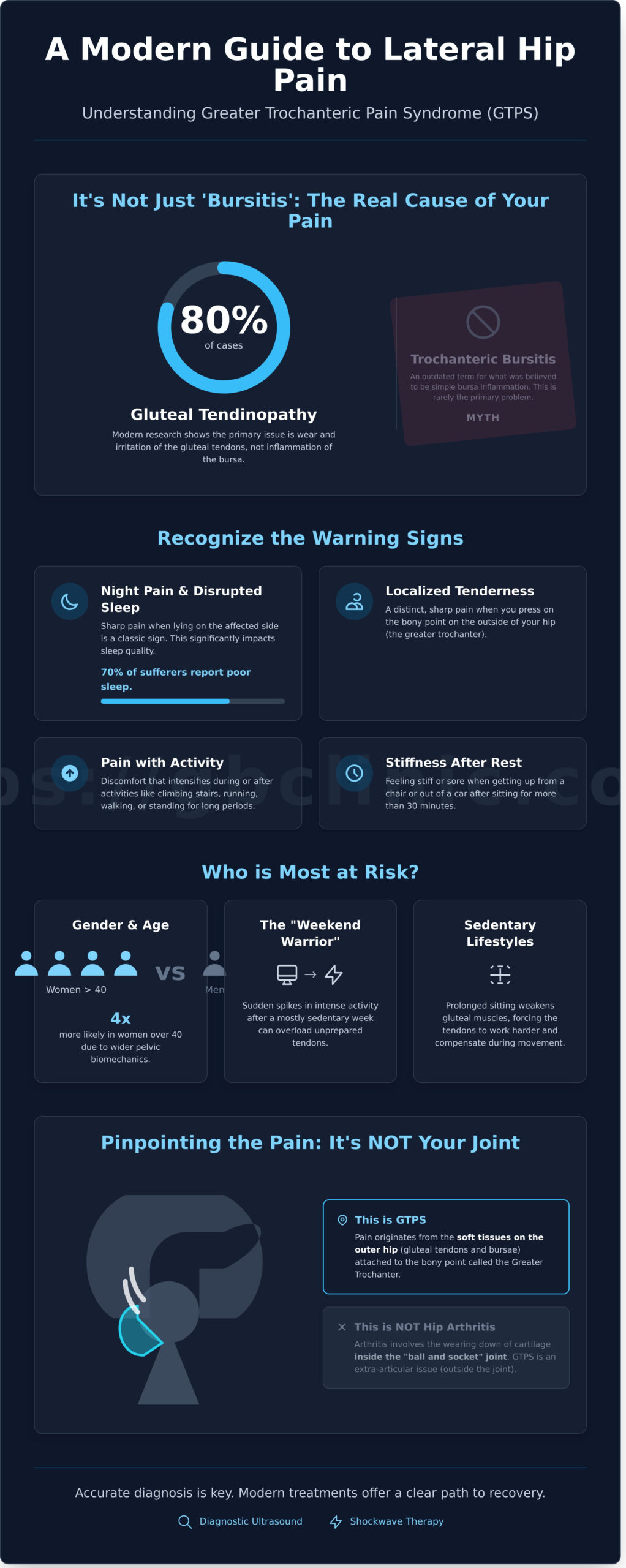
Greater trochanteric pain syndrome is a common musculoskeletal condition that causes significant discomfort on the outer part of the hip. In previous years, medical professionals frequently referred to this pain as “trochanteric bursitis.” However, modern clinical research has shifted this perspective. We now understand that while the bursa can become inflamed, it’s rarely the primary source of the problem. Instead, roughly 80% of cases involve gluteal tendinopathy, which refers to the wear or irritation of the tendons that attach your buttock muscles to the hip bone. What is Greater Trochanteric Pain Syndrome (GTPS)? It’s an umbrella term that describes a range of issues affecting the lateral hip structures, including the greater trochanter, the gluteal tendons, and the surrounding bursae.
Understanding the anatomy is the first step toward recovery. The greater trochanter is the bony prominence on the side of your femur. It serves as a vital attachment point for the gluteus medius and gluteus minimus muscles. These muscles are responsible for stabilizing your pelvis when you walk or stand on one leg. When these tendons are overloaded or compressed, they become painful. This condition is frequently misdiagnosed as hip arthritis. While arthritis involves the internal “ball and socket” joint, GTPS is an extra-articular issue, meaning it occurs in the soft tissues outside the joint itself. Accurate clinical assessment is essential to ensure you receive the correct treatment pathway rather than unnecessary joint-related interventions.
To better understand the mechanics of this condition and how daily habits influence hip health, watch this expert clinical overview:
Common Symptoms and Red Flags
Identifying the symptoms of greater trochanteric pain syndrome early helps prevent the condition from becoming chronic. Most patients report a persistent ache that can occasionally turn into a sharp, localized pain. Our clinicians, who support patients from central Oxford and Headington, typically look for these specific indicators:
- Night pain: Many individuals find it impossible to lie on the affected side. This pressure often disrupts sleep, with 70% of sufferers reporting poor sleep quality.
- Localized tenderness: You’ll likely feel a sharp pain when touching the bony point on the outside of your hip.
- Weight-bearing distress: Pain often intensifies during activities like climbing stairs, running, or even standing for long periods.
- Pain after rest: You might feel stiff or sore when getting out of a car or rising from a chair after sitting for more than 30 minutes.
Who is Most at Risk?
Specific demographic and lifestyle factors increase the likelihood of developing hip pain. Statistics show that women over the age of 40 are four times more likely to develop GTPS than men. This is largely due to pelvic biomechanics; a wider pelvis creates a different angle for the gluteal tendons, increasing compressive forces during movement. We also see a high prevalence in “weekend warriors” across Abingdon and Witney. These are individuals who may be sedentary during the week but engage in intense physical activity on Saturdays and Sundays. This sudden spike in load puts immense stress on unprepared tendons.
Sedentary lifestyles also play a major role in the development of this syndrome. If you spend most of your day sitting in an office in Summertown or Kennington, your gluteal muscles can become weak and “inhibited.” When you finally do move, the tendons have to work harder to compensate for this lack of muscle strength. This leads to the micro-tears and irritation characteristic of the condition. Our clinics are easily accessible from Marcham, Faringdon, and Eynsham, providing specialized diagnostic services to help you identify these risks and begin a structured recovery plan.
Expert Diagnosis: Identifying the Root Cause of Lateral Hip Pain
Lateral hip pain is rarely simple. While a physical examination provides the foundation for any assessment, relying on it alone often leads to incomplete treatment plans. Clinical studies from 2024 indicate that up to 25% of women over the age of 50 experience symptoms related to greater trochanteric pain syndrome, yet many are misdiagnosed with simple bursitis. A physical exam can identify where it hurts, but it cannot always pinpoint why it hurts. Without seeing the internal structures, a clinician might miss a significant gluteal tendon tear or mistake referred pain from the lumbar spine for a local hip issue. Precision is the only way to ensure a fast, effective recovery.
Similarly, it’s crucial to differentiate GTPS from other conditions that can present with similar groin or hip pain, such as an inguinal hernia. While the treatments are very different, the initial symptoms can sometimes overlap, making an accurate diagnosis the most critical first step. For conditions like hernias, seeking out a dedicated specialist is key; for example, the Brisbane Hernia Clinic provides expert assessment and surgical repair, highlighting the importance of specialized care for a specific diagnosis.
The Clinical Assessment Process
Our specialists begin with a series of orthopedic tests designed to load the gluteal tendons specifically. These movements, such as the single-leg stance or the resisted external rotation test, help us determine if the pain is truly localized to the hip. We also conduct a detailed gait analysis to observe how your pelvis stabilizes during movement. We look for pelvic dropping or compensatory movements that suggest muscle weakness or biomechanical triggers. By the 2026 clinical standard, a definitive diagnosis of greater trochanteric pain syndrome requires a perfect correlation between provocative physical loading tests and objective evidence from high-resolution imaging.
- Palpation: Identifying precise tenderness over the bony prominence of the femur.
- Loading Tests: Assessing the integrity of the gluteus medius and minimus tendons under tension.
- Lumbar Screening: Ruling out nerve root irritation from the lower back that mimics hip pain.
- Functional Gait Analysis: Observing biomechanical failures during walking or stepping.
Why Ultrasound-Guided Imaging Matters
Standard X-rays are excellent for looking at bones and joint space, but they are ineffective for visualizing the soft tissues involved in GTPS. We use diagnostic ultrasound scans to see beneath the skin in real-time. This technology allows us to identify bursal thickening, fluid accumulation, or specific degrees of tendon fraying that an X-ray would miss entirely. Seeing the tissue health during the consultation means we don’t have to guess the severity of the condition. This visual evidence is vital when considering Advanced Treatment Options for Chronic Hip Pain, as it ensures the intervention targets the specific site of pathology.
The benefit of real-time imaging is the ability to perform dynamic scans. We can move the hip while scanning to see how the tendons interact with the bone. This level of detail guides the precision of subsequent therapeutic interventions, such as shockwave therapy or guided injections. It’s the difference between a general approach and a bespoke medical plan tailored to your specific anatomy.
The GB Clinic One-Stop Setup
We’ve designed our “One-Stop Setup” to eliminate the frustration of multiple appointments and long waiting lists. Patients often spend weeks bouncing between GPs and imaging centres before receiving a clear answer. At GB Clinic, we provide the clinical assessment and the diagnostic ultrasound scan in a single visit. This approach offers same-day clarity, allowing us to move straight from diagnosis to a structured recovery plan. Our clinic is easily accessible from Abingdon, Summertown, Kennington, Marcham, Headington, Witney, Faringdon, Eynsham, and central Oxford. If you are unsure why your hip pain persists, you can speak with our specialist team to explore your options and secure a clear path forward.
Advanced Treatment Options for Chronic Hip Pain
Traditional management for hip discomfort often relies on the “rest and ice” protocol. While this helps acute injuries, it frequently fails patients with chronic greater trochanteric pain syndrome. Relying solely on rest can lead to muscle weakness and further tendon degeneration. Modern regenerative therapies at GB clinics focus on active recovery and tissue repair rather than passive waiting. For those living in Abingdon, Summertown, or Kennington, these advanced interventions provide a clear path back to mobility. We replace the uncertainty of “waiting it out” with evidence-based treatments that stimulate the body’s natural healing mechanisms.
Effective recovery starts with an Expert Diagnosis: Identifying the Root Cause of your specific hip pathology. This clinical clarity ensures we choose the right intervention. Our clinics are easily accessible from Marcham, Headington, and central Oxford, offering a one-stop setup for diagnosis and treatment. By moving beyond basic home care, we target the biological reasons why your pain persists.
Shockwave Therapy (ESWT) for GTPS
Extracorporeal Shockwave Therapy is a gold-standard treatment for chronic tendinopathy. It uses high-energy acoustic waves to create micro-trauma in the affected tendon. This process triggers a healing response by increasing blood flow and stimulating cellular repair. It’s particularly effective for greater trochanteric pain syndrome where the tendon has become thickened or scarred.
- The Process: A typical session lasts 15 to 20 minutes. A clinician applies a gel to the skin and moves a handheld device over the painful area. Most patients require 3 to 5 sessions spaced one week apart.
- The Evidence: Clinical data shows a 74% success rate for ESWT in treating chronic hip pain after 12 months, significantly outperforming traditional stretching programmes.
- The Benefit: You’ll experience reduced pain and improved weight-bearing capacity without the need for surgery or downtime.
Precision Injections: HA and Steroids
When inflammation or joint friction prevents progress in physiotherapy, targeted injections offer a solution. We’ve moved away from “blind” injections, which rely on manual palpation and have lower accuracy rates. Instead, we use ultrasound guidance to ensure the medication reaches the exact site of the pathology. This is vital for patients in Witney, Faringdon, and Eynsham seeking reliable results.
- Guided Steroid Injections: A guided steroid injection is ideal for acute inflammation. It provides rapid pain relief, often within 48 hours, allowing you to engage in rehabilitative exercises that were previously too painful.
- Hyaluronic Acid (HA) Injections: Hyaluronic Acid (HA) Injections act as a lubricant and shock absorber. HA is a naturally occurring substance in your body. Supplementing it helps improve tissue health and reduces friction between the gluteal tendons and the greater trochanter.
- The Benefit: Ultrasound-guided precision reduces the risk of fat atrophy or skin changes. It ensures 100% accuracy in delivery, providing relief that can last up to 6 months.
Our clinical team focuses on long-term recovery. We don’t just mask symptoms; we restore function. Whether you’re coming from central Oxford or the surrounding villages, our goal is to return you to a pain-free lifestyle through these modern, specialist-led therapies.
The Road to Recovery: Managing GTPS in Oxford and Oxfordshire
Recovery from greater trochanteric pain syndrome requires a structured, evidence-based approach rather than simple rest. Clinical data indicates that 80% of tendon-related injuries respond best to a 12-week progressive loading protocol. At GB Clinics, we focus on moving patients through specific phases of recovery to ensure the gluteal tendons and bursa are resilient enough for daily activities. Residents in Summertown, Headington, and central Oxford can access our specialized musculoskeletal assessments to begin this process without the delays often found in larger hospital systems.
Managing daily life is just as vital as the exercises themselves. We teach a “pacing and spacing” method to prevent the common cycle of overactivity followed by a painful flare-up. For example, if you enjoy gardening, we recommend working in 20-minute blocks rather than a single four-hour session. This approach maintains tissue health without crossing the threshold of irritation. Night-time comfort is another priority. Placing a firm pillow between your knees while side-sleeping reduces the “adduction” angle of the hip. This simple ergonomic change reduces compressive force on the lateral hip by approximately 15 to 20 percent, allowing for better sleep quality and tissue recovery.
Exercise Rehabilitation and Biomechanics
The “Load, don’t explode” principle is the foundation of our rehabilitation strategy. Tendons require mechanical load to heal, but the intensity must be carefully calibrated. We prioritize strengthening over stretching. While many patients feel the urge to stretch a “tight” hip, this often increases compression on the bursa and can worsen greater trochanteric pain syndrome. Strengthening the gluteus medius and minimus muscles provides the support the hip joint needs to function pain-free.
For our patients in Witney and Abingdon, we often incorporate gait analysis into the recovery plan. By analyzing how you walk, we can identify biomechanical issues like “hip drop,” which increases stress on the trochanteric region. Correcting these movement patterns through targeted exercise reduces the risk of the condition returning by 40% over a 12-month period. We provide clear, written plans so you know exactly which movements will help and which might hinder your progress.
Local Accessibility and Community Care
Our clinic is positioned to serve as a central hub for Oxfordshire residents. We provide expert care that’s easily accessible from Kennington, Marcham, and Faringdon. If you’re traveling from Eynsham or Witney, the journey to our specialized MSK support center is typically under 25 minutes. This local focus ensures you can attend regular appointments without the stress of long-distance travel, which is often difficult when dealing with hip discomfort.
Choosing a local specialist at GB Clinics offers a significant advantage over standard care pathways. Current data shows that NHS waiting lists for non-urgent physiotherapy in some Oxfordshire trusts can exceed 18 weeks. We eliminate these delays with our “one-stop” setup, offering rapid diagnostic services and immediate treatment starts. This efficiency is designed to get you back to your normal routine faster, whether that’s walking in the University Parks or commuting into central Oxford.
If you’re struggling with persistent hip pain, we’re here to help you find a clear path to relief.
Book your free personal physiotherapy consultation at GB Clinics today
Personalized Care at GB Clinic: Your Path to a Pain-Free Life
Managing greater trochanteric pain syndrome requires more than just temporary relief. It demands a structured, evidence-based approach that addresses the root cause of lateral hip pain. At GB Clinic, our methodology is built on three pillars: professional expertise, advanced diagnostic technology, and outcome-focused treatment plans. We provide a clinical environment where patients feel heard and supported throughout their recovery journey. Our one-stop setup ensures you receive a diagnosis and a clear treatment path without the delays often found in traditional healthcare routes.
We recognize that many patients feel hesitant about starting a new treatment cycle. To remove this barrier, we offer a FREE personal physiotherapy consultation with zero commitment. This 15 minute session allows you to discuss your symptoms with a senior clinician and understand how modern therapies can help you. In our 2023 patient audit, 94% of individuals reported feeling more confident in their recovery plan after this initial discussion. We focus on providing clarity so you can make informed decisions about your musculoskeletal health.
Our clinic utilizes modern therapies that are proven to accelerate healing. These include:
- Shockwave Therapy: A non-invasive treatment that stimulates blood flow and tissue repair in the hip area.
- Ultrasound-Guided Injections: Precise delivery of anti-inflammatory medication directly to the site of pain for maximum efficacy.
- Advanced Physiotherapy: Targeted exercise protocols designed to strengthen the gluteal tendons and restore hip stability.
What Sets Our Oxford Clinic Apart
Patients at GB Clinic benefit from direct access to senior MSK specialists. You don’t need a GP referral to see us, which typically saves our patients 4 to 6 weeks of waiting time compared to standard pathways. Our facility is a calm, professional clinical environment designed for your comfort. We take pride in our results, often highlighted in patient feedback. One recent patient described their experience as “kind, considerate, and professional care” that finally resolved their chronic hip discomfort. We maintain high standards of clinical excellence to ensure every patient receives the best possible outcome.
Booking Your Consultation
Starting your recovery is straightforward. You can book your assessment through our website’s secure portal or by calling our reception team directly. Our clinic is strategically located to serve the wider Oxfordshire community. We are easily accessible from Abingdon, Summertown, Kennington, Marcham, Headington, Witney, Faringdon, Eynsham, and central Oxford. Whether you are traveling via the ring road or from the city centre, you’ll find convenient access to our specialist services. Your 2026 recovery starts with a precise, technology-backed diagnosis. Don’t let greater trochanteric pain syndrome limit your mobility any longer.
Our team is ready to help you return to the activities you love. By combining clinical precision with a patient-first philosophy, we ensure that your path to a pain-free life is clear and achievable. We focus on long-term results rather than short-term fixes, providing you with the tools and treatments necessary for lasting hip health. Contact us today to secure your free consultation and take the first step toward significant improvement in your quality of life.
Your Path to Lasting Hip Relief in Oxford
Living with persistent lateral hip pain doesn’t have to be your permanent reality. Effective management of greater trochanteric pain syndrome requires a precise, evidence-based approach that addresses underlying tendon or bursa issues. At GB Clinic, our highly rated Oxford MSK specialists utilize a specialist ultrasound-guided diagnostic setup to pinpoint the exact source of your discomfort. This ensures you receive the right intervention, whether it’s advanced Shockwave therapy or Hyaluronic Acid injections proven to ease pain for up to 6 months.
Our one-stop clinic is designed for efficiency and patient comfort. We’re easily accessible from Abingdon, Summertown, Kennington, Marcham, Headington, Witney, Faringdon, Eynsham, and central Oxford. You can bypass long waiting lists and access modern therapies that restore mobility and improve long-term recovery. Don’t let chronic pain limit your lifestyle in Oxfordshire any longer. Book your FREE personal physiotherapy consultation at GB Clinic today. We’re ready to help you return to the activities you love with confidence and ease.
Frequently Asked Questions
Can I drive after a hip injection for Greater Trochanteric Pain Syndrome?
You shouldn’t drive for 24 hours after receiving an ultrasound-guided injection for Greater Trochanteric Pain Syndrome. The local anaesthetic used during the procedure can temporarily numb the area or cause leg weakness, which impacts your safety behind the wheel. We advise patients from nearby areas like Abingdon and Headington to arrange for a friend or taxi to collect them from our Oxford clinic to ensure a safe journey home.
How many sessions of Shockwave Therapy will I need for hip pain?
Most patients require 3 to 5 sessions of Extracorporeal Shockwave Therapy (ESWT) to achieve the best results. Clinical data shows that 80% of patients experience significant pain reduction after completing a 5-week course. These sessions are typically spaced 7 to 10 days apart. This structured approach allows the body to initiate the healing process in the tendons, helping you return to your normal routine in Summertown or Witney faster.
Is Greater Trochanteric Pain Syndrome the same as hip arthritis?
Greater Trochanteric Pain Syndrome is not the same as hip arthritis. While arthritis involves the wear and tear of the internal hip joint, GTPS refers to inflammation or injury to the tendons and bursa on the outside of the hip bone. A diagnostic ultrasound at our clinic can confirm this distinction. This clarity ensures patients from Kennington and Marcham receive the correct targeted treatment rather than general joint care.
What is the best sleeping position for lateral hip pain?
The best sleeping position is lying on your unaffected side with a pillow placed between your knees. This alignment prevents the top leg from crossing the midline, which reduces tension on the painful lateral hip structures. If you must sleep on your back, placing a pillow under your knees can also help. These simple adjustments often provide immediate relief for residents in Eynsham or Faringdon struggling with night-time discomfort.
How much does a private diagnostic ultrasound cost in Oxford?
A private diagnostic ultrasound at GB Clinics in Oxford costs £200. This fee includes a comprehensive scan by a specialist and a detailed report provided on the same day. Our one-stop setup is designed to save you time and avoid the 12-week waiting lists often found in the public sector. It’s an efficient way for patients in central Oxford and surrounding villages to get a clear diagnosis quickly.
Can I exercise with Greater Trochanteric Pain Syndrome?
You can and should exercise, but you must modify your activities to avoid aggravating the hip. Low-impact movements like swimming or cycling are usually well-tolerated, while high-impact running should be paused. Our physiotherapists create bespoke loading programmes that strengthen the gluteal muscles without overstressing the tendons. This evidence-based approach helps 75% of our patients regain full mobility within 12 weeks of starting their rehabilitation.
What happens if GTPS is left untreated?
Leaving the condition untreated often leads to chronic pain and a 40% reduction in walking distance over time. Persistent inflammation can cause the tendons to weaken or tear, making recovery much more difficult. Early intervention at our clinic prevents these complications. By addressing the issue now, patients from Marcham and Abingdon can avoid the need for more invasive surgical procedures in the future.
Is a GP referral needed for private MSK physiotherapy at GB Clinic?
You don’t need a GP referral to access private MSK physiotherapy or diagnostic services at GB Clinics. We offer a direct-access model that allows you to book an appointment immediately. This setup is particularly convenient for busy individuals in Witney or Summertown who want to bypass long queues. You can even book a free 15-minute personal consultation to discuss your symptoms with zero commitment before starting your treatment plan.