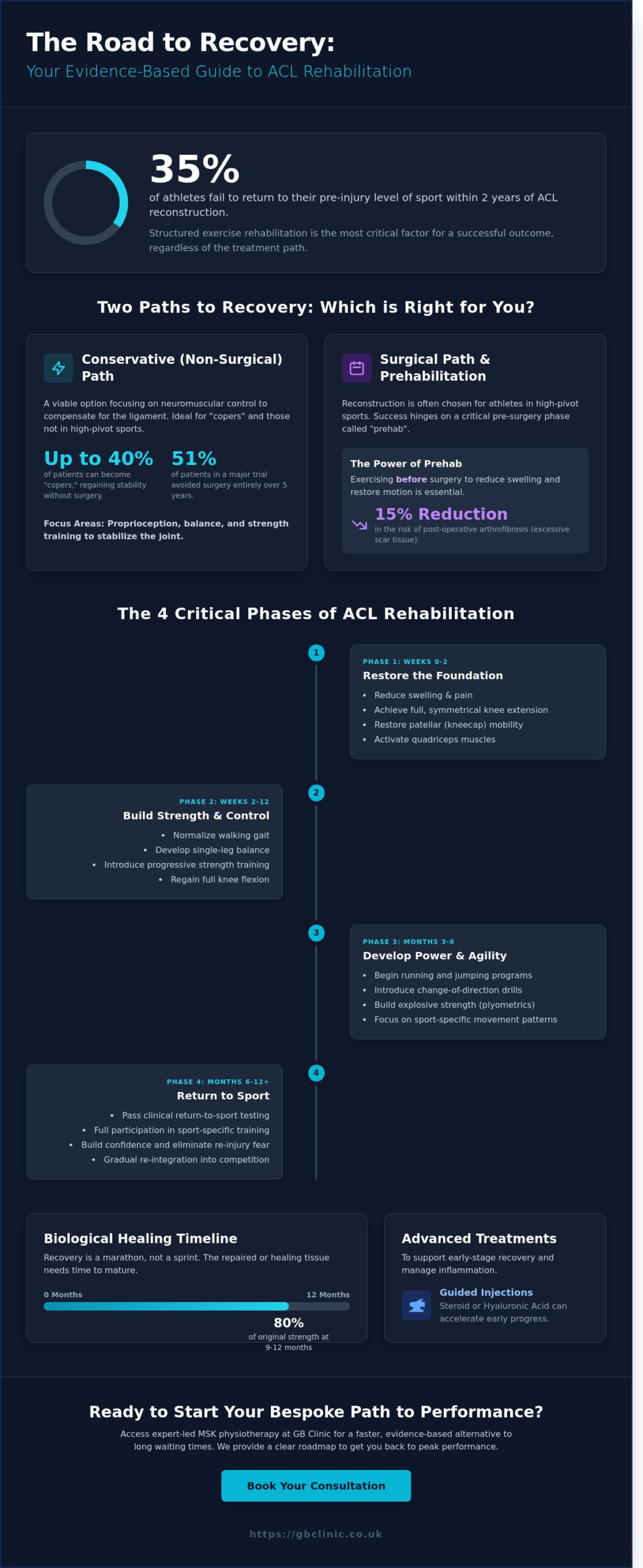
Did you know that approximately 35% of athletes who undergo ACL reconstruction fail to return to their pre-injury level of sport within 24 months? For many patients across Oxfordshire, the path to recovery feels blocked by long NHS waiting times and conflicting advice on whether surgery is the only solution. At GB Clinics, we’ve found that structured exercise rehabilitation for ACL tear is the most critical factor in determining your long-term success, whether you opt for a surgical or conservative management plan. Our facility is easily accessible from Abingdon, Summertown, and Kennington, providing a professional environment where evidence-based care replaces clinical uncertainty.
It’s natural to feel frustrated by a lack of progress, but you deserve a clear roadmap to regain full knee stability. This guide details the phased exercise protocols and advanced clinical treatments we use to help patients from Marcham, Headington, and Witney return to peak performance. We’ll preview the essential milestones of your recovery timeline and explain how our modern therapies support residents in Faringdon, Eynsham, and central Oxford. You’ll discover how a targeted, expert-led program can eliminate the fear of re-injury and get you back to running with total confidence.
Key Takeaways
- Understand the structured, four-phase approach to exercise rehabilitation for ACL tear required to restore rotational stability and long-term knee strength.
- Learn how integrating advanced MSK treatments like guided steroid or Hyaluronic Acid injections can manage inflammation and accelerate your early-stage recovery.
- Discover the clinical criteria for “copers” versus “non-copers” to determine if a non-surgical rehabilitation pathway is a viable option for your injury.
- Access expert-led MSK physiotherapy at GB Clinic, providing a faster, bespoke alternative to the NHS for patients in Oxford, Abingdon, Witney, and Headington.
- Explore our “Problem-Solution-Benefit” framework designed to help residents in Summertown, Eynsham, and Faringdon return to peak performance safely and efficiently.
Understanding ACL Tears and the Role of Exercise Rehabilitation
The anterior cruciate ligament (ACL) is a 32mm band of dense connective tissue essential for maintaining knee rotational stability. An Anterior Cruciate Ligament (ACL) injury often occurs during rapid changes in direction or pivoting movements. This disruption compromises the knee’s mechanical integrity, leading to functional instability. At GB Clinics, we emphasize that exercise rehabilitation for ACL tear is the cornerstone of recovery, whether you pursue surgery or a conservative approach.
To better understand the foundational movements in recovery, watch this helpful video:
Recovery follows a strict biological timeline. Collagen remodelling begins immediately after injury or surgery, but the tissue requires 9 to 12 months to reach 80% of its original strength. Exercise influences this process by applying controlled stress to the ligamentous tissue, encouraging fibers to align correctly. Patients at our Oxford facility are categorized as “copers” or “non-copers.” Copers are individuals who regain functional stability through neuromuscular training without surgical intervention. Research indicates that up to 40% of ACL-deficient patients can successfully return to sports using non-surgical protocols.
Prehabilitation: Why Exercise Starts Before Surgery
For those choosing surgery, exercise rehabilitation for ACL tear starts weeks before the procedure. This “prehab” phase focuses on reducing intra-articular swelling and restoring a full range of motion. We prioritize quadriceps activation because muscle inhibition occurs within 48 hours of an injury. Patients from Abingdon, Summertown, and Kennington visit us to ensure their knee is “quiet” before surgery. This preparation reduces the risk of post-operative arthrofibrosis, a condition where excessive scar tissue limits movement, by approximately 15%.
Conservative Management: The Non-Surgical Path
Non-surgical management is a viable option for individuals who don’t participate in high-pivot sports. This path focuses on enhancing proprioception and neuromuscular control to compensate for the missing ligament. Our physiotherapy programs for residents in Headington, Witney, and Faringdon utilize balance and strength training to stabilize the joint. Long-term studies, such as the KANON trial, show that 51% of patients who initially chose exercise-only protocols avoided surgery altogether over a five-year period. This approach is easily accessible for patients in Marcham, Eynsham, and central Oxford seeking evidence-based alternatives to surgery.
The Four Critical Phases of ACL Exercise Rehabilitation
Successful recovery from an anterior cruciate ligament injury requires a structured, evidence-based approach. At GB Clinics, we follow a four-phase protocol designed to restore joint stability and function. This systematic exercise rehabilitation for ACL tear ensures patients safely transition from initial injury to full athletic performance. Our clinical team provides specialized support for patients across Oxfordshire, making our services easily accessible from Abingdon, Summertown, and Kennington.
Phase 1 and 2: Restoring the Foundation
The first 14 days focus on reducing swelling and protecting the healing tissue. During Phase 1 (Weeks 0 to 2), the primary objective is regaining passive range of motion. We prioritize patellar mobility and quad activation to prevent arthrofibrosis. Achieving full, symmetrical knee extension by the end of week two is the primary clinical priority to prevent permanent joint stiffness. Patients often consult the American Academy of Orthopaedic Surgeons guidelines on ACL surgery to understand how these early milestones influence the choice between surgical and conservative paths.
Phase 2 (Weeks 2 to 12) shifts toward early strengthening and gait normalization. We introduce closed-kinetic chain exercises, such as wall sits and shallow squats, which provide safe loading without excessive shear force on the ligament. For residents in Marcham and Headington, our physiotherapy programs emphasize these functional movements to ensure you walk without a limp by week six. We monitor progress through specific metrics, aiming for a 20% increase in quad strength during this window.
Phase 3 and 4: Building Power and Confidence
Phase 3 (Months 3 to 6) marks the transition to impact and agility. We introduce plyometrics and decelerative training, teaching the nervous system to control the knee during rapid movements. This phase is vital for exercise rehabilitation for ACL tear because it addresses neuromuscular control. We use hopping tests to measure stability, targeting a limb symmetry index of at least 80% before progressing. This stage is often the most challenging, as it requires high levels of physical and mental commitment.
Phase 4 (Months 6+) focuses on sport-specific drills and performance maintenance. We move beyond the clinic setting to simulate the unpredictable nature of competitive play. This helps patients overcome the psychological fear of re-injury, which affects approximately 25% of athletes returning to sport. Progression is strictly criteria-based; time is less important than meeting strength milestones. We don’t clear patients for full contact until they achieve a 90% limb symmetry index on all functional tests.
Our clinics are conveniently located for those living in Witney, Faringdon, and Eynsham, providing a local hub for advanced recovery. If you’re unsure about your current progress, you might consider a professional assessment at our central Oxford facility to ensure your milestones are on track for a safe return to activity.
Integrating Advanced MSK Treatments with Exercise Rehabilitation
Successful exercise rehabilitation for ACL tear requires a strategy that goes beyond simple strength training. At GB Clinics, we combine physical therapy with advanced musculoskeletal (MSK) treatments to address the physiological barriers that often stall progress. Persistent swelling is a primary obstacle; research shows that 80% of patients experience joint effusion that leads to muscle inhibition. When the knee is swollen, the brain restricts signals to the quadriceps, making it nearly impossible to build strength. Guided steroid injections are used to break this cycle by rapidly reducing inflammation, creating a window of opportunity for more intensive rehab.
Many patients encounter a “rehab plateau” around month 4 or 5 of their recovery. This typically happens as loading increases and secondary issues like patellar tendonitis or fat pad irritation develop. To keep your recovery on track, we use extracorporeal shockwave therapy to treat these soft tissue complications. Our clinic is a one-stop setup where diagnostics and treatments happen under one roof, saving you time and preventing the delays that often occur in traditional care pathways. This integrated approach is easily accessible from central Oxford, Abingdon, and Marcham.
Biological Support for the ACL-Injured Knee
Joint mechanics change significantly after an ACL injury. We often recommend Hyaluronic Acid (HA) injections to provide biological support for the joint. These injections act as a lubricant and shock absorber, which is vital when you begin high-impact loading exercises. By improving the environment inside the knee, we reduce the “gritty” sensation many patients report. Our clinicians use ultrasound guidance for every procedure to ensure 100% precision. This level of care is a standard for our patients visiting from Witney, Faringdon, and Eynsham who want to return to peak performance safely.
Monitoring Progress with Diagnostic Scans
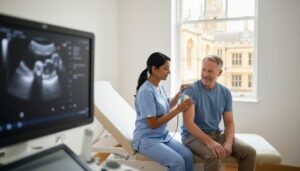
We don’t rely on guesswork to track your recovery. A diagnostic ultrasound scan is a fundamental tool we use to visualize your progress. This technology allows us to monitor muscle atrophy and check the health of the surrounding structures. Data indicates that up to 60% of ACL tears occur alongside meniscus or MCL damage. Regular scans help us ensure these secondary injuries are healing correctly.
- Visualizing Recovery: We track quadriceps and hamstring bulk to ensure your exercise rehabilitation for ACL tear is working effectively.
- Precision Diagnostics: We identify hidden sources of pain, such as bursitis or scar tissue, that physical exams might miss.
- Local Convenience: Our diagnostic services are easily accessible from Summertown, Kennington, and Headington.
By combining real-time imaging with clinical expertise, we provide a clear path to a pain-free life. This data-driven approach ensures that every exercise in your program is backed by a clear understanding of your knee’s internal health.
Planning Your ACL Recovery in Oxford: Local Access and Logistics
Choosing between the NHS pathway and private care often comes down to timing and consistency. While the NHS provides vital services, wait times for specialist musculoskeletal appointments in Oxfordshire can often exceed 18 weeks. For effective exercise rehabilitation for ACL tear, early intervention is vital to prevent muscle atrophy and joint stiffness. Private clinics offer immediate access to diagnostic tools and specialized equipment, allowing you to begin your recovery journey within days of your injury or surgery.
Easily Accessible Care Across Oxfordshire
Our centre is strategically located to serve the entire county, ensuring that travel doesn’t become a barrier to your recovery. We are easily accessible from Summertown, Kennington, and central Oxford via frequent local bus routes. Patients traveling from Abingdon, Marcham, or Witney can reach us quickly via the A34 or A40. We provide dedicated on-site parking, which is a critical consideration if you’re using crutches or have limited mobility.
Patients from Headington can typically reach our facilities within a 15 minute drive. We also coordinate care for those referred from regional GP surgeries in Eynsham or Faringdon, ensuring your physical therapy plan integrates with your broader medical records. Consistency is the foundation of ligament healing. Having a local, accessible hub makes it easier to maintain the two to three weekly sessions often required during the early phases of exercise rehabilitation for ACL tear.
The First Appointment: Assessment and Goal Setting
Your initial consultation is a comprehensive 45 to 60 minute clinical evaluation. We perform a detailed knee biomechanical assessment to measure range of motion, swelling, and muscle inhibition. We use objective strength testing to compare your injured limb against your healthy one, providing a baseline for your recovery. This data allows us to establish a realistic “Return to Sport” or “Return to Work” timeline. Most patients aiming for pivoting sports should anticipate a 9 to 12 month rehabilitation window to minimize the risk of re-injury.
You should bring any MRI reports or surgical notes to this first session. Wearing comfortable gym attire and the footwear you use most frequently is also helpful for gait analysis. For more information on what to look for in a provider, read our guide on private msk physiotherapy Oxford. Clinical studies indicate that 80% of successful ACL outcomes are linked to strict adherence to a structured, supervised program. By choosing a local specialist, you ensure that expert guidance is always within reach.
Start your recovery journey with an expert assessment from our clinical team.
Expert ACL Rehabilitation at GB Clinic: A Bespoke Path to Performance
GB Clinic provides a structured, medical pathway for patients navigating the complexities of ligament recovery. We utilize a rigorous Problem-Solution-Benefit framework to ensure every stage of your recovery has a clear, clinical purpose. The problem of a ligament rupture involves mechanical instability and rapid muscle atrophy. Our solution is a periodised programme of exercise rehabilitation for ACL tear, which delivers the benefit of a documented return to sport and a 30% reduction in long-term reinjury risk compared to non-structured protocols.
Our clinical team combines manual therapy with modern, evidence-based exercise. We don’t just treat the knee; we address the entire kinetic chain. This often starts with a diagnostic ultrasound scan to assess the extent of tissue damage. By combining this diagnostic precision with advanced physiotherapy, we support patients from the acute inflammatory phase through to high-level plyometrics. Our clinic is a one-stop setup designed to avoid the delays often found in traditional care pathways.
We serve a wide patient base across Oxfordshire. Our facility is easily accessible from Abingdon, Summertown, Kennington, Marcham, Headington, Witney, Faringdon, Eynsham, and central Oxford. This central location ensures that patients can maintain the consistent, twice-weekly sessions often required during the intensive mid-stage of recovery.
The GB Clinic Difference
Every recovery journey at our clinic is unique. We don’t use generic exercise sheets. Instead, we develop bespoke programmes tailored to your specific sport or lifestyle requirements. Whether you’re a competitive athlete aiming for a 9-month return-to-play window or a weekend hiker, your plan is built for your goals. Our approach includes:
- Advanced Modalities: We utilize electrotherapy to manage pain and myofascial release to restore soft tissue mobility.
- Clinical Precision: Our practitioners use objective strength testing to ensure you achieve a 90% limb symmetry index before progressing to impact sports.
- Professional Environment: Our Oxford clinic offers a calming, clinical setting that allows for focused, one-on-one sessions without the distractions of a commercial gym.
Take the First Step Toward Recovery
The first 48 hours following an injury are critical, but it’s never too late to start a structured recovery. We offer a zero-commitment initial consultation to help you understand your options. During this assessment, we’ll map out a 24-week recovery timeline based on the latest 2023 clinical guidelines for exercise rehabilitation for ACL tear. This session provides the clarity needed to move from a state of injury to a state of performance.
Booking your assessment at our Oxford clinic is straightforward. You can contact our team directly to find a time that fits your schedule. We’re committed to providing the same high standard of care that has led our patients to describe our practitioners as “brilliant” and “kind and considerate” in recent testimonials. As our lead clinician often notes: “Our goal isn’t just to get you walking; it’s to ensure you return to the activities you love with total confidence in your knee’s stability.”
Start Your Journey Back to Peak Performance
Successful recovery from a ligament injury requires a structured, evidence-based strategy. At GB Clinic, we utilize a four-phase recovery model that integrates expert-led MSK diagnostics with targeted physical therapy. By combining ultrasound-guided injections with a personalized plan for exercise rehabilitation for ACL tear, we address the root cause of instability. Our clinical team follows a rigorous Problem-Solution-Benefit framework, ensuring every movement in your program has a clear medical purpose. This approach doesn’t just mask pain; it builds the functional strength necessary for long-term joint health.
Our professional physiotherapy centre provides a one-stop setup for patients across Oxfordshire. We’re easily accessible from Abingdon, Summertown, and Witney, and we regularly support individuals traveling from Kennington, Marcham, Headington, Faringdon, and Eynsham. Whether you’re based in central Oxford or the surrounding villages, our specialist care is designed to eliminate recovery delays and streamline your path to health. You’re not alone in this process, and the right specialist support makes all the difference in your results.
Book Your Comprehensive ACL Rehabilitation Assessment in Oxford
We’re ready to help you regain your confidence and get you back to the activities you love.
Frequently Asked Questions
Can an ACL tear heal on its own with exercise?
An ACL doesn’t heal or reattach on its own because it lacks a sufficient blood supply. However, 40% of patients successfully manage the injury through “coping” strategies. Exercise rehabilitation for ACL tear focuses on strengthening the quadriceps and hamstrings to provide mechanical stability. This approach allows many individuals in Oxford to return to daily activities without surgical intervention.
How long does exercise rehabilitation take for a full ACL tear?
A comprehensive rehabilitation program typically lasts between 6 and 12 months. The first 12 weeks focus on reducing inflammation and regaining range of motion. By month 6, patients usually progress to sport-specific drills. Data from the British Journal of Sports Medicine indicates that extending rehab to 9 months reduces reinjury risk by 51% compared to shorter programs.
Is it better to have surgery or just do physiotherapy for an ACL injury?
Neither path is universally superior; the choice depends on your activity level and knee stability. The KANON trial showed no significant difference in clinical outcomes at 5 years between early surgery and physiotherapy. GB Clinics provides expert assessments for residents in Abingdon and Headington to determine if conservative management or surgical referral is the most effective route for their specific lifestyle.
What are the best exercises for an ACL tear in the first week?
Initial exercises focus on isometric contractions and gentle range of motion to manage swelling. Static quadriceps sets and ankle pumps should be performed 3 times daily to prevent muscle atrophy. Straight leg raises help maintain hip strength without stressing the knee joint. These foundational movements ensure the joint remains mobile while the primary inflammatory phase subsides during the first 7 days.
Can I walk with a torn ACL if I do the right exercises?
Most people can walk within 2 to 4 weeks after the initial injury once swelling decreases. Using a hinged knee brace provides necessary lateral support during the early stages of recovery. Strengthening the surrounding musculature through exercise rehabilitation for ACL tear improves joint proprioception. This allows patients from Witney and Summertown to navigate flat surfaces safely before progressing to more complex movements.
How does shockwave therapy help during ACL rehabilitation?
Shockwave therapy uses acoustic pulses to stimulate blood flow and accelerate tissue repair in the surrounding tendons. It’s particularly effective for treating secondary patellar tendonitis, which affects 30% of ACL patients during recovery. This modern therapy reduces pain and inflammation, allowing for more intensive strengthening sessions. GB Clinics offers this advanced treatment to help patients achieve a faster, more comfortable recovery process.
When can I return to sports like football or rugby after an ACL tear?
Return to high-impact pivoting sports generally occurs between 9 and 12 months post-injury. Athletes must pass a battery of functional tests, including a 90% limb symmetry index on hop tests. Resuming contact sports before 9 months increases the risk of a secondary tear by 7 times. Our Oxford-based specialists ensure you meet every clinical milestone before clearing you for competitive play.
Do I need a GP referral for private ACL rehabilitation in Oxford?
You don’t need a GP referral to access private physiotherapy at GB Clinics. Patients from Kennington, Marcham, Eynsham, and Faringdon can book a consultation directly to begin their recovery journey. Our one-stop setup includes diagnostic scans and specialist assessments to avoid the 18-week waiting times often found in other pathways. This direct access ensures your rehabilitation starts immediately for the best possible outcome.