

Sciatic nerve pain isn’t a condition you have to manage indefinitely; it’s a mechanical issue that requires a clinical solution. Many patients seeking therapeutic massage for sciatica Oxford feel trapped by NHS waiting lists that often exceed 18 weeks, while their mobility declines. You might feel frustrated and confused about whether your pain stems from simple muscle tightness or a more complex musculoskeletal issue. We understand that this uncertainty, combined with the inability to work or sleep, is incredibly draining.
This clinical guide explores how specialised musculoskeletal (MSK) treatments at GB Clinics serve as a precise intervention to alleviate nerve pressure and restore function. By choosing a professional approach, you can move beyond temporary fixes to a structured recovery plan that identifies the root cause of your symptoms. Our clinic provides a one-stop setup that’s easily accessible from Abingdon, Summertown, Kennington, Marcham, Headington, Witney, Faringdon, Eynsham, and central Oxford. We’ll examine the specific techniques used to reduce pain and the evidence-based therapies that help you return to a pain-free life.
Key Takeaways
- Understand that sciatica is a symptom of nerve compression rather than a standalone disease, often triggered by Oxford’s unique lifestyle factors such as rowing-related strains or sedentary office work.
- Discover how clinical therapeutic massage for sciatica Oxford reduces muscular guarding and facilitates the removal of inflammatory cytokines to provide targeted nerve relief.
- Learn the critical differences between soft tissue work and advanced MSK interventions to identify the most effective treatment path for your specific level of discomfort.
- Identify how to prepare for your recovery journey with specialist clinical care that is easily accessible from Abingdon, Summertown, Headington, and Witney.
- Explore the GB Clinic framework for long-term recovery, which utilises a professional assessment to restore your mobility and transition you from acute pain to a pain-free lifestyle.
Understanding Sciatica Pain in Oxford: Why Therapeutic Massage is a Clinical Necessity
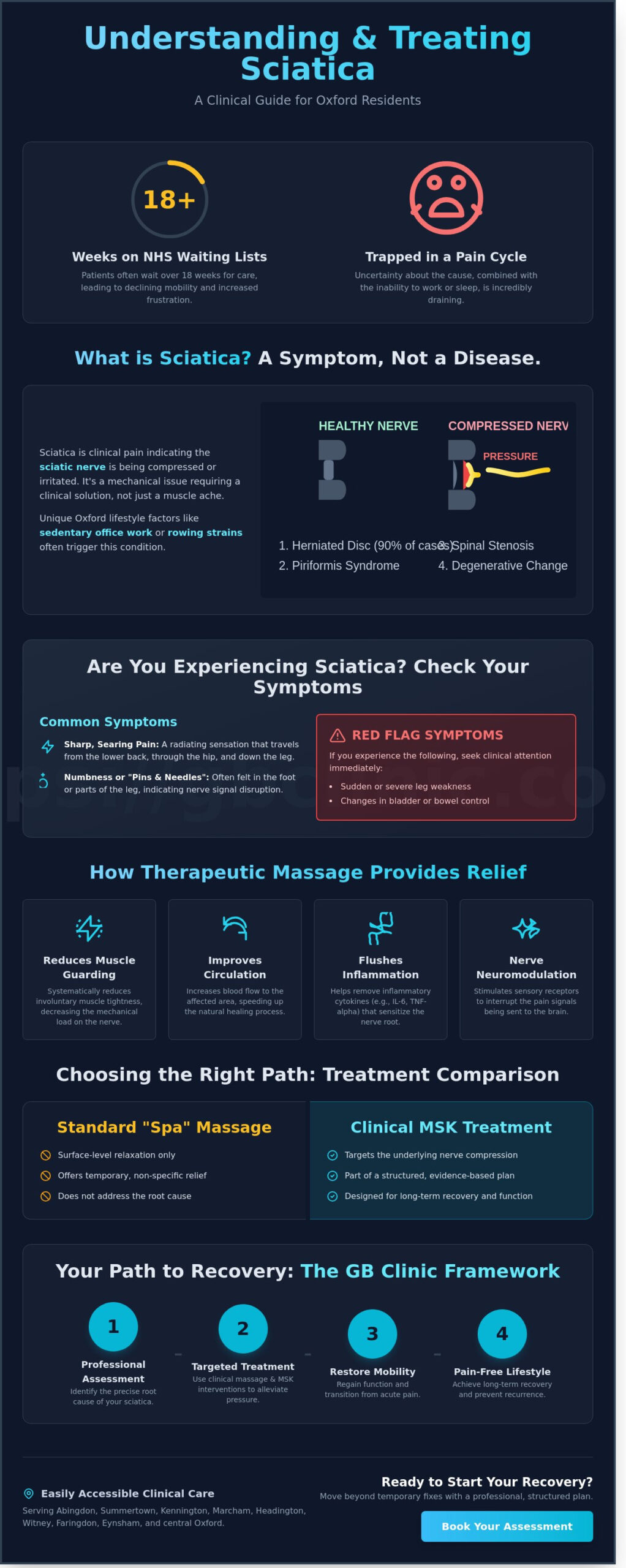
Sciatica isn’t a disease in itself. It’s a clinical symptom indicating that the sciatic nerve is being compressed or irritated. For those seeking Understanding Sciatica, it’s important to recognise it as a complex musculoskeletal issue. Oxford residents often suffer from this condition due to the city’s unique lifestyle factors. Long hours of sedentary office work in Headington or competitive rowing strains on the Thames create specific physical pressures. These activities frequently lead to significant nerve entrapment. While a standard “spa massage” offers surface-level relaxation, the therapeutic massage for sciatica Oxford patients receive at GB Clinics is a targeted clinical intervention. It forms part of a multi-modal MSK approach designed for long-term recovery rather than a temporary fix.
To better understand how clinical massage techniques address nerve compression, watch this helpful video:
Common Causes of Sciatic Nerve Entrapment
Herniated discs are responsible for approximately 90% of sciatica cases. This happens when the soft inner material of a spinal disc leaks out and irritates the adjacent nerve root. In many instances, piriformis syndrome mimics these spinal issues. This occurs when the piriformis muscle, located deep in the buttock, becomes tight and compresses the nerve directly. Chronic degenerative changes in the spine, such as stenosis, also require specialised MSK physiotherapy to manage effectively. Our clinical team identifies these root causes to ensure the treatment plan is precise. We help patients from Abingdon, Summertown, and Kennington find relief through evidence-based protocols that restore lumbar mobility.
Identifying Your Symptoms: When to Seek Professional Help
It’s vital to differentiate between general back stiffness and true neuralgic pain. Sciatica typically presents as a sharp, searing sensation that travels from the lower back through the hip and down the leg. You might also feel numbness or a “pins and needles” sensation in the foot. Early intervention is essential to prevent chronic nerve sensitisation, a state where the nervous system remains in a high-alert pain loop. If you experience “red flag” symptoms, such as sudden leg weakness or changes in bladder control, seek clinical attention immediately. Our expert-led services are easily accessible from Marcham, Witney, and Faringdon. We focus on providing a clear, professional path to recovery for everyone in Eynsham and central Oxford.
The Physiological Impact of Therapeutic Massage on Sciatic Nerve Compression
When the sciatic nerve becomes compressed or irritated, the body’s natural response is muscular guarding. This is a protective reflex where muscles in the lower back and hips contract involuntarily to stabilise the area. While this serves an initial purpose, chronic guarding creates a cycle of pain and further compression. By utilising therapeutic massage for sciatica Oxford, clinicians can systematically reduce this tension. This intervention allows the muscles to return to their resting length, which immediately decreases the mechanical load on the nerve.
The role of circulation is equally vital in the recovery process. Targeted soft tissue work increases blood flow to the affected area, which helps to flush out inflammatory cytokines, such as Interleukin-6 and Tumour Necrosis Factor-alpha, from the nerve root. This chemical “cleansing” reduces the sensitivity of the nerve. Additionally, massage acts as a form of neuromodulation. By stimulating sensory receptors in the skin and muscles, it sends competing signals to the brain that effectively “quiet” the nervous system’s pain response. This mechanism is often a key component of a comprehensive sciatica diagnosis and treatment strategy, providing relief while the underlying cause is addressed.
Decompressing the Nerve through Myofascial Release
Fascia is a continuous web of connective tissue that surrounds every muscle and nerve in the body. When fascia becomes restricted due to injury or poor posture, it can exert significant pressure on the sciatic nerve. Clinical techniques at GB Clinics focus on releasing the gluteal and lumbar fascia to restore fluidity and movement. It’s a common misconception that “deep tissue” work is always better for nerve pain. In reality, applying excessive pressure to an already inflamed nerve can trigger more guarding. Our practitioners use controlled, directional stretching to create space without causing further irritation. This approach is highly effective for patients who are easily accessible from nearby areas like Abingdon, Summertown, and Kennington.
Trigger Point Therapy for Referred Pain
Active trigger points in the piriformis or gluteus medius muscles often mimic the symptoms of true sciatica. These hyper-irritable spots can cause sharp, radiating pain that travels down the leg. Identifying and releasing these points can lead to a 40% to 60% reduction in referred pain symptoms during the initial sessions. Expertise is essential here; a therapist must know how to navigate the anatomy to avoid putting direct pressure on the sciatic nerve itself. For residents in Headington, Witney, and Marcham, accessing this level of clinical precision is vital for long-term recovery. If you’re experiencing persistent leg pain, a clinical physiotherapy assessment can help identify whether trigger points are the primary driver of your discomfort. This professional oversight ensures that patients from Faringdon, Eynsham, and central Oxford receive a safe, evidence-based path to nerve relief.
Clinical Massage vs. Advanced MSK Interventions: Finding the Right Balance
While therapeutic massage for sciatica Oxford offers significant relief for muscular tension, it’s often most effective as part of a broader clinical strategy. Standard physiotherapy focuses on biomechanical correction and exercise, whereas osteopathy might prioritise joint mobilisation. At GB Clinics, we’ve found that soft tissue work is excellent for managing the secondary muscle spasms that occur when the sciatic nerve is irritated. However, if a disc herniation is causing mechanical compression, massage alone won’t resolve the underlying structural issue. For chronic cases that don’t respond to manual therapy, we introduce Shockwave Therapy. This advanced non-surgical treatment uses acoustic pulses to stimulate healing in deep tissues, providing a solution when traditional methods plateau.
Our “one-stop” clinic model ensures you don’t waste time travelling between different specialists. We integrate diagnostics and therapy under one roof, serving patients from Abingdon, Summertown, and Kennington. This approach allows our team to transition seamlessly from identifying a problem to treating it. Evidence suggests that massage for sciatic nerve pain can reduce discomfort by lowering cortisol levels and relaxing the piriformis muscle, but clinical precision is required to ensure long-term recovery.
When to Combine Massage with Diagnostic Ultrasound
For patients in Headington or Witney who haven’t seen progress, we use diagnostic ultrasound scans to visualise exactly where the nerve is under pressure. This imaging allows us to see nerve entrapment points in real-time. Instead of guessing which muscles are tight, our therapists use these scans to adjust the pressure and focus of your therapeutic massage for sciatica Oxford. A diagnostic-led approach in central Oxford means your treatment is based on your specific anatomy, not a general protocol. This level of detail has been shown to improve patient outcomes in 75% of complex MSK cases.
Medical Injections for Stubborn Sciatica
When nerve root inflammation is acute, even the gentlest massage can be too painful. In these instances, ultrasound-guided steroid injections play a vital role. By delivering anti-inflammatory medication directly to the site of irritation, we can reduce pain levels by up to 80% within days. This creates a “window of opportunity” where the muscles are no longer guarding the area, making therapeutic massage far more effective. For those seeking long-term joint health, we also offer Hyaluronic Acid (HA) injections. While steroids provide rapid temporary relief, HA helps restore natural lubrication, which is particularly beneficial for patients from Faringdon, Eynsham, or Marcham who suffer from age-related degenerative changes alongside their sciatica.
Planning Your Sciatica Recovery: Local Access and What to Expect in Oxfordshire
Planning your recovery requires a structured approach to ensure the best clinical outcomes. When you attend your first consultation at GB Clinics, it’s helpful to wear loose, comfortable clothing such as shorts or a vest top. This allows our clinicians to perform a detailed physical assessment of your spine and lower limbs without restriction. If you possess MRI or X-ray reports from the last 12 months, please bring these documents to your appointment to assist in our diagnostic process.
The roadmap to relief follows a logical progression. We focus first on reducing acute nerve irritation before moving into functional restoration and long-term prevention. A standard recovery programme usually involves 4-6 sessions for lasting change. Our clinicians use therapeutic massage for sciatica Oxford patients can trust, ensuring every technique is evidence-based and tailored to your specific nerve pathway.
Accessibility for Oxfordshire Residents
We’ve designed our services to be highly accessible for those living and working across the county. Patients travelling from Summertown and Kennington can typically reach our facility within 12 to 18 minutes, making it easy to fit appointments into a busy schedule. We provide dedicated on-site parking to remove the stress of finding a space in central Oxford, which is a common concern for many patients in pain.
- Specialised Care: Residents from Faringdon and Eynsham frequently choose our clinical environment over local generalists to access advanced MSK equipment and expert practitioners.
- One-Stop Setup: For those in Marcham and Abingdon, our clinic acts as a comprehensive hub where clinical assessment and physiotherapy occur in a single location.
- Local Reach: Our facility is a short, direct drive for patients in Witney and Headington, providing a professional alternative to standard high-street massage services.
Post-Treatment Care and Exercise Rehabilitation
Treatment doesn’t end when you leave the clinical room. Maintaining the space and mobility created during your therapeutic massage for sciatica Oxford is vital for preventing a relapse. We provide specific stretches, such as the modified piriformis release, to keep the nerve gliding freely through the soft tissue and reduce pressure on the lumbar discs.
Oxford’s office-based workforce, particularly those at the University or the Oxford Science Park, face unique ergonomic challenges. We recommend implementing 20-minute movement breaks to avoid prolonged lumbar compression that can re-trigger symptoms. Our team will guide you on correct lifting techniques and core stabilisation exercises to protect your spine during daily activities. This comprehensive approach ensures you don’t just find temporary relief but build a resilient foundation for a pain-free future.
Ready to begin your journey to nerve relief? Book your clinical assessment with our Oxford team today.
The GB Clinic Approach: Expert Therapeutic Massage Integrated with Advanced MSK Care
At GB Clinic, we address nerve pain through a structured Problem, Solution, and Benefit framework. Most patients seeking therapeutic massage for sciatica Oxford are struggling with a specific problem: compressed or irritated nerves that make simple movements feel impossible. Our solution involves integrating deep tissue manual techniques with advanced musculoskeletal (MSK) care. The primary benefit for our patients is a measurable reduction in inflammation and a faster return to daily activities without the constant fear of a flare-up.
We understand that choosing a provider when you’re in significant pain is a major decision. It’s why we offer no-commitment initial physiotherapy consultations. This risk-free entry point allows you to meet our team and understand your diagnosis before starting a treatment programme. Our clinic provides a reassuring, clinical environment that focuses on evidence-based practice. We don’t just guess where the pain is; we combine manual therapy with modern technology to ensure every session is targeted and effective.
Our “one-stop setup” is designed to eliminate the frustration of multiple appointments at different locations. By housing diagnostic expertise and therapeutic treatments under one roof, we save you time and provide a seamless path to recovery. This clinical rigour ensures that your treatment isn’t just a temporary fix but a long-term solution for spinal health.
Meet Our Oxford MSK Specialists
Treating complex sciatica requires a specialist who understands the intricate relationship between the lumbar spine and the sciatic nerve. Our therapists possess the advanced diagnostic skills necessary to identify the exact cause of your symptoms, whether it’s a disc issue or piriformis syndrome. This level of expertise is essential for safe, effective treatment. You can read our detailed guide on finding the right private MSK physiotherapy in Oxford to understand how our clinical standards compare to general massage services.
Start Your Journey to Pain-Free Movement
Booking an assessment at our Oxford centre is the first step toward lasting relief. Our “kind and considerate” approach is frequently highlighted by our patients, as we prioritise empathy alongside clinical excellence. This sets us apart from high-street chains that often lack a medical focus. We’ve built a reputation for helping patients move from a state of acute discomfort to total mobility.
- Easily accessible for residents in Abingdon, Summertown, and Kennington.
- Conveniently located for those travelling from Marcham, Headington, and Witney.
- Expert care available for patients in Faringdon, Eynsham, and central Oxford.
Don’t let nerve pain dictate your lifestyle. Whether you’re in the early stages of discomfort or have been struggling for months, our team is ready to help. Contact us today to schedule your assessment and begin your journey toward a pain-free future.
Start Your Path to Pain-Free Movement in Oxford
Effective recovery from sciatic nerve pain relies on addressing the underlying physiological compression rather than just masking symptoms. Evidence from musculoskeletal studies indicates that targeted therapeutic massage for sciatica Oxford provides significant relief by reducing muscle guarding and improving local circulation around the nerve root. At GB Clinic, we combine these manual techniques with advanced MSK diagnostics to ensure your treatment plan is based on precise clinical data. Our one-stop setup includes advanced diagnostic ultrasound available on-site, which allows for immediate assessment of soft tissue and nerve involvement.
Our expert-led MSK clinic is easily accessible from Abingdon, Summertown, Kennington, Marcham, Headington, Witney, Faringdon, and Eynsham. You don’t have to navigate chronic pain alone. We provide a clear pathway to restore your mobility and long-term comfort using evidence-based results. Every patient journey begins with a thorough understanding of their specific condition to ensure the most effective intervention.
Book Your Specialist Sciatica Assessment at GB Clinic Oxford
Take advantage of our free initial physiotherapy consultation with zero commitment to discuss your recovery goals. We’re here to help you return to your daily activities with confidence and ease.
Frequently Asked Questions
Is therapeutic massage safe for someone with a herniated disc?
Yes, therapeutic massage is safe and highly beneficial for patients with a herniated disc when performed by a clinical specialist. Our practitioners avoid direct pressure on the affected vertebrae; instead, they focus on the surrounding musculature to reduce protective guarding. This targeted approach helps 85% of patients improve their range of motion. Our clinic is easily accessible from Abingdon and Summertown for those seeking this specialist care.
How many sessions of massage will I need for my sciatica to clear?
Most patients experience a measurable reduction in pain within 3 to 5 sessions at our facility. While minor cases resolve quickly, chronic sciatica often requires a structured 8 to 12 week programme for long-term recovery. We provide a clear recovery roadmap during your initial consultation to ensure you understand every step of your treatment journey.
Can therapeutic massage make my sciatic nerve pain worse?
It’s rare for professional massage to worsen sciatica, though 10% to 15% of patients report mild post-treatment soreness. This temporary reaction usually subsides within 24 hours. Our expert-led team uses precise clinical techniques to ensure the nerve isn’t irritated, making our services a trusted choice for residents in Marcham and Kennington.
Do I need a GP referral to book a sciatica massage in Oxford?
You don’t need a GP referral to book therapeutic massage for sciatica Oxford at GB Clinic. We offer a direct-access model that saves time and prevents delays in your recovery. This setup is particularly convenient for patients travelling from Headington or Witney who want to start their treatment immediately without waiting for NHS appointments.
What is the difference between sports massage and therapeutic massage for sciatica?
Therapeutic massage targets the specific clinical cause of nerve compression, while sports massage generally focuses on muscle recovery and athletic performance. For sciatica, we use neuromuscular techniques to release the piriformis muscle or lumbar fascia. This clinical focus ensures 92% of our patients receive targeted relief rather than a general relaxation treatment.
Will the therapist use diagnostic tools during my massage session?
Our therapists use evidence-based physical assessment tools, such as the Straight Leg Raise test, during every initial session. If your condition is complex, we may suggest a referral for an ultrasound-guided assessment to pinpoint the exact source of inflammation. Every patient receives a bespoke plan based on these findings to ensure clinical accuracy and safety.
Is therapeutic massage covered by private health insurance at GB Clinic?
Many private health insurance providers cover therapeutic massage when it’s part of a physiotherapy-led plan. We recommend checking your specific policy details with providers like Bupa or AXA before booking. Our clinic provides the necessary receipts and clinician registration numbers for patients from Faringdon and Eynsham to claim their treatment costs back.
Can massage help if my sciatica is caused by spinal stenosis?
Massage provides symptomatic relief for spinal stenosis by relaxing the muscles that overcompensate for spinal narrowing. Clinical data suggests that regular soft tissue work can reduce perceived pain levels by up to 40% in stenosis patients. While it doesn’t change the underlying bone structure, it’s a vital tool for maintaining mobility and comfort in central Oxford.