
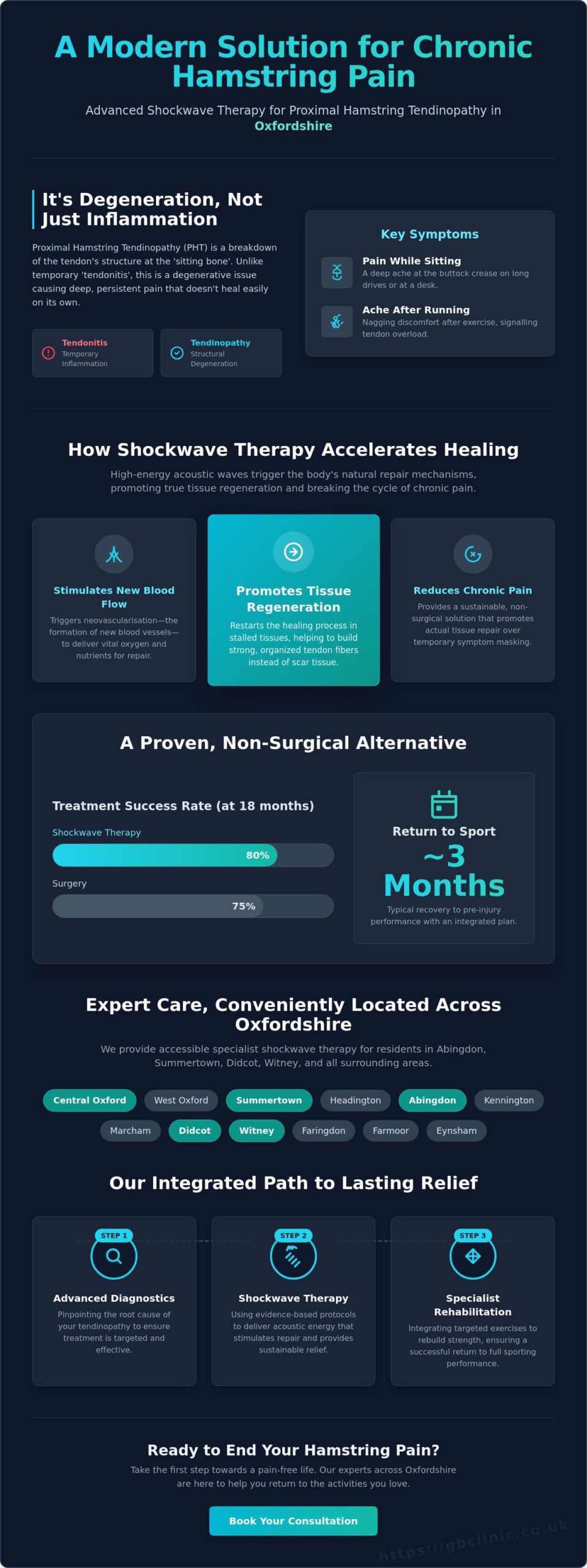
Clinical studies show that for chronic tendon conditions, shockwave therapy can achieve an 80% success rate at 18 months, which actually exceeds the 75% success rate typically reported for surgery. If you’re experiencing sharp pain while sitting or a nagging ache at the buttock crease after a run, you’re likely frustrated by how slowly these injuries heal. Many patients throughout Oxfordshire are now choosing shockwave therapy for hamstring tendonitis as a sophisticated, non-surgical method to trigger tissue repair and reduce chronic discomfort.
This guide explores how advanced extracorporeal shockwave therapy provides a clear path back to running and pain-free driving. We’ve made these specialist services highly accessible for residents in Abingdon, Summertown, Kennington, and Marcham, as well as those in Headington, Farmoor, Eynsham, and Didcot. You’ll discover an expert-led recovery plan that serves Witney, Faringdon, Central Oxford, and West Oxford. We will preview how our diagnostic tools and evidence-based protocols help you return to your pre-injury level of sport, often within just three months of starting treatment, according to recent clinical data.
Key Takeaways
- Identify the root cause of proximal hamstring tendinopathy as a degenerative process at the sitting bone rather than simple inflammation.
- Understand how acoustic waves stimulate neovascularisation, creating new blood vessels to provide essential nourishment to the damaged tendon tissue.
- Discover why shockwave therapy for hamstring tendonitis provides a sustainable non-surgical solution that promotes actual tissue repair over temporary symptom masking.
- Access professional clinical care from convenient locations across Oxfordshire, including Abingdon, Summertown, Headington, Didcot, and Witney.
- Learn how integrating advanced technology with specialist exercise rehabilitation ensures a successful transition from immediate pain relief to full sporting performance.
Understanding Chronic Hamstring Pain: Proximal Hamstring Tendinopathy
Proximal hamstring tendinopathy (PHT) is a condition that is frequently misunderstood as simple inflammation. In reality, it is a degenerative process affecting the tendon where it attaches to the ischial tuberosity, which is the sitting bone in your pelvis. For patients across Central Oxford and Summertown, this often manifests as a deep, nagging ache right at the buttock crease that becomes unbearable during a long drive or a desk-based workday. While many people use the term “hamstring tendonitis,” this is usually a misnomer for chronic tendinosis. This means the tendon’s internal structure has actually started to change and weaken over time rather than just being temporarily swollen or red. If you’re searching for shockwave therapy for hamstring tendonitis, it’s likely because standard treatments haven’t resolved this deeper structural issue.
Modern clinical evidence suggests that effective recovery often requires Extracorporeal shockwave therapy (ESWT). This technology is a primary component of shockwave therapy for hamstring tendonitis, helping to restart the natural healing process in tissues that have stalled in their recovery. It’s particularly useful for those in West Oxford or Headington who find that standard rest and stretching haven’t provided lasting relief. By delivering precise acoustic energy to the point of injury, we can stimulate the cellular changes necessary for long-term repair.
To better understand how this condition develops and how modern technology addresses it, watch this helpful video:
Common Causes and Risk Factors
Mechanical overload is a frequent culprit, especially for runners in Abingdon or Witney who may be over-striding during training sessions. However, compression is an equally significant factor. For those commuting from Didcot, Faringdon, or Marcham, prolonged sitting and driving puts direct pressure on the tendon against the sitting bone. This constant compression, when combined with poor lumbopelvic stability, creates a high-strain environment that the tendon cannot easily withstand. This often leads to sharp pain during sprinting or discomfort during long periods of sitting in the office.
Why Hamstring Tendons Struggle to Heal Naturally
Tendons have a significantly poorer blood supply compared to muscle tissue. This limited vascularity means that once micro-trauma begins, the body struggles to deliver the necessary oxygen and nutrients required for cellular repair. For residents in Kennington, Farmoor, or Eynsham dealing with chronic pain, simply resting or using ice is rarely sufficient to fix the structural underlying issue. The tendon often becomes stuck in a cycle of failed healing responses where the body attempts to repair the tissue but creates disorganized fibers instead. Without a targeted intervention like specialist physiotherapy or shockwave, the tissue remains weak and highly prone to re-injury during even low-impact daily activities.
How Shockwave Therapy Accelerates Hamstring Tendon Repair
The science behind shockwave therapy for hamstring tendonitis relies on a process called mechanical transduction. This occurs when high-energy acoustic waves pass through the skin to reach the deep tissues of the upper leg, where they convert mechanical energy into biological signals for repair. One of the most significant benefits of this intervention is neovascularisation. By creating microscopic trauma at the cellular level, the treatment encourages the formation of new blood vessels. This increased blood flow is vital because, as previously mentioned, the proximal hamstring tendon naturally lacks the robust vascularity needed to heal chronic degeneration on its own.
Beyond biological signaling, these acoustic waves help physically disrupt disorganized scar tissue and stubborn calcifications that often develop in long-term cases. This mechanical “cleaning” of the tendon allows for a more functional remodeling of the tissue. Patients also frequently experience a significant reduction in discomfort through pain modulation. The energy waves de-sensitize localized nerve endings, which can provide immediate relief for those struggling with the sharp sensations associated with sitting or sprinting. For residents in Central Oxford and West Oxford, this technology offers a way to address the physical cause of pain rather than just masking the symptoms.
The Biological Mechanism of ESWT
The effectiveness of this treatment lies in its ability to induce a controlled pro-inflammatory response. While chronic PHT is a degenerative state, shockwave therapy effectively “re-boots” the healing cycle by triggering the body’s natural defensive mechanisms. These high-energy acoustic waves stimulate tenocyte proliferation to facilitate essential collagen synthesis within the tendon matrix. This process is supported by a randomized controlled clinical study which demonstrated that shockwave therapy is significantly more effective than traditional conservative management for athletes with chronic proximal hamstring injuries.
We utilize both radial and focused shockwave technology to ensure the energy reaches the specific depth of the hamstring attachment at the sitting bone. This precision is what makes the treatment a leading choice for patients in Summertown, Headington, and Kennington who require a more sophisticated approach than standard manual therapy alone. By tailoring the wave’s focus, we can target the exact site of the micro-trauma without affecting the surrounding healthy muscle tissue.
What to Expect During a Shockwave Session
A typical session is efficient and straightforward, usually lasting between 15 and 20 minutes. We apply a clear coupling gel to the skin to ensure the acoustic waves transmit perfectly into the body. Your specialist then moves a handheld probe over the affected area, delivering the pulses. You’ll feel a distinct tapping or pulsing sensation; however, we always adjust the intensity based on your personal comfort levels to ensure the treatment is tolerable. Most patients require a standard course of 3 to 5 sessions, typically spaced one week apart, to achieve optimal results.
This modern recovery path is easily accessible for those living in Abingdon, Marcham, Farmoor, and Eynsham. Whether you’re traveling from Didcot, Witney, or Faringdon, our clinical team provides a structured environment focused on your return to mobility. If you’re ready to move past chronic pain, you can explore our specialist clinical options to see how we can support your recovery journey.
Shockwave Therapy vs. Traditional Management: Choosing the Best Option
Traditional management for hamstring injuries often relies on a combination of rest, ice, and manual therapy. While these methods are effective for minor muscle strains, they frequently fall short when treating the deep-seated degeneration of proximal hamstring tendinopathy. Standard physiotherapy focuses on muscle flexibility and general strengthening; however, shockwave therapy for hamstring tendonitis specifically targets the biological structure of the tendon at the sitting bone. For patients in Central Oxford and West Oxford, choosing advanced technology over months of slow progress with traditional massage can mean the difference between a frustratingly long recovery and a swift return to sport. A clinical review of shockwave therapy for hamstring tendinopathy suggests that this non-invasive approach provides a superior safety profile compared to surgical options, offering a viable solution for those who haven’t responded to initial conservative care.
Deciding between shockwave and a guided steroid injection is another common consideration for residents in Abingdon and Summertown. While steroids are excellent for reducing acute inflammation, they can sometimes lead to tendon weakening if used repeatedly. Shockwave therapy, conversely, promotes actual tissue remodeling and neovascularisation. It’s a regenerative choice rather than a symptomatic one. We often see patients from Kennington and Marcham who have spent months trying to manage their pain with over-the-counter solutions, only to find that 3-5 sessions of ESWT provide the functional restoration they’ve been missing. The efficiency of this treatment is backed by data showing that 80% of athletes can return to their pre-injury level of sport within three months, a result rarely achieved through rest alone.
Busting Myths: Is Shockwave Therapy Painful?
Many individuals in Headington and Farmoor worry that the treatment will be painful. It’s best described as uncomfortable but entirely tolerable. We intentionally avoid local anaesthetics during the procedure because the body’s natural inflammatory response is essential for the biological effectiveness of the treatment. You might feel a “bruised” sensation for 24-48 hours after your session, but this is actually a positive sign that the healing process has been successfully triggered. It’s a small, temporary trade-off for the long-term pain-free sitting and driving that our patients in Eynsham and Didcot expect.
Who is Not Suitable for Shockwave Therapy?
Safety is our clinical priority, so we perform a rigorous screening for every patient from Witney or Faringdon. Certain contraindications mean shockwave isn’t appropriate for everyone, including:
- Pregnancy or active localized infections.
- Blood clotting disorders or the use of specific anticoagulant medications.
- Recent steroid injections in the same area within the last 6-12 weeks.
- The presence of a cardiac pacemaker.
We also use diagnostic ultrasound scans when necessary to rule out referred pain from the lower back, ensuring that we’re treating the true source of your discomfort. This expert-led approach ensures that every patient receives the most appropriate intervention for their specific clinical needs.
Accessing Specialist Shockwave Therapy in Oxford and Surrounding Towns
GB Clinic stands as a central hub for advanced MSK services, providing specialized shockwave therapy for hamstring tendonitis to patients across Central Oxford and West Oxford. We understand that effective recovery relies on consistency. Having a local clinic ensures you don’t miss essential follow-up sessions due to travel fatigue or scheduling conflicts. Our facility serves as a primary resource for the wider Oxfordshire community, bridging the gap between clinical excellence and regional accessibility. We prioritize a patient-focused environment where modern therapeutic methods are delivered with interpersonal warmth and professional demeanor.
The Vital Role of Diagnostic Ultrasound
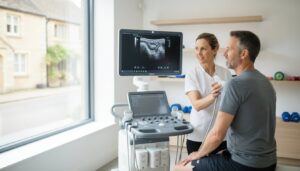
Before commencing any treatment plan, we strongly recommend a diagnostic ultrasound scan. This step is critical because it allows us to visualize the internal structure of the tendon in real-time. We can identify the exact grade of tendinopathy or detect the presence of partial tears that might not be evident through a physical examination alone. This diagnostic precision ensures we aren’t mistaking your symptoms for adjacent issues like ischial bursitis or piriformis syndrome. By confirming the diagnosis first, we ensure your treatment is targeted and efficient, avoiding the delays often associated with generalized care pathways.
Convenient Care for the Oxfordshire Region
Our clinical reach extends far beyond the city center. We provide a convenient solution for residents in Abingdon, Summertown, and Headington who require expert-led intervention without the need for long-distance travel. Patients frequently visit us from Witney, Didcot, and Bicester, benefiting from our modern clinical environment and streamlined patient journey. We’ve designed our services to reduce the stress of recovery by offering the following advantages:
- Easy accessibility for those traveling from Kennington, Marcham, and Farmoor.
- Ample parking facilities to ensure a stress-free arrival for patients from Eynsham and Faringdon.
- Modern clinical rooms equipped with the latest extracorporeal shockwave technology.
- A measured and logical flow from initial assessment to final rehabilitation.
The journey to our clinic is straightforward and efficient for those in outlying rural areas. We accommodate your schedule to ensure that professional, evidence-based care is never out of reach. This regional focus ensures that high-quality intervention is accessible to everyone in the county, regardless of their location. If you’re seeking a local partner for your recovery, you can view our full range of musculoskeletal services to begin your journey toward pain-free movement and restored mobility.
The GB Clinic Approach: Integrated Recovery for Lasting Relief
Successful recovery from chronic tendon injuries requires more than just high-tech intervention. While shockwave therapy for hamstring tendonitis serves as a powerful catalyst for tissue repair, it’s most effective when integrated into a comprehensive management plan. We combine acoustic wave technology with specialist physiotherapy to ensure the tendon doesn’t just heal, but also regains the functional strength needed for daily life. For our patients in Central Oxford and West Oxford, this means transitioning from immediate pain relief to a structured, strength-based rehabilitation program designed to prevent future relapses.
Our multidisciplinary approach also addresses concurrent musculoskeletal issues that often complicate hamstring recovery. Many active individuals in Summertown and Headington also experience joint-related discomfort in the hip or knee. In these complex cases, we may recommend Hyaluronic Acid (HA) injections to improve joint lubrication and reduce mechanical stress on the surrounding soft tissues. By treating the entire kinetic chain, we provide a more robust solution for residents in Didcot and Witney who have struggled with persistent, multi-site discomfort.
Your Personalized Hamstring Rehabilitation Pathway
We guide every patient through a measured, three-phase recovery journey to ensure the safest return to activity:
- Phase 1: Tissue Stimulation. We focus on pain reduction and restarting the healing cycle using extracorporeal shockwave therapy (ESWT).
- Phase 2: Progressive Loading. Under clinical supervision, you’ll begin specific exercises to improve the tendon’s tensile strength and load-bearing capacity.
- Phase 3: Functional Restoration. This final stage involves gait analysis and sport-specific testing to ensure you’re ready for full activity.
Advanced Alternatives for Complex Cases
If a diagnostic assessment reveals secondary issues like acute bursitis, we can provide ultrasound-guided steroid injections to settle localized inflammation quickly. For patients in Abingdon, Faringdon, or Marcham with particularly stubborn injuries, we also offer regenerative options like PRP and prolotherapy. These treatments are designed to support the body’s natural repair mechanisms when standard conservative paths have reached a plateau.
Long-term prevention is the final piece of the recovery puzzle. We work with patients from Kennington, Farmoor, and Eynsham to modify running mechanics and improve sitting ergonomics at work. These small but vital adjustments help protect the ischial tuberosity from excessive compression. Booking an initial assessment is the first step toward a clear, expert-led clinical pathway that restores your mobility and gets you back to the activities you love without the constant shadow of pain.
Start Your Path to Pain-Free Movement
Overcoming chronic tendon pain requires a shift from temporary relief to actual tissue regeneration. By utilizing shockwave therapy for hamstring tendonitis, you’re choosing a non-invasive treatment that boasts an 80% success rate for returning athletes to their sport within three months. Our expert MSK clinicians use state-of-the-art diagnostic ultrasound to ensure your recovery plan is based on precise clinical data. This modern approach addresses the underlying degeneration at the sitting bone, helping you move past the limitations of traditional rest and ice.
We’ve established a highly rated local clinic that’s easily accessible for residents across Oxfordshire. Whether you’re traveling from Abingdon, Summertown, or Kennington, our team provides the consistent, expert-led care necessary for lasting results. We also serve patients from Marcham, Headington, and Farmoor; as well as those in Eynsham, Didcot, and Witney. If you’re based in Faringdon, Central Oxford, or West Oxford, you’ll find our facilities conveniently located with ample parking to ensure a stress-free experience.
Book Your Initial Shockwave Assessment in Oxford Today
You don’t have to endure sharp pain while sitting or driving. Professional, evidence-based relief is closer than you think.
Frequently Asked Questions
How many sessions of shockwave therapy will I need for hamstring tendonitis?
Most patients require a standard course of 3 to 5 sessions spaced at weekly intervals to achieve the best results. This specific timeframe allows the body to initiate the biological repair process between applications. Your specialist will monitor your progress during each visit to our Oxford clinic; ensuring the treatment plan remains aligned with your specific recovery goals and physical restoration.
Is shockwave therapy for hamstring pain covered by private health insurance?
Many private health insurance providers do cover shockwave therapy for hamstring tendonitis, though coverage varies depending on your specific policy. We recommend contacting your insurer directly to confirm their requirements for musculoskeletal treatments. Our administrative team can provide the necessary clinical receipts and documentation to support your claim after your sessions in our West Oxford or Headington facilities.
How soon can I return to running after starting shockwave treatment?
A phased return to running typically begins after the initial course of treatment, with many athletes reaching their pre-injury level within three months. This timeline depends on the severity of the tendon degeneration and your adherence to the prescribed exercise rehabilitation plan. We use functional testing to ensure your tendon can safely handle the mechanical load before you resume training in Witney or Didcot.
Can shockwave therapy help if I have had hamstring pain for several years?
Shockwave therapy for hamstring tendonitis is specifically designed to address chronic conditions where the natural healing process has stalled for several years. It works by converting a chronic, degenerative state back into an acute healing phase through mechanical transduction. This makes it an ideal solution for residents in Marcham or Kennington who’ve struggled with long-standing pain that hasn’t responded to traditional rest.
What is the difference between radial and focused shockwave for deep injuries?
Radial shockwaves disperse energy over a wider, more superficial area, while focused shockwaves penetrate deeper with greater precision. For deep hamstring injuries at the sitting bone, focused technology is often preferred to reach the exact site of the tendon attachment. Our clinicians serving Farmoor and Eynsham select the most appropriate method based on the depth of your injury as identified during your diagnostic ultrasound.
Will I feel immediate relief after my first shockwave session?
You may experience an immediate reduction in pain due to the de-sensitization of localized nerve endings during the session. However, the true biological repair and remodeling of the tendon tissue occur over several weeks following the treatment course. Patients in Faringdon should expect gradual functional improvement rather than a total disappearance of symptoms after just one visit to our specialist clinical facility.
Are there any side effects to shockwave therapy for the hamstring?
Side effects are generally mild and temporary, often including a bruised sensation, slight swelling, or redness in the treated area. These reactions are actually positive indicators that the body’s inflammatory healing response has been activated. Most discomfort resolves within 24 to 48 hours, allowing you to continue with your daily activities in Central Oxford or Summertown without any significant disruption.
Do I need a GP referral to book shockwave therapy at GB Clinic in Oxford?
You don’t need a GP referral to book an assessment at GB Clinic. We accept direct bookings from individuals across Oxfordshire seeking specialist intervention for musculoskeletal pain. During your initial consultation, our expert clinicians will perform a comprehensive screening and diagnostic scan to determine if this is the most effective clinical pathway for your specific condition in Abingdon or surrounding areas.