
With over one million people in the UK currently enduring the debilitating stiffness of adhesive capsulitis, it’s clear that you aren’t alone in your struggle to reach for a seatbelt or find a comfortable sleeping position. If you’re searching for effective frozen shoulder treatment Oxford specialists can provide, you’ve likely already experienced the frustration of waiting for improvement while your quality of life diminishes. The constant, throbbing pain doesn’t just limit your movement; it steals your rest and makes simple daily tasks feel like monumental challenges.
We understand that the fear of invasive surgery often prevents patients from seeking the help they need. However, there’s a clinical path to recovery that avoids the operating theatre entirely. Ultrasound-guided shoulder hydrodistension offers a sophisticated, non-surgical reset for your joint, using precise pressure to expand the tightened capsule and restore your range of motion. This advanced procedure is now readily accessible for residents across Oxfordshire, including those in Abingdon, Summertown, Kennington, and Marcham. Whether you’re based in Headington, Farmoor, Eynsham, or Didcot, our expert-led approach focuses on rapid pain relief and functional restoration. We’ll explain how combining precision injections with specialist rehabilitation in Witney, Faringdon, Central Oxford, and West Oxford can help you reclaim a mobile life and finally enjoy a full night’s sleep.
Key Takeaways
- Identify which of the three stages of frozen shoulder you’re currently experiencing to determine the most effective clinical path for your recovery.
- Discover how ultrasound-guided hydrodistension acts as a precise, non-surgical frozen shoulder treatment Oxford residents can access to rapidly restore joint mobility.
- Understand the vital “window of opportunity” in the first 72 hours post-injection, where specialist manual therapy and exercise rehabilitation are most effective.
- Access expert MSK care without the frustration of long waiting lists, with clinics conveniently located for patients in Abingdon, Summertown, Witney, and Didcot.
- Learn how the physical expansion of the shoulder capsule through controlled fluid volume provides a mechanical reset to eliminate chronic pain and sleep deprivation.
Understanding Frozen Shoulder (Adhesive Capsulitis)
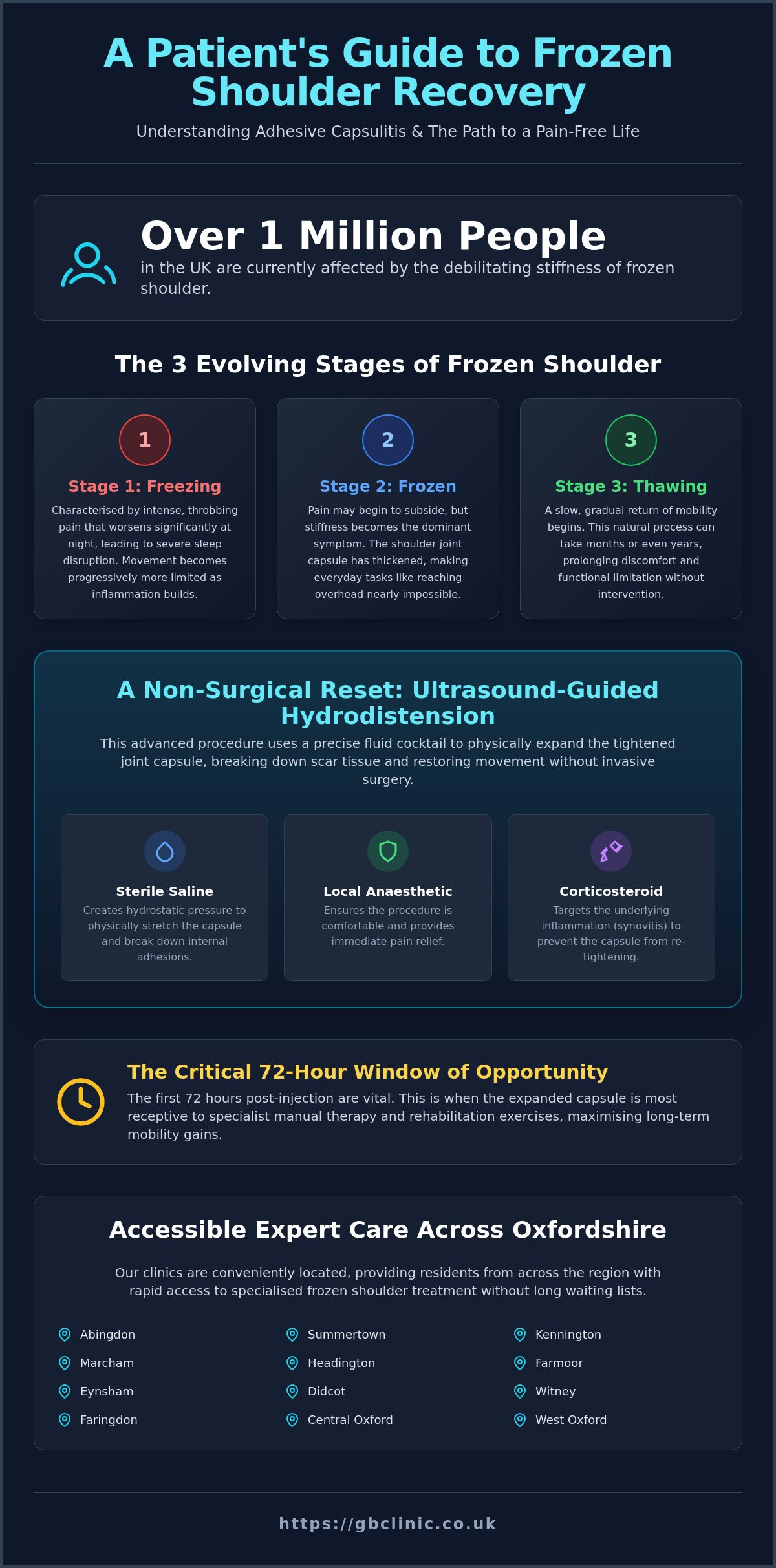
Frozen shoulder, clinically known as Understanding Adhesive Capsulitis (Frozen Shoulder), is a condition characterised by the progressive thickening and contraction of the shoulder joint capsule. This “wrapper” around the joint becomes inflamed and scarred, significantly restricting the space for the humerus to move freely. It affects approximately 2% to 5% of the UK population, particularly those aged between 40 and 70. Individuals with diabetes or those recovering from minor shoulder trauma are at a higher risk, often experiencing a sudden onset of stiffness that can last for months or even years.
The condition typically evolves through three distinct phases. The “Freezing” stage is marked by intense, throbbing pain, especially at night. This transitions into the “Frozen” stage, where pain may subside but stiffness becomes the dominant symptom, making it nearly impossible to reach behind your back or overhead. Finally, the “Thawing” stage sees a slow return of mobility. For many seeking frozen shoulder treatment Oxford clinics provide, the goal is to bypass the years of discomfort that these stages can occupy and regain function much sooner than the natural history of the condition allows.
To better understand the mechanical nature of this condition and how specific movements play a role, watch this helpful video:
The Inflammatory Cycle of Adhesive Capsulitis
The process begins with synovitis, a painful inflammation of the joint lining. As the body attempts to heal, it produces excess collagen, leading to fibrosis or internal scarring. This makes the joint capsule dense and inelastic. During the early freezing stage, standard physiotherapy can often be counterproductive; aggressive movement may actually flare the inflammation. A precise diagnostic ultrasound scan is essential to confirm the stage of the condition and tailor the intervention appropriately, ensuring early intervention prevents years of avoidable stiffness.
Why Traditional Stretches Sometimes Stall
Many patients in Abingdon, Summertown, and Headington find that traditional home stretches yield little progress. When the capsule has physically thickened and adhered to itself, no amount of stretching can overcome that mechanical barrier without assistance. This physical blockade is why residents from Witney to Didcot and across West Oxford are turning to mechanical solutions like hydrodistension. By physically stretching the capsule from the inside, we create the space needed for specialist physiotherapy to finally work. This local choice is ideal for those in Kennington, Marcham, Farmoor, Eynsham, Faringdon, and Central Oxford seeking a path beyond the leathery resistance of a scarred joint.
The Science of Shoulder Hydrodistension (Hydrodilatation)
Hydrodistension is more than a simple injection; it’s a mechanical procedure designed to physically expand a joint capsule that has become leathery and restrictive. For those seeking frozen shoulder treatment Oxford specialists offer, understanding the “how” behind the procedure builds confidence in its efficacy. We use a precisely formulated “cocktail” of sterile saline, local anaesthetic, and a corticosteroid. Each component serves a specific clinical purpose. The saline creates the necessary hydrostatic pressure to break down internal adhesions. Meanwhile, the local anaesthetic ensures the procedure remains comfortable, and the corticosteroid targets the underlying synovitis to prevent the capsule from tightening again after the procedure.
The steroid’s role is particularly crucial for long-term success. While the saline provides the immediate mechanical stretch, the corticosteroid halts the inflammatory cycle. This prevents the formation of new myofascial adhesions. It’s this combination of immediate physical release and ongoing chemical suppression that makes this one of the most effective non-surgical options available in Didcot, Witney, and Eynsham. By addressing both the physical barrier and the biological trigger, we provide a comprehensive solution for those in Faringdon and West Oxford.
The Mechanical Release Effect
In a healthy shoulder, the joint capsule typically holds about 15ml to 20ml of fluid. In a frozen shoulder, this capacity often shrinks to as little as 2ml or 3ml. Hydrodistension works by carefully injecting a controlled volume of fluid to stretch the capsule back toward its natural capacity. This creates a physical “release” of the restricted tissues. Unlike Manipulation Under Anaesthetic (MUA), which involves a surgeon forcefully moving the arm while the patient is unconscious, hydrodistension is performed while you’re awake. This significantly reduces the risks associated with general anaesthesia and bone fractures, making it a safer, modern alternative for residents in Kennington, Marcham, and Farmoor.
Ultrasound Guidance: Ensuring Precision
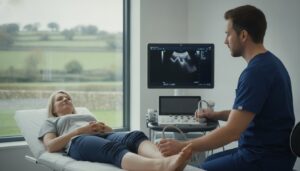
The success of this procedure relies entirely on the accuracy of the needle placement. Traditional “blind” injections rely on anatomical landmarks, which can be imprecise. We utilise a high-resolution diagnostic ultrasound scan to visualise the needle in real-time as it enters the posterior joint capsule. This ensures the fluid is delivered exactly where it’s needed to achieve maximum distension. By seeing the capsule expand on the screen, our specialists can confirm the mechanical release is occurring. This level of precision is why patients from Abingdon, Summertown, and Headington trust our clinical approach. If you’re ready to explore these advanced options, you can speak with our Oxford team about your specific symptoms.
The Procedure: Precision Treatment at GB Clinic Oxford
At GB Clinic, we prioritise a calm and efficient environment for your recovery. Your journey begins with a comprehensive initial assessment where our MSK specialists confirm the diagnosis of adhesive capsulitis. This step is vital to ensure that hydrodistension is the appropriate frozen shoulder treatment Oxford patients require, as it allows us to rule out other conditions like rotator cuff tears that might present similarly. We carefully check for any contraindications, such as active infections or specific allergies, to ensure your safety throughout the clinical process.
After the procedure, you’ll remain in our clinic for a brief period of observation. Our practitioners perform immediate range-of-motion checks to assess the initial improvement in your mobility. It’s often a significant moment for patients who haven’t been able to lift their arm comfortably for many months. We provide clear, straightforward guidance on what to expect over the following hours, ensuring you feel supported as you leave the clinic.
Step-by-Step Patient Journey
Our clinical team maintains a strictly sterile environment, using a meticulous skin preparation process with antiseptic solution to minimise any risk of infection. To ensure the procedure is as comfortable as possible, we apply a local anaesthetic to the entry site and the joint capsule itself. Once the area is numb, the specialist uses a diagnostic ultrasound scan to guide the needle with sub-millimetre precision. As the saline and guided steroid injection enter the joint, we monitor the capsule’s expansion in real-time. You might feel a sensation of fullness or pressure; this is a positive sign that the mechanical adhesions are being successfully stretched.
Local Accessibility for Oxfordshire Patients
We’ve designed our services to be the convenient, local choice for the region. Residents in Abingdon, Summertown, and Headington can reach our Oxford hubs within minutes, avoiding the logistical stress of large, city-centre hospitals. For those travelling from Kennington, Marcham, or Farmoor, the journey is straightforward and efficient. We provide dedicated parking and easy access for patients visiting from Eynsham, Witney, Didcot, or Faringdon. Choosing a specialist private clinic for frozen shoulder treatment Oxford residents can trust means you receive a tailored, patient-focused experience without the long waiting lists found in the public sector. Our practitioners take the time to listen to your concerns, providing a level of interpersonal warmth and professional demeanor that is central to our care in Central Oxford and West Oxford.
Post-Injection Rehabilitation: Maximising Your Results
The mechanical reset achieved through hydrodistension is only the first step in your recovery. To ensure the joint capsule doesn’t simply “scar down” again, the first 72 hours following your procedure represent a critical window of opportunity. During this time, the capsule is at its most pliable, and the local anaesthetic provides a period of reduced discomfort that allows for movements previously considered impossible. Integrating your frozen shoulder treatment Oxford with immediate, specialist physiotherapy in Oxford is essential to maintain the range of motion gained during the injection.
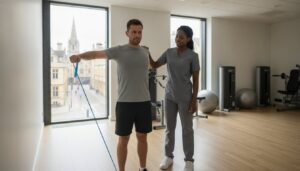
Our practitioners use targeted manual therapy to gently guide the joint through its new boundaries. This hands-on approach helps to desensitise the nervous system and prevent the protective muscle guarding that often accompanies chronic shoulder pain. We also provide a structured self-management plan. These specific exercises are designed to keep the joint surfaces gliding, ensuring that patients from Abingdon, Summertown, and Kennington can continue their progress at home. Consistent movement is the only way to prevent the inflammatory cycle from restarting.
Advanced Recovery with Multimodal Care
In many cases, the primary stiffness of a frozen shoulder leads to secondary issues like compensatory tendonitis or bursitis. We often incorporate shockwave therapy to address these persistent soft tissue problems. This technology uses acoustic pulses to stimulate blood flow and tissue regeneration, which is particularly beneficial for residents in Marcham, Headington, and Farmoor who have been suffering for several months. By combining hydrodistension with these advanced MSK tools, we provide a comprehensive path to recovery that addresses every layer of your discomfort.
A Typical 6-Week Recovery Roadmap
Recovery is a progressive journey that requires patience and clinical guidance. Patients visiting from Eynsham, Didcot, and Witney typically follow this structured path:
- Week 1: Focus on gentle, pain-free range of motion and managing any post-procedural soreness.
- Weeks 2-4: Progression to strengthening the rotator cuff and stabilising the scapula to support the new mobility.
- Weeks 5-6: A return to full functional activities, including sports, gardening, or overhead reaching for those in Faringdon and West Oxford.
Our goal is to return you to a state of pain-free movement as efficiently as possible. If you’re ready to start your journey toward a mobile shoulder, book your initial assessment at our Central Oxford clinic today.
Why Choose GB Clinic for Frozen Shoulder Treatment in Oxfordshire?
GB Clinic stands as a regional authority for those seeking a faster, more precise alternative to traditional healthcare waiting lists. Our practitioners are highly skilled MSK specialists who combine extensive clinical experience with the latest diagnostic technology. We don’t just offer a single intervention; we provide a complete recovery pathway. By integrating guided steroid injections with expert-led manual therapy and exercise rehabilitation, we ensure your recovery is both rapid and sustainable. This comprehensive approach is why we serve the wider community, from Didcot and Faringdon to West Oxford and beyond.
- Specialist-led diagnostic and therapeutic procedures for maximum accuracy.
- CQC registered facility ensuring the highest clinical and safety standards.
- Direct access to specialist care without the requirement for a GP referral.
- A seamless journey from your initial ultrasound scan to your final rehabilitation session.
Our commitment to excellence means we focus on outcomes that matter to you. We understand that residents in Witney, Eynsham, and Farmoor want to return to their daily activities without the delay of long-term stiffness. By choosing a specialist clinic for your frozen shoulder treatment Oxford, you’re opting for a service that prioritises your mobility and long-term joint health.
Trust and Clinical Excellence
We pride ourselves on a professional demeanor that places patient comfort at the centre of our practice. We use direct patient feedback to refine our clinical standards, ensuring every individual feels heard and respected. Our clinic provides a calm, clinical environment designed to reduce the anxiety often associated with medical procedures. This focus on interpersonal warmth, combined with our technical expertise, has established us as a primary destination for frozen shoulder treatment Oxford residents can rely on for consistent results.
Your Path to a Pain-Free Shoulder
Living with a frozen shoulder is a significant burden, but hydrodistension provides a clear mechanical solution. By physically expanding the joint capsule, we offer the direct benefit of restored mobility and a return to a comfortable, active life. Whether you live in Central Oxford, Headington, or Summertown, or you’re visiting from Abingdon, Kennington, or Marcham, our clinic is easily accessible and ready to support your recovery. We provide a tailored experience that large hospitals often struggle to match, focusing on your specific functional goals.
You don’t have to endure the pain and sleep deprivation of a frozen shoulder any longer. Book your specialist shoulder assessment at GB Clinic today and take the first step toward reclaiming your range of motion.
Reclaiming Your Mobility and Restful Sleep
Restoring your range of motion doesn’t have to involve the risks of invasive surgery or the frustration of long hospital waiting lists. By choosing ultrasound-guided hydrodistension, you’re opting for a mechanical joint reset that addresses the physical barriers of adhesive capsulitis directly. Our specialist MSK practitioners use real-time imaging to ensure every procedure meets the highest clinical standards of precision. This advanced frozen shoulder treatment Oxford residents rely on is designed to bridge the gap between chronic pain and a return to full functional activity.
Our CQC registered facility provides a convenient, local choice for individuals throughout the region. Whether you’re based in Abingdon, Summertown, Kennington, or Marcham, our clinic is easily reachable for your appointments. We also regularly support patients from Headington, Farmoor, Eynsham, and Didcot, alongside those travelling from Witney, Faringdon, Central Oxford, and West Oxford. By combining ultrasound-guided precision with a structured rehabilitation roadmap, we help you overcome the leathery resistance of a frozen joint. It’s time to stop enduring sleep deprivation and start your journey toward a mobile, pain-free life. We’re here to support your recovery every step of the way.
Book Your Specialist Shoulder Assessment in Oxford
Frequently Asked Questions
Is shoulder hydrodistension painful?
Most patients experience a sensation of fullness or pressure rather than sharp pain during the procedure. We apply local anaesthetic to the entry site and the joint capsule to ensure your comfort throughout the process. While the mechanical stretching of the capsule can be briefly uncomfortable, the presence of anaesthetic in the fluid cocktail manages this effectively. Residents from Kennington or Marcham find the process much more tolerable than they initially anticipated.
How long does it take for a hydrodistension injection to work?
You’ll often notice an immediate mechanical improvement in your range of motion right after the injection. However, the full anti-inflammatory effect of the corticosteroid typically takes between one and two weeks to reach its peak. This is why the initial 72-hour window is so vital for starting your prescribed exercises. Patients in Abingdon and Farmoor are encouraged to use this period of reduced pain to begin their intensive rehabilitation.
Can I drive home after a shoulder hydrodistension procedure?
We strongly advise that you don’t drive for at least 24 hours following your shoulder procedure. The local anaesthetic used can temporarily affect the strength and coordination of your arm, making it unsafe to operate a vehicle. We recommend arranging for a friend or family member to collect you from our clinic. This ensures a safe journey back to locations like Didcot, Witney, or Eynsham after your specialist treatment.
What are the risks or side effects of shoulder hydrodilatation?
While hydrodistension is a safe, non-surgical procedure, potential side effects include temporary post-injection pain or a flare of symptoms for about 48 hours. Rare risks include joint infection, which we mitigate through strict sterile techniques, or temporary skin thinning at the injection site. Our practitioners provide comprehensive aftercare instructions to all patients from Summertown and Headington to ensure any minor reactions are managed effectively and safely.
How many hydrodistension injections will I need for frozen shoulder?
Most patients require only a single hydrodistension procedure to achieve long-term relief when it’s combined with a structured exercise program. If your condition is particularly advanced or stubborn, a second injection might be considered after several months of rehabilitation. This tailored approach to frozen shoulder treatment Oxford ensures we don’t over-treat, focusing instead on the minimum intervention needed to restore your mobility and daily routine.
Is hydrodistension better than surgery for frozen shoulder?
Hydrodistension is a significantly less invasive alternative to surgery that avoids the risks of general anaesthesia and long hospital stays. Clinical evidence suggests it’s highly effective for the majority of patients, particularly those in the frozen stage of the condition. Unlike surgical manipulation, this procedure uses controlled fluid pressure to gently expand the capsule from the inside. This makes it a preferred local choice for residents in Faringdon or West Oxford.
Can I get hydrodistension on the NHS vs privately in Oxford?
Hydrodistension is available on the NHS, but waiting lists in Oxfordshire can often be several months long. Choosing a private frozen shoulder treatment Oxford clinic allows you to bypass these delays and start your recovery almost immediately. We offer fast-track assessments and procedures for patients across Central Oxford and the surrounding towns. This speed of access is often the deciding factor for those suffering from severe sleep deprivation.
What should I wear for my shoulder injection appointment?
You should wear loose-fitting clothing that allows easy access to your shoulder, such as a sleeveless top or a vest. We need to maintain a sterile field around the joint, so being able to expose the area without removing all your layers is very helpful. If you’re visiting from Marcham or Kennington, bringing a zip-up hoodie can also keep you comfortable and warm after the procedure while ensuring the injection site remains protected.