

That first step out of bed shouldn’t feel like walking on rusted gears. For many active individuals across Oxfordshire, from Summertown to Abingdon, persistent stiffness often feels like a permanent barrier to daily exercise or work. You likely fear that an ankle fusion or replacement is your only remaining option. However, hyaluronic acid injections for ankle arthritis provide a specialized, non-surgical method to restore the natural lubrication your joint has lost. By focusing on joint fluidity rather than just masking inflammation, this treatment aims to return you to a mobile, comfortable state without the risks of invasive surgery.
We understand the frustration of reduced mobility, whether you’re navigating the streets of Central Oxford or walking in the countryside near Farmoor and Eynsham. This 2026 guide details how our expert-led clinics in Headington and West Oxford utilize ultrasound-guided technology for maximum precision. You’ll learn how combining these injections with targeted rehabilitation can improve your range of motion and provide long-lasting pain relief. We also highlight the accessibility of our specialist services for residents in Kennington, Marcham, Didcot, Witney, and Faringdon, ensuring that professional, evidence-based care is always a convenient, local choice.
Key Takeaways
- Learn how restoring natural lubrication in the joint can significantly reduce bone-on-bone friction and alleviate persistent ankle stiffness.
- Understand why hyaluronic acid injections for ankle arthritis offer a sustainable mechanical solution compared to the temporary effects of steroid treatments.
- Discover the clinical importance of ultrasound-guided technology for ensuring precise delivery into the narrow and complex ankle joint space.
- Find out how specialist MSK care is easily accessible for residents across Oxfordshire, including those in Abingdon, Witney, Didcot, and Summertown.
- Explore how advanced non-surgical interventions can improve your daily mobility and help delay the need for invasive ankle fusion or replacement surgery.
Understanding Ankle Arthritis and the Role of Hyaluronic Acid
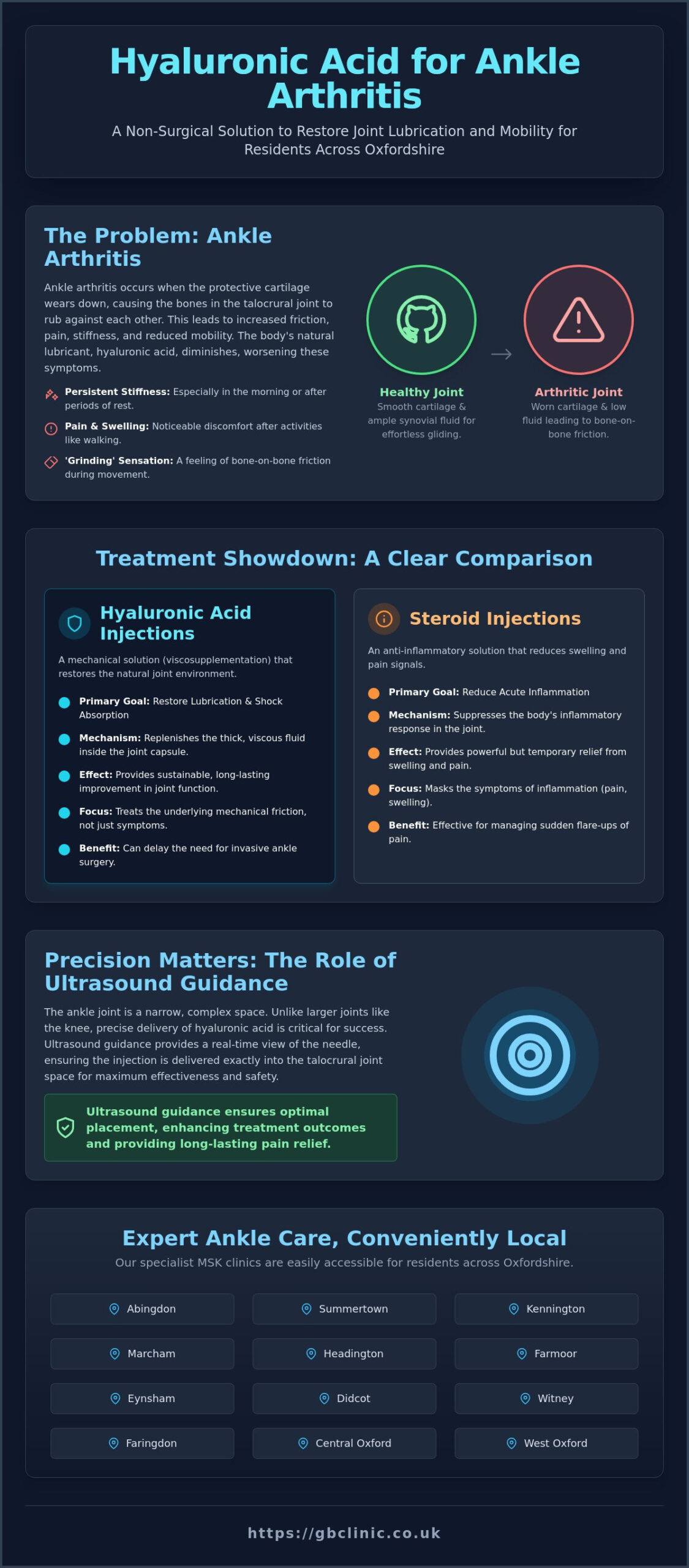
Ankle arthritis occurs when the smooth cartilage lining the talocrural joint begins to erode. This cartilage acts as a vital buffer between the tibia and the talus bone. When it wears down, the joint loses its ability to glide effortlessly, often resulting in pain and restricted movement. This degenerative process is frequently accelerated by a decrease in the quality of synovial fluid within the joint capsule.
Hyaluronic acid is a naturally occurring lubricant found within this fluid. It’s essential for maintaining the viscosity needed to protect the joint under weight-bearing pressure. As we age or following a traumatic injury, the body’s production of this lubricant slows down, leading to increased friction and discomfort. Viscosupplementation is the clinical process of restoring this vital substance through direct application. Hyaluronic acid injections for ankle arthritis are a non-surgical intervention designed to improve joint shock absorption by replenishing the natural fluid balance.
To better understand how these treatments help you stay active, watch this overview of managing ankle arthritis:
Common Symptoms of Ankle Osteoarthritis
For patients in Abingdon, Kennington, or Marcham, recognizing early signs is key to avoiding long-term mobility issues. Symptoms typically include morning stiffness that requires a ‘warm up’ period before movement feels fluid. You might also notice swelling after walking around Central Oxford or a distinct ‘grinding’ sensation in the foot joint. These issues often lead to a reduced range of motion that makes navigating uneven terrain in Farmoor or Eynsham increasingly difficult.
Why the Ankle Joint Responds Differently to Treatment
The ankle is a unique, high-pressure joint. Unlike the knee, it has a significantly smaller surface area that must support the entire body’s weight. This concentrated pressure means that cartilage in the ankle is naturally thinner and more susceptible to mechanical stress. Early intervention with Hyaluronic Acid (HA) injections is often more beneficial than relying solely on aggressive anti-inflammatories. While steroids address acute swelling, lubrication focuses on the physical friction that causes long-term damage.
Our specialists in Headington and Summertown focus on this mechanical restoration to preserve your joint health. Residents in Didcot, Witney, Faringdon, and West Oxford can access these advanced MSK services without the delays often found in traditional hospital settings. By prioritizing hyaluronic acid injections for ankle arthritis, we help you maintain an active lifestyle and delay the need for more invasive procedures.
The Science of Viscosupplementation for Ankle Joint Pain
Viscosupplementation works by physically altering the environment within the talocrural joint to restore lost function. When we administer hyaluronic acid injections for ankle arthritis, the primary objective is to increase the viscosity of the synovial fluid. This thicker fluid acts as a high-performance lubricant, which directly reduces the bone-on-bone friction that causes debilitating pain during movement. Clinical research regarding the Effectiveness of Viscosupplementation for Ankle Arthritis suggests that this intervention is particularly useful for managing mechanical symptoms that haven’t responded to traditional rest or ice.
Beyond simple lubrication, the injected substance provides a temporary ‘biological scaffold’. This structure supports the remaining cartilage cells and may help protect them from further mechanical breakdown. Interestingly, the presence of exogenous hyaluronic acid often triggers the joint’s lining to begin producing more of its own natural lubricant. This dual action explains why the benefits of the treatment don’t disappear overnight. Most patients in areas like Headington or Summertown find that their symptoms continue to improve as the joint environment stabilizes.
Results from these injections are rarely instantaneous, as the body needs time to integrate the supplement. Therapeutic benefits typically peak between 4 and 6 weeks after the session. During this window, the anti-inflammatory properties of the HA take full effect, providing a smoother internal surface for the joint. For residents in Marcham, Kennington, or Abingdon, this often translates to several months of improved mobility and a significant reduction in daily discomfort.
How HA Reduces Mechanical Pain
The ankle joint endures immense force, particularly during the ‘heel strike’ phase of walking. Hyaluronic acid acts as a primary shock absorber, dampening the impact before it reaches the bone. It also works by coating sensitive pain receptors within the joint capsule, which helps to lower overall nerve sensitivity. This improved ‘glide’ allows for a more natural gait, whether you’re commuting through Central Oxford or walking on the uneven terrain around Farmoor and Eynsham.
Who is a Suitable Candidate for Ankle HA Injections?
This treatment is most effective for individuals with mild to moderate (Grade 1-3) osteoarthritis. It is a strategic choice for those living in Didcot, Witney, or Faringdon who wish to delay or entirely avoid invasive ankle fusion surgery. If you have already explored options like manual therapy but still experience persistent stiffness, viscosupplementation may be the next logical step in your recovery. Our specialists in West Oxford can help you assess your suitability for this advanced non-surgical option during a clinical consultation.
Comparing Hyaluronic Acid vs. Steroid Injections for the Ankle
Choosing the right intervention for joint pain depends on whether the primary issue is acute inflammation or mechanical wear. Corticosteroids are powerful chemical agents designed to suppress the immune system’s inflammatory response. They offer rapid relief for joints that are swollen, hot, or severely painful. In contrast, hyaluronic acid injections for ankle arthritis focus on the physical environment of the joint. Rather than just masking symptoms, this treatment restores the natural gliding properties of the talocrural joint, providing a mechanical solution to a mechanical problem.
While steroids work quickly, often within forty-eight hours, they carry risks if used too frequently. Repeated exposure to high-dose steroids can lead to the degeneration of local tissues, including tendons and the remaining cartilage. This is why many active individuals in Headington and Summertown now look toward viscosupplementation. Hyaluronic acid has a slower onset of action, typically taking several weeks to reach its full effect, but it maintains a superior safety profile for long-term joint preservation. It is a strategic choice for those who want to remain mobile without compromising the structural integrity of their ankle.
When to Choose Corticosteroids
Corticosteroids remain the gold standard for managing acute ‘flare-ups’ where the ankle is visibly swollen and painful even at rest. If you need immediate relief to regain basic mobility for work in Central Oxford or to manage a sudden increase in symptoms, these injections are highly effective. At our clinics, Guided steroid injections are used to ensure the medication reaches the exact site of inflammation. This precision helps to break the cycle of pain and swelling quickly, though it is often viewed as a short-term bridge rather than a long-term cure.
When Hyaluronic Acid is the Superior Choice
For the chronic, ‘grumbly’ pain associated with daily walking or exercise, hyaluronic acid is often the better option. It is ideal for residents in Abingdon, Witney, and Didcot who find that their ankle stiffness persists despite not being actively swollen. This treatment is specifically designed to preserve the joint by reducing internal friction. It is the preferred path for patients in Kennington, Marcham, or Faringdon who wish to avoid the potential side effects of steroids while maintaining an active lifestyle. Whether you are navigating the uneven paths in Farmoor and Eynsham or commuting through West Oxford, focusing on lubrication helps keep the joint healthy and functional for the long term.
The Importance of Ultrasound-Guided Injections for Ankle Accuracy
The ankle joint space is significantly narrower and more complex than the knee. This anatomical reality makes precision essential for successful viscosupplementation. While some practitioners still rely on landmark-based or “blind” injections, these have a notably higher failure rate in the ankle due to the tight joint capsule. When administering hyaluronic acid injections for ankle arthritis, our specialists use advanced imaging to ensure the gel is placed exactly where it’s needed.
Ultrasound technology allows the practitioner to see the needle enter the joint capsule in real-time. This visualization eliminates guesswork and ensures that the hyaluronic acid isn’t accidentally injected into surrounding soft tissue or fat pads. For patients in Abingdon, Witney, and Didcot, this level of accuracy leads to significantly better clinical outcomes and reduced procedural discomfort. Residents in Headington and Summertown benefit from our on-site diagnostic capabilities, which streamline the entire treatment process.
What to Expect During the Procedure
Your appointment begins with a diagnostic ultrasound scan to assess the current state of the talocrural joint. This step is crucial for identifying any structural changes that might influence the injection path. Once the joint is mapped, the skin is thoroughly cleaned. A local anaesthetic may be used to ensure your comfort throughout the process. The HA gel is then precisely delivered into the synovial space under continuous visualization. This method ensures that the lubricant is distributed evenly across the weight-bearing surfaces of the joint.
Post-Injection Care and Recovery
Recovery after the procedure is typically straightforward. We recommend that you avoid strenuous weight-bearing exercise for 48 hours to allow the gel to settle within the joint. It’s normal to feel a mild sensation of ‘fullness’ or pressure in the ankle for the first 24 hours as the joint adjusts to the increased volume of fluid. This feeling usually subsides quickly as you resume light activity.
To maximize long-term results, we suggest integrating the injection with a tailored physiotherapy programme. Strengthening the muscles around the ankle joint helps to offload the cartilage and maintain the benefits of the lubrication. Whether you’re commuting through Central Oxford, working in West Oxford, or walking near Farmoor and Eynsham, this combined approach offers the best chance for sustained relief. Patients from Kennington, Marcham, and Faringdon find our comprehensive care model provides a clear path back to their favorite activities. If you’re ready to address your persistent ankle pain, you can book a specialist assessment at our Oxfordshire clinic today.
Accessing Specialist Ankle Care Across Oxfordshire
GB Clinic serves as a central hub for advanced MSK care in the Oxfordshire region. Our facilities are strategically placed to offer convenient access for residents in Summertown, Headington, and Central Oxford. We prioritize a patient-first approach, ensuring that your journey from initial diagnosis to final rehabilitation is seamless and professional. For those traveling from surrounding areas, our clinics offer easy access and nearby parking to minimize the stress of your visit.
If you’re dealing with persistent stiffness or seeking to delay invasive surgery, hyaluronic acid injections for ankle arthritis provide a viable, non-surgical path to recovery. We focus on providing evidence-based treatments within a calm, clinical environment that builds confidence in your recovery plan. Our team is dedicated to restoring your mobility through precise, expert-led interventions.
Serving Our Local Communities
We are committed to providing expert care to patients across the entire county. Our specialist services are easily reachable for individuals living and working in several key areas. We provide local access to advanced treatments for those in:
- Abingdon, Kennington, and Marcham
- Witney, Faringdon, and Eynsham
- Didcot, West Oxford, and Farmoor
By positioning our clinics as the convenient choice for advanced physical interventions, we ensure that high-quality care is never far away. You don’t need to navigate long hospital waiting lists to receive specialist attention. We provide the efficiency and expertise required to address your physical discomfort without delay.
Why Choose GB Clinic for Your Ankle Recovery?
Choosing the right provider is essential for achieving long-term relief. We offer direct access to specialist consultations, allowing you to begin your treatment without unnecessary hurdles. Our clinics provide a combined approach that integrates hyaluronic acid injections with expert exercise rehabilitation to ensure your joint remains functional and supported. This method doesn’t just treat the pain; it targets the underlying mechanical cause of your discomfort.
Our practitioners are recognized for their interpersonal warmth and professional demeanor. We understand how physical limitations affect your daily life, and our goal is to get you back to the activities you love. From the moment you enter our clinic, you’ll experience a serious medical environment focused on physical restoration and effective symptom reduction. We use the latest diagnostic tools, including on-site ultrasound, to ensure every intervention is precise and tailored to your specific anatomical needs. This commitment to modern, evidence-based care makes us the trusted choice for ankle health in Oxfordshire.
Restoring Your Mobility with Specialist Ankle Care
Ankle arthritis shouldn’t dictate your lifestyle or force you toward invasive surgery before exploring all available options. By prioritizing mechanical lubrication through hyaluronic acid injections for ankle arthritis, you can address the root cause of joint friction and stiffness. Our clinical approach focuses on restoring joint fluidity with specialist ultrasound-guided accuracy. This ensures that every treatment is delivered with the highest level of precision to maximize your comfort and recovery.
Whether you are based in Abingdon, Didcot, or Witney, our expert MSK practitioners are ready to help you regain your mobility. We provide a clear, non-surgical path to recovery for residents in Summertown, Headington, Kennington, and Marcham. With convenient Oxfordshire locations serving Central Oxford, West Oxford, Farmoor, Eynsham, and Faringdon, professional care is always within reach. You can avoid the delays of traditional healthcare routes and start your journey toward a more active life today. We look forward to helping you return to the activities you love with confidence and ease.
Book Your Specialist Ankle Assessment in Oxford Today
Frequently Asked Questions
How long do hyaluronic acid injections for the ankle last?
Hyaluronic acid injections for the ankle typically provide relief for six to twelve months. The exact duration depends on the severity of your arthritis and your daily activity levels in areas like Abingdon or Witney. Many patients find that the improved lubrication allows them to maintain their exercise routines without the return of significant stiffness for nearly a full year.
Are hyaluronic acid injections painful for ankle arthritis?
Most patients experience only minimal discomfort during the procedure. We utilize specialist ultrasound guidance to ensure the needle is placed accurately, which reduces procedural pain. A local anaesthetic is often applied to the skin beforehand, so residents from Summertown and Headington usually describe the sensation as a brief pressure rather than sharp pain.
How many injections will I need for my ankle pain?
The number of sessions depends on the specific formulation of the lubricant used for your condition. Some advanced treatments require only a single high-volume injection, while others involve a course of three weekly sessions. During your assessment in Central Oxford, we’ll determine the most effective protocol for your specific grade of ankle arthritis to ensure optimal shock absorption.
Can I walk immediately after an ankle HA injection?
You can walk immediately after receiving hyaluronic acid injections for ankle arthritis, though we recommend a period of relative rest. It’s perfectly safe to walk to your car or navigate West Oxford streets, but you should avoid strenuous weight-bearing exercise for forty-eight hours. This short rest period allows the substance to settle properly within the joint capsule.
What is the success rate of HA injections for ankle osteoarthritis?
Success rates are generally high for individuals with mild to moderate (Grade 1-3) osteoarthritis. Clinical evidence suggests that the majority of patients experience a meaningful reduction in daily pain and a significant improvement in joint fluidity. For those in Didcot or Faringdon, this treatment is an effective tool for delaying the need for more invasive surgical interventions.
Is hyaluronic acid better than a steroid shot for the ankle?
Hyaluronic acid is often superior for long-term joint health, while steroids are better for acute, hot inflammation. Steroids provide fast relief but can have degenerative effects on tissue if used repeatedly. HA focuses on mechanical lubrication, making it the preferred choice for the chronic stiffness often felt by residents in Kennington or Marcham.
Are there any side effects to hyaluronic acid injections in the foot?
Side effects are rare and usually limited to mild, localized reactions. You might feel a temporary sensation of “fullness” or slight swelling in the foot for the first twenty-four hours after the procedure. Because HA is a substance naturally found in the body, the risk of an adverse reaction is significantly lower than with many synthetic medications.
Do I need a GP referral for an injection at GB Clinic?
You don’t need a GP referral to access specialist care at our clinic. We offer direct access to MSK consultations for residents in Farmoor, Eynsham, and the wider Oxfordshire community. This direct path allows you to begin your recovery journey without the delays often associated with traditional healthcare waiting lists.