
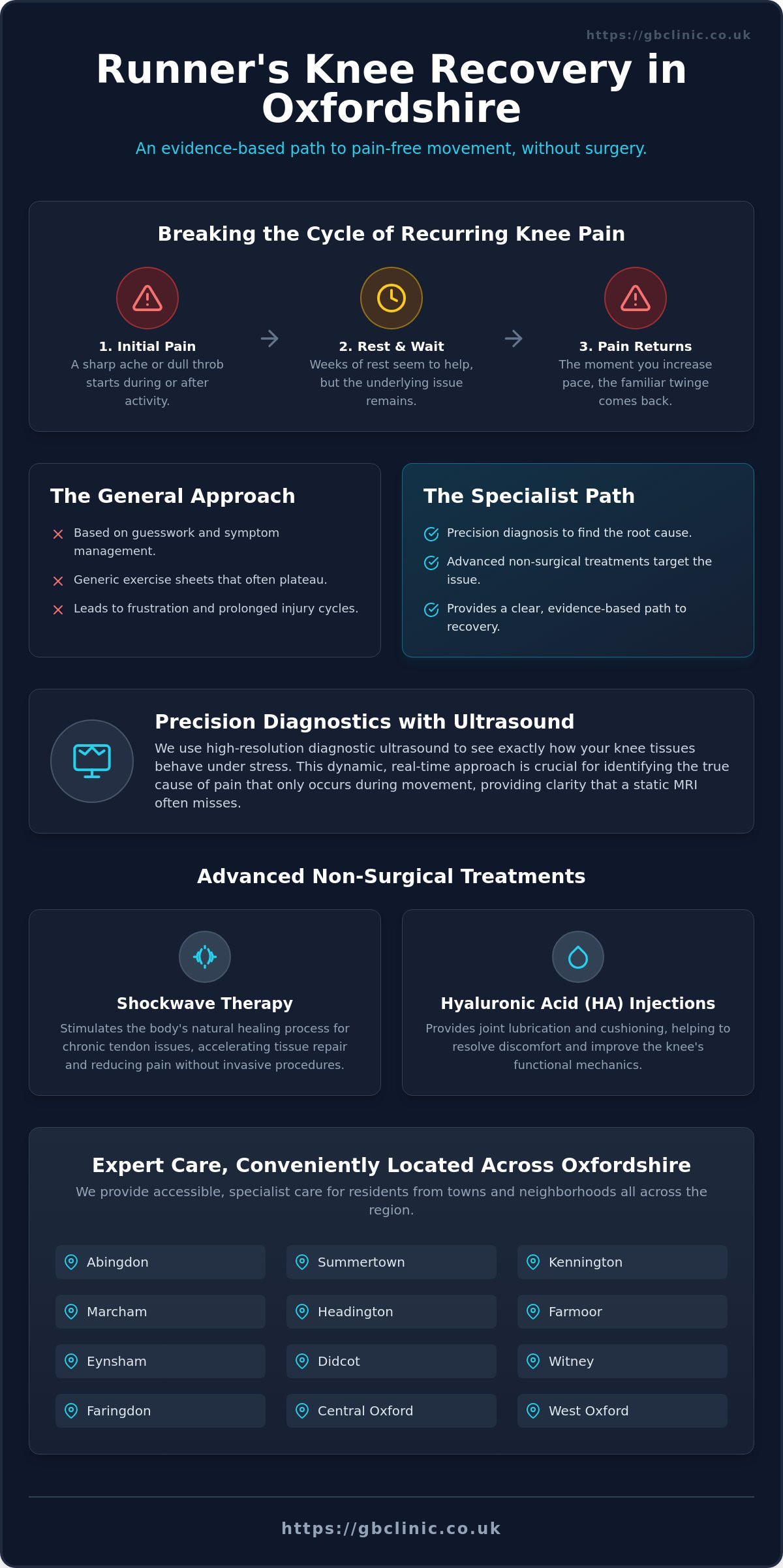
For many athletes across Oxfordshire, the sharp ache under the kneecap during a descent or the persistent throb after a weekend session in Headington or Abingdon isn’t just a physical ailment; it’s a disruption to a way of life. You’ve likely experienced the frustration of resting for weeks only to feel that familiar twinge return the moment you pick up the pace again. It’s common to feel caught in a loop of uncertainty, unsure if you require a standard physiotherapist or a surgical consultation to resolve the issue for good.
By consulting a specialist for runner’s knee Oxford, you can finally move past the guesswork. We understand that your goal is a return to pain-free movement without the need for invasive surgery. We provide residents from Summertown to Kennington and Marcham with a clear, evidence-based path to recovery through precision diagnostics and advanced non-surgical interventions. Whether you’re based in Farmoor, Eynsham, or Didcot, our clinics offer the clinical expertise needed to identify the exact cause of your discomfort through a professional assessment.
This guide outlines how specialized ultrasound scans and modern treatments like shockwave therapy or hyaluronic acid injections can accelerate healing. We’ll show you how patients from Witney, Faringdon, and across Central and West Oxford are successfully reclaiming their training schedules and returning to the activities they love.
Key Takeaways
- Learn why precise diagnostic ultrasound is essential for mapping out an effective recovery plan for persistent knee pain.
- Discover how advanced non-surgical treatments like shockwave therapy and hyaluronic acid injections resolve chronic tendon issues without the need for surgery.
- Access expert care from a specialist for runner’s knee Oxford at clinics conveniently located for residents in Abingdon, Summertown, Headington, and Witney.
- Identify the root cause of your discomfort through professional assessments available to patients in Didcot, Faringdon, and across Central or West Oxford.
- Explore how residents in Kennington, Marcham, Farmoor, and Eynsham can benefit from a professional, evidence-based path to pain-free movement.
Understanding Runner’s Knee: Why a Specialist Diagnosis Matters
Runner’s knee is frequently used as an umbrella term for various types of anterior knee pain. For many residents in Headington and Abingdon, this discomfort manifests as a persistent, dull ache behind the patella or a noticeable stiffness after periods of inactivity. While the name suggests it only affects athletes, individuals across Summertown and Kennington often experience these symptoms during everyday activities like walking or climbing stairs. Consulting a specialist for runner’s knee Oxford is the first step in breaking the cycle of recurring injury that often follows an inaccurate self-diagnosis.
To better understand this concept, watch this helpful video:
Distinguishing between different types of knee pain is critical for effective treatment. A general ache might be mistaken for a minor strain, but without a professional assessment, you might overlook more complex issues like meniscal tears or ligament instability. Our clinics serve patients from Marcham, Farmoor, and Eynsham, providing the clinical clarity needed to ensure your recovery plan targets the actual root cause rather than just the symptoms. Precise identification prevents the frustration of prolonged injury cycles and sets the stage for a mobile, comfortable state.
Identifying Patellofemoral Pain Syndrome (PFPS)
The most common condition falling under the runner’s knee label is Patellofemoral Pain Syndrome (PFPS). This occurs when the kneecap doesn’t track smoothly within the femoral groove, often due to muscle imbalances or biomechanical issues. You’ll likely notice symptoms aggravated by squatting, descending stairs, or prolonged sitting. It’s helpful to understand that PFPS is primarily a functional misalignment rather than a structural tear, meaning it responds exceptionally well to targeted, non-surgical interventions that address the mechanics of the joint.
When to Move Beyond General Physiotherapy
Many patients in Didcot, Witney, and Faringdon come to us after their initial physiotherapy exercises have plateaued. If a standard exercise sheet hasn’t yielded results within a few weeks, it’s time for a more specialized approach. A specialist MSK assessment utilizes objective imaging, such as a diagnostic ultrasound scan, to confirm the underlying pathology. This precision is vital for residents in Central Oxford and West Oxford who need a definitive diagnosis to return to their training schedules safely and efficiently.
Precision Diagnostics: Using Ultrasound to Map Your Recovery
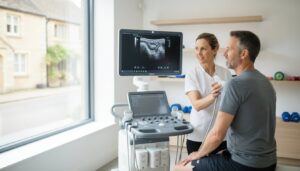
Residents in Abingdon and Summertown often face long waiting lists for hospital-based MRI scans. While an MRI is a valuable tool, it provides a static image of a joint that usually only hurts when it’s moving. As a specialist for runner’s knee Oxford, I utilize point-of-care diagnostic ultrasound to observe the knee in real-time. This dynamic approach allows us to see exactly how the tissues behave under stress, which is essential for athletes in Kennington or Marcham who only feel pain during specific phases of their gait.
The Role of Diagnostic Ultrasound in Knee Assessments
A diagnostic ultrasound scan provides high-resolution images of the patellar tendon, fat pads, and surrounding bursae. This level of detail is necessary to distinguish between simple overuse and more complex degenerative changes. Ultrasound identifies fluid markers of inflammation, such as hypoechoic areas or localized swelling, which are often invisible during a standard physical touch. This objective data is vital for exploring modern diagnostic and treatment options that move beyond basic rest and ice. Patients from Headington and Farmoor benefit from this immediate visual confirmation, as it removes the uncertainty from their recovery plan.
Diagnostic ultrasound is particularly effective at identifying:
- Soft tissue inflammation and fluid markers
- Tendon thickening or micro-tears
- Bursitis and fat pad impingement
- Dynamic tracking issues during joint movement
Accuracy vs. ‘Blind’ Physical Examinations
Physical examinations are an important baseline, but they can be subjective. It’s easy for a ‘blind’ test to misidentify the source of pain, leading to weeks of ineffective rehabilitation for runners in Eynsham or Didcot. By ‘seeing’ the injury, we can tailor a plan that targets the specific pathology, whether it’s bursitis or a thickened tendon. This precision significantly reduces the time to recovery, helping individuals in Witney and Faringdon return to their training schedules much faster. If you’re unsure about the source of your pain, you can book a specialist assessment to gain clarity before starting any new treatment. This expert-led approach ensures that every patient in Central Oxford and West Oxford receives a plan from a specialist for runner’s knee Oxford that’s built on clinical evidence rather than assumptions.
Advanced Treatments: Shockwave Therapy and HA Injections
For athletes in Headington or Witney, reaching a plateau in recovery is a common frustration. You might have followed the initial NHS information on runner’s knee, yet the pain persists during every outing. When standard rehabilitation isn’t yielding results, advanced musculoskeletal technologies offer a vital alternative to surgical intervention. As a specialist for runner’s knee Oxford, we provide treatments designed to stimulate biological repair and restore joint function. This approach ensures residents from Abingdon to Summertown can return to a mobile state without the risks associated with operations.
Extracorporeal Shockwave Therapy (ESWT) for Tendon Issues
Extracorporeal Shockwave Therapy (ESWT) is a non-invasive solution that uses acoustic waves to trigger the body’s natural healing response. For runners in Kennington or Marcham suffering from chronic discomfort, shockwave therapy for patellar tendonitis is often a game-changer. The high-energy pulses increase blood flow and metabolic activity in the tendon, breaking down calcifications and stimulating collagen production. This effectively restarts the healing process in tissues that have become stuck in a chronic state of pain, providing a clear path back to full training loads.
Hyaluronic Acid Injections for Joint Lubrication
While shockwave targets tendons, hyaluronic acid injections address the internal mechanics of the joint itself. This treatment is particularly effective for those experiencing friction behind the kneecap. We utilize a specific structure to ensure patients understand the value of this intervention:
- Problem: Decreased synovial fluid leads to increased friction and pain during running or using stairs.
- Solution: Injecting medical-grade HA mimics the natural lubricant found in healthy joints.
- Benefit: Reduced mechanical wear, decreased pain, and improved mobility for patients in Farmoor and Eynsham.
Unlike guided steroid injections, which primarily focus on suppressing acute inflammation, HA provides structural support and joint nourishment. This makes it an excellent option for residents in Didcot, Faringdon, and across Central Oxford and West Oxford who want to maintain an active lifestyle. Integrating these advanced therapies with a structured physiotherapy plan ensures that the functional improvements are sustained. By consulting a specialist for runner’s knee Oxford, you gain access to these modern tools that bridge the gap between basic exercise and surgery, helping you reclaim a pain-free life.
Accessing Specialist Care Across Oxfordshire
Finding a specialist for runner’s knee Oxford shouldn’t involve long, uncomfortable journeys while you’re managing physical pain. We’ve established our services to ensure that expert musculoskeletal care is within easy reach for residents across the entire region. Whether you’re a regular at the local running clubs in Headington or a commuter living in Summertown, our clinics provide a professional environment focused on your rapid return to activity. We’ve removed the barriers to advanced care by positioning our expertise where it’s needed most.
Clinics Near You: From Summertown to Abingdon
Accessibility is a cornerstone of our patient-focused approach. We serve the active communities of Witney, Didcot, and Bicester, providing a local alternative to the often-lengthy waiting times found in larger hospital settings. For those based in Abingdon, Marcham, or Faringdon, our clinics offer a streamlined path to diagnosis and treatment. We recognize that consistency is vital for recovery. By choosing a local specialist, you ensure that your appointments fit seamlessly into your daily schedule without the stress of cross-county travel. Residents in Farmoor, Eynsham, and Kennington benefit from our strategic proximity to the A34 and central commuter routes, making it simple to attend assessments or follow-up sessions.
Our commitment to local accessibility includes:
- Reduced travel times for patients in Central Oxford and West Oxford.
- Efficient appointment scheduling to avoid unnecessary delays in your treatment.
- A clinical environment that is both modern and reassuringly close to home.
Integrated Rehabilitation and Manual Therapy
Effective recovery from runner’s knee requires more than just a single intervention; it demands an integrated approach. Our Oxford specialists combine manual therapy and therapeutic massage with structured exercise rehabilitation to address the functional causes of your pain. This comprehensive care model is essential for long-term prevention. We don’t just treat the symptoms; we work to restore your body to a mobile, comfortable state. By receiving your care locally, you can maintain the regular contact required for successful manual therapy and guided rehabilitation. This is particularly beneficial for patients in West Oxford who need frequent progress checks to ensure their patellar tracking is improving correctly. To begin your recovery locally, you can book your initial assessment at GB Clinic and receive a clear, evidence-based plan tailored to your specific needs.
Maintaining a professional distance while providing empathetic, expert-led care allows us to guide you through each stage of the recovery process. This measured and logical rhythm of care ensures you feel informed and confident in your treatment plan. Every session is designed to move you one step closer to pain-free running, supported by the clinical authority of a dedicated specialist for runner’s knee Oxford.
Choosing GB Clinic for Your Runner’s Knee Recovery
Selecting a specialist for runner’s knee Oxford is a significant decision for any athlete or active individual. At GB Clinic, we maintain a clinical environment that is both modern and reassuring, designed to build confidence in your path to physical restoration. We serve patients from Headington and Abingdon, providing a serious medical approach to musculoskeletal health that avoids unnecessary delays. Our focus remains entirely on evidence-based, non-surgical treatments that help you return to a mobile, comfortable state without the risks associated with invasive operations.
Our Expert-Led Approach to MSK Health
We pride ourselves on being at the forefront of our field by offering contemporary clinical solutions. Our private MSK physiotherapy Oxford services are led by practitioners who combine clinical excellence with a genuinely caring demeanor. Client feedback frequently highlights the professional warmth and attentiveness of our team, which is essential when seeking relief from persistent discomfort. Whether you are coming from Summertown or Kennington, you can expect a comprehensive care plan that addresses your specific functional goals.
Our clinical process follows a logical Problem/Solution/Benefit framework to ensure clarity for every patient:
- Problem: Persistent anterior knee pain that disrupts training schedules and daily activities for residents in Marcham and Farmoor.
- Solution: Accurate diagnosis through point-of-care ultrasound and advanced treatments like shockwave therapy or HA injections.
- Benefit: A clear, non-surgical recovery plan that leads to a pain-free return to running and improved long-term joint health.
Booking Your Initial Assessment in Oxford
We understand that navigating healthcare options can be confusing. To provide a risk-free entry point, we offer a complimentary initial assessment for residents in Eynsham, Didcot, and Witney. During this first visit, we will discuss your symptoms and determine if our specialized treatments are the right fit for your recovery. This patient-first approach underscores our confidence in the effective, evidence-based care we provide.
Individuals in Faringdon and Central Oxford can access our expertise without the need for a GP referral. We are dedicated to providing the West Oxford community with efficient, specialist support that prioritizes outcomes. If you’re ready to move past the frustration of persistent pain and regain your mobility, book your consultation today. By choosing a dedicated specialist for runner’s knee Oxford, you are taking a measured and logical step toward a full, pain-free recovery.
Reclaim Your Active Lifestyle with Specialist MSK Care
Persistent knee pain shouldn’t be the reason you stop training. We’ve explored how identifying the root cause through expert-led diagnostic ultrasound allows for a more targeted recovery plan. By utilizing advanced non-surgical treatments like shockwave therapy and hyaluronic acid injections, you can stimulate biological repair and restore joint lubrication without the need for invasive operations.
Whether you live in Headington, Abingdon, or Summertown, accessing a specialist for runner’s knee Oxford is straightforward and local. Our clinics provide residents from Kennington to Marcham and Witney with a clear path to physical restoration. We also serve active communities in Didcot, Faringdon, and Eynsham, ensuring that patients in Central Oxford, West Oxford, and Farmoor don’t have to travel far for high-quality clinical care.
Take advantage of our complimentary initial assessment to discover how our evidence-based approach can help you return to a mobile, comfortable state. Our team is dedicated to providing the professional support you need to reach your goals. Book your specialist runner’s knee assessment at GB Clinic Oxford and start your journey back to pain-free movement today.
Frequently Asked Questions
What exactly is runner’s knee and how do I know if I have it?
Runner’s knee is officially known as Patellofemoral Pain Syndrome and is identified by a dull ache behind or around the kneecap. You’ll likely notice increased discomfort when navigating stairs in Headington or Abingdon, or after sitting for long periods with your knees bent. This condition typically indicates that the patella isn’t tracking smoothly, leading to mechanical irritation that requires a professional assessment to resolve effectively.
Do I need a GP referral to see a runner’s knee specialist in Oxford?
You don’t need a GP referral to consult a specialist for runner’s knee Oxford when self-funding your care. Many residents from Summertown and Kennington appreciate this direct access, as it eliminates the delays often found in traditional healthcare pathways. If you plan to use private medical insurance, it’s always advisable to verify your specific policy requirements, though we maintain a professional, expert-led environment for all patients.
Is shockwave therapy painful for treating knee injuries?
Shockwave therapy involves high-energy acoustic pulses that may feel like a series of sharp taps against the skin. While it can be slightly uncomfortable, most patients in Marcham and Farmoor find the procedure entirely manageable. The specialist can adjust the intensity to ensure your comfort while still achieving the biological stimulation necessary to repair chronic tendon issues and restore your body to a mobile, comfortable state.
How many hyaluronic acid injections will I need for my knee pain?
Most patients achieve significant improvement after just one hyaluronic acid injection, with the lubricating benefits typically lasting between 6 and 12 months. This treatment is a modern clinical offering designed to reduce friction behind the kneecap. For individuals in Eynsham and Didcot, this single session often provides the necessary relief to resume a pain-free training schedule without the need for recurring medical interventions or invasive surgery.
Can I continue running while receiving treatment at GB Clinic?
Many runners in Witney and Faringdon can continue with a modified training plan rather than stopping entirely. Complete rest is rarely the solution for runner’s knee; instead, we focus on managing your physical load while addressing the underlying biomechanical cause. Your specialist will use findings from your diagnostic ultrasound to determine a safe activity level, ensuring you maintain your fitness while your tissues recover and strengthen.
How quickly can I get a diagnostic ultrasound scan in Oxfordshire?
We offer direct access to diagnostic ultrasound scans, frequently providing appointments within the same week for patients in Central Oxford and West Oxford. This rapid service ensures you receive a definitive diagnosis without the long waiting times associated with hospital imaging. Early precision diagnostics are essential for mapping out an effective recovery plan and preventing a minor ache from becoming a chronic, disruptive injury.
What is the difference between a steroid injection and hyaluronic acid for the knee?
A steroid injection is a powerful anti-inflammatory used to settle acute flare-ups, while hyaluronic acid acts as a medical-grade lubricant for the joint surfaces. Steroids provide rapid relief from swelling, but HA offers a more structural solution by reducing mechanical wear and friction behind the patella. Your specialist will recommend the most appropriate option based on whether your symptoms are driven by acute inflammation or joint surface irritation.
Is runner’s knee treatment covered by private health insurance?
Most major private health insurance providers in the UK recognize and cover specialist MSK treatments and diagnostic imaging. We regularly work with major insurers to provide evidence-based care for patients across Oxfordshire. It’s important to contact your insurer before your appointment to confirm your level of cover and any potential shortfalls, ensuring your focus remains entirely on your recovery and return to pain-free activity.