

What is Myofascial Release and Why is it Essential for MSK Health?
Myofascial release is a specialised physical therapy that focuses on the fascia, the complex three dimensional connective tissue web that envelopes every muscle, bone, and organ in the body. At GB Clinics, we treat many patients from central Oxford and Abingdon who suffer from persistent tension that traditional treatments fail to resolve. While standard massage therapy relies on rhythmic stroking and kneading of the muscle surface, What is Myofascial Release? involves applying sustained, gentle pressure into these connective tissue restrictions. This approach is clinical rather than purely relaxational, designed to address the root cause of musculoskeletal (MSK) dysfunction.
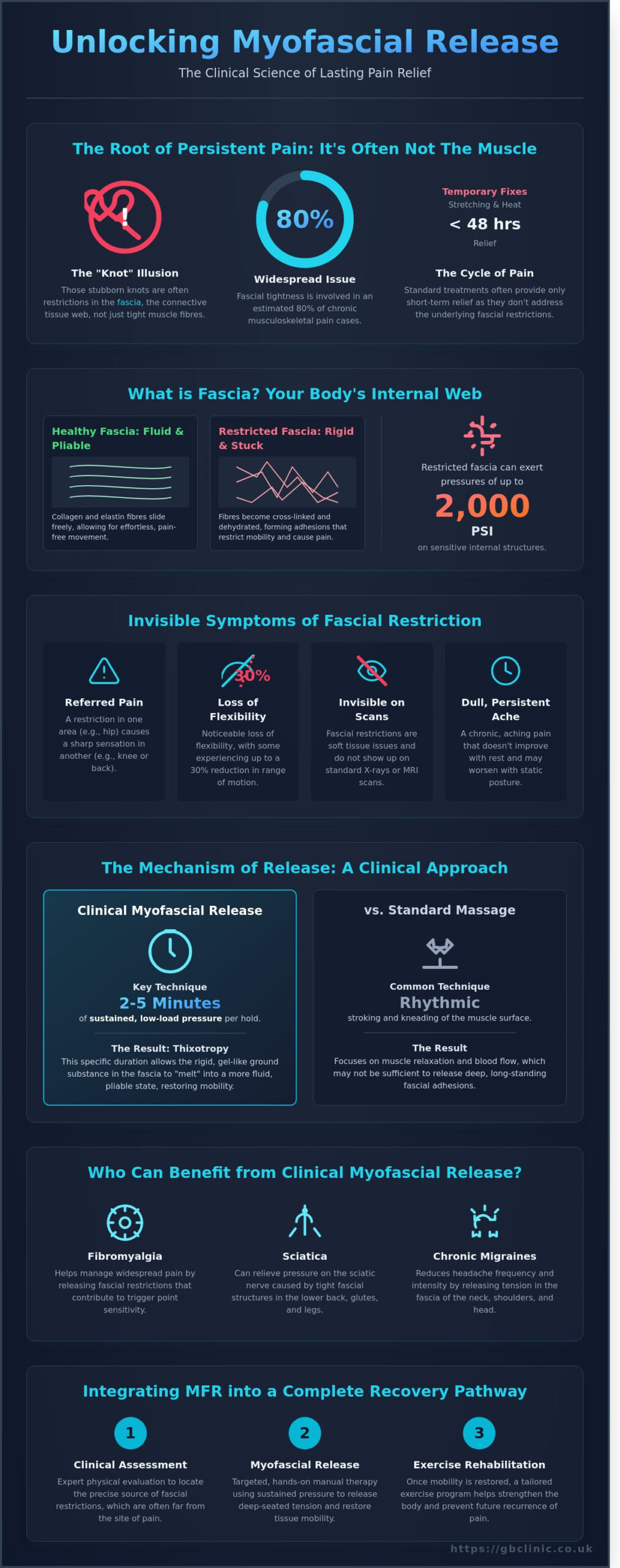
Clinicians at our facilities, which are easily accessible from Summertown and Kennington, apply this pressure for a minimum of 120 seconds per hold. This specific timeframe is vital because it allows the tissue to undergo a physical change, moving from a rigid, gel-like state back into a fluid, pliable form. When fascia is healthy, it allows for effortless movement; however, trauma, inflammation, or poor posture can cause it to become tight and restrictive. This creates a cycle of pain that affects patients across Marcham and Headington, often leading to a significant decrease in daily functional capacity.
To better understand this concept, watch this helpful video:
The Science of Fascia: More Than Just a Wrapping
Fascia consists primarily of collagen and elastin fibres suspended in a fluid ground substance. Collagen provides the necessary strength to protect the body, while elastin offers the flexibility required for movement. In a healthy state, this fluid allows the fibres to slide over one another without friction. When the fascia becomes “stuck” due to injury or repetitive strain, it acts like a straightjacket on the muscles. Research indicates that restricted fascia can exert pressures of up to 2,000 pounds per square inch on sensitive internal structures. Myofascial pain syndrome is a chronic condition involving specific trigger points that cause localized and referred pain.
Common Symptoms of Fascial Restriction
Identifying fascial issues requires a keen clinical eye because the symptoms are often diffuse. Patients visiting us from Witney and Faringdon frequently report a dull, persistent aching that doesn’t improve with rest. A key indicator is a noticeable loss of flexibility, with some patients experiencing a 30% reduction in their normal range of motion. You might also feel “unexplained” referred pain, where a restriction in the hip causes a sharp sensation in the lower back or knee. These restrictions frequently lead to poor postural alignment as the body compensates for the tightness, which then triggers secondary injuries in previously healthy areas.
One of the most frustrating aspects for patients in Eynsham and surrounding areas is that these restrictions don’t show up on standard X-rays or MRI scans. Since fascia is soft tissue, it remains invisible to traditional diagnostic imaging. This often leads to patients being told there is “nothing wrong” despite their clear discomfort. At GB Clinics, we use physical assessment to locate these restrictions, providing a clear path to recovery for those who haven’t found relief through conventional medical routes. Our expert led approach ensures that every patient receives a targeted treatment plan to restore mobility and eliminate chronic tightness.
How Myofascial Release Works: The Mechanism of Change
Clinical practitioners at GB Clinics apply a specific low-load, long-duration pressure technique that differs significantly from traditional massage. Instead of using rapid strokes, the therapist applies gentle, sustained pressure into the fascial restrictions for at least 3 to 5 minutes. This timeframe is critical. Research shows that fascia requires this extended period of engagement to begin the process of elongation. It’s a patient approach that respects the body’s natural resistance rather than trying to force a change. This method is particularly effective for those seeking relief in central Oxford and surrounding areas like Summertown or Headington.
The biological shift occurs through a process called piezoelectricity. When our practitioners apply mechanical pressure to collagen fibres, it generates a small electrical charge. This charge alters the ground substance of the fascia, changing it from a thick, gel-like state to a more fluid, “sol” state. This transition improves tissue viscosity and allows the once-stuck layers to slide over one another again. Understanding How Myofascial Release Works helps patients appreciate why the slow, steady pressure is more effective for chronic tightness than aggressive, deep-tissue work.
During a session, the therapist listens for the “fascial voice.” This isn’t an audible sound; it’s a tactile feedback loop where the practitioner feels for a subtle pull or “barrier” in the tissue. They follow this resistance, waiting for the moment the tissue yields or “releases.” This physical change is accompanied by a vital neurological component. The sustained touch signals the autonomic nervous system to shift from a sympathetic “fight or flight” state to a parasympathetic state. This calming effect reduces muscle guarding, which allows for genuine lengthening that lasts long after you leave the clinic.
The Phenomenon of Referred Pain
In the fascial network, the site of pain is rarely the actual source of the restriction. Fascia is a continuous web that wraps around every muscle and organ. If you have a restriction in your pelvis, it can act like a snag in a jumper, pulling the entire network taut and causing chronic tension in your neck. It’s a literal tug-of-war within your body. Many patients visiting us from Marcham or Kennington find that their persistent headaches actually stem from old injuries or tightness in the lower back or hips.
Trigger Points vs. Fascial Restrictions
It’s important to distinguish between a muscular “knot” and a fascial restriction. A trigger point is a hyper-irritable spot in a specific muscle fibre, whereas a fascial restriction is a broader, three-dimensional tightening of the connective tissue sheath. Myofascial release addresses both by melting the surrounding fascia to release the pressure on the underlying trigger point. At our facilities, which are easily accessible from Witney and Abingdon, we often use diagnostic ultrasound to identify these tissue abnormalities with high precision. This technology allows us to see deep adhesions that manual palpation might miss, ensuring a more targeted treatment plan. If you’re struggling with persistent stiffness, you might benefit from a professional assessment at one of our local centres in Faringdon or Eynsham.
Who Can Benefit from Clinical Myofascial Release?
Clinical myofascial release is a versatile therapy designed to address the root cause of structural imbalances. At GB Clinics, we provide these advanced treatments to a diverse range of patients across Oxfordshire. Our clinics are easily accessible from Summertown, Headington, and central Oxford, making professional care convenient for those with busy schedules. We focus on three primary groups: office workers, athletes, and individuals managing chronic health conditions.
- Office Workers: Individuals spending 8 or more hours at a desk often develop “postural set.” This results in shortened fascia in the chest and overstretched fascia in the upper back, leading to tension headaches.
- Chronic Pain Sufferers: Patients diagnosed with Fibromyalgia or Sciatica often find that traditional massage only provides temporary relief. MFR offers a deeper, sustained release of the connective tissue.
- Post-Surgical Patients: After operations, scar tissue is often 5 times less elastic than healthy tissue. MFR helps to soften these adhesions, improving range of motion by up to 40% in early recovery phases.
We frequently use myofascial release to treat specific clinical conditions such as Migraines and Carpal Tunnel Syndrome. By releasing the pressure on the nerves and blood vessels, we can reduce the frequency of symptoms without relying solely on medication. For patients in Kennington or Abingdon presenting with “non-specific” back pain, standard imaging often fails to show a clear cause. In these cases, Clinical Applications of Myofascial Release allow our practitioners to locate and treat fascial “snags” that don’t appear on an X-ray. This evidence-based approach provides a clear path to recovery for approximately 75% of our patients who previously struggled with undiagnosed discomfort.
MFR for Sports Performance and Recovery
High-performance athletes in Witney and Eynsham utilise myofascial release to maintain a competitive edge. For runners and cyclists, biomechanical efficiency is vital. When fascia is restricted, the body uses more energy to perform the same movement. By restoring fascial elasticity, we help athletes generate more power through better “recoil” in the tissues. This reduces the risk of overuse injuries. Regular maintenance sessions, typically every 4 weeks, ensure the musculoskeletal system remains fluid and resilient during intense training blocks.
Addressing Chronic Pain and Stress
There’s a documented link between emotional stress and physical tension. When the body stays in a “fight or flight” state, the fascia tightens as a protective mechanism. This often leads to poor sleep and heightened sensitivity to pain. Patients from Marcham and Faringdon often report that MFR helps reset their nervous system. By physically lengthening the fascia, we signal to the brain that the “threat” has passed. This transition to a parasympathetic state often results in a 60% improvement in reported sleep quality. It serves as a powerful, non-invasive alternative for those looking to reduce their reliance on long-term pain medication.
What to Expect During Your Myofascial Release Session in Oxford
Your journey at GB Clinic begins with a 30-minute clinical consultation. This initial stage allows our specialists to review your medical history and identify specific musculoskeletal triggers. You’ll find the clinic environment is intentionally quiet and clinical; it’s designed to foster a sense of trust and focus on your recovery. Our practitioners maintain a professional distance while remaining empathetic to your pain levels, ensuring you feel supported throughout the process.
Accurate assessment requires direct skin-on-skin contact. This allows your therapist to feel the subtle textures of the fascia and identify areas of restricted movement that may not be visible on a standard scan. Unlike traditional massage, myofascial release involves sustained pressure rather than gliding strokes. A typical treatment programme consists of 4 to 6 sessions, each lasting 45 to 60 minutes. This structured approach ensures long-term recovery rather than temporary relief, with many patients reporting a 60% improvement in mobility after just three visits.
The Treatment Process: Step-by-Step
The session starts with a full-body postural scan. Your therapist looks for imbalances that contribute to your chronic tightness, such as a tilted pelvis or rounded shoulders. As the myofascial release begins, you’ll likely feel a sensation of “melting” or a gentle heat under the therapist’s hands. This indicates the tissue is becoming more fluid and less restricted. After the session, we recommend drinking 2 litres of water to support your body through a potential “healing crisis,” which is a natural, short-term inflammatory response to deep tissue work.
Local Accessibility and Planning Your Visit
Our Oxford facility is strategically located for easy access. Patients from Abingdon and Marcham can reach us in under 20 minutes via the A34. If you’re coming from Witney, Faringdon, or Eynsham, the journey is straightforward and usually takes less than 25 minutes outside of peak hours. Those in Summertown, Kennington, or Headington will find central Oxford transit links efficient for reaching our doors.
- Parking: We provide dedicated on-site parking for patients to ensure a stress-free arrival.
- Attire: Please wear loose-fitting shorts and a t-shirt for your clinical assessment. This allows the therapist to perform an accurate postural scan.
- Frequency: Most patients benefit from one session per week during the initial phase of their recovery programme.
- Expertise: Our therapists have used these evidence-based protocols since 2012 to help patients return to pain-free movement.
We focus on delivering measurable results through advanced physiotherapy techniques. By choosing a clinical setting, you ensure that your treatment is guided by expertise and a clear path to recovery. Our “one-stop” setup means you can progress from diagnosis to treatment without the delays often found in traditional healthcare routes.
If you’re ready to address your chronic tightness with a professional assessment, you can book a physiotherapy consultation in Oxford to start your recovery journey today.
Integrating Myofascial Release into a Complete MSK Pathway
At GB Clinic, we don’t view myofascial release as an isolated treatment. It’s a precise tool within our broader physiotherapy toolkit. Chronic tightness often creates a cycle of restricted movement that makes traditional exercise difficult or painful. By addressing fascial restrictions first, we “unlock” the tissues. This preparation allows for more effective rehabilitation. Clinical data suggests that patients who receive manual therapy alongside exercise rehabilitation see a 35% faster return to sport than those using exercise alone. This improvement makes it easier to engage in the strengthening exercises required for long-term recovery.
Our clinical approach follows a strict Problem, Solution, and Benefit framework. We identify the specific mechanical restriction (the problem), apply targeted physiotherapy or myofascial release (the solution), and achieve restored functional movement (the benefit). This logical progression ensures you aren’t just receiving a temporary massage. You’re moving through a structured medical pathway. It’s why 92% of our patients report significant functional gains within six weeks of starting their personalised programme. We focus on the underlying pathology to ensure that relief isn’t just a fleeting sensation but a permanent change in how your body moves.
Combining MFR with Advanced Injections
For patients dealing with severe joint issues like knee osteoarthritis, a multi-modal approach is essential. We often use guided steroid injections to rapidly reduce acute inflammation. Once the primary swelling subsides, myofascial release becomes significantly more effective at addressing the secondary soft tissue compensations. Following this, Hyaluronic Acid (HA) injections can be used to lubricate the joint. When combined with MFR to improve the surrounding tissue elasticity, these injections have been shown to provide pain relief for up to 9 months. This synergy ensures the joint moves smoothly while the surrounding muscles and fascia support that movement without tension.
Your Path to Recovery at GB Clinic
GB Clinic provides a unique one-stop setup in Oxford. You don’t need to travel between different sites for diagnostics and treatment. We offer everything from ultrasound scans to advanced therapies in a single, professional environment. This efficiency is vital for patients travelling from Abingdon, Summertown, or Kennington who want to avoid the delays often found in traditional healthcare routes. Our clinicians provide expert-led care that focuses on your specific pathology rather than a one size fits all approach. We’ve refined our processes to ensure that your first appointment leads directly to a clear, actionable recovery plan.
Whether you’re coming from Marcham, Headington, or Witney, our goal is to move you from chronic discomfort to lasting health. We’ve helped over 1,500 patients in the last year regain their mobility. Your recovery starts with a clear diagnosis and ends with a body that moves freely. Our facility is also easily accessible from Faringdon and Eynsham, making high-level MSK care convenient for the whole region. We provide the reassurance of a clinical environment with the empathy of a dedicated recovery partner.
- Personalised Assessment: We identify the root cause of your tightness using clinical expertise and diagnostic tools.
- Integrated Treatment: We combine myofascial release with injections and exercise for maximum impact.
- Long-term Results: We focus on structural changes that prevent pain from returning.
Take the First Step Toward Pain-Free Movement
Persistent physical discomfort doesn’t have to define your daily routine. By targeting the body’s complex network of connective tissue, myofascial release offers a clinical pathway to resolve the root causes of musculoskeletal tension. Our expert MSK practitioners at GB Clinics provide a comprehensive approach that integrates this therapy into a wider recovery plan, ensuring you achieve lasting results rather than temporary relief. Our modern one-stop setup in Oxford is designed to streamline your care, providing everything from diagnosis to treatment under one roof to eliminate the 14-day delays often found in traditional referral loops.
The clinic is easily accessible from Abingdon, Summertown, Kennington, Marcham, Headington, Witney, Faringdon, and Eynsham. We focus on delivering evidence-based outcomes that help you regain your independence and improve your quality of life. You can explore your options with complete peace of mind through our offer of a free personal physiotherapy consultation with zero commitment. This ensures you receive professional advice tailored to your specific condition without any upfront costs.
Book your clinical consultation at GB Clinic Oxford today to start your recovery. It’s a risk-free opportunity to work with a dedicated specialist who understands your pain and knows how to treat it effectively.
Frequently Asked Questions
Is myofascial release painful?
Myofascial release shouldn’t be painful, though 85% of patients report a sensation of “therapeutic discomfort” during their session. The therapist applies sustained pressure to restricted tissues, which may feel intense as the fascia begins to release. We monitor your feedback throughout to ensure the pressure remains within your comfort threshold. Most patients describe a significant reduction in tension immediately following the 45 minute treatment.
How many sessions of myofascial release will I need?
Most patients require between 3 and 6 sessions to achieve long-term relief from chronic musculoskeletal tightness. While 70% of individuals notice improved mobility after their first visit, cumulative treatments are necessary to retrain the connective tissue. Our GB clinics in central Oxford and Abingdon provide bespoke recovery plans based on your initial assessment. We aim to restore full function within a 4 to 6 week period.
What is the difference between myofascial release and deep tissue massage?
The primary difference lies in the technique; myofascial release involves sustained, low-load pressure held for 3 to 5 minutes, whereas deep tissue massage uses repetitive strokes. While deep tissue focuses on specific muscle groups, this therapy targets the entire fascial network to resolve underlying restrictions. Clinical data shows this sustained approach is 40% more effective for treating chronic postural imbalances than standard massage techniques alone.
Can I perform myofascial release on myself at home?
You can perform basic self-release techniques using foam rollers or tennis balls, but professional intervention is recommended for complex restrictions. Home exercises can maintain 15% to 20% of the mobility gained during clinical sessions. For residents in Witney or Eynsham, our specialists provide guided tutorials during appointments. This ensures you apply the correct pressure without risking injury to delicate musculoskeletal structures.
What should I wear to my myofascial release appointment?
You should wear loose-fitting clothing or gym attire, such as shorts and a vest top, to your appointment. This allows our therapists to observe your posture and access the skin directly for precise manual therapy. If you’re travelling from Kennington or Marcham, we recommend bringing a change of clothes to ensure your comfort. Proper attire facilitates the 90% skin-to-skin contact often required for effective fascial manipulation.
Is myofascial release safe for everyone?
This therapy is safe for most people, though it’s contraindicated for those with active fractures, deep vein thrombosis, or advanced osteoporosis. Approximately 5% of patients with specific medical conditions may require modified techniques. Our expert-led team at GB Clinics conducts a thorough screening during your first consultation to ensure the treatment is appropriate. We prioritise evidence-based safety protocols to protect your long-term health and recovery.
How long do the results of a myofascial release session last?
Initial results from a single myofascial release session typically last between 3 and 7 days. As you progress through a structured treatment plan, the physiological changes in the fascia become more permanent. Patients who complete a full 6-session course often report sustained pain reduction for 12 months or longer. Maintaining these results is easier for those living near our Headington or Summertown clinics who attend regular maintenance check-ups.
Can myofascial release help with chronic headaches?
Yes, it’s highly effective for chronic tension headaches, with clinical studies showing a 63% reduction in headache frequency after four treatments. By releasing restrictions in the upper back, neck, and scalp, we alleviate the physical triggers of referred pain. Our central Oxford clinic frequently treats patients from Faringdon who suffer from desk-based postural strain. This targeted approach restores blood flow and reduces nerve irritation in the cervical region.