
Imagine waking up in Central Oxford and dreading that first step out of bed because your heel feels like it’s being gripped by a vice. If you’ve spent over six months struggling with persistent stiffness, you aren’t alone; clinical data suggests that up to 30% of runners will experience this debilitating condition at some stage. You’ve likely found that standard calf stretches and eccentric exercises haven’t provided the relief you need to return to your morning jog or daily walk. Our clinic provides specialized shockwave therapy for achilles tendonitis Oxford to help you move past these limitations without the need for invasive surgery or steroid injections.
We understand the frustration of failed traditional treatments and the fear that surgery is your only remaining option. This advanced recovery guide for 2026 details how Extracorporeal Shockwave Therapy (ESWT) triggers a natural healing response to repair damaged tissue and significantly reduce pain levels. We’ll outline a clear, expert-led rehabilitation plan that is easily accessible for residents in Summertown, Headington, and West Oxford. Whether you’re traveling from Abingdon, Didcot, or Witney, or live locally in Kennington, Marcham, or Farmoor, our one-stop setup ensures you receive efficient, evidence-based care. From Eynsham to Faringdon, we’re helping patients across Oxfordshire regain their active lifestyles through modern, clinical expertise.
Key Takeaways
- Understand the science of mechanotransduction and how shockwaves stimulate neovascularisation to repair degenerative “dead” zones in the Achilles tendon.
- Compare the long-term benefits of non-surgical ESWT against traditional corticosteroid injections to ensure the best outcome for your tendon longevity.
- Discover how we deliver specialized shockwave therapy for achilles tendonitis Oxford residents can easily access from Summertown, Headington, and West Oxford.
- Explore our comprehensive clinical process, which combines diagnostic ultrasound with customized treatment frequencies to ensure a comfortable and effective recovery journey.
- Learn about the convenient accessibility of our specialist care for the wider Oxfordshire community, including patients in Abingdon, Witney, Didcot, and Kennington.
Understanding Achilles Tendonitis and the Role of Shockwave Therapy
Achilles tendonitis isn’t just a single condition; it’s a spectrum of tendon health that affects many active individuals across Oxfordshire. While acute inflammation is common, many patients suffer from chronic degenerative tendinopathy, where the tendon fibers have failed to heal correctly. For residents in Central Oxford and Headington, this often results in a persistent ache that makes the first steps of the day incredibly painful. Standard treatments like ice and rest often fall short because they don’t address the underlying lack of blood flow in the tendon tissue.
To better understand how this treatment helps resolve long-term pain, watch this helpful video:
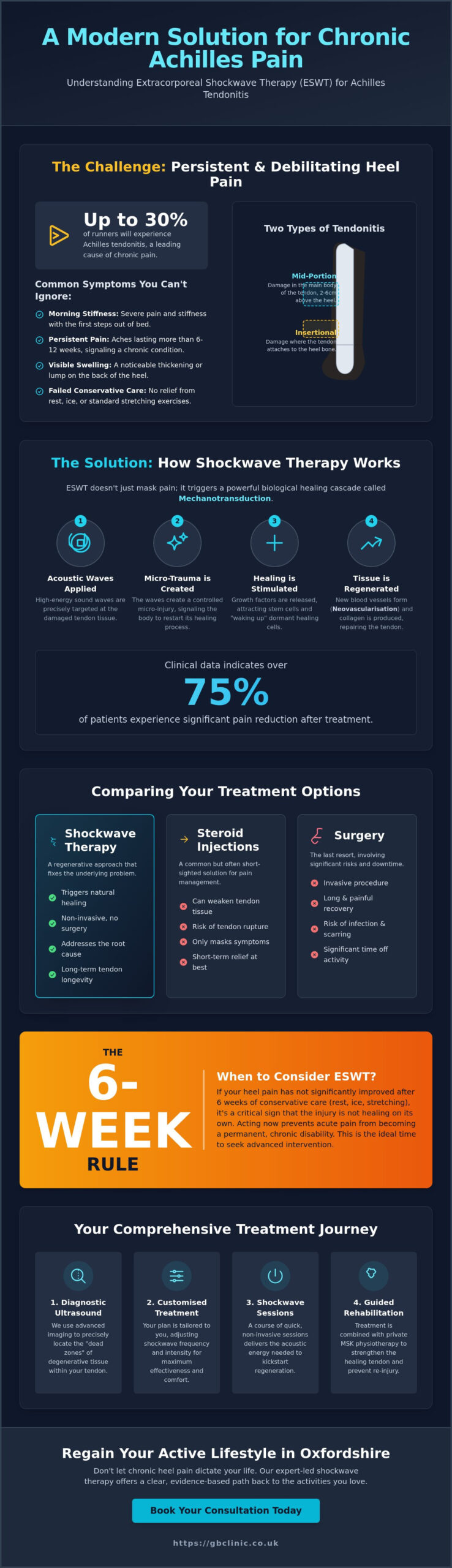
The introduction of shockwave therapy for achilles tendonitis Oxford clinics has changed the recovery timeline for many. Extracorporeal shockwave therapy (ESWT) is a non-invasive medical procedure that sends acoustic waves into the damaged area. These waves create micro-trauma that restarts the body’s natural healing process, promoting new blood vessel formation and collagen production. It’s a gold-standard choice for those in West Oxford or Kennington who want to avoid the risks and lengthy downtime associated with surgery. Clinical data indicates that over 75% of patients experience significant pain reduction after a full course of treatment.
Mid-portion vs. Insertional Achilles Tendonitis
Your recovery plan depends on where the damage is located. Mid-portion tendonitis occurs in the narrow 2-6cm zone above the heel bone. In contrast, insertional tendonitis happens right where the tendon meets the heel. At our clinic, we serve patients from Abingdon and Summertown by tailoring the shockwave intensity to these specific zones. Mid-portion cases often respond quickly to standard protocols, while insertional cases may require a more nuanced approach to manage the bone-tendon interface effectively and prevent further calcification.
When to Consider ESWT for Heel Pain
We recommend considering ESWT if you’ve reached the six-week mark without significant improvement. This “6-week rule” is essential for preventing a temporary injury from becoming a permanent disability. For patients in Marcham, Farmoor, or Eynsham, combining this technology with private MSK physiotherapy Oxford ensures the tendon is both healed and strengthened. If you live in Didcot, Witney, or Faringdon and notice your pain is preventing you from walking even short distances, it’s a clear signal that advanced intervention is necessary. Shockwave therapy for achilles tendonitis Oxford provides a clear path back to activity when conservative methods fail.
- Persistent Pain: Discomfort lasting more than 6-12 weeks.
- Morning Stiffness: Difficulty walking during the first few minutes after waking.
- Failed Conservative Care: No relief from rest, orthotics, or standard exercises.
- Visible Swelling: A noticeable thickening or “lump” on the back of the heel.
How Shockwave Therapy Accelerates Achilles Tendon Healing
Shockwave therapy for achilles tendonitis Oxford represents a shift from managing symptoms to actively triggering tissue regeneration. The process relies on mechanotransduction; this is a biological phenomenon where the mechanical energy of the acoustic pulses is converted into cellular signals. These signals “wake up” dormant healing cells in the tendon, which is vital for chronic cases where the body has stopped trying to repair the damage. Whether you are coming from Abingdon, Summertown, or Kennington, this clinical approach offers a clear path to recovery without the need for invasive surgery.
One of the most critical hurdles in Achilles recovery is the tendon’s naturally poor blood supply, especially in the “watershed zone” located 2cm to 6cm above the heel bone. Shockwave therapy overcomes this by stimulating neovascularisation. This process involves the growth of new micro-capillaries within the “dead” zones of the tendon. According to a Systematic Review on Shockwave Therapy Effectiveness, this increase in nutrient-rich blood flow is a primary reason why ESWT is so effective at reducing pain and restoring function in 75% to 80% of patients.
Beyond blood flow, the treatment targets pain at its source. The high-energy pulses deplete Substance P, a neurotransmitter that sends intense pain signals to the brain. By reducing this chemical concentration, patients often experience an immediate reduction in discomfort. For those in Marcham, Headington, or Farmoor dealing with insertional tendonitis, the therapy also helps resolve calcifications. These “bone spurs” within the tendon are physically disrupted by the waves, allowing the body to reabsorb the calcium deposits over several weeks. If you have had these identified during a diagnostic ultrasound scan, shockwave is often the most effective non-surgical solution.
The Biological Mechanism of Recovery
ESWT triggers a controlled healing response by creating targeted micro-trauma that restarts the body’s inflammatory repair cycle. This process specifically boosts Type I collagen production, which is essential for restoring the structural integrity and tensile strength of the Achilles. Increased metabolism at the injury site, fueled by ATP release, ensures that the tendon has the energy required to rebuild itself. This cellular “reset” is why many of our patients from Eynsham, Didcot, and Witney see long-term results rather than temporary relief.
Radial vs. Focused Shockwave: What You Need
Understanding the difference between wave types is essential for clinical success. Radial shockwaves spread energy over a larger surface area, making them ideal for mid-portion tendonitis. Focused shockwaves penetrate deeper and with more precision, which is often required for stubborn insertional injuries near the heel bone. GB Clinic utilizes advanced technology to match the wave type to the specific depth of your injury. This precision ensures that residents in Faringdon, Central Oxford, and West Oxford receive the most effective dosage for their specific pathology. If you are struggling with persistent heel pain, you can book a specialist assessment to determine which technology will best accelerate your recovery.
Comparing Shockwave Therapy to Other Achilles Treatments
Extracorporeal Shockwave Therapy (ESWT) provides a distinct clinical advantage over traditional corticosteroid injections for tendon health. While steroids offer rapid pain suppression, they can lead to tendon weakening or a 6% to 10% increased risk of rupture when used repeatedly in the Achilles. Shockwave therapy for achilles tendonitis Oxford clinics focus on regenerative healing by stimulating collagen production and neovascularisation. For patients in Central Oxford or Headington experiencing joint-related heel pain, combining ESWT with Hyaluronic Acid injections can improve tissue lubrication and reduce mechanical friction.
Comparing ESWT to surgical intervention reveals significant benefits in recovery time and risk management. Surgery for Achilles tendinopathy often involves a 6 to 12 month rehabilitation period and carries risks of wound complications or nerve damage. In contrast, clinical data shows that shockwave therapy has a success rate of 75% to 80% for chronic cases. It allows residents from Witney, Abingdon, and West Oxford to remain mobile during their treatment cycle without the significant downtime of an operation. A multi-modal approach yields the best results by addressing both the biological repair and the mechanical cause of the injury.
ESWT vs. Traditional Conservative Management
Standard “eccentric loading” exercises are a foundation of recovery, but they often require 12 to 16 weeks of consistent effort before significant pain reduction occurs. Many patients in Didcot or Faringdon find that shockwave therapy succeeds where exercise alone fails by “re-starting” the healing response in stalled, chronic conditions. Choosing private ESWT avoids the typical 18-week NHS wait times found across Oxfordshire. We combine advanced shockwave protocols with physiotherapy to ensure patients from Kennington and Marcham achieve permanent relief through improved calf strength and tendon resilience.
Advanced Injection Therapies as an Alternative
When acute inflammation is the primary issue, guided steroid injections may be considered to settle symptoms quickly. However, we always perform a diagnostic ultrasound scan first to assess the degree of tendon tearing. This precision ensures that patients in Summertown, Eynsham, and Farmoor receive the most appropriate intervention for their specific pathology.
- Shockwave Therapy: Best for chronic thickening and non-healing “grey zones” in the tendon.
- PRP and Prolotherapy: Often used for recalcitrant cases to introduce growth factors.
- Diagnostic Imaging: Essential for distinguishing between bursitis and true tendonitis.
What to Expect: Your Treatment Journey at GB Clinic Oxford
Patients visiting our facility from Central Oxford, Headington, and Summertown often arrive with questions about the practicalities of their recovery. We follow a structured, five-step clinical pathway designed to move you from acute pain to functional strength. This evidence-based approach ensures that shockwave therapy for achilles tendonitis Oxford is delivered with precision, focusing on long-term tissue repair rather than temporary symptom masking.
The Clinical Assessment Process
Your journey begins with a 45-minute clinical evaluation. We don’t rely on guesswork. Our specialists often use diagnostic ultrasound scans to visualize the internal structure of the Achilles tendon. This allows us to identify specific areas of thickening or small intrasubstance tears that might be missed during a physical exam. This step is vital for residents in areas like Abingdon and Witney who need a definitive diagnosis before committing to a treatment plan. We also screen for contraindications, such as blood-thinning medications or local infections, to ensure your safety throughout the course.
- Step 1: Clinical history and ultrasound imaging to map the tendon’s health.
- Step 2: Calibration of the shockwave device. We adjust the pressure (measured in bars) and frequency based on your specific pathology and pain threshold.
- Step 3: The active session. We apply a conductive gel and deliver approximately 2,000 to 3,000 pulses directly to the site of the injury.
- Step 4: Post-session debrief. We explain the “48-hour rule,” which requires avoiding strenuous weight-bearing activities to let the cellular response begin.
- Step 5: Progress tracking. Most patients from Didcot, Faringdon, and West Oxford require a course of 3 to 5 sessions, spaced 7 to 10 days apart, to achieve optimal results.
The Treatment Experience and Aftercare
During the 15-minute session, you’ll feel a rhythmic tapping or pulsing sensation. It’s designed to be uncomfortable but tolerable. We constantly communicate with you to adjust the intensity. A key part of our protocol involves managing your biochemistry. We advise you to avoid anti-inflammatory medications (NSAIDs) like ibuprofen during your course. Shockwave therapy works by stimulating a pro-inflammatory healing response; suppressing this with medication can reduce the treatment’s effectiveness.
For runners and athletes in Eynsham, Farmoor, and Kennington, we provide a phased loading program. You won’t be sidelined indefinitely. Instead, we transition you from isometric holds to heavy slow resistance training. This structured return ensures the new collagen fibers stimulated by the shockwave therapy are strong enough to handle the demands of your sport. If you’re ready to start your recovery, book your initial assessment with our specialist team today.
Whether you’re commuting from Marcham or living in the heart of the city, our “one-stop” setup means you can receive your diagnosis and first treatment session in a single visit, saving you time and accelerating your path to a pain-free lifestyle.
Accessing Specialized Care: Shockwave Therapy in Oxford and Beyond
Finding effective shockwave therapy for achilles tendonitis Oxford shouldn’t be a logistical hurdle. GB Clinic is strategically located to serve patients across the county, providing a professional clinical environment for those in Central Oxford, Summertown, and Headington. By positioning our facility as a regional specialist hub, we’ve ensured that residents from West Oxford and Farmoor have direct access to advanced musculoskeletal treatments without the need for long-distance travel.
Why Choose GB Clinic for Your Achilles Recovery?
Our approach moves beyond generic exercises to provide advanced MSK physiotherapy. We operate a “One-Stop” setup where your journey from diagnosis to final rehabilitation happens under one roof. This efficiency is critical for Achilles tendonitis, where delays in treatment often lead to chronic degeneration. We focus on clear outcomes: reducing pain and restoring your mobility through evidence-based care.
- Expert-Led Clinical Care: Our practitioners focus on specific protocols, ensuring every shockwave session is targeted to your stage of tendon healing.
- Integrated Diagnostics: We can utilize diagnostic ultrasound scans to visualize the tendon structure, allowing for precise treatment application.
- Verified Patient Success: Patient feedback consistently highlights our clinical expertise and the professional, calming environment we maintain during recovery.
Convenient Accessibility for the Region
We’ve designed our services to be accessible for the wider Oxfordshire community. Patients traveling from Witney and Eynsham can reach us easily via the A40, while those coming from Faringdon find a straightforward route along the A420. For residents in South Oxfordshire, including Abingdon, Marcham, and Didcot, the A34 provides a quick connection to our doors, often resulting in travel times of under 25 minutes.
If you’re visiting from Kennington or Central Oxford, we offer clear guidance on local parking facilities to ensure your arrival is stress-free. Our clinic features modern facilities designed for patient comfort and clinical excellence. We understand that mobility is limited when you’re suffering from Achilles pain, so we prioritize an efficient, accessible patient experience from the moment you arrive.
You can start your recovery journey today by booking a free personal physiotherapy consultation. This no-commitment session allows us to assess your condition and explain how shockwave therapy for achilles tendonitis Oxford can help you return to pain-free movement.
Start Your Recovery Journey in Oxfordshire Today
Achilles tendonitis doesn’t have to be a permanent barrier to your daily activities. Modern ESWT technology provides a non-invasive alternative to surgery, stimulating blood flow and tissue regeneration in chronic cases. At GB Clinic, we use expert clinical assessments with diagnostic ultrasound to ensure your treatment is precisely targeted. This evidence-based approach helps restore function more effectively than standard physiotherapy alone.
We’ve become a trusted choice for patients across Abingdon, Witney, and Central Oxford seeking shockwave therapy for achilles tendonitis Oxford. Whether you’re traveling from Summertown, Kennington, Marcham, or Headington, our clinic is easily accessible. We also support residents from Farmoor, Eynsham, Didcot, Faringdon, and West Oxford with a streamlined setup designed to reduce delays. You don’t have to manage persistent pain on your own.
Book Your Free Achilles Consultation at GB Clinic Oxford
Our team is ready to help you return to the activities you love with confidence and professional support.
Frequently Asked Questions
Is shockwave therapy for Achilles tendonitis painful?
Shockwave therapy for achilles tendonitis Oxford patients is generally described as uncomfortable rather than painful. The sensation feels like small pulses hitting the skin; we adjust the intensity based on your feedback to ensure a manageable experience. Most patients report that any discomfort subsides immediately after the 10 minute procedure. This non-invasive approach avoids the need for local anaesthetic or recovery time, making it a convenient choice for those traveling from nearby Summertown or Headington.
How many sessions of shockwave therapy will I need for my heel pain?
Most patients require between 3 and 6 sessions to achieve optimal results for chronic heel pain. We typically schedule these appointments at 7 to 10 day intervals to allow the tissue time to regenerate effectively. Clinical data indicates that 80% of patients experience significant improvement after the third session. Our clinic is centrally located for residents in Abingdon and Kennington, ensuring you can maintain this weekly schedule without disrupting your routine.
Can I drive home after a shockwave therapy session in Oxford?
You can drive home immediately after your session because the treatment doesn’t involve sedation or local anaesthetic. There’s no numbness or loss of motor control in the foot following the procedure. This makes it easy for patients visiting from Witney or Faringdon to return to their daily activities without delay. You’ll leave the clinic fully capable of operating a vehicle safely, allowing for a stress-free journey back to West Oxford or Central Oxford.
What is the success rate of ESWT for chronic Achilles tendonitis?
The success rate for ESWT in treating chronic Achilles tendonitis is between 70% and 85% according to clinical research published in the British Journal of Sports Medicine. It’s particularly effective for those who haven’t responded to traditional physiotherapy over a 6 month period. By stimulating blood flow and cellular repair, the treatment provides a clear path to long-term recovery. This evidence-based success makes it a trusted option for our patients across Farmoor and Eynsham.
Is shockwave therapy covered by private health insurance at GB Clinic?
Shockwave therapy is covered by most major UK private health insurance providers at GB Clinic, including Bupa, AXA, and Vitality. We recommend you contact your insurer before your first visit to obtain an authorisation code for your specific condition. Our administrative team helps streamline this process for patients coming from Didcot or Marcham. This ensures your focus remains on recovery rather than paperwork, providing a seamless transition into your advanced physiotherapy program.
How soon will I see results after my first shockwave treatment?
Many patients notice an immediate reduction in pain after their first shockwave therapy for achilles tendonitis Oxford session, though the primary biological healing occurs over 8 to 12 weeks. The initial relief is often due to a temporary numbing effect on the nerves; the long-term repair involves new blood vessel formation. We monitor your progress closely to ensure your mobility improves steadily. This structured approach helps residents in Headington return to pain-free movement as quickly as possible.
Are there any side effects to shockwave therapy for the Achilles?
Side effects are minimal and typically resolve within 48 hours of your treatment session. You might experience some redness, slight swelling, or minor bruising around the Achilles tendon area. These are normal signs that the body’s inflammatory healing response has been activated to repair the damaged tissue. We provide clear aftercare instructions to manage these temporary symptoms. Patients from across Oxfordshire find these minor effects a small trade-off for the significant reduction in chronic tendon pain.
Can I continue to exercise while undergoing shockwave therapy?
You’ll need to avoid high-impact exercise like running or jumping for 48 hours after each session to allow the tendon to respond to the therapy. Gentle walking and daily activities are perfectly acceptable and encouraged during this period. We’ll provide a tailored rehabilitation plan that gradually reintroduces load to the tendon. This ensures your recovery is sustainable, whether you’re training for a local event in Abingdon or simply walking through the parks in Summertown.