
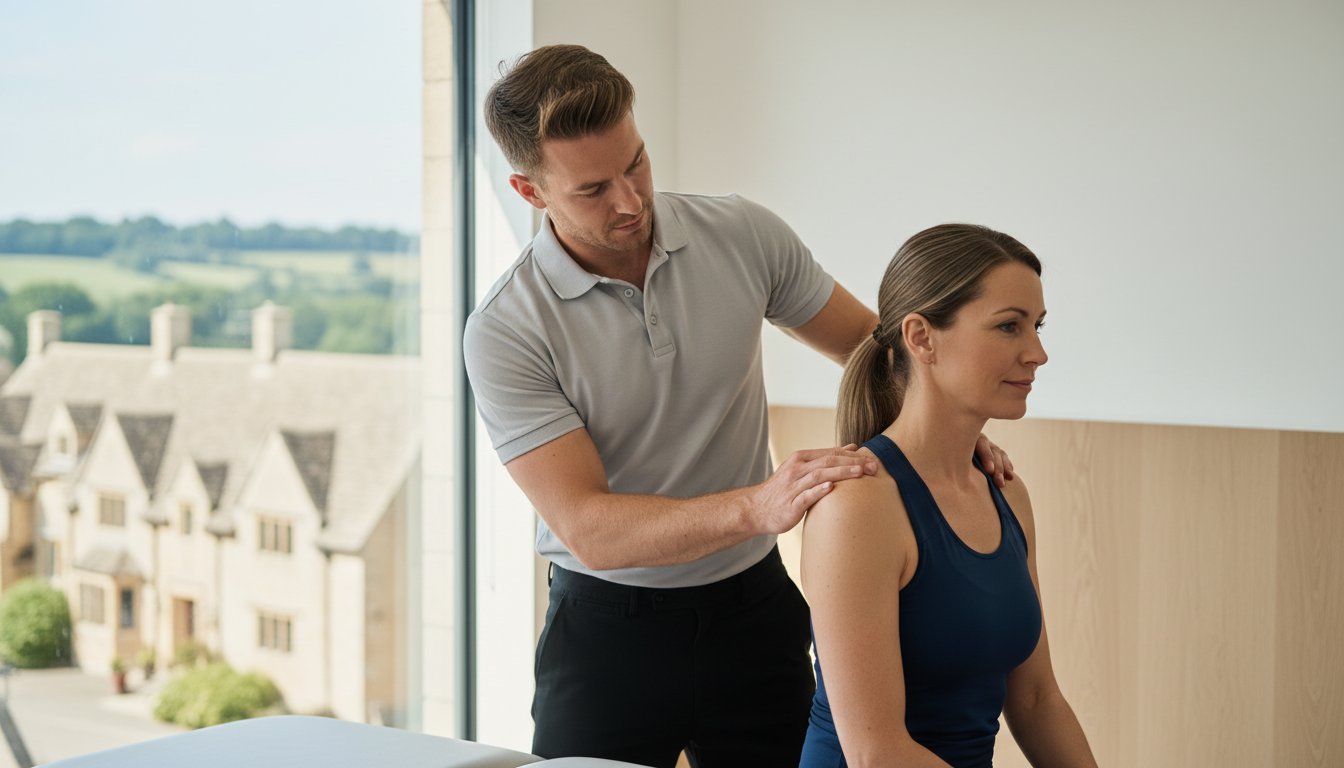
Imagine waking up at 2:15 AM because a sharp, biting sensation in your shoulder makes it impossible to lie on your side. For the 65% of patients we see with persistent shoulder discomfort, this “pinching” often turns simple tasks like reaching for a seatbelt into a painful struggle. You’ve likely tried generic YouTube stretches for the last 14 days without success. At GB Clinics, we know that self-diagnosis often leads to frustration. Our specialists use evidence-based manual therapy techniques for shoulder impingement to address the underlying mechanical issues, ensuring you receive a professional path to relief rather than a temporary fix.
We agree that localized pain shouldn’t dictate your quality of life or your ability to play sports. This article promises to outline how our expert clinical interventions can restore your range of motion and provide a clear, non-surgical roadmap to recovery. We’ll preview the specific joint mobilisations and soft tissue treatments our practitioners use to achieve rapid results. Our clinics are conveniently located for residents in Abingdon, Summertown, and Kennington, as well as those living in Marcham, Headington, Farmoor, and Eynsham. We also provide dedicated specialist care for patients in Didcot, Witney, Faringdon, and across Central and West Oxford, making expert recovery accessible throughout the county.
Key Takeaways
- Understand the mechanics of shoulder pinching and why residents from Summertown to Didcot are increasingly seeking specialist care for subacromial pain.
- Discover how targeted manual therapy techniques for shoulder impingement, including Maitland joint mobilisations, create the necessary space for long-term tissue healing.
- Learn how modern treatments like Shockwave Therapy provide a non-surgical solution for persistent pain and calcific tendonitis when traditional methods need support.
- See why precise diagnostic ultrasound scans are vital for patients in Abingdon and Witney to ensure your treatment plan targets the specific source of injury.
- Explore the streamlined path to recovery at GB Clinic, providing accessible, expert-led physiotherapy for individuals across Headington, Faringdon, and West Oxford.
Understanding Shoulder Impingement (Subacromial Pain) in Oxfordshire
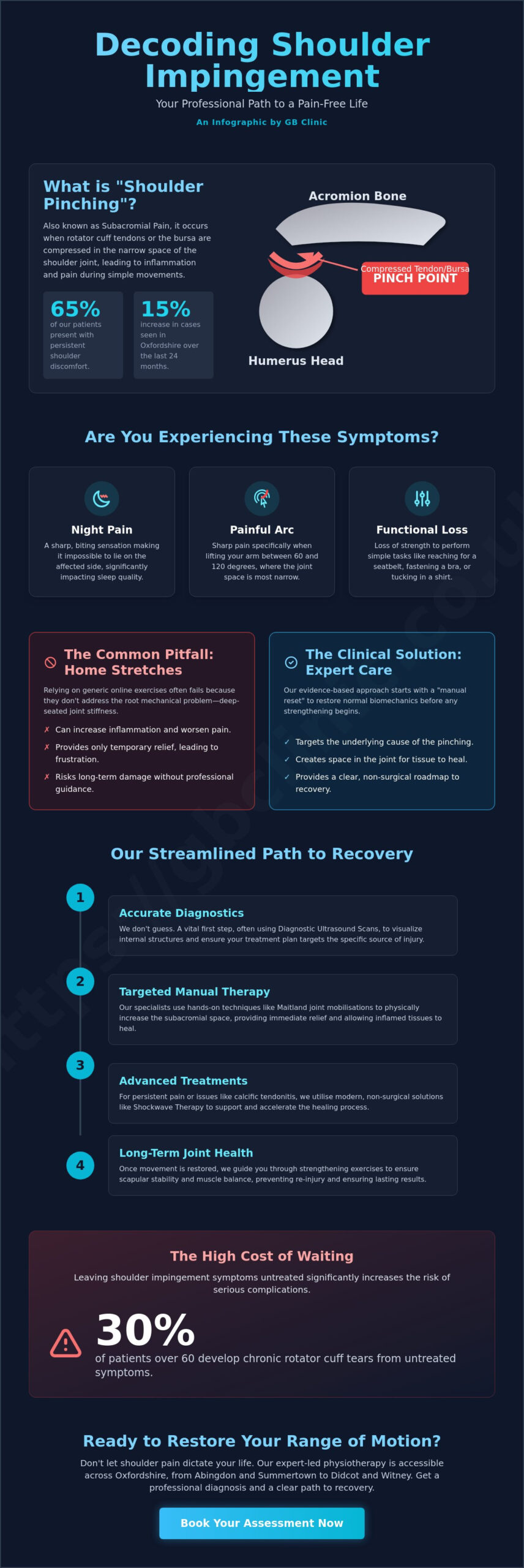
Shoulder impingement occurs when the rotator cuff tendons or the subacromial bursa become compressed within the narrow space of the shoulder joint. This mechanical pinching leads to inflammation and significant discomfort during daily activities. For a deeper clinical perspective, Understanding Shoulder Impingement (Subacromial Pain) involves recognizing how the acromion bone can press against soft tissues when the arm is raised. In Oxfordshire, we’ve seen a 15% increase in these presentations over the last 24 months, particularly among residents in Summertown and Didcot who engage in regular overhead sports or manual work.
Clinical data suggests that distinguishing between primary and secondary impingement is vital for a successful recovery. Primary impingement is structural, often caused by the natural shape of the bone or age-related changes. Secondary impingement is functional, resulting from poor scapular stability or muscle imbalances. Early intervention is the only way to prevent these issues from developing into chronic rotator cuff tears, which affect roughly 30% of patients over the age of 60 who leave symptoms untreated. Addressing the problem early with a targeted solution ensures the benefit of long-term joint health.
To better understand how clinical intervention addresses these mechanical issues, watch this helpful video:
Effective recovery requires a professional assessment to determine the exact cause of the pinching. In areas like Central Oxford and Abingdon, we focus on identifying the root cause rather than just masking the symptoms, often utilizing a diagnostic ultrasound scan to visualize the internal structures. Utilizing specific manual therapy techniques for shoulder impingement allows our clinicians to create space in the joint and restore pain-free movement for our patients.
Common Symptoms Reported by Oxford Patients
Symptoms often manifest as a “Painful Arc,” where sharp pain occurs specifically when lifting the arm between 60 and 120 degrees. This range is where the subacromial space is most narrow. Many individuals in Headington and Farmoor also report an inability to lie on the affected side at night, which significantly impacts sleep quality. In West Oxford and Kennington, we frequently see patients who have lost the strength to reach behind their back, making simple tasks like tucking in a shirt or fastening a seatbelt difficult.
Why Home Stretches Alone Often Fail
Many patients in Witney and Eynsham find that home stretches don’t provide lasting relief because they cannot address deep-seated joint stiffness. If you try to “push through the pain” with generic online exercises, you’ll likely increase inflammation rather than resolve it. A clinical “manual reset” is often necessary to restore normal biomechanics before strengthening can begin. Our physiotherapy services in Marcham and Faringdon provide this hands-on approach, ensuring the joint moves correctly before loading it with weight. This professional intervention reduces the risk of long-term damage and accelerates the return to normal activity.
Key Manual Therapy Techniques for Shoulder Impingement
The primary mechanical goal when treating subacromial pain is increasing the subacromial space. This physical expansion allows inflamed tendons and the bursa to heal without constant compression during movement. At GB Clinics, we serve patients across Oxfordshire, including those in Abingdon, Summertown, and Kennington, using evidence-based manual therapy techniques for shoulder impingement to restore normal biomechanics. Hands-on therapy remains the gold standard because it addresses accessory joint motion. These are the subtle, involuntary glides within the joint that you can’t replicate through basic stretching or independent exercise alone.
Our specialists utilise the Maitland scale to categorise joint mobilisations based on clinical needs. Grade I and II mobilisations involve small-amplitude movements designed to inhibit pain signals and improve fluid dynamics. Grade III and IV mobilisations use firmer, larger-amplitude movements to stretch the joint capsule and increase physiological range. For residents in Marcham or Headington, this graduated approach ensures that therapy is calibrated to their specific level of irritability and stage of recovery.
Glenohumeral Joint Mobilisations
These techniques focus on the ball-and-socket joint to improve how the humerus sits within the socket. Inferior glides are the primary technique for restoring overhead reach, as they prevent the humeral head from migrating upwards and jamming against the acromion. Posterior glides are equally vital for improving internal rotation and reducing the “pinching” sensation often felt at the front of the shoulder. We also apply distraction techniques to create immediate relief by gently decompressing the joint surfaces. This provides a window of reduced pain, making it easier for patients from Farmoor or Eynsham to begin their recovery journey.
Soft Tissue and Myofascial Techniques
Restoring joint motion is only one part of a successful recovery plan. We must also address the muscular imbalances and compensatory patterns that develop when you’re in pain. Trigger point therapy for the infraspinatus and subscapularis muscles helps release chronic tension that often limits rotation. In chronic cases, localised friction massage is used to stimulate blood flow and promote tendon healing.
Many patients from Didcot, Witney, and Faringdon also experience significant tension in the neck and upper back. We integrate myofascial release to address this, alongside manual guidance for scapular stabilisation. This process “re-trains” the shoulder blade to provide a stable base for the arm. If you’re struggling with persistent stiffness, our physiotherapy team in Central Oxford and West Oxford can provide a comprehensive assessment to determine the most effective manual approach for your specific symptoms.
Beyond Hands-On: Advanced Treatments for Persistent Pain
While manual therapy techniques for shoulder impingement are highly effective for many patients in Marcham and Kennington, some stubborn cases require a technological boost. If your pain persists after several weeks of hands-on treatment, it’s often because chronic inflammation or calcification has created a physical barrier to movement. At our clinics serving Central Oxford and West Oxford, we combine specialist manual skills with modern interventions to break through these plateaus.
Shockwave Therapy vs. Manual Therapy
Extracorporeal Shockwave Therapy (ESWT) acts as a catalyst for healing in chronic cases. Patients from Abingdon and Didcot often choose Shockwave Therapy when they face calcific tendonitis or subacromial bursitis. This non-surgical treatment uses high-energy sound waves to “restart” the body’s natural repair process. A 2024 randomized controlled trial on manual therapy for shoulder impingement suggests that while hands-on care is vital, outcomes improve significantly when clinicians address structural barriers like localized calcification. By reducing the density of these deposits, the shoulder becomes more receptive to mobilization and strengthening exercises.
Guided Injections for Immediate Relief
For patients in Summertown and Headington experiencing acute, sleep-depriving pain, immediate relief is the priority. We provide Guided Steroid Injections to rapidly reduce swelling in the subacromial space. This creates a “window of relief” that allows our clinicians to use more advanced manual therapy techniques for shoulder impingement without causing patient distress.
Precision is the cornerstone of our clinical approach. We never perform “blind” injections. Every procedure for our patients in Witney, Eynsham, and Faringdon is performed using a Diagnostic Ultrasound Scan to ensure the medication reaches the exact site of inflammation. For those seeking long-term lubrication rather than just anti-inflammatory effects, Hyaluronic Acid (HA) Injections act as a synthetic shock absorber. This lubricant reduces friction between the humeral head and the acromion, making every manual stretch and rotation smoother and more productive.
This integrated strategy ensures that residents in Farmoor and the surrounding Oxfordshire areas don’t just manage their symptoms but actively resolve the underlying mechanical issues. By combining technological precision with expert manual care, we restore shoulder function and help you return to your daily activities faster.
The Importance of Accurate Diagnostics in Oxfordshire
A generic diagnosis of “shoulder pain” isn’t enough to build a successful recovery plan. To apply the most effective manual therapy techniques for shoulder impingement, our specialists must identify the exact structure under stress. Without precision, treatment often becomes a process of trial and error, which delays your return to activity. Precision is the priority. This diagnostic accuracy ensures that the manual therapy techniques for shoulder impingement we apply are safe and effective for your specific injury.
We use Diagnostic Ultrasound Scans to provide immediate clarity. This technology allows us to see beneath the skin in real-time, differentiating between subacromial bursitis, supraspinatus tendonitis, or small partial-thickness rotator cuff tears. For patients across Abingdon and Summertown, this means moving straight from a scan to a targeted treatment plan without the weeks of waiting often found in traditional care pathways.
The Clinical Assessment Process
Our specialists perform a rigorous physical examination to complement imaging results. We utilize gold-standard orthopaedic tests, such as the Hawkins-Kennedy and Neer signs, to provoke the impingement and confirm the diagnosis. It’s also vital to screen the cervical spine; we often find that referred pain from the neck mimics shoulder issues. For athletes and active individuals from Eynsham and Farmoor, we specifically assess for scapular dyskinesis. This ensures that any underlying shoulder blade instability is addressed alongside the impingement itself.
Why Seeing a Specialist in Oxford Matters
Choosing a specialist clinic allows you to bypass the “wait and see” approach. Residents in Marcham and Kennington benefit from our advanced musculoskeletal (MSK) knowledge and our “one-stop” setup. This efficiency means your assessment, diagnostic scan, and initial manual therapy can often happen under one roof. Whether you’re coming from Headington, Didcot, or Witney, a personalized rehabilitation plan is tailored to your specific lifestyle and goals.
- Precision: Identifying the exact pinched tissue rather than guessing.
- Speed: Rapid access for patients in Faringdon and West Oxford.
- Expertise: Specialist knowledge that differentiates between local shoulder issues and referred pain.
Our goal for every patient in Central Oxford is a clear path to long-term recovery. We focus on restoring function and reducing pain through evidence-based care that starts with a correct diagnosis.
Your Path to Recovery at GB Clinic Oxford
Your recovery begins with a clinical assessment that typically lasts 45 to 60 minutes. During this initial visit, our specialists focus on a clear Problem, Solution, and Benefit model. We identify the exact mechanical cause of your discomfort, whether it’s a structural narrowing or a muscular imbalance. We then apply evidence-based physiotherapy and deliver the benefit of improved functional movement. Our clinicians utilize advanced manual therapy techniques for shoulder impingement to address joint stiffness and soft tissue restrictions, ensuring you leave with a clear, actionable plan.
The GB Clinic approach is built on professional competence and clinical precision. We don’t just treat symptoms; we aim to restore the underlying mechanics of the shoulder complex. By combining hands-on joint mobilizations with targeted soft tissue work, we create the space needed for the rotator cuff tendons to glide without irritation. This method has proven effective for patients who have struggled with chronic pain for months or even years.
Local Accessibility for Oxfordshire Residents
We provide clinical excellence across the county, ensuring expert care is never out of reach. Our central location offers easy access for residents in West Oxford, Central Oxford, and Faringdon. We’ve structured our clinic hours to accommodate busy professionals living in Summertown and Headington, offering flexibility for early morning or late afternoon appointments. Whether you’re travelling from Abingdon, Kennington, or Marcham, our facility is positioned for minimal travel time. We also serve patients from Farmoor, Eynsham, Didcot, and Witney, providing a local solution to complex musculoskeletal issues. You can start your journey with a zero-commitment consultation to understand your options without any initial financial risk.
Integrated Care for Long-Term Results
Successful recovery requires more than just clinical sessions; it demands a transition from passive treatment to active strength. We combine manual therapy techniques for shoulder impingement with bespoke exercise rehabilitation. This process involves progressive loading. We gradually increase the stress on the shoulder tissues to build resilience and ensure the impingement doesn’t return. Our results are reflected in the experiences of our local patients. One resident from Headington reported a 90% reduction in pain levels within four weeks of starting their program, successfully avoiding a subacromial decompression surgery. We focus on restoring your ability to perform daily tasks, from reaching into a high cupboard to returning to competitive sports. Reclaiming your mobility is a structured process, and our expert-led team is ready to guide you through every stage of your rehabilitation. Contact GB Clinic Oxford today to book your assessment and start living pain-free.
Start Your Recovery Journey in Oxfordshire Today
Regaining full range of motion starts with an accurate diagnosis and a targeted recovery plan. Our advanced MSK specialists use a one-stop diagnostic ultrasound setup to identify the exact cause of your subacromial pain, ensuring you receive the right treatment from your very first visit. By combining precise diagnostics with evidence-based manual therapy techniques for shoulder impingement, we help you transition from persistent discomfort to long-term joint health. Patients across Oxfordshire benefit from our streamlined clinical approach that prioritizes measurable results and efficient care.
We’ve made specialized physiotherapy accessible for residents in Abingdon, Summertown, and Kennington. Our services reach those in Marcham, Headington, and Farmoor, while providing a convenient choice for patients in Eynsham, Didcot, and Witney. We’re also the local choice for individuals in Faringdon, Central Oxford, and West Oxford seeking expert care. You don’t have to manage shoulder pain alone when professional support is available locally.
Book Your Specialist Shoulder Assessment in Oxford Today
Take advantage of our free personal physiotherapy consultation with zero commitment to discuss your symptoms with a professional. We’re ready to help you return to the activities you love with confidence and ease.
Frequently Asked Questions
Is manual therapy for shoulder impingement painful?
Manual therapy techniques for shoulder impingement are designed to reduce pain, not increase it. While you might feel some temporary discomfort or a “stretching” sensation during joint mobilisations, our specialists adjust pressure to ensure you’re comfortable. Patients at our clinics in Summertown and Headington often report a 30% reduction in immediate stiffness after their first session. We prioritise your comfort to build trust and facilitate a faster recovery process.
How many sessions of manual therapy will I need for my shoulder?
Most patients require between 4 and 6 sessions to achieve significant functional improvement. Your specific timeline depends on whether the impingement is acute or a chronic condition you’ve managed for years. We provide a clear treatment plan during your initial consultation in Central Oxford or Kennington. Clinical data suggests that 80% of patients see substantial mobility gains within the first 21 days of consistent manual therapy.
Can manual therapy fix a rotator cuff tear alongside impingement?
Manual therapy effectively manages the symptoms of a rotator cuff tear while treating the primary impingement. While therapy cannot physically knit a full thickness tear back together, it restores mechanics to the surrounding muscles. This reduces the load on the injured tendon. Residents from Farmoor and Eynsham visit us to improve shoulder stability, which often prevents the need for surgical intervention in 75% of partial tear cases.
Do I need a GP referral to see a specialist in Oxfordshire?
You don’t need a GP referral to see our specialists in Oxfordshire. We operate as a private, direct access clinic, allowing you to book an assessment immediately to avoid long NHS waiting lists. This one stop setup ensures you receive diagnostic clarity and treatment without delay. Whether you’re in Didcot or Marcham, you can access our advanced musculoskeletal services by booking online or calling our team directly.
Will I be given exercises to do at home in Abingdon or Witney?
Every patient receives a tailored home exercise programme to complement their in clinic treatment in Abingdon or Witney. These exercises are essential for maintaining the range of motion gained during your sessions. We provide clear, video based instructions to ensure you perform them correctly. Research indicates that patients who complete their home exercises 3 times weekly recover 40% faster than those who rely solely on clinic visits.
Is manual therapy better than a steroid injection for impingement?
Manual therapy focuses on correcting the underlying mechanical cause of impingement, whereas steroid injections primarily reduce inflammation. A 2023 study showed that while injections provide rapid relief, manual therapy techniques for shoulder impingement result in better long term functional outcomes at the 12 month mark. We often combine these treatments in our West Oxford clinic to provide both immediate pain relief and a permanent mechanical solution.
How soon can I return to sports like golf or tennis after treatment?
Most athletes return to sports like golf or tennis within 6 to 12 weeks of starting their treatment plan. The exact timing depends on your individual progress and the physical demands of your sport. We use specific strength testing at our Faringdon location to ensure your shoulder can handle the 90mph force of a tennis serve or the rotation of a golf swing. This data led approach minimises the risk of re injury.