What if the solution to the grinding morning stiffness that makes your staircase feel like a mountain isn’t an immediate surgical referral? With knee arthritis affecting approximately 18% of the UK population over the age of 45, many patients across Oxfordshire ask, can massage help knee arthritis, as they seek alternatives to invasive procedures. If you’re struggling to walk through the Cotswolds or navigate Central Oxford, you’ve likely felt the frustration of joints that simply won’t cooperate. It’s common to feel confused by the difference between a relaxing spa treatment and a clinical intervention designed for musculoskeletal health.
At GB Clinics, we’ve helped residents from Abingdon, Summertown, and Headington regain their mobility through evidence-based care. You’ll discover how therapeutic massage reduces swelling and how it fits into a comprehensive management plan. Whether you’re visiting us from Didcot, Witney, or Faringdon, we provide a clear path toward long-term recovery. We’ll also explain when to combine soft tissue work with advanced clinical treatments available to our patients in Kennington, Marcham, Farmoor, Eynsham, and West Oxford. This article outlines exactly how to restore your function and move toward a pain-free lifestyle.
Key Takeaways
- Understand how therapeutic massage targets the soft tissues surrounding the joint to alleviate the symptoms of knee osteoarthritis and improve joint function.
- Explore the latest clinical evidence answering “can massage help knee arthritis” and how specific manual therapies significantly improve mobility and WOMAC scores.
- Discover why a multi-modal approach combining physiotherapy with advanced medical injections is essential for patients in Abingdon, Witney, Didcot, and Central Oxford.
- Learn a step-by-step guide to identifying if your knee is ‘massage-ready’ and which specific muscle groups to target for effective home-based symptom management.
- Access expert-led care at our Oxfordshire clinics, conveniently located for residents in Summertown, Headington, Kennington, Marcham, Farmoor, Eynsham, Faringdon, and West Oxford.
Understanding Knee Arthritis and the Role of Therapeutic Massage
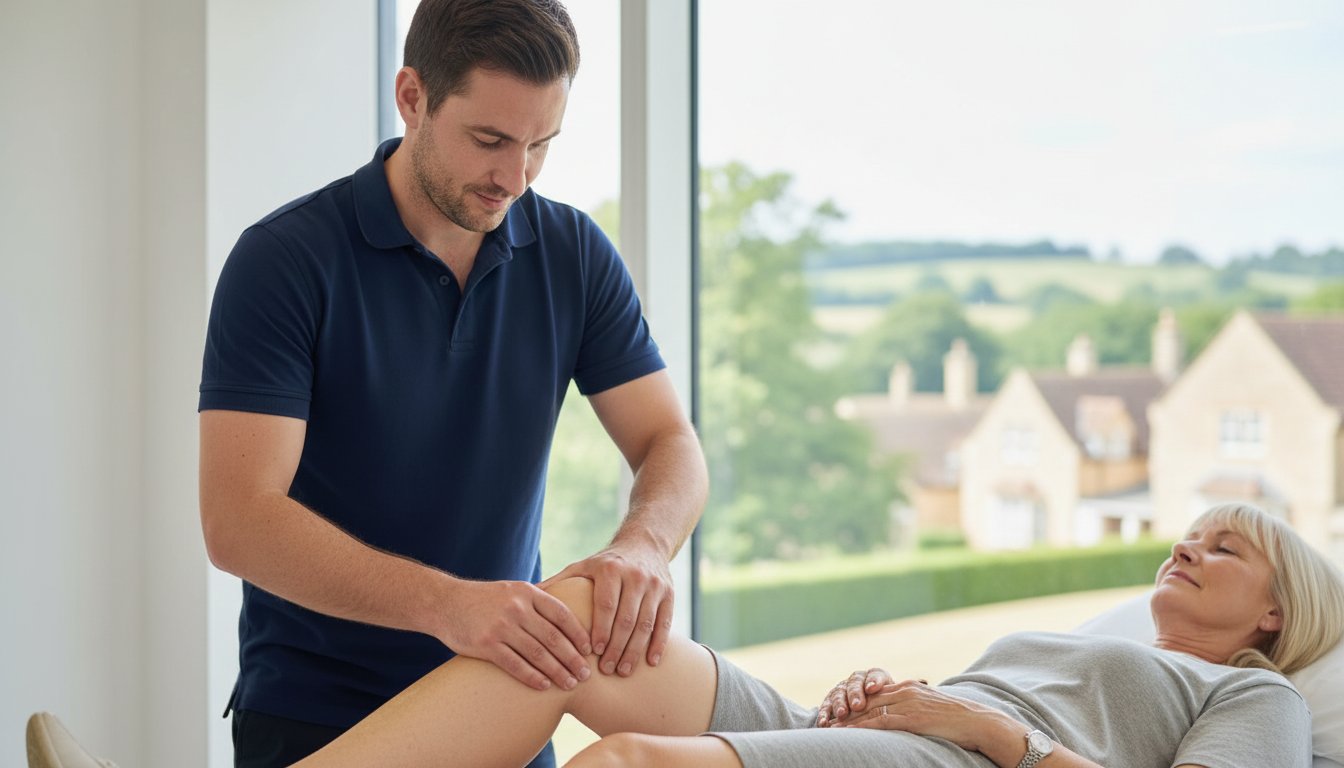
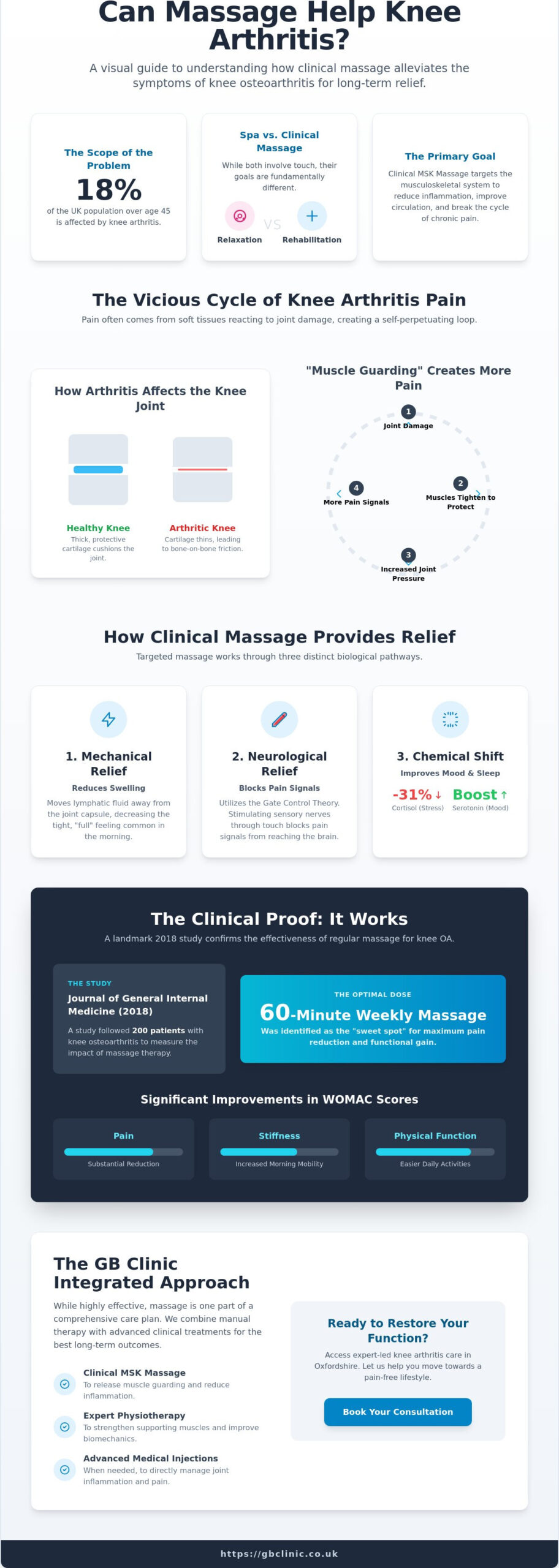
Knee Osteoarthritis (OA) involves the progressive thinning of the protective cartilage that cushions the ends of your bones. While the primary issue is the structural wear within the joint, the pain you feel often originates from the soft tissues reacting to that damage. Many patients wonder, can massage help knee arthritis? The clinical answer is that while massage cannot regrow cartilage, it’s highly effective at managing the secondary symptoms that cause the most daily distress. At GB Clinics, we distinguish between a standard relaxation massage and Clinical MSK Massage. Our specialists focus on the musculoskeletal system to reduce inflammation, improve local circulation, and break the cycle of chronic pain.
To better understand how targeted physical therapy and massage techniques can address joint discomfort, watch this helpful video:
How Massage Influences Arthritic Knee Joints
Clinical massage provides relief through distinct biological pathways. Mechanically, the application of targeted pressure helps move lymphatic fluid away from the joint capsule. This reduces the visible swelling that often makes the knee feel tight or “full” in the morning. Neurologically, we utilize the Gate Control Theory of pain relief. By stimulating sensory nerve fibers through touch, we effectively block pain signals from reaching the brain. Research shows that this type of therapy can lower cortisol levels by up to 31% while simultaneously boosting serotonin. This chemical shift is vital for patients, as it improves sleep quality and lowers the overall perception of chronic pain.
Identifying Muscle Guarding in Oxfordshire Patients
When a knee joint is damaged, your brain instinctively tightens the surrounding quadriceps and hamstrings to protect the area. This is known as muscle guarding. While it’s a natural reflex, it creates a harmful cycle where the tightened muscles increase the pressure on the arthritic joint, leading to more pain. Patients visiting us from Abingdon, Witney, and Didcot often present with these secondary compensations that limit their mobility more than the arthritis itself.
Whether you’re located in Summertown, Headington, or Central Oxford, our expert team identifies these specific tension patterns. We regularly help residents from Kennington, Marcham, and Farmoor release this “guarding” to restore a more natural gait. By softening the muscles in patients from Eynsham, Faringdon, and West Oxford, we reduce the compressive forces on the knee. This targeted approach is a fundamental component of our physiotherapy protocols, ensuring that your recovery is both clinical and comprehensive.
The Clinical Evidence: Can Massage Actually Improve Mobility?
Clinical research provides a clear answer for patients asking “can massage help knee arthritis” with evidence-based results. A landmark 2018 study published in the Journal of General Internal Medicine followed 200 patients with knee osteoarthritis over several months. The researchers found that participants receiving a weekly 60-minute Swedish massage experienced significant improvements in their Western Ontario and McMaster Universities Osteoarthritis Index (WOMAC) scores. These scores measure pain, stiffness, and physical function; the study indicated that 60 minutes once a week was the “sweet spot” for achieving the most substantial pain reduction and functional gains.
This data has shifted how musculoskeletal (MSK) recovery is approached in the UK. Many NHS-aligned recommendations now include massage as a valid adjunctive therapy alongside traditional physiotherapy. By reducing muscle tension and improving circulation around the joint, massage helps facilitate the movement patterns required for long-term rehabilitation. For residents in Abingdon, Witney, and Headington, this means massage isn’t just a luxury; it’s a functional tool for maintaining independence.
Short-Term vs. Long-Term Benefits
Massage provides immediate symptomatic relief by stimulating the nervous system to “gate” pain signals. While it’s vital to remember that massage isn’t a cure for the underlying degeneration of Osteoarthritis (OA), its cumulative effects are significant. Regular sessions help maintain the joint’s range of motion, preventing the surrounding tissues from becoming fibrotic or excessively tight. This is particularly important for active individuals in Summertown and Central Oxford who wish to remain mobile for daily walks or cycling. Consistent therapy ensures that the muscles supporting the knee don’t compensate in ways that lead to secondary hip or back pain.
The Importance of Professional MSK Assessment
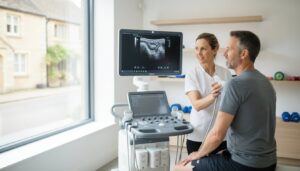
Safety is paramount when treating arthritic joints. Before starting any deep tissue work, a professional assessment is required to ensure the treatment won’t exacerbate the condition. At GB Clinic, we often recommend a diagnostic ultrasound scan to visualize the internal structures of the knee. This is crucial because aggressive massage can be harmful if a patient has an active Baker’s cyst or severe acute inflammation. The Benefits of Massage are most safely realized when the therapist understands the specific stage of your arthritis.
Our therapists across Oxfordshire, including those serving Kennington, Marcham, and Farmoor, tailor their pressure based on these clinical findings. We adjust techniques for patients in Eynsham, Didcot, Faringdon, and West Oxford to ensure the intensity matches the joint’s current tolerance. If you’re unsure about the current state of your joint health, you can book a consultation with our specialist team to determine the safest path forward.
Massage vs. Advanced Interventions: When Manual Therapy Isn’t Enough
A common objection patients in Abingdon or Summertown raise is that the benefits of manual therapy feel temporary. While massage provides immediate relief, the physiological effects on chronic inflammation often subside after 3 to 5 days if used as a standalone treatment. At our Oxfordshire clinics, we don’t view massage as a cure. Instead, we integrate it into a multi-modal recovery plan designed for lasting results.
When considering can massage help knee arthritis, it’s vital to understand what it targets. Massage addresses the “external” factors of arthritis, specifically the muscular guarding and fascial restrictions that develop when you change your gait to avoid pain. However, it cannot repair the “internal” joint environment. This is where advanced medical interventions become necessary. By combining soft tissue work with clinical procedures, we create a comprehensive path to recovery for residents in Kennington and Eynsham.
Soft tissue work serves a specific clinical purpose: it prepares the knee for rehabilitation. Reduced muscle tension allows for a greater range of motion during physiotherapy sessions. This makes it significantly easier for patients from Farmoor or Witney to perform the strengthening exercises essential for long-term joint stability. We use manual therapy to “open the window” of movement, allowing more intensive exercises to take hold.
Integrating Hyaluronic Acid (HA) Injections
While massage manages external tension, Hyaluronic Acid injections treat the joint’s internal mechanics directly. HA acts as a biological lubricant, mimicking the natural synovial fluid that cushions your knee. This synergy is highly effective. The injection reduces intra-articular friction for up to 6 months, while manual therapy releases the tight quadriceps and hamstrings that place unnecessary pressure on the joint. We provide these targeted treatments for patients across Didcot, Faringdon, and West Oxford.
Shockwave Therapy for Chronic Knee Pain
For patients in Central Oxford dealing with secondary issues like patellar tendonitis or chronic ligament pain, we often recommend Shockwave Therapy. This technology uses high-energy acoustic waves to stimulate healing in stubborn connective tissues where manual pressure isn’t sufficient. Our “one-stop setup” allows residents from Headington and Marcham to access diagnostic scans and advanced therapies under one roof, ensuring a faster transition from pain management to active recovery.
Actionable Guidance: Professional Care and Self-Management in Oxfordshire
Determining if your joint is “massage-ready” is the first step toward relief. If you’re wondering can massage help knee arthritis during a flare-up, it’s best to wait. If the knee is visibly red, hot to the touch, or experiencing sharp, stabbing pain, it’s in an acute inflammatory phase. Massage is most effective when the joint feels stiff or achy rather than acutely inflamed. For patients in Kennington and Farmoor, tracking morning stiffness levels provides a reliable indicator of when to begin soft tissue work.
Safe Self-Massage Techniques for Home Use
Preparation is essential for effective home care. Apply a heat pack to the thigh and calf for 15 minutes before starting. This increases tissue pliability and improves local circulation. Once the muscles are warm, use the “gentle effleurage” technique. This involves long, sweeping strokes starting just above the knee and moving upward toward the hip. This specific direction helps move excess fluid away from the knee cap and toward the lymph nodes for drainage.
- Target the Quadriceps: Focus on the large muscles at the front of the thigh to reduce the “pull” on the patella.
- Release the IT Band: Use flat palms to apply moderate pressure along the outside of the thigh.
- Address the Calves: Knead the gastrocnemius muscle to improve overall lower limb mechanics.
- Safety Warning: Never apply heavy, direct pressure onto the bony prominences or the kneecap itself.
What to Look for in an Oxfordshire MSK Clinic
While home care is beneficial, managing chronic Osteoarthritis (OA) often requires professional intervention. Clinical studies indicate that one 60-minute session per week for a period of 8 weeks can lead to a 30% improvement in WOMAC pain scores. When choosing a provider, always verify HCPC registration and specialized musculoskeletal (MSK) experience. A private MSK physiotherapy session offers significantly more value than a standard spa visit because it combines manual therapy with diagnostic precision.
Accessibility is a priority for busy residents. We ensure our services are easy to reach for those in Eynsham, Central Oxford, and West Oxford. Patients traveling from Abingdon, Summertown, or Headington benefit from our streamlined “one-stop” setup. We also provide convenient care for individuals in Marcham, Didcot, Witney, and Faringdon, ensuring that expert clinical guidance is never more than a short drive away. Our goal is to restore your mobility through evidence-based treatments that provide long-term recovery rather than temporary fixes.
If you’re ready to move beyond temporary relief and address the root cause of your knee pain, we can help. Contact GB Clinics today to book your expert assessment.
The GB Clinic Approach: Integrated Knee Arthritis Care in Oxford
While patients often ask can massage help knee arthritis, the clinical team at GB Clinic focuses on evidence-based strategies that offer more than short-term comfort. Our philosophy is built on professional, expert-led care that prioritises your specific recovery goals. We don’t believe in generic treatments. Instead, we use a patient-focused model that combines advanced medical expertise with a compassionate touch.
Our “Problem/Solution/Benefit” framework ensures every patient understands their journey:
- Problem: Persistent knee pain and restricted mobility caused by joint degeneration.
- Solution: A combination of specialist Physiotherapy and advanced medical injections, such as Hyaluronic Acid.
- Benefit: Significant reduction in inflammation and a return to daily activities without pain.
We pride ourselves on being a modern specialist clinic. By integrating diagnostic precision with therapeutic excellence, we help you avoid the long waiting lists often found in traditional healthcare settings. Our goal is to get you back to your best as quickly as possible.
A Personalised Path to Recovery
Every recovery starts with a comprehensive initial assessment. We don’t just look at the knee; we analyse how you move. This process often includes a detailed gait analysis to identify biomechanical issues that contribute to joint wear. We use your feedback at every stage to refine your plan, ensuring the treatment remains effective and comfortable.
Patient testimonials frequently highlight our “very kind and considerate” approach. We understand that living with chronic pain is exhausting. That’s why our Oxfordshire practitioners maintain a calm, clinical environment where your concerns are heard. This professional distance, paired with genuine empathy, builds the trust necessary for successful long-term recovery.
Booking Your Assessment in Oxfordshire
Our clinic is designed as a “One-Stop” setup to save you time and reduce stress. We’re conveniently located for residents across the county. If you’re in Central Oxford, Summertown, or West Oxford, our facilities are just a short journey away. We also provide easy access for patients travelling from Abingdon, Kennington, or Marcham via the A34.
For those living in Headington, Farmoor, or Eynsham, our streamlined booking process means you can often see a specialist within days. We also regularly treat patients from further afield, including Didcot, Witney, and Faringdon, who value our expert-led injections and advanced physiotherapy services.
We offer a FREE personal physiotherapy consultation with zero commitment. It’s a risk-free way to speak with an expert about whether your current symptoms require medical intervention. Take the first step toward restoring your mobility today. You don’t have to live with knee pain; let us help you find a clear path to a pain-free life.
Take Control of Your Knee Health in Oxfordshire
Understanding can massage help knee arthritis is the first step toward reclaiming your active lifestyle. While manual therapy offers valuable relief for muscle stiffness, clinical evidence shows that the best outcomes arise from a structured, professional approach. Our HCPC Registered MSK Specialists use advanced diagnostic ultrasound on-site to ensure your treatment plan is based on an accurate assessment of your joint health. This integrated method helps reduce inflammation and restores the mobility you need for daily activities.
We’ve made expert care accessible for residents across the region. Whether you live in Central Oxford, Abingdon, or Witney, our clinics provide a professional environment for your recovery. We regularly support patients from Headington, Summertown, and Didcot, as well as those traveling from Faringdon, Eynsham, and West Oxford. If you’re based in Kennington, Marcham, or Farmoor, you’ll find our specialist services are conveniently located to help you avoid long waiting lists. You don’t have to let knee pain limit your movement when evidence-based solutions are available locally. Our team is dedicated to providing the clear path to recovery you deserve.
Book your FREE personal physiotherapy consultation in Oxfordshire today
We look forward to helping you move without discomfort again.
Frequently Asked Questions
Is massage safe for all stages of knee arthritis?
Massage is safe for most stages of knee arthritis when a clinical specialist adapts the technique to your specific symptoms. For patients in Summertown or Kennington experiencing acute Grade 4 swelling, we use gentle lymphatic drainage to move fluid away from the joint. If you’re in a chronic, stable phase, deeper pressure helps release tight muscles. Our clinicians assess your joint health to ensure the treatment supports your recovery without causing irritation.
How often should I have a massage for my knee pain?
We recommend one session per week for a four-week period to achieve the best results for chronic stiffness. Research from a 2018 study in the Archives of Physical Medicine and Rehabilitation suggests this frequency significantly improves joint function. Residents from Marcham and Farmoor often transition to a monthly maintenance plan once their initial mobility improves. This consistent approach helps manage long-term symptoms and keeps you active.
Can massage actually ‘cure’ my osteoarthritis?
Massage cannot cure osteoarthritis because it’s a degenerative condition involving structural changes to bone and cartilage. However, understanding can massage help knee arthritis involves looking at symptom management rather than a permanent structural fix. It works by reducing muscle tension and improving circulation around the joint. This provides significant relief and improves your quality of life even though the underlying joint wear remains unchanged.
Will my health insurance cover therapeutic massage at your Oxford clinic?
Most private health insurers like Bupa, AXA, and Vitality cover therapeutic massage when it’s part of a prescribed physiotherapy program. You’ll need to check your specific policy details before visiting our Central Oxford or Headington clinics. We provide detailed receipts with professional registration numbers to make your claims process straightforward. This ensures patients from Eynsham and Faringdon can access expert care with financial peace of mind.
What is the difference between sports massage and massage for arthritis?
Sports massage uses high-intensity pressure for muscle repair, whereas arthritis massage uses 50% lighter pressure focused on joint lubrication. The goal for our West Oxford patients is to decrease cortisol levels and improve synovial fluid flow without stressing the bone. This specific clinical focus ensures we manage your pain effectively without the post-treatment soreness often associated with traditional sports therapy.
Can I have a massage if I’ve recently had a steroid injection in my knee?
You must wait a minimum of 72 hours after a steroid injection before having a massage on the treated knee. This window allows the corticosteroid to settle into the joint space and begin reducing inflammation effectively. Massaging the area too soon might displace the medication into the surrounding soft tissues, which reduces its clinical impact. Patients in Witney and Abingdon should always inform their therapist about recent injections during their consultation.
What should I wear to my physiotherapy or massage appointment in Oxfordshire?
Wear loose-fitting shorts or leggings that allow 100% access to the area from the mid-thigh to the mid-calf. This visibility is essential for our specialists in Didcot and Faringdon to accurately track patellar movement and swelling. Around 95% of our patients find that wearing athletic gear makes the 45-minute assessment much more efficient. We provide private spaces for you to change if you’re traveling from Central Oxford.
How soon will I feel the benefits of a professional knee massage?
You’ll likely notice a 20% improvement in joint flexibility immediately after your first 30-minute session. While the initial relief is helpful, clinical data indicates that the most significant results occur after a 4-week course of treatment. When considering can massage help knee arthritis, patients across Headington and Kennington report that consistent therapy allows them to walk 15% further without pain. This cumulative effect is why we prioritize a structured treatment plan.