

Your frozen shoulder recovery is a marathon, not a sprint, and performing the wrong movements at the wrong time can actually set your progress back by months. It’s incredibly frustrating when you can’t reach for a seatbelt or sleep through the night because of that constant, throbbing ache. You might even worry that your shoulder will stay “frozen” forever, especially since this condition affects between 2% and 5% of the UK population. This guide provides a specialist-led exercise plan for frozen shoulder designed to restore your mobility and reduce pain safely through every biological stage of the condition.
We’ll explain how to tailor your movements to your specific phase of adhesive capsulitis, ensuring you don’t aggravate the joint. Whether you’re in Central Oxford, Headington, or Summertown, accessing professional support is essential if home care isn’t enough. GB Clinics provides expert musculoskeletal care for patients across Abingdon, Witney, and Didcot, as well as surrounding areas like Kennington, Marcham, and Farmoor. From Eynsham to Faringdon and West Oxford, we offer clear paths to recovery. You’ll learn exactly which exercises suit your current stage and when it’s time to see a specialist to prevent the typical 12 to 18 month recovery window from stretching even longer.
Key Takeaways
- Identify the three distinct biological stages of adhesive capsulitis to ensure your movements align with your current level of inflammation and pain.
- Follow a specialist-led exercise plan for frozen shoulder that incorporates the pendulum swing and towel stretch to restore essential range of motion.
- Discover when to consider advanced musculoskeletal treatments, such as Hyaluronic Acid injections, for patients in Central Oxford, Headington, and Summertown.
- Access professional, one-stop physiotherapy services conveniently located for residents in Abingdon, Witney, Didcot, and West Oxford.
- Learn how expert intervention helps patients in Kennington, Marcham, and Faringdon overcome severe stiffness and return to pain-free daily activities.
Understanding Adhesive Capsulitis: Why Exercise is Essential in Oxfordshire
Adhesive capsulitis, commonly known as frozen shoulder, is a clinical condition where the connective tissue surrounding the glenohumeral joint becomes inflamed, thickened, and tight. This biological change restricts the joint’s volume, making simple movements like reaching into a cupboard or dressing nearly impossible. For a comprehensive overview of adhesive capsulitis, clinical research confirms that the capsule physically shrinks around the humerus. This explains why standard gym routines often fail. You can’t simply “power through” a capsule that has biologically tightened, and doing so often increases inflammation.
For residents in Summertown and Headington dealing with this intense stiffness, movement is the primary clinical recommendation. Gentle, targeted movement stimulates the production of synovial fluid, which acts as a lubricant for the joint. It also increases local blood flow, which is vital for delivering oxygen and nutrients to the inflamed tissue. Without a structured exercise plan for frozen shoulder, the joint remains stagnant, potentially leading to further thickening of the capsule. Since this condition affects between 2% and 5% of the UK population, understanding these mechanics is the first step toward relief.
To better understand the mechanics of this condition and the movements required for relief, watch this helpful video:
Symptoms and Diagnosis in Oxfordshire
Patients often describe two distinct types of pain: a constant, dull throb that disrupts sleep and a sudden, sharp “catch” when reaching behind the back. If you live in Central Oxford or West Oxford and aren’t sure if your pain is a rotator cuff tear or adhesive capsulitis, a professional assessment is necessary. At GB Clinics, we often recommend a diagnostic ultrasound scan to provide a clear view of the soft tissues. This helps residents in Kennington and Marcham receive an accurate diagnosis without the long wait times often associated with secondary care, ensuring your treatment starts immediately.
The Goal of Your Exercise Programme
The primary objective of your exercise plan for frozen shoulder isn’t to build muscle mass; it’s to restore functional range of motion. We focus on maintaining the mobility you still have to prevent secondary issues, such as tension headaches or mid-back pain, which often occur when you overcompensate for a stiff shoulder. For patients in Abingdon, Didcot, and Witney, this consistent approach prepares the joint for advanced therapies like injections if recovery plateaus. Whether you’re based in Farmoor, Eynsham, or Faringdon, starting early with the right movements is the most effective way to shorten the overall recovery timeline, which can otherwise last up to 3 years.
The Three Stages of Frozen Shoulder: Tailoring Your Plan
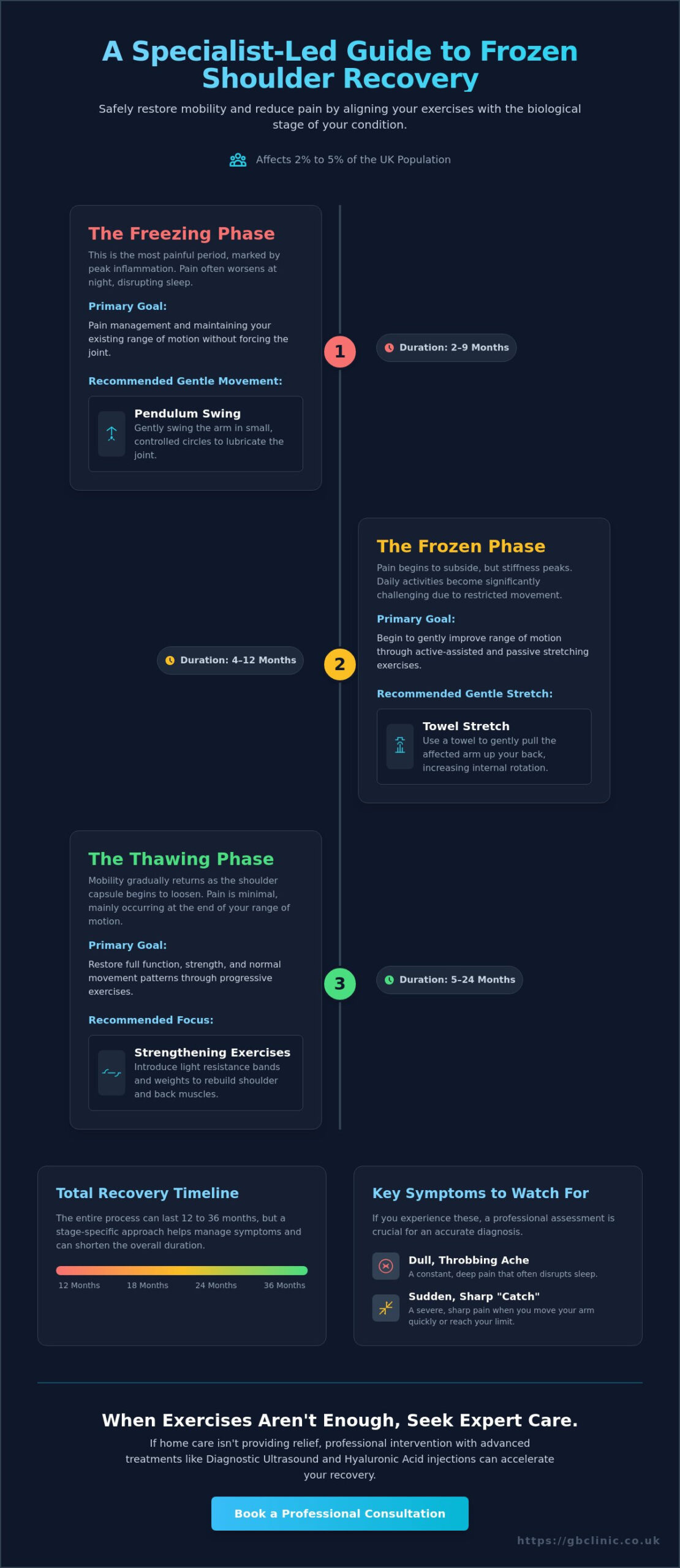
Frozen shoulder is a unique clinical condition because it evolves through three distinct biological phases. A generic exercise plan for frozen shoulder that works in the final stage could be detrimental if applied during the initial onset. For residents in Abingdon and Didcot, understanding where you sit on this timeline is the key to reducing pain and avoiding unnecessary flare-ups. Clinical data suggests that the entire process can last between 12 and 36 months, but a stage-specific approach helps manage symptoms more effectively throughout this period.
- Stage 1: The Freezing Phase (2–9 months): This is the most painful period. Inflammation is at its peak, and pain often worsens at night. Your goal here is pain management and maintaining existing mobility without forcing the joint.
- Stage 2: The Frozen Phase (4–12 months): Pain may begin to plateau or slightly decrease, but the shoulder becomes significantly stiffer. The “catch” pain is less frequent, but functional reach is severely limited.
- Stage 3: The Thawing Phase (6 months–2 years): The capsule begins to loosen. Range of motion gradually returns, and this is the time to focus on progressive strengthening and functional restoration.
Whether you are in Summertown, Headington, or Central Oxford, matching your activity level to these phases prevents the cycle of “stretch-pain-inflammation” that stalls many patients’ progress. If you find your symptoms are not following this typical trajectory, seeking professional physiotherapy can help clarify your diagnosis and adjust your recovery path.
Stage 1: Pain Management Stretches
During the freezing phase, aggressive stretching is counterproductive. Patients in Kennington and Marcham should focus on gentle “pendulum” movements and micro-rotations that don’t trigger sharp pain. Applying heat therapy via a warm pack for 15 minutes before starting your movements can help relax the surrounding musculature. Using NHS shoulder mobility exercises as a baseline ensures you are moving within safe clinical boundaries. Avoid any movement that causes your pain to linger for more than 30 minutes after you finish.
Stage 2 & 3: Progressive Mobilisation
As you transition into the frozen and thawing phases, your exercise plan for frozen shoulder must become more active. Residents in Witney, Faringdon, and West Oxford can start using household items like towels or broomsticks to assist the “stiff” arm through a larger range of motion. It’s vital to distinguish between “recovery pain”—a dull, stretching sensation—and “injury pain,” which feels like a sharp, stabbing catch. For those in Farmoor and Eynsham, introducing light isometric holds helps wake up the rotator cuff muscles that often weaken during the months of inactivity. If you feel stuck in the frozen phase, a specialist consultation can help determine if advanced intervention is required to kickstart the thawing process.
A Step-by-Step Exercise Plan for Frozen Shoulder Relief
Implementing a structured exercise plan for frozen shoulder requires patience and precision. For residents in Summertown and Headington, these specific movements form the foundation of a home-based recovery strategy. Each exercise targets a unique aspect of the capsule’s restriction, slowly encouraging the tissue to become more pliable. It’s vital to perform these movements slowly to avoid triggering the sharp “catch” pain discussed in previous sections.
- The Pendulum Swing: Lean forward, supporting your weight with your “good” arm on a sturdy table. Let the affected arm hang vertically and swing it in small, gentle circles. This uses gravity to create space in the joint without active muscle contraction.
- Towel Stretch: Hold a long towel behind your back with both hands in a vertical position. Use your healthy arm to pull the affected arm upward. This is essential for restoring the internal rotation needed for daily tasks like dressing or tucking in a shirt.
- Finger Walk: Stand facing a wall about arm’s length away. Use your fingers to “walk” up the wall as high as you can comfortably reach. This safely increases overhead reach for patients in Kennington and Marcham.
- Cross-Body Reach: Use your good arm to lift the affected arm at the elbow and bring it across your body. Hold for 15 to 20 seconds to release the posterior capsule stiffness.
- Inward and Outward Rotation: Hold a rubber exercise band between your hands with elbows at a 90-degree angle. Slowly rotate the affected arm outward while keeping the elbow tucked into your side. This restores the shoulder’s pivot mechanism.
Daily Routine and Frequency
Consistency is more important than intensity. We recommend performing these movements 3 times daily within your Witney or Faringdon home. Start with 5 to 10 repetitions of each movement and hold stretches for approximately 15 seconds. As your tolerance improves, you can gradually increase the volume. Linking this routine to professional physiotherapy ensures you receive real-time feedback on your form. Residents in Central Oxford and West Oxford benefit from this professional oversight to ensure they aren’t inadvertently stalled by poor technique.
Common Mistakes to Avoid
The most frequent error is pushing into sharp, stabbing pain. The “no pain, no gain” philosophy is dangerous here; it triggers the inflammatory response we’re trying to calm. Patients in Abingdon and Didcot should also avoid using momentum to “swing” the arm into position. Controlled muscle engagement is necessary to protect the joint. Finally, don’t neglect your posture or the “good” arm. Overcompensating with your neck or back can lead to secondary musculoskeletal issues in areas like Farmoor or Eynsham.
When Exercises Aren’t Enough: Advanced MSK Treatments in Oxford
While consistent movement is the cornerstone of recovery, some patients find that a home exercise plan for frozen shoulder fails to yield results after 12 weeks of diligent effort. If your range of motion remains static or pain levels continue to disrupt your sleep despite regular stretching, you may be classified as a “non-responder.” For residents in Eynsham, Farmoor, and Witney, this is the point where advanced musculoskeletal (MSK) interventions become necessary to break the cycle of stiffness and chronic inflammation. Approximately 15% of patients require these clinical escalations to progress past the freezing stage.
At GB Clinics, we offer Hyaluronic Acid (HA) Injections, which act as a high-grade lubricant for the tightened joint capsule. This treatment is proven to ease pain for up to 6 months, providing the comfort needed to re-engage with your rehabilitation. Additionally, Shockwave Therapy is an effective non-surgical option. It uses acoustic pressure waves to stimulate blood flow and break down persistent scar tissue within the capsule, accelerating the natural healing process for those whose recovery has plateaued.
The Synergy of Injections and Exercise
Advanced treatments don’t replace your movement routine; they facilitate it. A guided steroid injection can rapidly reduce local inflammation, making your exercise plan for frozen shoulder much more effective during the critical “window of opportunity” that follows. For our patients in Kennington, Marcham, and Abingdon, we design post-injection rehabilitation programmes that capitalise on this reduced pain state. This ensures that the temporary relief provided by the injection translates into long-term functional gains rather than just a short-term mask for the pain.
Diagnostic Clarity with Ultrasound
Escalating treatment without a clear internal view can lead to wasted time and effort. A diagnostic ultrasound scan is vital for residents in Central Oxford, West Oxford, and Faringdon to confirm the diagnosis. This technology allows us to differentiate adhesive capsulitis from other conditions like calcific tendonitis, which involves calcium deposits in the tendons and requires a different clinical approach. Our fast-track diagnostic setup ensures that patients from Headington, Summertown, and Didcot receive answers quickly, allowing for a more targeted and effective recovery strategy. If your progress has stalled, you can book a specialist consultation to explore these advanced options.
Professional Physiotherapy and Rehabilitation in Oxfordshire
A successful recovery from adhesive capsulitis requires more than just a list of movements; it requires a clinical partner to guide you through each stage. At GB Clinics, we provide a “one-stop setup” that integrates diagnostics, injections, and rehabilitation under one roof. This efficiency saves time for busy residents in Abingdon and Summertown who need to balance their recovery with work and family commitments. By combining expert manual therapy with your exercise plan for frozen shoulder, we ensure that every session moves you closer to full functional mobility.
Manual therapy performed by a specialist helps to gently mobilise the joint capsule in ways that are difficult to achieve alone at home. This professional intervention reduces the protective muscle guarding that often develops when you’re in chronic pain. For patients in Kennington and Marcham, our approach focuses on transitioning from immediate pain relief to long-term shoulder health. We don’t just treat the stiffness; we address the underlying biomechanics to prevent compensatory injuries in your neck and upper back.
Expert Care Near You
Accessing high-quality musculoskeletal care shouldn’t involve long commutes or waiting lists. Our clinics are strategically located for easy access from Headington, Didcot, and Witney, ensuring you can attend regular appointments without stress. The team at GB Clinics is professional, reassuring, and expert-led, focusing on evidence-based treatments that deliver measurable results. We understand that starting treatment can feel like a significant step, which is why we offer a personal physiotherapy consultation with zero commitment. This allows you to discuss your symptoms and understand the potential path forward before beginning your formal exercise plan for frozen shoulder.
Your Path to a Pain-Free Shoulder
We follow a logical, three-step process to restore your quality of life. This measured rhythm builds confidence and ensures no stage of your recovery is rushed. Residents in Central Oxford, West Oxford, and Farmoor benefit from this structured journey:
- Step 1: Accurate Diagnosis: Using advanced tools like ultrasound to confirm adhesive capsulitis and rule out other pathologies.
- Step 2: Pain Management: Utilising targeted injections or shockwave therapy to calm inflammation and create a window for movement.
- Step 3: Targeted Exercise: Implementing a bespoke rehabilitation programme tailored to your specific lifestyle in Eynsham or Faringdon.
Restoring your ability to drive comfortably, reach for high shelves, and sleep soundly through the night is our primary goal. Expert intervention can significantly shorten the recovery window, helping you return to a pain-free life faster than following a generic plan alone. You can book your specialist shoulder assessment in Oxford today to begin your clinical recovery journey.
Restore Your Mobility with Specialist Care in Oxfordshire
Recovering from adhesive capsulitis is a structured process that requires moving from initial pain management to progressive mobilisation. By following a staged exercise plan for frozen shoulder, you can safely navigate the freezing and thawing phases without causing further inflammation. Our expert MSK physiotherapists provide the professional oversight needed to ensure your home routine remains effective and safe. This clinical guidance is vital for preventing the secondary neck and back pain that often occurs when you overcompensate for a stiff joint.
If your progress has plateaued, GB Clinics offers advanced treatments like Hyaluronic Acid injections and Shockwave therapy to accelerate your healing. We provide a kind and considerate environment for patients across Central Oxford, Headington, and Summertown. Our clinics are easily accessible for residents in Abingdon, Didcot, and Witney, as well as those in Kennington, Marcham, and Faringdon. Whether you’re based in Farmoor, Eynsham, or West Oxford, expert care is conveniently nearby. You don’t have to wait years for your shoulder to “thaw” on its own. Book Your Specialist Shoulder Consultation in Oxford today to start your journey back to a pain-free life.
Frequently Asked Questions
How long does a frozen shoulder take to heal with exercise?
Recovery typically takes between 12 and 18 months, though some cases can last up to 3 years. A structured exercise plan for frozen shoulder helps manage symptoms and maintain function throughout this biological timeline. Patients in Abingdon and Didcot often see noticeable improvements in their range of motion within 12 weeks of starting a clinical rehabilitation programme. Consistency with daily movements is the most effective way to prevent the stiffness from becoming permanent.
Can I do frozen shoulder exercises if my arm is very painful at night?
Yes, you should continue with gentle movements, but you must reduce the intensity of your stretches. Night pain is a hallmark of the “freezing” stage and affects approximately 70% of patients. Focus on micro-movements and pain-free pendulums before bed rather than aggressive stretching. Residents in Summertown and Headington find that these gentle movements help circulate synovial fluid, which can dull the throbbing ache that often prevents restful sleep.
What is the best exercise for a frozen shoulder in the early stage?
The pendulum swing is the gold standard for the early, inflammatory stage of adhesive capsulitis. It allows the joint capsule to open slightly using gravity rather than active muscle tension. For those in Kennington and Marcham, performing this 3 times daily provides a safe entry point for rehabilitation. It maintains essential mobility without the risk of triggering the sharp “catch” pain that is common during the first 9 months of the condition.
Is it possible to “break” a frozen shoulder by exercising too hard?
You cannot physically “break” the joint, but you can cause a significant inflammatory flare-up by pushing too hard. Aggressive stretching can lead to micro-tears in the thickened capsule, which actually increases pain and stiffness. Our specialists in Witney and Faringdon advise staying within a 3/10 pain threshold during any activity. Pushing into sharp pain often results in a setback that requires several weeks of rest and anti-inflammatory treatment to resolve.
Do I need a GP referral for private physiotherapy in Oxfordshire?
No, you can self-refer to GB Clinics for an assessment and diagnostic scan. We provide a one-stop setup for patients in Central Oxford and West Oxford, allowing for immediate treatment without the wait times often found in secondary care. Many patients from Farmoor and Eynsham choose this direct route to receive an accurate diagnosis and start their recovery programme within days of their first contact with our clinical team.
What should I do if my frozen shoulder exercises are making the pain worse?
You should stop the specific movement and consult a musculoskeletal specialist immediately. If pain lingers for more than 30 minutes after your exercise plan for frozen shoulder, the intensity is likely too high for your current biological stage. Our clinicians in Headington and Didcot can adjust your repetitions and range of motion to ensure you are working within your tolerance rather than aggravating the underlying inflammation.
Can Shockwave therapy be used alongside my exercise plan?
Yes, Shockwave therapy is an excellent adjunct to active rehabilitation. It uses acoustic pressure waves to stimulate blood flow and break down persistent scar tissue within the capsule. For residents in Summertown and Abingdon, this treatment often provides the symptomatic relief needed to progress with more challenging stretches. It’s particularly effective during the “frozen” and “thawing” phases, helping to accelerate the return of functional strength and mobility.
Are there specific exercises to help me sleep better with a frozen shoulder?
Gentle rotations and heat therapy before bed are the most effective ways to improve sleep quality. Using a warm pack for 15 minutes followed by 5 minutes of slow, controlled movements can relax the surrounding muscles. Patients in Witney and Kennington also find that supporting the affected arm with a pillow during the night prevents the joint from falling into painful positions, reducing the likelihood of being woken by a sudden throb.