

Imagine waking up at 3 AM for the third night this week, not because of an external noise, but because a persistent throb in your hip or knee simply won’t subside. You’ve likely dedicated weeks to traditional physiotherapy and rest, yet the frustration of restricted mobility continues to interrupt your daily routine. Understanding how to know if you need a joint injection is often the first step toward reclaiming your quality of life when conservative measures haven’t provided the expected relief.
We recognize that managing persistent pain is challenging, especially when you’re unsure which intervention is appropriate for your specific condition. This article outlines the clinical signs that suggest a targeted injection is necessary and how specialized diagnostics in Oxfordshire can confirm the right path for your recovery. Whether you’re visiting from Abingdon, Summertown, Kennington, or Marcham, our clinics provide professional, evidence-based care that’s easy to reach.
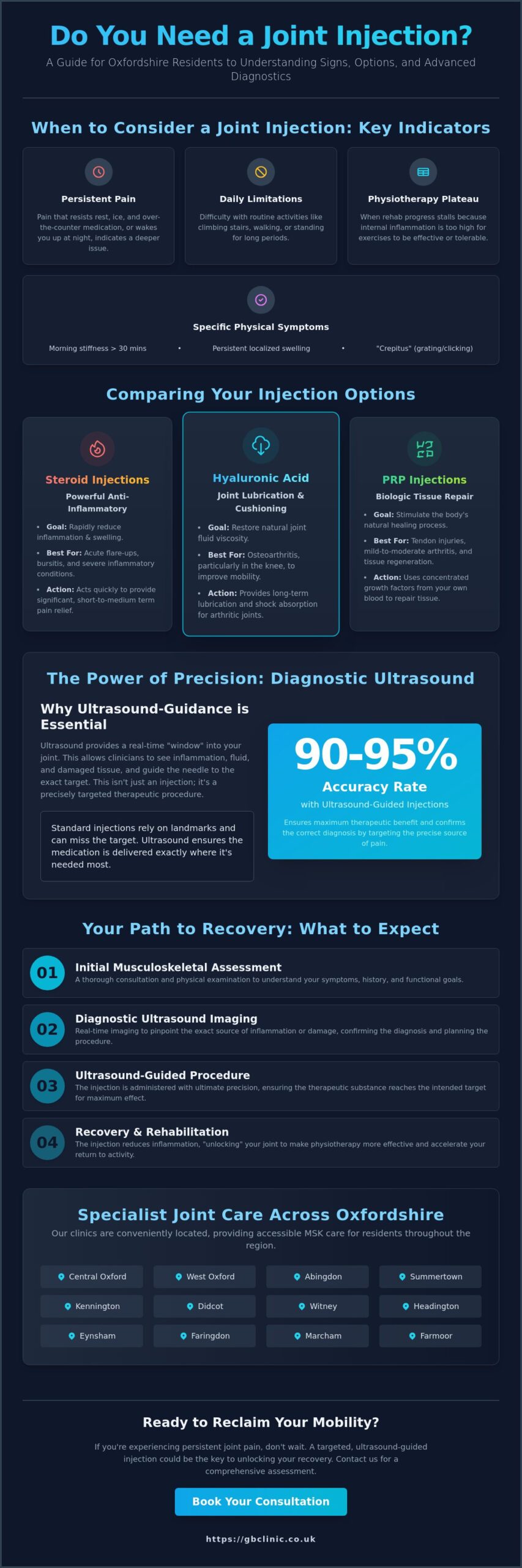
We’ll examine the functional differences between treatments like Hyaluronic Acid and steroid injections, while highlighting how diagnostic ultrasound ensures 90 to 95 percent accuracy in delivery. From Headington and Farmoor to Eynsham, Didcot, Witney, and Faringdon, residents across Central and West Oxford can access a clear, clinical roadmap to restored mobility and comfort.
Key Takeaways
- Identify the specific clinical indicators, such as pain that resists rest or a plateau in physiotherapy, that help you determine how to know if you need a joint injection.
- Understand the functional differences between anti-inflammatory steroid injections for acute flare-ups and Hyaluronic Acid for long-term lubrication in arthritic joints.
- Discover how diagnostic ultrasound provides real-time imaging of inflammation and fluid build-up, ensuring significantly higher accuracy than a standard physical exam.
- Learn how residents across Abingdon, Witney, and Central Oxford can access specialized MSK care close to home, with clinics conveniently located for those in Headington, Summertown, and Didcot.
- Preview the step-by-step journey from your initial musculoskeletal assessment through to the ultrasound-guided procedure and recovery phase.
Recognising the Signs: When is it Time for a Joint Injection?
Determining how to know if you need a joint injection involves assessing how your symptoms respond to initial conservative treatments. Most patients begin their recovery journey with rest, ice, and over-the-counter anti-inflammatories. If these measures fail to provide relief after several weeks, it’s a clear signal that the underlying issue requires a more targeted approach. Residents in Abingdon, Summertown, and Kennington often find that while initial self-care helps temporarily, deep-seated pain persists during daily activities. This persistent discomfort suggests that the source of the problem is likely deeper than surface-level treatments can reach.
To better understand this concept, watch this helpful video:
Clinical signs often manifest as morning stiffness that lasts longer than 30 minutes or localized swelling that doesn’t subside. You might also experience “crepitus,” which is a grating or clicking sensation within the joint during movement. These symptoms often indicate inflammatory joint conditions that benefit from direct therapeutic intervention. For those living in Marcham, Headington, or Farmoor, recognizing these physical cues early can prevent long-term damage and accelerate the return to a pain-free lifestyle. Night pain that interrupts restful sleep is another critical indicator that the joint requires clinical attention.
The ‘Physiotherapy Plateau’ and Injection Timing
Many individuals in Eynsham and Didcot seek our expertise when they reach a “physiotherapy plateau.” This occurs when manual therapy or standard exercises no longer reduce symptoms because the level of internal inflammation is too high. At this stage, an injection isn’t a sign of failure in your recovery journey; rather, it acts as a strategic bridge. By reducing localized inflammation, the injection “unlocks” the joint, making it possible to progress with exercise rehabilitation without debilitating discomfort. It allows you to perform the necessary strengthening movements that were previously too painful to attempt.
Daily Functional Limitations as a Key Indicator
Functional limitations are often the most reliable way to gauge the severity of your condition. If you find that climbing stairs or walking the dog around Witney or Faringdon has moved from being a minor annoyance to a significant limitation, it’s time to consider clinical options. It’s vital to distinguish between acute injury pain, which typically follows a predictable healing curve, and chronic degenerative joint pain, which often worsens without intervention. Our clinics in Central Oxford and West Oxford focus on identifying these thresholds to ensure you receive the right treatment at the right time, moving you from a state of frustration to one of active recovery.
Comparing Your Options: Steroids, Hyaluronic Acid, and PRP
Understanding how to know if you need a joint injection requires a clear look at the available substances and their clinical roles. Each treatment serves a unique purpose based on your specific pathology. Steroid injections act as powerful anti-inflammatories, making them ideal for acute flare-ups or conditions like bursitis where rapid reduction of swelling is the priority. Conversely, Platelet-Rich Plasma (PRP) utilizes the body’s own growth factors to stimulate tissue repair. For residents in Kennington, Headington, or Summertown, choosing between these depends on whether the clinical goal is immediate inflammation control or biological structural support.
Specialists use diagnostic and therapeutic injections to pinpoint the exact source of pain while delivering concentrated relief. This dual-purpose approach ensures that patients from Abingdon, Marcham, or Faringdon don’t just receive a temporary mask for their symptoms, but a targeted intervention tailored to their specific tissue needs. By identifying the underlying cause, we can select the agent that offers the most effective path to physical restoration.
Hyaluronic Acid: The Lubrication Approach
Hyaluronic Acid (HA) is a substance that mimics the natural synovial fluid found in healthy joints. It acts as a lubricating shock absorber, which is particularly beneficial for knee arthritis patients in Didcot or Witney who experience bone-on-bone sensations. By restoring this internal cushion, Hyaluronic Acid Injections can significantly improve mobility and reduce the mechanical grinding that often causes discomfort during daily movement. This approach focuses on improving the joint environment to facilitate better function over several months.
Steroids vs. HA: Which is Right for You?
The choice between these options often comes down to the speed of relief versus the duration of the effect. Steroids typically provide rapid pain reduction, often within a few days, but the effects generally last between 2 and 10 weeks. They are excellent for breaking a cycle of severe, acute inflammation. In contrast, HA may take longer to reach its full effect, but it typically provides symptom relief for 6 to 12 months. For those in Farmoor, Eynsham, or West Oxford seeking long-term joint preservation, HA is often the preferred clinical path. We utilize guided steroid injections when precision is required to treat specific pockets of inflammation without affecting surrounding healthy tissue.
Identifying the right intervention is a collaborative process between you and your specialist. If you’re unsure which path is best for your recovery, you can speak with our clinical team to explore your options and find a convenient appointment in Central Oxford or the surrounding areas.
The Essential Role of Diagnostic Ultrasound
While clinical signs and physical symptoms provide the initial clues, relying solely on a manual examination can leave room for ambiguity. Utilizing a diagnostic ultrasound scan is the modern gold standard for bridging the gap between suspecting a condition and confirming it. This technology provides real-time imaging, allowing clinicians to see inflammation, tendon tears, or fluid build-up that remains hidden during a standard assessment. For those wondering how to know if you need a joint injection, the clarity provided by a scan often offers the final, evidence-based answer required to proceed with confidence.
Seeing the Problem: Why We Scan First
Ultrasound is exceptionally effective at identifying specific pathologies like bursitis, tendinitis, or joint effusions. Unlike “blind” injections, where a clinician relies on anatomical landmarks and touch, guided procedures use imaging to ensure the needle reaches the exact “sweet spot” within the tissue. This precision is vital because it significantly reduces the risk of side effects by avoiding surrounding nerves and blood vessels. MSK ultrasound serves as a safe, non-invasive way to peek inside the joint, providing a level of detail that a manual exam cannot match. This diagnostic step is a core part of the care we provide for residents in Abingdon, Summertown, and Kennington.
- Identifying Fluid: Clearly distinguishes between joint swelling and soft tissue inflammation.
- Structural Integrity: Visualises the health of tendons and ligaments in real-time.
- Precision Mapping: Identifies the safest and most effective entry point for the therapeutic agent.
Accuracy and Patient Confidence
Precision guidance doesn’t just improve safety; it leads to better clinical outcomes. According to the American College of Rheumatology on Joint Injections, accurate placement of the medication is essential for maximising the duration of relief and the reduction of symptoms. Research indicates that ultrasound-guided injections have an accuracy level generally over 90 to 95 percent, which is significantly higher than unguided methods. When patients from Marcham, Headington, or Farmoor see the pathology on the screen, it builds a higher level of trust in the recovery process.
At GB Clinic, we use ultrasound for both the initial diagnosis and as a live map during the procedure itself. This approach is highly efficient for individuals in Eynsham, Didcot, or Witney who want to avoid the delays often associated with separate scanning appointments. Whether you are located in Faringdon, Central Oxford, or West Oxford, our goal is to provide a clear, visible path to recovery. Understanding how to know if you need a joint injection becomes a straightforward process when you can actually see the clinical necessity on a screen.
Accessing Specialist Joint Care Across Oxfordshire
Accessing professional care shouldn’t be a hurdle in your recovery journey. For residents across the county, our clinics provide a streamlined path to clinical clarity and physical restoration. Whether you’re based in Central Oxford or live in surrounding towns like Abingdon and Didcot, expert assessment is readily available. Understanding how to know if you need a joint injection often requires a face-to-face evaluation with a specialist who can correlate your physical symptoms with real-time imaging. We’ve positioned our services to ensure that high-level diagnostics are never more than a short journey away.
Our clinical reach extends across the region to provide convenient options for individuals experiencing persistent discomfort. We serve a diverse range of local communities, including:
- Central and West Oxford: Ideally located for those living or working in the city heart.
- Northern Hubs: Expert MSK services easily accessible for residents in Summertown and Headington.
- Southern Reach: Convenient clinical locations serving Kennington, Abingdon, and Marcham.
- Western Districts: Rapid access for patients from Witney, Faringdon, and Eynsham.
Local Expertise in MSK Health
We’ve established ourselves as a regional authority for private MSK physiotherapy in Oxford. This expertise allows us to provide a comprehensive continuum of care, from initial diagnostic ultrasound to long-term rehabilitation. For residents in Farmoor and surrounding villages, the proximity of our specialist clinics means that follow-up care is manageable and consistent. Local follow-up is a vital component of successful recovery, as it allows for the monitoring of the injection’s efficacy and the progression of your exercise plan. We focus on delivering clinical excellence within your own community, removing the need for long-distance travel to reach specialist providers.
Booking Your Assessment in Oxfordshire
The path to relief is designed to be as efficient as possible. We offer a simple, referral-free process for private patients, allowing you to bypass lengthy waiting lists. This is particularly beneficial for busy professionals in Central Oxford or West Oxford who require flexible appointment times that fit around a demanding schedule. Our commitment to serving the entire Oxfordshire county means that whether you are in Didcot, Witney, or Faringdon, you can expect a prompt and professional consultation. During your initial assessment, we focus on identifying the precise tissue needs of your joint to determine the most effective intervention for your specific symptoms.
If you are ready to address your persistent pain and regain your mobility, you can book a specialist assessment at our Oxfordshire clinics today to begin your recovery.
What to Expect: From Consultation to Recovery
The clinical journey begins with a comprehensive musculoskeletal (MSK) assessment. This stage is crucial for confirming how to know if you need a joint injection by correlating your medical history with specific physical tests. Patients from Headington, Summertown, and Kennington receive a thorough evaluation of joint range, strength, and symptom provocation. This evidence-based approach ensures that the procedure is not only appropriate but also timed correctly for your recovery. By the time you reach this stage, the diagnostic data should leave no doubt regarding the clinical necessity of the intervention.
The Day of the Procedure
Our clinical environment is designed to prioritize patient comfort and safety. Many individuals from Abingdon and Marcham ask if the process is painful; we provide professional reassurance by utilizing local anesthetics to numb the area before the therapeutic agent is delivered. The procedure itself is efficient and precise, utilizing the ultrasound guidance discussed earlier to ensure accuracy. For those traveling from Farmoor or Eynsham, the appointment is structured to be comprehensive yet respectful of your time. You’ll be in a sterile, modern setting where every step is explained to maintain a calm and professional atmosphere.
The Road to Recovery
Immediate aftercare is a vital component of the treatment’s success. You should expect a “flare” period, which is a temporary increase in discomfort, in the first 24 to 48 hours following the procedure. During this window, we recommend restricted activity to allow the joint to settle and the medication to begin its work. While steroid injections offer relatively rapid relief, those receiving Hyaluronic Acid may find that the full benefits emerge over several weeks as the lubrication integrates with the joint. Residents in Didcot, Witney, and Faringdon are provided with clear, written guidance on managing this initial phase. Understanding how to know if you need a joint injection is only half the battle; the other half is following a disciplined post-procedure protocol to ensure the tissue heals correctly.
Long-term success depends on more than just the injection itself. It serves as a window of opportunity to engage in a structured physiotherapy programme. This rehabilitative phase addresses the biomechanical root causes of your pain, such as muscle weakness or joint stiffness, which the injection has now made it comfortable enough to treat. Whether you’re visiting from Central Oxford or West Oxford, our goal is to transition you from immediate pain relief to a state of durable, long-term mobility and physical restoration.
Take the Next Step Toward Lasting Joint Relief
Deciding how to know if you need a joint injection is a process that combines your personal experience of pain with specialized clinical evidence. We’ve explored how persistent discomfort, morning stiffness, and a plateau in exercise progress serve as primary indicators that a more direct intervention is required. By utilizing diagnostic ultrasound-guided procedures, we achieve a level of accuracy between 90 and 95 percent, ensuring the therapeutic agent reaches the exact source of your symptoms. This level of precision is essential for effective physical restoration and long-term joint health.
As an expert-led MSK clinic in Oxfordshire, we’re dedicated to providing advanced care for residents in Summertown, Headington, and Kennington. Our specialists in Hyaluronic Acid and steroid injections offer a clear path to recovery for patients from Abingdon, Marcham, and Farmoor. Whether you’re traveling from Eynsham, Didcot, Witney, or Faringdon, our clinics in Central Oxford and West Oxford are conveniently positioned to support your journey back to mobility. Don’t let persistent joint pain dictate your daily routine. You can book a specialist MSK assessment at GB Clinic today to confirm the best treatment plan for your needs. We look forward to helping you return to a comfortable, active lifestyle.
Frequently Asked Questions
How long does a joint injection take to start working?
Steroid injections typically begin to reduce inflammation within two to seven days. In contrast, Hyaluronic Acid injections may take several weeks to reach their full effect as the substance integrates with your natural joint fluid. While the initial local anaesthetic provides immediate numbness, the therapeutic relief depends on the specific agent used. We monitor your progress to ensure the treatment effectively addresses your mobility goals.
Is a steroid injection better than Hyaluronic Acid for knee pain?
Neither treatment is universally better; the choice depends on your specific clinical diagnosis. Steroids are highly effective for acute inflammatory flare-ups and bursitis because they provide rapid relief. Hyaluronic Acid is often preferred for long-term management of osteoarthritis as it focuses on lubrication and joint preservation. Our specialists in Central Oxford and West Oxford help you determine the most appropriate option for your condition.
Are there any side effects to joint injections?
Common side effects include a temporary increase in pain known as a “steroid flare” or minor localized bruising. While rare, there is a very small risk of infection, which is approximately 1 in 10,000 cases. We utilize diagnostic ultrasound guidance to significantly reduce the risk of affecting surrounding nerves or vessels. This precise approach ensures the procedure is as safe as possible for our patients across Oxfordshire.
Do I need a GP referral for a private joint injection in Oxford?
No, you don’t need a GP referral to access our private MSK services. We accept self-referrals from residents in Summertown, Headington, and Abingdon who are seeking clinical clarity. Our specialists perform a comprehensive initial assessment to determine how to know if you need a joint injection. This streamlined process allows you to access expert diagnostics and treatment without the delays often found in traditional pathways.
Can I drive home after having a joint injection?
It’s generally recommended that you arrange alternative transportation following your procedure. Because we use local anaesthetic, your sensation and motor control in the treated limb may be temporarily altered. For safety reasons, we advise patients from Witney, Didcot, or Faringdon to avoid driving for at least a few hours. This precaution ensures you don’t experience any unexpected numbness while operating a vehicle on your return journey.
How many joint injections can I have in one year?
Clinical guidelines typically limit corticosteroid injections to three or four per year in a single joint. This limitation exists because repeated steroid use can potentially impact the long-term health of your joint cartilage. Hyaluronic Acid injections follow different protocols and can often be repeated every six to twelve months. We prioritize a balanced approach that focuses on symptom relief while maintaining the structural integrity of your joints.
Will a joint injection cure my arthritis permanently?
Joint injections are highly effective management tools, but they don’t provide a permanent cure for arthritis. They are designed to reduce inflammation and improve lubrication, which creates a window of opportunity for rehabilitation. For residents in Kennington, Marcham, and Farmoor, we combine these injections with tailored exercise programmes. This comprehensive strategy addresses the underlying biomechanical issues to provide the most durable results possible for your mobility.
Is the procedure painful?
Most patients describe the sensation as a sharp pinch or a feeling of pressure rather than significant pain. We use local anaesthetic to numb the skin and superficial tissues before the procedure begins. Our use of real-time ultrasound guidance ensures the needle follows the most direct and least disruptive path to the joint. This professional approach ensures a comfortable experience for individuals visiting our clinics from Eynsham or other surrounding Oxfordshire areas.