
Did you know that musculoskeletal ultrasound studies have increased by 200% since 1996? With over 1.71 billion people globally affected by MSK disorders, the demand for precise, accessible imaging has never been higher. For residents in Abingdon, Summertown, and Kennington, a diagnostic ultrasound of soft tissue offers a dynamic, real-time window into the body that static scans simply cannot replicate. Whether you’re commuting from Marcham, Headington, or Farmoor, obtaining a clear answer about your physical health should be a straightforward and stress-free process.
It’s common to feel anxious about long NHS waiting times or the prospect of a claustrophobic MRI machine when you’re seeking relief from persistent pain. We understand that you want a clear diagnosis for a suspected tear or lump without the need for invasive procedures or unnecessary radiation. This guide explores how high-resolution ultrasound provides immediate insights, helping patients in Eynsham, Didcot, Witney, and Faringdon secure a fast-tracked treatment plan. We’ll explain why this technology is the preferred choice for MSK imaging and how clinical expertise in Central Oxford and West Oxford bridges the gap between injury and a full return to mobility.
Key Takeaways
- Understand the clinical advantages of real-time imaging, which allows specialists to observe your muscles and tendons in motion for a more precise diagnosis.
- Learn why a diagnostic ultrasound of soft tissue is the preferred choice for detecting tears, hematomas, and tendonitis with higher spatial resolution than traditional static scans.
- Discover how to prepare for your appointment and what to expect during the non-invasive procedure, ensuring a comfortable experience without the need for radiation.
- Find out how residents in Abingdon, Witney, Didcot, Kennington, and Marcham can bypass long diagnostic delays by accessing specialist clinics across Oxfordshire.
- Explore the accessibility of expert care for patients in Summertown, Headington, West Oxford, Farmoor, and Eynsham, ensuring a smooth path to recovery.
What is Diagnostic Ultrasound of Soft Tissue?
A diagnostic ultrasound of soft tissue is a specialized, non-invasive imaging modality. It uses high-frequency sound waves to create detailed visualizations of muscles, tendons, and ligaments. Unlike X-rays that focus primarily on bone, this technology is specifically designed to see the “soft” parts of your anatomy. For residents in Central Oxford and West Oxford, this tool is the gold standard for superficial tissue assessment because it provides immediate clarity without the need for radiation or invasive procedures.
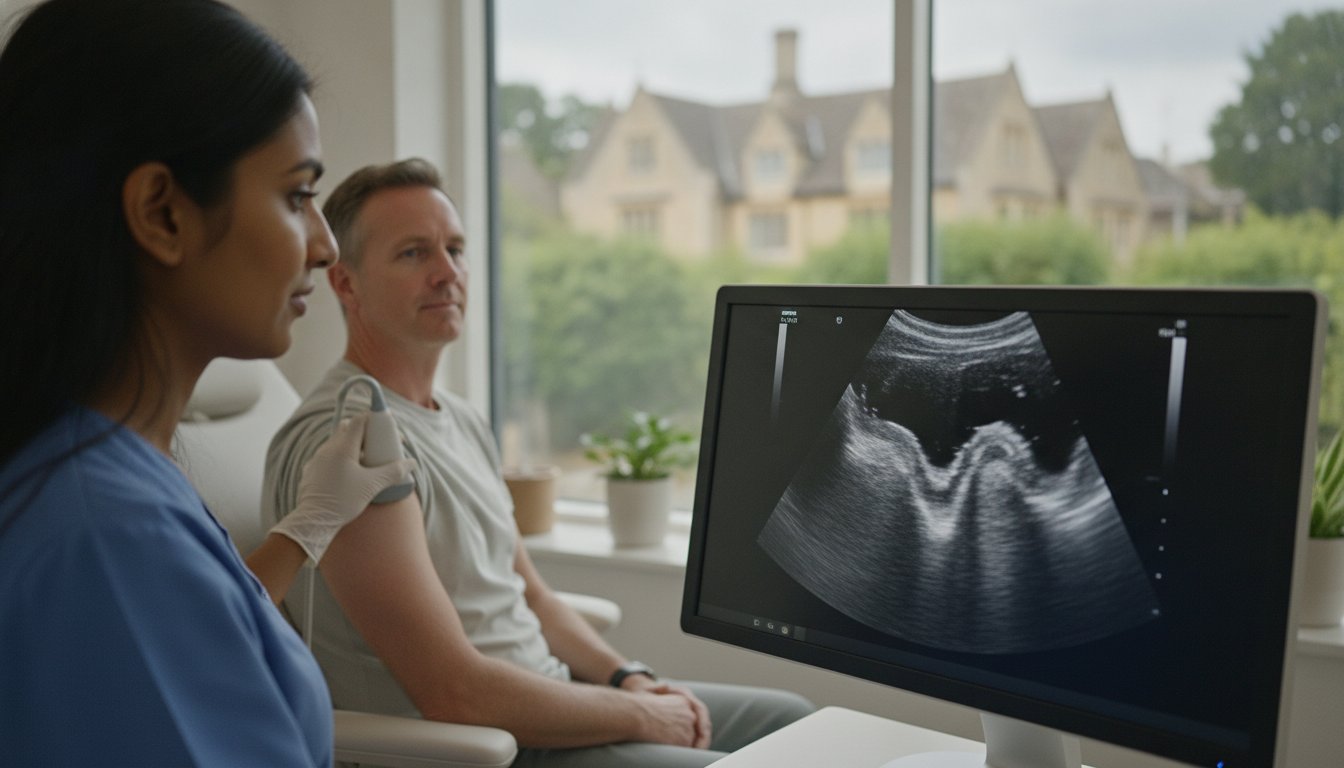
The process relies on the skill of a trained sonographer who guides a handheld transducer over the skin. They interpret the echoes that bounce back from internal structures in real-time. This methodology is rooted in the principles of Medical ultrasonography, where sophisticated software translates sound waves into a visual map. Patients traveling from nearby Headington, Summertown, or Kennington often find this approach significantly more reassuring than waiting several weeks for results from a static hospital scan.
To better understand this concept, watch this helpful video:
The Science of Sound Waves in MSK Health
When performing a diagnostic ultrasound of soft tissue, the transducer acts as both a transmitter and a receiver. It emits sound waves that penetrate the skin and reflect off tissues. These reflections, or echoes, vary depending on the density of the structure they hit. This is known as “echogenicity.” Dense tissues like tendons reflect more sound and appear bright white, while fluid-filled areas appear dark. This contrast allows specialists serving Abingdon, Marcham, and Farmoor to identify structural abnormalities such as fluid build-up or fiber disruption. Diagnostic ultrasound is a safe, radiation-free method for visualizing internal structures in real-time.
Why Dynamic Imaging Changes the Diagnostic Game
Traditional imaging tools like MRI or CT are almost always static. You must lie perfectly still while the machine captures a snapshot. However, many musculoskeletal issues only occur when you’re in motion. A diagnostic ultrasound scan changes the diagnostic game by allowing for dynamic assessment. A clinician can ask you to move your shoulder, flex your knee, or rotate your ankle while they watch the tissue interact on the screen.
This capability is essential for patients in Witney, Didcot, or Eynsham who experience “clicking” or “catching” sensations. It helps identify impingements or “snapping” tendons that a static scan might miss entirely. By seeing the anatomy function in real-time, the specialist can pinpoint the exact cause of pain. This leads to a more accurate diagnosis and a faster, more effective treatment plan for individuals living in Faringdon and the surrounding Oxfordshire areas.
What Can a Soft Tissue Ultrasound Detect?
Residents in Central Oxford and West Oxford often seek clarity when a nagging ache turns into sharp pain. A diagnostic ultrasound of soft tissue serves as a precise tool for identifying the root cause of musculoskeletal discomfort. Unlike general medical imaging that might focus on internal organs, MSK ultrasound specializes in the intricate layers of muscles, tendons, and ligaments. If you’ve ever wondered What is a diagnostic ultrasound, it’s essentially a high-definition map of your moving parts. It excels at detecting acute muscle tears, chronic strains, and deep hematomas that often follow sports injuries or falls.
For patients in Abingdon and Summertown, this modality offers a detailed look at tendon health. We can differentiate between tendonitis, which is acute inflammation, and tendinosis, which involves chronic degeneration. This distinction is crucial because the treatment paths for each condition differ significantly. Similarly, we use ultrasound to evaluate ligament sprains in the ankle, knee, and wrist. Because the scan is dynamic, we can test the stability of the ligament while you move, which provides a much more functional assessment than a static image.
Common MSK Pathologies Identified by Ultrasound
Athletes and active individuals in Witney and Didcot frequently present with complex joint pain. Ultrasound is particularly effective for:
- Rotator cuff tears: We can assess the degree of fraying or full-thickness ruptures in the shoulder with exceptional detail.
- Plantar fasciitis: Visualizing the thickening of the fascia in the foot helps confirm the cause of chronic heel pain.
- Bursitis: We pinpoint fluid-filled sacs in the hip, elbow, or knee that cause localized swelling and restricted movement.
For those in Headington or Kennington, getting a diagnostic ultrasound scan means receiving a clear explanation of these pathologies without unnecessary delays.
Evaluating Lumps, Bumps, and Foreign Bodies
Beyond sports injuries, ultrasound is a vital tool for assessing new growths. It’s often the first step for patients in Marcham, Farmoor, or Eynsham who discover a mysterious lump. The technology easily distinguishes between simple fluid-filled cysts and solid soft tissue masses like lipomas or ganglia. It also locates non-radiopaque foreign bodies. Materials like glass or wood splinters often vanish on X-rays, but they reflect sound waves clearly. Early detection of persistent swelling ensures that minor issues don’t become chronic problems. If you’re concerned about a recent injury or a new lump, a professional assessment in Oxfordshire can provide the answers you need to move forward confidently. This local expertise is easily accessible for those living in Faringdon and surrounding towns.
Diagnostic Ultrasound vs. MRI and X-ray: Which is Best?
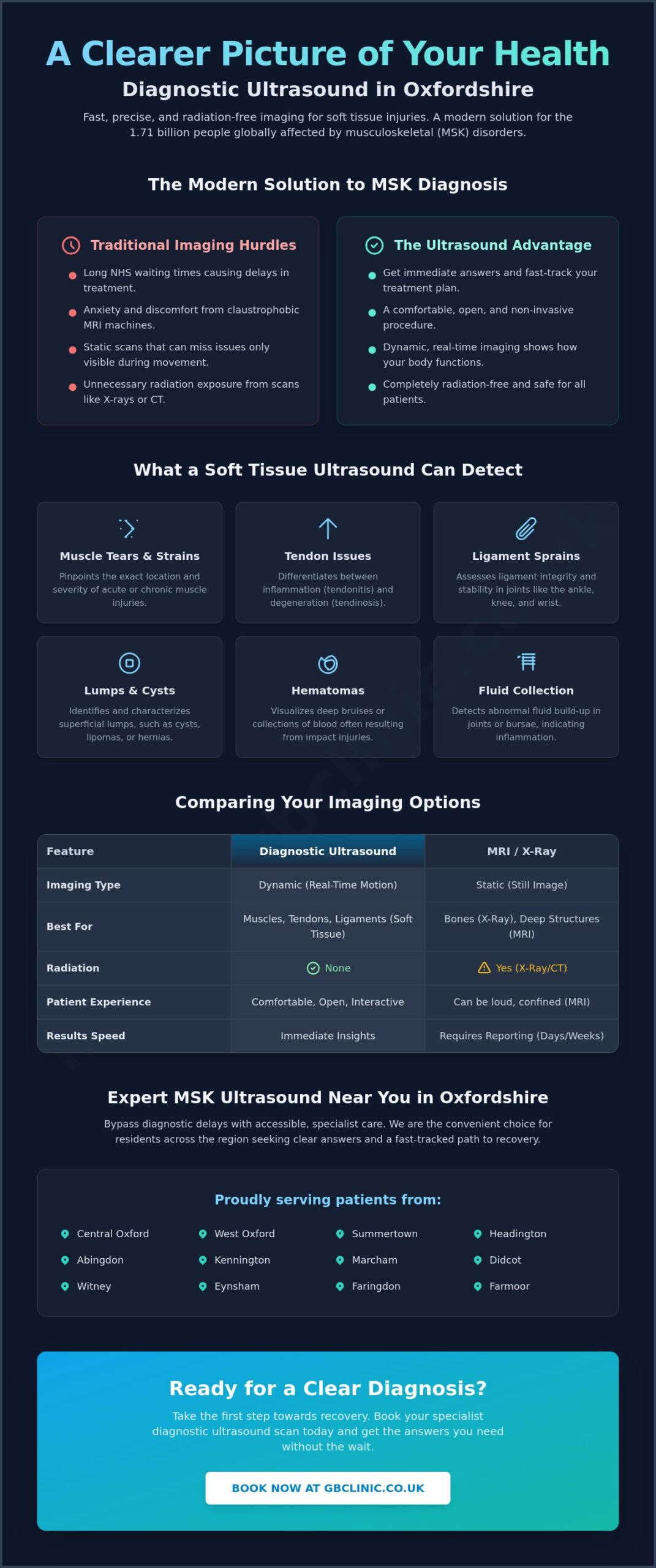
Choosing the right imaging modality is essential for a fast-tracked recovery. While X-rays are excellent for identifying bone fractures, they often fail to capture the nuances of soft tissue injuries. MRI is frequently seen as the default for complex issues, but a diagnostic ultrasound of soft tissue often provides superior spatial resolution for small, superficial structures like nerves and tendons. In many clinical scenarios, Ultrasound compared to MRI shows that sonography is not only more accessible but also provides immediate, high-resolution insights that static machines might overlook.
Accessibility and cost are significant factors for patients in Central Oxford and West Oxford. MRI scans can involve long waiting times and significant expenses, whereas ultrasound is generally more affordable and easier to schedule. Safety is another primary consideration. Ultrasound uses zero ionizing radiation, making it a safer alternative to X-rays and CT scans. For individuals in Abingdon or Summertown who feel anxious about claustrophobic MRI tunnels, ultrasound offers a comfortable, open-air environment with no need for sedation.
When Ultrasound is the Superior Choice
Ultrasound is particularly effective for assessing superficial structures located within 5-10cm of the skin surface. This makes it the ideal tool for residents in Kennington, Marcham, and Headington suffering from wrist, ankle, or shoulder pain. It’s also the only viable option for patients with metal implants or pacemakers who are contraindicated for MRI. Beyond diagnostics, the technology allows for precision in treatment. We use it to perform hyaluronic acid injections and guided steroid injections, ensuring the medication reaches the exact site of inflammation. This level of accuracy is why many in Farmoor and Eynsham choose local specialist clinics over general hospital settings.
The Limitations of Soft Tissue Ultrasound
No single imaging tool is perfect. While ultrasound is highly effective for many MSK conditions, it cannot see through bone. This means it’s less effective for evaluating deep intra-articular pathology or structures hidden deep within large joints like the central hip. In these specific cases, MRI remains the gold standard. Additionally, ultrasound is highly operator-dependent. The accuracy of the results depends entirely on the expertise of the clinician performing the scan. For patients in Didcot, Witney, and Faringdon, it’s vital to seek out an experienced MSK specialist who understands the subtle echoes of damaged tissue. This ensures your diagnosis is both accurate and actionable, leading to a more effective rehabilitation plan.
The Diagnostic Process: What to Expect During Your Scan
Understanding the diagnostic process helps alleviate the anxiety often associated with medical appointments. For patients in Abingdon, Summertown, and Kennington, the experience is designed to be straightforward and efficient. Unlike other imaging tests, a diagnostic ultrasound of soft tissue requires minimal preparation. You won’t need to fast or wear specific hospital attire; we simply recommend wearing loose, comfortable clothing that allows easy access to the area of concern, such as the shoulder or knee. This accessibility makes it a convenient option for busy individuals traveling from Marcham or Headington.
Once you’re settled in our clinical environment in Central Oxford or West Oxford, a specialist applies a clear, water-based gel to your skin. This gel ensures a smooth connection between the transducer and your body, allowing sound waves to travel effectively. The clinician then moves the transducer over the affected area to capture high-resolution images. The entire procedure typically lasts between 15 and 30 minutes. The duration depends on the complexity of the injury and the number of areas being assessed. Because the imaging happens in real-time, our experts often discuss initial findings with you during the scan, providing immediate clarity that static hospital reports cannot offer.
From Scan to Treatment Plan
A clear diagnosis is only the first step toward recovery. At our clinics serving Farmoor and Eynsham, ultrasound findings are integrated directly into physiotherapy assessments. This seamless transition ensures that your rehabilitation exercises are targeted specifically to the damaged tissue identified on screen. Whether you’re recovering from a sports injury or managing chronic degeneration, an accurate scan prevents the “trial and error” approach that often delays the return to full mobility. Following the scan, your clinician will outline a clear path forward, which may include manual therapy or exercise rehabilitation tailored to your specific anatomical needs.
Safety and Comfort Considerations
The non-invasive nature of ultrasound makes it an ideal choice for patients of all ages, from children with sports injuries to elderly residents in Didcot, Witney, and Faringdon seeking relief from arthritis. There are no needles or dyes involved in a standard diagnostic ultrasound of soft tissue, unless you’ve specifically opted for a guided injection. The clinical environment is professional, quiet, and focused entirely on your comfort. We prioritize a patient-first approach, ensuring you feel heard and respected throughout your time with us. If you’re ready to move past the uncertainty of physical pain, you can book a specialist diagnostic assessment at one of our convenient Oxfordshire locations today.
Accessing Specialist MSK Ultrasound in Oxford and Oxfordshire
Securing a diagnostic ultrasound of soft tissue shouldn’t involve months of waiting on a hospital list. When you’re in pain, every day of uncertainty feels like a week. Choosing a local specialist clinic in Oxfordshire allows you to bypass the lengthy GP referral process and access high-resolution imaging much faster. Residents in Abingdon, Witney, and Didcot often find that local care isn’t just more convenient; it’s more comprehensive. By seeing a clinician who can both diagnose the issue and provide immediate treatment, you save time and reduce the stress of multiple appointments.
Our patient-focused approach ensures you receive a clear diagnosis and a fast-tracked recovery plan in one place. We don’t believe in the “wait and see” method that often leads to chronic injury. Instead, we provide the answers you need to start rehabilitation immediately. This “one-stop” shop model is particularly beneficial for active individuals who need to return to their mobile, comfortable state without unnecessary delays.
Serving the Oxfordshire Community
We’ve positioned our services to be highly accessible for everyone across the region. If you live or work in Summertown, Headington, or Central Oxford, our clinics are just a short journey away. We understand that travel can be difficult when you’re dealing with a physical injury, so we’ve ensured easy travel links for patients coming from Faringdon, Eynsham, and Farmoor. Our proximity to West Oxford, Kennington, and Marcham means that rapid diagnostics are always within reach. Whether you’re commuting from the outskirts or living in the heart of the city, expert MSK care is local to you.
Why Choose GB Clinic for Your Soft Tissue Scan?
Expert-led care is the foundation of everything we do. We combine diagnostic excellence with advanced therapeutic options like shockwave therapy to ensure your recovery is evidence-based and effective. Our team maintains a professional yet empathetic distance, focusing on your physical restoration through modern clinical methods. We prioritize clear communication, so you’ll always understand the findings of your scan and the logic behind your treatment plan.
Don’t let an undiagnosed injury hold you back from the activities you love. You can book your diagnostic ultrasound scan today at our Oxfordshire clinic to begin your path to recovery. We’re committed to providing the residents of Oxfordshire with the highest standard of musculoskeletal care, ensuring a smooth and confident return to health.
Take Control of Your Recovery with Precision Diagnostics
A diagnostic ultrasound of soft tissue provides the high-resolution, real-time clarity needed to move from uncertainty to action. By choosing a dynamic assessment, you benefit from a deeper understanding of how your muscles and tendons function in motion. This technology remains the gold standard for identifying tears, lumps, and inflammation without the need for ionizing radiation or invasive procedures. It’s the most efficient way to secure a definitive diagnosis and begin a targeted treatment plan.
Residents across Oxfordshire, from Abingdon and Witney to Summertown and Headington, can access this specialist care without the delays of a traditional GP referral. Whether you’re based in Kennington, Marcham, or Didcot, our expert MSK clinicians provide a streamlined path to recovery. We serve the entire region, including Farmoor, Eynsham, Faringdon, and both Central and West Oxford. You don’t have to live with physical discomfort or the anxiety of long waiting lists. Book Your Diagnostic Ultrasound Scan in Oxford Today and secure the answers you need for a faster return to a comfortable, mobile state.
Frequently Asked Questions
Is a soft tissue ultrasound painful?
A diagnostic ultrasound of soft tissue is entirely painless and non-invasive. The specialist moves a handheld transducer over your skin with a water-based gel, which might feel cool but doesn’t cause discomfort. Unlike injections or surgical biopsies, there’s no breaking of the skin or needles involved. Patients in Abingdon and Summertown often find the experience much more relaxing than other forms of clinical imaging.
How much does a private MSK diagnostic ultrasound cost in the UK?
Private musculoskeletal ultrasound scans in the UK typically range from £150 to £350 depending on the complexity of the area. In the Oxfordshire region, specific assessments for one area are often found around £160. These costs generally cover the clinical expertise of the sonographer and the immediate generation of the diagnostic report. This is a cost-effective alternative for residents in Kennington or Marcham seeking rapid answers.
Do I need a GP referral for a diagnostic ultrasound at GB Clinic?
You don’t need a GP referral to access our diagnostic services. We accept self-referrals, which allows patients in Headington and Farmoor to bypass long NHS waiting lists and secure an appointment directly. This streamlined process ensures that you can begin your rehabilitation journey without administrative delays. It’s a convenient choice for individuals in Eynsham or Didcot who want to take immediate control of their recovery.
Can ultrasound detect a muscle tear better than an MRI?
Ultrasound often provides superior spatial resolution for superficial muscle tears compared to MRI. Because the scan is dynamic, clinicians can observe the muscle fibers as they contract and relax, which helps identify small or subtle ruptures that static scans might miss. For residents in Witney or Faringdon, this means a more accurate functional assessment. However, MRI remains better for deep intra-articular injuries where sound waves cannot penetrate bone.
What should I wear for my soft tissue ultrasound appointment?
We recommend wearing loose, comfortable clothing that allows easy access to the body part being scanned. For a shoulder scan, a sleeveless top is ideal; for a knee or ankle assessment, shorts are often the most practical choice. You won’t usually need to change into a hospital gown. This makes the process quick and efficient for patients traveling from Central Oxford or West Oxford during their workday.
How quickly will I get the results of my scan?
You’ll receive immediate verbal feedback during your diagnostic ultrasound of soft tissue. Our specialists discuss their findings with you in real-time as they move the transducer over the affected area. A formal written report is typically provided shortly after the appointment. This rapid turnaround allows patients in Oxfordshire to transition into a targeted treatment plan without the anxiety of waiting weeks for hospital results.
Can ultrasound see through bandages or casts?
Ultrasound cannot see through bandages, plaster casts, or thick dressings. The transducer requires direct contact with the skin via a water-based gel to transmit sound waves effectively. If you have a wound or a removable splint, please let us know in advance so we can plan the scan safely. This ensures that patients from nearby towns receive the clearest possible imaging results during their visit.
Is diagnostic ultrasound safe during pregnancy?
Diagnostic ultrasound is considered very safe during pregnancy because it doesn’t use ionizing radiation. It relies on high-frequency sound waves to create images, which has no known harmful effects on a developing fetus. This makes it the preferred imaging modality for pregnant women in Oxfordshire who are suffering from musculoskeletal pain or sports injuries. It’s a reassuring option for those who want to avoid the risks associated with X-rays or CT scans.