

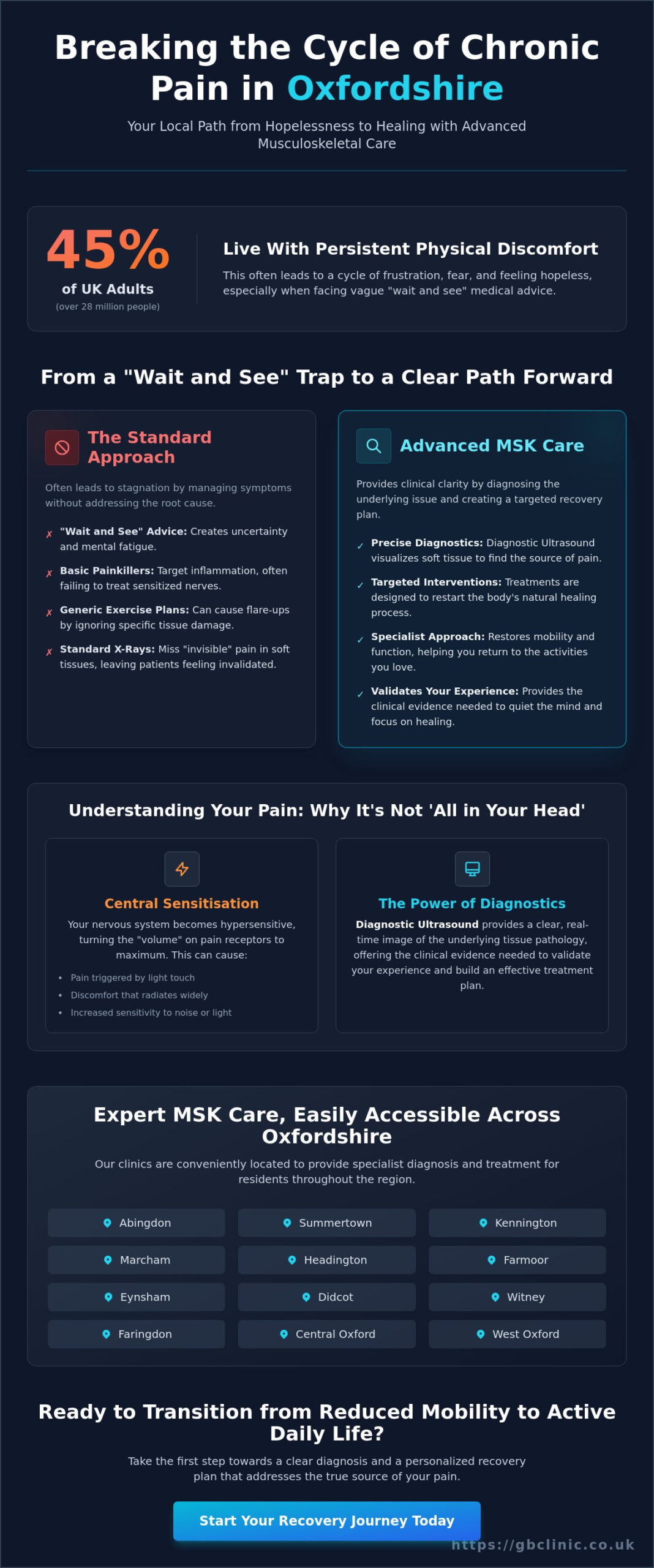
Over 28 million adults in the UK are currently living with persistent physical discomfort, a figure that has climbed to nearly 45% of the population. It’s entirely understandable if you’re feeling hopeless about chronic pain when your daily life is increasingly defined by physical limitations. Whether you live in Abingdon, Witney, or Central Oxford, the frustration of “wait and see” medical advice often leads to a deep fear that the pain will never end. You might feel like you’ve lost your identity or worry about being a burden to your family in Summertown or Headington.
This article explains why chronic conditions often trigger these emotional cycles and how advanced musculoskeletal (MSK) care provides a clear way out. We’ll explore how residents in Kennington, Marcham, and West Oxford can access precise diagnostics and treatments like shockwave therapy or ultrasound-guided injections. By moving beyond basic painkillers, you can find a clinical path toward recovery that’s easily accessible from Farmoor, Eynsham, Didcot, or Faringdon. You’ll learn how a specialist approach helps restore mobility and returns you to the activities that matter most.
Key Takeaways
- Understand why feeling hopeless about chronic pain is a biological reality and how clinical clarity can help break the cycle of despair.
- Identify the limitations of standard “wait and see” approaches and why specialized diagnostic ultrasound is essential for an accurate recovery plan.
- Explore advanced interventions such as Hyaluronic Acid injections and Shockwave Therapy designed to restore joint function and reduce symptoms.
- Locate accessible expert care within Oxfordshire, providing convenient treatment options for residents in Abingdon, Summertown, Didcot, Witney, and Central Oxford.
- Learn how to transition from reduced mobility to active daily life with services available to those in Headington, Kennington, Marcham, Farmoor, Eynsham, Faringdon, and West Oxford.
Why Feeling Hopeless About Chronic Pain is a Physiological Reality
Chronic pain is a physiological state that alters the brain’s architecture over time. When you’re feeling hopeless about chronic pain, you’re experiencing a documented biological response to a nervous system that has remained on “high alert” for too long. While acute pain acts as a useful alarm for injury, chronic pain is often maladaptive. It serves no protective purpose and instead creates a feedback loop that exhausts your mental and physical resources. This constant signaling rewires how the brain processes sensory input, making the feeling of despair a natural consequence of persistent physical trauma.
To better understand this concept, watch this helpful video:
The absence of a clear recovery timeline is one of the most significant contributors to mental fatigue. Patients in Abingdon, Didcot, and Witney often report that the “wait and see” approach makes them feel as though their lives are on hold. Without a specific diagnosis, the brain naturally fills the void with worry. This cycle of uncertainty can lead to a state where the body and mind are stuck in a defensive posture, preventing the relaxation necessary for tissue healing.
The Nervous System and Central Sensitisation
Central sensitisation occurs when your nervous system becomes hypersensitive. It’s as if the “volume” on your pain receptors has been turned up and stuck in place. In this state, the body becomes “too good” at feeling pain, interpreting normal movements as threats. Standard painkillers often fail to provide relief for those in Marcham, Kennington, or Summertown because these medications target local inflammation rather than the sensitized nerves themselves. Common indicators of this condition include:
- Pain triggered by light touch or minor temperature changes.
- Discomfort that radiates far beyond the original site of injury.
- Increased sensitivity to environmental stressors like loud noises or bright lights.
The Impact of “Invisible” Pain on Mental Health
Many individuals in Headington and Central Oxford struggle with pain that doesn’t show up on a standard X-ray. This “invisibility” frequently leads to Pain catastrophizing, a psychological state where the mind ruminates on the worst possible outcomes. It’s a survival mechanism triggered by an unexplained threat. Utilizing a diagnostic ultrasound scan at a clinic accessible to those in Farmoor, Eynsham, Faringdon, or West Oxford can provide the clinical evidence needed to validate your experience. MSK pathology serves as the physical foundation upon which emotional hopelessness is built, and addressing the underlying tissue dysfunction is the key to quieting the mind.
The Limits of Standard Management: Why Pacing Isn’t Always Enough
Standard management strategies like pacing are frequently recommended to those feeling hopeless about chronic pain. While intended to prevent flare-ups, these methods often act as a temporary bandage rather than a curative solution. When a patient in Didcot or Witney is told to simply “manage” their activity levels, it can inadvertently lead to a sense of stagnation. This “wait and see” approach often ignores the underlying mechanical or inflammatory issues that prevent long-term tissue healing. If the source of the pain remains unaddressed, “management” becomes a full-time job that yields very little physical restoration.
Generic exercise programmes can sometimes trigger significant flare-ups in specialised cases. For individuals in Kennington, Marcham, or Farmoor, a one-size-fits-all rehabilitation plan may actually aggravate sensitized tissues. This happens when the mechanical load of the exercise exceeds the current capacity of the damaged structure. Identifying the exact moment when conservative management must shift toward clinical intervention is essential for breaking the cycle of discomfort.
When Pacing and Activity Diaries Stall
Residents in Summertown or Headington might find that their progress has plateaued despite following traditional physiotherapy protocols. Keeping an activity diary for months without seeing functional improvement carries a heavy psychological cost. As noted by the National Institute of Mental Health in their discussion on Chronic Illness and Mental Health, the lack of progress in physical recovery is a primary driver for developing secondary anxiety or depression. When you’re feeling hopeless about chronic pain, a plateau isn’t just a physical hurdle; it’s an emotional burden that signals the need for a more advanced diagnostic perspective.
The Problem with Long-term Medication
The reliance on oral analgesics often leads to diminishing returns and unwanted side effects. Many patients in Abingdon and Central Oxford are now seeking non-pharmacological alternatives to avoid the systemic impact of long-term drug use. Systemic medications rarely provide the targeted relief necessary for complex musculoskeletal pathologies. Transitioning from general prescriptions to targeted clinical procedures allows for a more precise strike at the pain source. For those living in Eynsham, Faringdon, or West Oxford, moving toward evidence-based interventions can provide the clarity needed to finally advance your recovery. If your current plan has stalled, you may benefit from exploring the specialist MSK treatments available at our regional clinics.
Breaking the Fog: The Role of Advanced MSK Diagnostics
Diagnostic uncertainty is a primary driver for those feeling hopeless about chronic pain. When you’re told your discomfort is simply “part of aging” or “stress,” it invalidates your physical experience and leaves you without a clear plan for recovery. Patients in West Oxford and Central Oxford often find themselves stuck in a cycle of vague terminology that fails to address the actual source of their symptoms. This lack of a specific target for treatment is precisely why many individuals begin to believe their condition is permanent. Clinical research has explored the physiological link between chronic pain and hopelessness, confirming that diagnostic “fog” actively reinforces the brain’s pain pathways.
Moving away from general “referred pain” theories requires a more sophisticated approach. Utilizing diagnostic ultrasound scans allows our specialists to identify hidden pathologies that standard X-rays frequently miss. For residents in Abingdon or Kennington, seeing a specific inflamed tendon or a localized tear on a screen fundamentally changes the psychological relationship with the pain. It transforms an abstract, overwhelming threat into a concrete clinical problem with a visible solution. This visual evidence is often the first step in breaking the emotional weight of a long-term condition.
Ultrasound vs. MRI: What is Best for MSK Issues?
Ultrasound provides a unique dynamic advantage because we can move the joint while performing the scan. This real-time imaging helps identify mechanical issues that only appear during specific movements, which a static MRI might overlook. For individuals in Didcot, Witney, or Faringdon, rapid access to these diagnostics means you don’t have to endure the months-long waiting lists associated with traditional hospital pathways. Identifying a specific condition like bursitis or a rotator cuff tear provides the clarity needed to start a targeted intervention immediately.
A Specialised Assessment in Summertown and Headington
Our clinics in Summertown and Headington combine a rigorous physical examination with high-resolution imaging to ensure no detail is overlooked. This level of comprehensive care is easily accessible to those living in Marcham, Farmoor, or Eynsham. We use the data gathered during your assessment to build a bespoke recovery programme that focuses on structural restoration rather than just symptom management. Diagnostic clarity is the antidote to chronic pain hopelessness. By pinpointing the exact tissue source, we provide patients in West Oxford and the surrounding regions with a definitive map toward physical recovery.
Targeted Interventions to Restart the Healing Process
Moving from a clear diagnosis to a targeted intervention is the turning point for anyone feeling hopeless about chronic pain. While basic heat packs or rest may offer temporary comfort, they do not address the structural pathology of complex musculoskeletal conditions. Our clinics provide advanced, non-surgical options that restart the body’s natural healing process. By focusing on the specific tissue source identified during your assessment, we can apply treatments that go far beyond standard “wait and see” protocols. This proactive approach is designed to restore function for residents across the county, from Abingdon to Witney.
Hyaluronic Acid: More Than Just Lubrication
Hyaluronic Acid (HA) Injections act as a synthetic lubricant and shock absorber within the joint. This treatment is particularly effective for those in the Oxford area suffering from mild to moderate osteoarthritis in the knee or hip. HA mimics the natural fluid found in healthy joints, reducing friction and protecting the remaining cartilage. Ideal candidates often report a significant reduction in stiffness and an improved ability to manage stairs or long walks. Most patients experience relief for 6 to 12 months, providing a stable window to engage in further rehabilitation without the constant distraction of joint pain.
Shockwave Therapy: Re-triggering the Body’s Repair Mechanism
For chronic tendon issues that have failed to respond to rest, Shockwave Therapy is a regenerative tool. It uses high-energy acoustic waves to break down stubborn calcifications and stimulate local blood flow. This process re-triggers the body’s repair mechanism in tissues that have become stagnant in their healing. It is a game-changer for individuals in West Oxford, Eynsham, and Faringdon struggling with plantar fasciitis or Achilles tendinopathy. A typical treatment course involves 3 to 5 sessions, which are often enough to resolve long-standing issues that previously led to a sense of physical defeat.
Specialised Manual Therapy and Rehabilitation
We integrate advanced physiotherapy with these medical procedures to ensure long-term stability. While Guided Steroid Injections are excellent for calming severe inflammation in Headington or Summertown, they are most effective when followed by a bespoke rehabilitation plan. Our combined approach follows a clear Problem/Solution/Benefit structure:
- Problem: Chronic tissue restriction and muscle guarding.
- Solution: Targeted myofascial release and progressive exercise rehabilitation.
- Benefit: Improved range of motion and the prevention of future flare-ups.
This comprehensive care model is easily accessible to patients in Kennington, Marcham, Farmoor, Didcot, and Central Oxford. You can view our full range of specialist MSK treatments to see which intervention best suits your current needs.
Finding Your Path to Recovery in Oxfordshire
Choosing the right clinical partner is the most important step in moving toward physical restoration. If you’re feeling hopeless about chronic pain, the logistical stress of traveling long distances for treatment shouldn’t be an additional barrier to your recovery. We provide expert-led care that’s deeply rooted in the local community, ensuring that advanced musculoskeletal services are within easy reach. Whether you’re traveling from Abingdon, Didcot, Witney, or Faringdon, our clinics are positioned to be your convenient choice for evidence-based interventions.
Our practitioners understand the specific needs of Oxfordshire residents, from those managing active lifestyles to individuals struggling with age-related joint wear. By providing a professional and reassuring environment, we help patients navigate the complexities of their conditions without the delays often found in traditional healthcare pathways. This local expertise ensures that your treatment plan isn’t just clinically sound but also practical for your daily life in the region.
Easy Access from Surrounding Towns
Reaching our specialist facilities is straightforward for those living in Kennington, Marcham, and Farmoor. Many of our patients find that choosing a specialist within the county is a far more sustainable option than the exhausting commute to London-based clinics. For those working or living in Central Oxford, we provide accessible locations with nearby parking options, ensuring that limited mobility doesn’t prevent you from attending your appointments. We also serve the communities of Headington and Summertown, offering a clinical setting where your concerns are addressed with modern diagnostic tools and interpersonal warmth.
Your Journey from Hopeless to Mobile
The GB Clinic approach is defined by efficiency and clinical excellence. We understand that every day spent in discomfort contributes to feeling hopeless about chronic pain, which is why we prioritize a “no-delay” diagnostic and treatment model. Your journey begins with a comprehensive initial assessment where we listen to your history and perform a detailed physical examination. If required, a diagnostic ultrasound scan can be performed to provide immediate clarity on the state of your tissues.
Our goal is to move you from a state of physical restriction to a mobile, active life in West Oxford or Eynsham. Chronic pain is a complex physiological challenge, but it doesn’t have to be a permanent fixture in your life. By combining advanced diagnostics with targeted interventions like shockwave therapy or specialist injections, we provide a clear, evidence-based path to restoration. You don’t have to face this journey alone; our team is dedicated to providing the clinical competence required to help you reclaim your independence and return to the activities you love.
Take the First Step Toward Physical Restoration
Breaking the cycle of persistent discomfort requires moving beyond symptom management toward structural recovery. We’ve explored how advanced diagnostics and targeted treatments provide the clarity needed to restart the healing process. If you’re feeling hopeless about chronic pain, it’s important to remember that clinical evidence and precise interventions offer a reliable path forward. Our expert-led clinical team in Oxfordshire provides state-of-the-art diagnostic ultrasound on-site to ensure every treatment plan is based on objective data.
These services are easily accessible for residents in Abingdon, Didcot, Witney, and Faringdon, as well as those in Summertown, Headington, and Central Oxford. We also welcome patients from Kennington, Marcham, Farmoor, Eynsham, and West Oxford who are seeking a professional, evidence-based approach to musculoskeletal care. You can book your initial MSK assessment at GB Clinic today to explore our complimentary initial assessment options. Choosing a local specialist allows you to focus on your recovery without the stress of long-distance travel. Restoration is possible, and we’re here to support your return to a comfortable, active lifestyle.
Frequently Asked Questions
Why do I feel so hopeless when my chronic pain flares up?
Hopelessness is a biological response to a nervous system that has remained in a state of high alert for too long. When you’re feeling hopeless about chronic pain, your brain is processing a constant stream of threat signals that exhaust your mental resources. This physiological feedback loop is a common experience for residents in Summertown or Headington who haven’t yet received a clear, evidence-based diagnosis for their physical discomfort.
Can advanced physiotherapy really help if standard physio failed?
Advanced care succeeds by integrating high-resolution diagnostics with targeted medical interventions to address the specific source of pain. Standard programmes often fail because they rely on generic exercises that don’t account for hidden tissue pathologies like localized tears or severe inflammation. Patients in Abingdon and Witney find that combining clinical imaging with bespoke rehabilitation provides the breakthrough they need for long-term functional restoration.
What is the difference between a steroid injection and a Hyaluronic Acid injection?
Steroid injections are powerful anti-inflammatory agents used primarily to calm severe flare-ups and reduce acute swelling. In contrast, Hyaluronic Acid acts as a synthetic lubricant and shock absorber to improve joint glide and cushioning in arthritic conditions. Both procedures are performed under ultrasound guidance at our clinics to ensure precision for patients in Kennington and Marcham who require localized relief without systemic side effects.
How long does it take to see results from Shockwave Therapy?
Most patients require a course of three to five sessions to achieve significant functional improvement. While some individuals notice a reduction in symptoms after the first visit, the biological repair process and tissue remodeling typically take several weeks to complete. This regenerative treatment is a highly effective option for chronic tendon issues affecting residents in West Oxford and Eynsham who are seeking non-surgical solutions.
Do I need a GP referral to visit the GB Clinic in Oxford?
You do not need a GP referral to access our specialist musculoskeletal services. Direct booking allows residents in Central Oxford and Farmoor to bypass long hospital waiting lists and receive a precise clinical assessment without delay. This streamlined process ensures that you can begin your recovery journey immediately, focusing on evidence-based treatments that prioritize your return to a mobile and active state.
Is diagnostic ultrasound better than an X-ray for joint pain?
Ultrasound is superior for assessing soft tissues such as tendons, ligaments, bursae, and nerves. Unlike a standard X-ray, which focuses primarily on bone structure, ultrasound allows for a dynamic assessment where we can move the joint during the scan. This real-time imaging provides residents in Didcot and Faringdon with a much clearer understanding of mechanical issues that may be contributing to their persistent discomfort.
What towns in Oxfordshire do you provide services for?
We provide comprehensive musculoskeletal care for residents across the entire county. Our clinics are strategically located to be easily accessible for people living or working in Abingdon, Summertown, Kennington, Marcham, Headington, Farmoor, Eynsham, Didcot, Witney, Faringdon, Central Oxford, and West Oxford. We prioritize local proximity and ease of travel to ensure that every Oxfordshire resident can access expert-led clinical care without unnecessary logistical stress.
Can chronic pain actually be “cured” or just managed?
While the term “cure” is complex, the restoration of physical function and the significant reduction of symptoms are entirely achievable goals. By identifying the exact tissue source of your discomfort and applying targeted interventions, we help you break the cycle of feeling hopeless about chronic pain. Our focus is on moving beyond simple “coping” strategies toward a clinical path that restores your mobility and improves your overall quality of life.