

What if the solution to your persistent ankle stiffness isn’t a surgeon’s scalpel, but a biological cushion delivered directly to the joint? You likely wake up with that familiar morning stiffness, feeling like your ankle is “locked” before you’ve even taken your first step. It’s frustrating when a simple walk through Central Oxford or Headington feels like a challenge to your mobility. If you’re living with the fear that ankle fusion or replacement surgery is your only remaining option, hyaluronic acid injections for ankle arthritis provide a sophisticated, non-surgical alternative to manage these symptoms effectively.
We understand that you want to return to your daily activities without the constant shadow of discomfort. This guide outlines how targeted lubrication can reduce pain and improve flexibility for patients throughout Abingdon, Summertown, and Kennington. We’ll preview the clinical benefits, including relief that typically lasts between 6 and 12 months, helping residents in Marcham, Farmoor, and Eynsham achieve a better range of motion. For those in Didcot, Witney, Faringdon, and West Oxford, this treatment represents a modern approach to joint health that prioritizes physical restoration and long-term comfort.
Key Takeaways
- Understand how hyaluronic acid injections for ankle arthritis restore the joint’s natural lubrication, effectively cushioning bone-on-bone friction to reduce persistent morning stiffness.
- Compare the benefits of viscosupplementation against corticosteroids and PRP to determine the most effective non-surgical treatment plan for your specific stage of arthritis.
- Learn why using diagnostic ultrasound scans is essential for precision, ensuring the injection is delivered exactly where it’s needed for maximum relief.
- Discover a clear aftercare protocol and the role of MSK physiotherapy in maintaining improved range of motion and long-term joint health.
- Access expert-led care conveniently from clinics across Oxfordshire, including Headington, Witney, and Abingdon, providing a local path to recovery without the need for invasive surgery.
Understanding Ankle Arthritis and the Role of Hyaluronic Acid
Ankle osteoarthritis (OA) is a degenerative condition characterized by the progressive thinning of articular cartilage within the talocrural joint. This joint serves as the primary hinge between your foot and leg. When this protective layer wears down, the underlying bones begin to rub against one another. This “bone-on-bone” interaction is exacerbated by a decrease in the quality and quantity of synovial fluid. Healthy joints rely on this thick, viscous liquid to provide lubrication and shock absorption. In an arthritic ankle, the fluid becomes thin and watery, losing its ability to protect the joint surfaces from daily impact.
Hyaluronic acid injections for ankle arthritis address this mechanical failure directly. The treatment introduces Sodium hyaluronate, which is a concentrated version of the body’s natural lubricant. By replenishing this vital substance, we aim to restore the mechanical environment of the ankle. This process, known as viscosupplementation, does not just mask pain. It physically cushions the joint to improve function. This helps patients in Didcot and Witney move with greater ease during their daily routines.
Why the Ankle Joint is Unique
The ankle joint faces physical demands that differ significantly from the knee or hip. During a standard gait cycle, the talocrural joint must withstand forces several times your body weight. This high-pressure environment means that even minor cartilage loss can cause significant disability. While many patients in Abingdon or Summertown use orthotics to manage alignment, these external supports cannot address internal biological friction. Patients often report specific mechanical symptoms that indicate a need for lubrication:
- A “locking” sensation that prevents full movement of the foot.
- Audible “grinding” or “crepitus” during walking.
- Persistent stiffness that requires a long “warm-up” period each morning.
The Problem, Solution, and Benefit
We approach ankle care using a structured framework to ensure patients in Kennington, Marcham, and Headington understand their path to recovery.
- The Problem: Mechanical friction leads to cartilage degradation and chronic inflammation. This makes walking through Central Oxford or West Oxford increasingly painful and restrictive.
- The Solution: We provide ultrasound-guided HA injections to replenish the joint’s natural fluid. This precise delivery ensures the lubricant reaches the narrow spaces of the talocrural joint.
- The Benefit: Residents in Farmoor, Eynsham, and Faringdon experience long-term pain reduction and restored mobility. This allows for a return to daily activities without the immediate need for invasive surgical intervention.
How Viscosupplementation Works for Ankle Joint Pain
Viscosupplementation is a clinical procedure designed to restore the natural viscosity and elasticity of the synovial fluid within the ankle joint. While many patients in Summertown or Headington are familiar with simple pain relief measures, this treatment provides a more structural approach. It involves the precise delivery of a high-concentration gel directly into the joint space. This gel mimics the healthy fluid that has been lost due to wear and tear over time. It’s an advanced way to reset the joint’s environment for residents in Marcham and Farmoor who need lasting results without relying on daily medication.
The primary mechanism is dual-action. First, it acts as a mechanical lubricant, reducing the friction that causes the “grinding” sensation mentioned previously. Second, it serves as a biological signal. Research into the clinical effectiveness of hyaluronic acid indicates that these injections can actually stimulate the cells within the joint (synoviocytes) to produce more of the body’s own natural lubricant. This means the treatment is therapeutic rather than a temporary mask for symptoms. It provides a biological boost that helps the joint help itself.
The Science of Joint Lubrication
Hyaluronic acid has a unique gel-like consistency that allows it to coat the remaining articular cartilage within the ankle. During low-impact movement, it provides slick lubrication to ensure the joint surfaces glide smoothly. However, during high-impact activities like walking on uneven pavement in Central Oxford or West Oxford, the HA molecules reorganize to provide shock absorption. This “shock-absorbing” property protects the joint from the high pressures experienced during the gait cycle. Viscosupplementation is the process of restoring joint fluid viscosity to healthy levels, effectively giving the ankle a second chance at smooth function. This is particularly beneficial for active individuals in Eynsham who want to maintain their mobility.
Duration of Relief and Efficacy
Patients seeking hyaluronic acid injections for ankle arthritis often want to know how soon they’ll feel better. While some immediate cushioning occurs, the most significant improvements usually peak between 4 and 6 weeks post-injection. This is when the biological stimulation of your own joint fluid is most active. Unlike steroid injections, which typically offer relief for 6 to 12 weeks, the effects of HA often persist for 6 to 12 months. This long-term efficacy makes it a preferred choice for residents in Witney, Didcot, and Faringdon who want to avoid frequent clinical visits. We utilize high-quality formulations such as Ostenil Plus to ensure the highest standards of care for our patients in Abingdon and Kennington. If you’re ready to explore these options, our team can help you develop a personalized recovery plan tailored to your lifestyle.
Comparing HA Injections, Steroids, and PRP for Ankle Pain
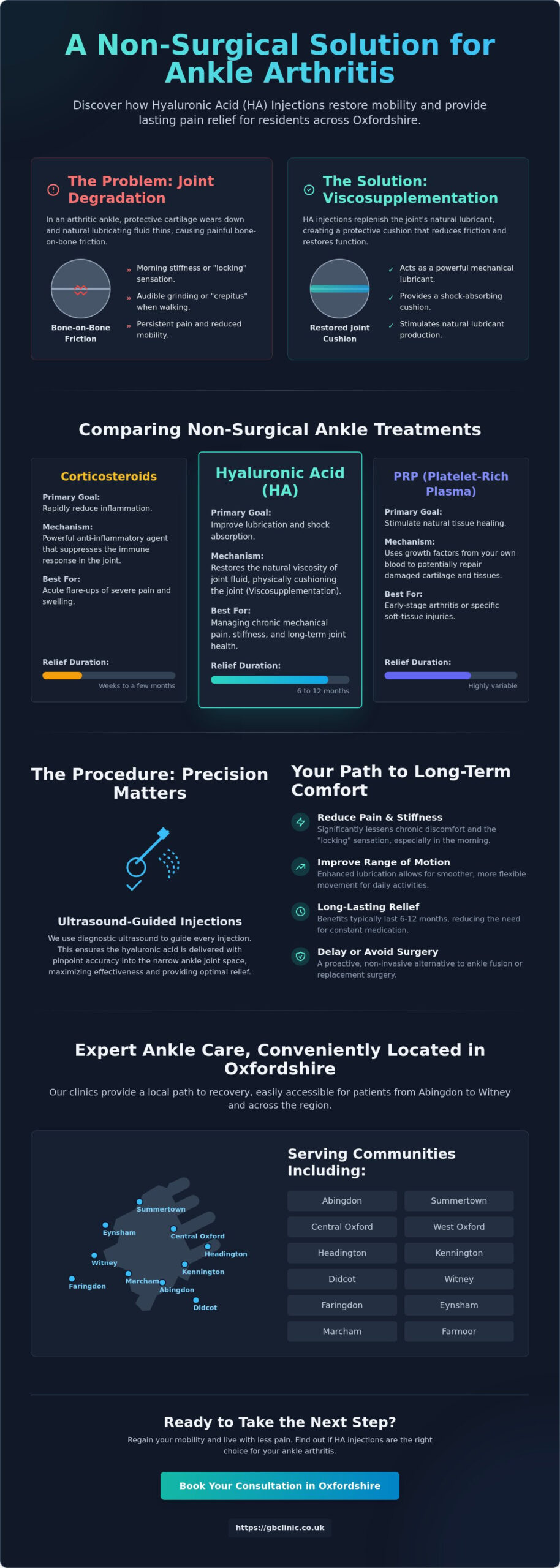
Patients in Headington or Summertown often arrive with a common question: “Which injection is right for my stage of arthritis?” While several options exist, understanding the distinction between hyaluronic acid (HA), corticosteroids, and Platelet-Rich Plasma (PRP) is essential for an effective recovery. Each therapy targets a different aspect of joint health. Steroids focus on suppressing acute inflammation. HA focuses on restoring mechanical lubrication. PRP aims to utilize the body’s growth factors for biological healing. For complex cases where both intense inflammation and mechanical friction are present, we often find a synergy between HA and guided steroid injections.
HA vs. Corticosteroids (Steroids)
Steroids are the “fast-acting” choice. They provide rapid relief by shutting down the inflammatory response, which is helpful for sudden flare-ups that limit walking in Central Oxford or West Oxford. However, this relief is often short-lived, typically lasting 6 to 12 weeks. There’s also clinical evidence suggesting that repeated steroid use can potentially accelerate cartilage degradation over time. In contrast, hyaluronic acid injections for ankle arthritis are the “protective” choice. HA takes longer to peak but offers a biological cushion that supports the joint for 6 to 12 months. It’s an ideal long-term strategy for residents in Kennington and Marcham who want to preserve their remaining cartilage while reducing daily discomfort.
HA vs. PRP (Platelet-Rich Plasma)
PRP therapy involves using a concentrated sample of the patient’s own blood to stimulate a regenerative response. While PRP focuses on cellular repair, HA focuses on the immediate physical environment through lubrication. These treatments aren’t mutually exclusive. In fact, combining them can be highly effective for moderate arthritis cases in Abingdon or Didcot. We use a clear framework to help you decide:
- Mild to Moderate Wear: HA is often the primary choice to maintain joint space and lubrication during daily movement.
- Acute Inflammatory Flare: A steroid injection may be used initially to “calm” the joint before introducing HA for long-term maintenance.
- Early Degeneration with High Activity: PRP might be considered to support tissue repair alongside the mechanical benefits of HA.
Residents in Farmoor, Eynsham, and Faringdon can access these specialized assessments to determine the most appropriate clinical path. For those in Witney, our focus remains on providing a clear, evidence-based plan that avoids the delays often found in general medical consultations. Our goal is to ensure you receive the specific intervention your joint requires for physical restoration.
The Procedure: Ultrasound-Guided Injections in Oxfordshire
The success of hyaluronic acid injections for ankle arthritis depends heavily on the accuracy of the delivery. Unlike larger joints like the knee, the ankle joint capsule is small and anatomically complex. Performing “blind” injections, which are done by feel alone, carries a higher risk of the lubricant being deposited into the surrounding soft tissue rather than the joint itself. This significantly reduces the treatment’s efficacy and can lead to unnecessary discomfort. We prioritize a clinical environment that combines modern technology with a patient-focused approach, ensuring every procedure is as effective and comfortable as possible for residents in Central Oxford and Headington.
Step-by-Step: What to Expect at GB Clinic
At GB Clinic, the process begins with a thorough initial assessment to understand your history of ankle pain and mobility limitations. We utilize diagnostic ultrasound scans to confirm the severity of the arthritis and map the internal structures of your joint. Once the target area is identified, the skin is prepared with a sterile solution. We often use a local anaesthetic to ensure the site is numb before the procedure begins. Using real-time ultrasound visualization, our specialists can see the needle entering the joint capsule on a monitor. This ensures the hyaluronic acid is placed precisely where it will provide the most mechanical benefit. This level of precision is why many patients in Summertown and West Oxford trust us for their joint care.
Local Accessibility for Oxfordshire Residents
Choosing a local provider shouldn’t mean compromising on the quality of care. Our clinics are strategically located to serve the entire Oxfordshire region, making it easy for those traveling from Abingdon, Didcot, and Witney to access specialist treatment. We understand that persistent ankle pain makes long-distance travel difficult, which is why we’ve focused on proximity for patients in Eynsham, Farmoor, and Kennington. Residents in Marcham and Faringdon no longer need to travel to London to receive advanced viscosupplementation. By offering expert-led care close to home, we help you avoid the delays and stress often associated with larger hospital systems. If you’re ready to improve your mobility and address your joint pain, you can book a consultation at one of our convenient Oxfordshire locations today.
Recovery and Long-Term Management of Ankle Arthritis
The successful administration of hyaluronic acid injections for ankle arthritis is the first step toward physical restoration. While the injection provides a biological cushion, the recovery phase ensures that these benefits translate into long-term mobility. Our clinical team works with patients across Central Oxford and West Oxford to manage this transition effectively. We focus on a measured return to activity, allowing the joint environment to stabilize while you regain confidence in your movement. This structured approach helps residents in Headington and Summertown move from a state of chronic discomfort to one of controlled, pain-free activity.
Post-Injection Guidance
The first 48 hours following your procedure are vital for optimal results. We advise resting the joint and avoiding any high-impact exercise, such as running or heavy lifting, for at least 2 to 3 days. It’s common to experience a temporary sensation of “fullness” or mild pressure within the joint capsule as the high-viscosity gel settles. This is a normal part of the viscosupplementation process and usually resolves quickly. Most patients can resume light walking immediately after leaving the clinic, making it convenient for those returning to Abingdon, Didcot, or Witney. If you experience any localized tenderness, a simple cold pack can provide comfort during the initial settling period.
Combining HA with Professional Physiotherapy
To maximize the lifespan of hyaluronic acid injections for ankle arthritis, we recommend integrating the treatment with MSK physiotherapy. Lubrication alone addresses the mechanical friction, but strengthening the surrounding musculature reduces the overall load placed on the arthritic joint. Our specialists help patients in Kennington, Marcham, and Farmoor develop specific exercise rehabilitation plans. These plans focus on gait re-education to prevent the compensatory movements that often lead to further wear. By improving the stability of the ankle, you protect the newly restored joint space and prolong the duration of pain relief.
Residents in Eynsham and Faringdon can benefit from this comprehensive care model, which bridges the gap between clinical intervention and daily wellness. We prioritize a clear path to recovery that avoids the ambiguity of self-managed care. If you’re ready to transition from managing pain to restoring your active lifestyle, we invite you to Book your consultation at GB Clinic. Our Oxfordshire-based team is dedicated to providing the expert-led, non-surgical solutions you need for lasting joint health.
Take the Next Step Toward Restored Ankle Mobility
Managing persistent joint stiffness doesn’t have to mean waiting for invasive surgery. By choosing hyaluronic acid injections for ankle arthritis, you’re opting for a biological solution that restores lubrication and protects your remaining cartilage. Our expert-led MSK specialists in Oxfordshire combine precision ultrasound-guided procedures with comprehensive care, including diagnostic scans and integrated physiotherapy, to ensure your recovery is both effective and sustainable.
Residents in Abingdon, Summertown, and Kennington can access this modern care close to home. We also provide convenient support for those in Marcham, Headington, and Farmoor, as well as individuals in Eynsham, Didcot, Witney, and Faringdon. Whether you’re in Central Oxford or West Oxford, our clinics offer a professional alternative to lengthy hospital delays. You’ve discovered how viscosupplementation provides a long-term cushion that standard treatments often miss. Now, you can move forward with a clear, evidence-based treatment plan tailored to your lifestyle.
Book a Consultation for Ankle Pain Relief at GB Clinic and begin your journey back to comfortable, daily movement. Our team is here to provide the clinical expertise and attentive care you need to manage your recovery with confidence.
Frequently Asked Questions
How long do hyaluronic acid injections for ankle arthritis last?
Hyaluronic acid injections for ankle arthritis typically provide pain relief for 6 to 12 months. This duration is significantly longer than the 6 to 12 weeks of relief often associated with steroid treatments. Residents in Abingdon and Summertown find this extended timeframe allows for a sustained return to daily walking and activities without the need for frequent clinical visits.
Is the injection painful?
Most patients find the procedure very tolerable because we utilize local anaesthetic and precise ultrasound guidance. The use of real-time imaging ensures the needle is placed accurately within the joint capsule, minimizing tissue disruption. This commitment to clinical precision ensures a comfortable experience for our patients visiting from Kennington and Marcham.
How many injections will I need for my ankle?
You’ll typically require only a single high-concentration injection to achieve the desired therapeutic effect. Modern formulations such as Ostenil Plus are designed for patient convenience, delivering the necessary lubrication in one session. This is an efficient option for busy individuals in Headington and Farmoor who want to avoid multi-injection regimens.
Can I walk immediately after the injection?
You can walk immediately after leaving the clinic, though we recommend avoiding high-impact exercise for the first 48 hours. Light movement is actually encouraged as it helps the lubricant distribute evenly throughout the joint space. This makes it easy for those traveling back to Eynsham or Didcot to resume their normal daily routine safely.
Are there any side effects to HA injections in the ankle?
Side effects are generally mild and limited to the injection site, including temporary swelling, redness, or a sensation of “fullness” in the joint. These symptoms usually resolve within 2 to 3 days without further intervention. Our specialists provide clear aftercare guidance to all patients in Witney and Faringdon to ensure a smooth recovery process.
Is HA more effective than a cortisone shot for arthritis?
HA is generally more effective for addressing the mechanical “wear and tear” of arthritis, while cortisone is better suited for acute inflammatory flare-ups. While steroids offer rapid relief, hyaluronic acid injections for ankle arthritis provide long-term lubrication that protects the joint for up to a year. This makes HA the preferred choice for residents in Central Oxford seeking lasting results.
Will my insurance cover hyaluronic acid injections at an MSK clinic?
Coverage varies significantly between providers and depends on your specific policy. While Bupa no longer funds viscosupplementation, other major insurers like Aviva or AXA may provide coverage if specific procedural codes for image-guided injections are used. We recommend that patients in West Oxford contact their insurer directly to verify their level of cover before booking.
How soon will I see results after the procedure?
While some patients feel an immediate “cushioning” effect, the most significant pain reduction usually peaks between 4 and 6 weeks post-injection. This is the period when the treatment’s biological stimulation of your own joint fluid is most active. It provides a steady, progressive improvement in mobility for our patients across the Oxfordshire region.