What if the biological tools to heal your persistent heel pain are already circulating in your body? For many active individuals across Central Oxford and Summertown, a stubborn Achilles injury feels like a permanent barrier to the sports they love. You might worry about the risks of a re-rupture or feel stuck on a long waiting list for specialist care. Choosing PRP for Achilles tendon repair provides a modern, evidence-based alternative that focuses on accelerating your body’s natural recovery processes without the need for invasive surgery.
We understand that whether you’re based in Abingdon, Headington, or Witney, your primary goal is returning to daily activities without discomfort. It’s common to feel apprehensive about traditional treatments that don’t seem to address the root of the tissue damage. This article outlines a clear, non-surgical roadmap for your recovery, explaining how Platelet-Rich Plasma therapy can reduce pain and promote faster biological healing. We’ll look at the specific benefits for residents in Farmoor, Eynsham, and Didcot, and how our specialist MSK care serves the wider Oxfordshire community, including Kennington, Marcham, West Oxford, and Faringdon.
Key Takeaways
- Learn how growth factors derived from your own blood stimulate collagen production to biologically repair damaged tendon tissue.
- Discover why PRP for Achilles tendon repair is a preferred non-surgical option for residents across Summertown, Headington, and West Oxford seeking to avoid long specialist wait times.
- Compare regenerative injections with other clinical interventions like Shockwave Therapy to determine the most effective path for your specific injury.
- Understand the importance of a diagnostic ultrasound scan in identifying whether your condition is an acute rupture or chronic tendinopathy.
- View a clear roadmap of the treatment process and recovery milestones for patients visiting our clinics from nearby Abingdon, Witney, or Didcot.
Understanding Achilles Tendon Injuries and the Role of PRP
The Achilles tendon is the strongest and thickest tendon in the human body, acting as the vital link between your calf muscles and your heel bone. It’s responsible for the power behind every step, jump, and sprint. Because it bears such extreme loads, it’s highly susceptible to injury. Residents in Central Oxford and Summertown often come to us after experiencing a sharp “pop” or persistent, nagging pain that limits their daily walks or sporting activities. While some injuries are sudden, others develop over months of repetitive stress. Patients traveling from Marcham, Farmoor, or Eynsham often find that traditional rest simply isn’t enough to resolve these deep-seated issues.
Distinguishing between the types of injury is essential for determining the right treatment path. Acute ruptures involve a sudden tear of the tendon fibers, often requiring immediate clinical attention. In contrast, chronic Achilles tendinopathy is an overuse injury where the tendon fails to repair itself properly after micro-trauma. This is where What is Platelet-Rich Plasma (PRP) therapy becomes a significant asset. By using PRP for Achilles tendon repair, we provide a concentrated biological boost to the body’s innate repair mechanisms. This helps restart the healing process in tissues that have become stagnant or stuck in a cycle of degeneration.
Common Achilles Conditions Treated with PRP
Many patients from Headington, Kennington, and Abingdon seek help for conditions that haven’t responded to basic rest. We typically apply PRP to:
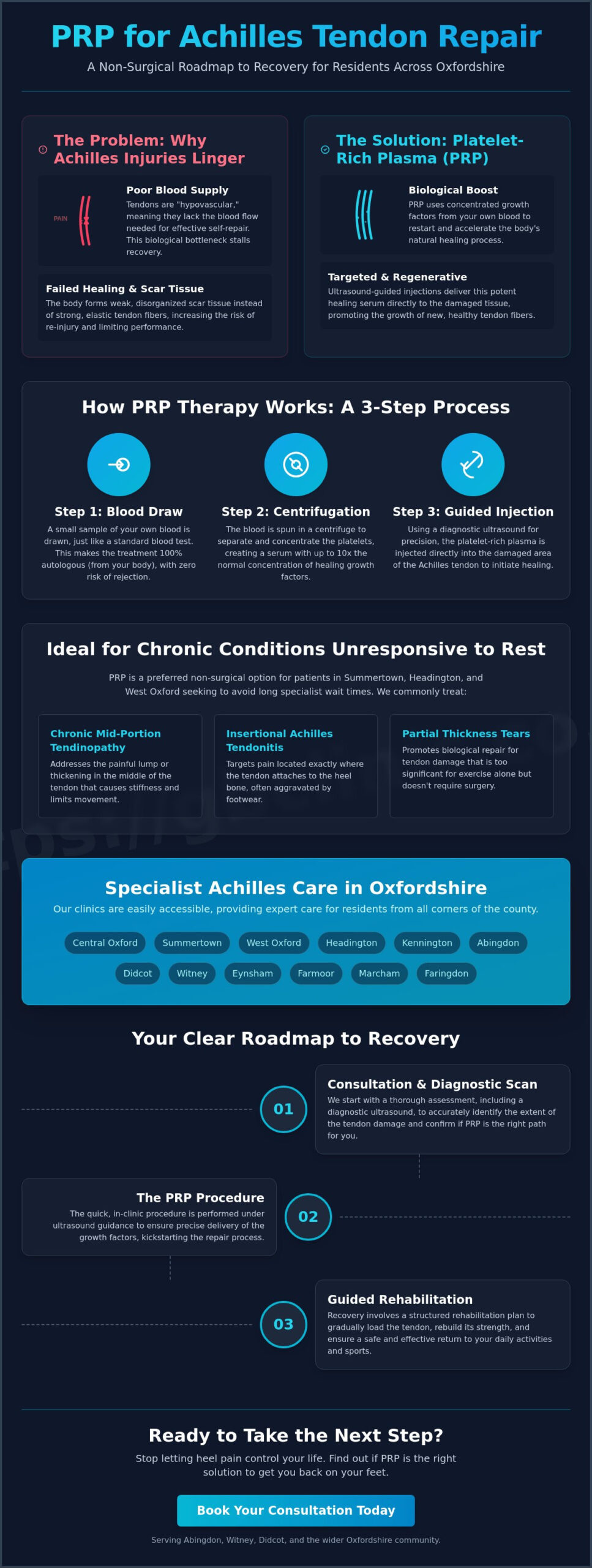
- Chronic mid-portion Achilles tendinopathy: This presents as a painful lump or thickening in the middle of the tendon, often making morning movement difficult.
- Insertional Achilles tendonitis: Here, the pain is located exactly where the tendon attaches to the heel bone, often aggravated by footwear.
- Partial thickness tears: These are injuries where the tendon is damaged but not completely severed. They’re often too significant for simple exercise alone but don’t require surgical intervention.
The Problem: Why Traditional Healing Often Fails
Tendons are “hypovascular” tissues. This means they have a very limited natural blood supply compared to muscles. This lack of blood flow is the primary reason why an injury in West Oxford or Didcot can linger for months without improvement. Without sufficient blood, the body can’t deliver the necessary growth factors to the site of the injury. It’s a biological bottleneck that stalls recovery.
Often, the body attempts to heal by creating disorganized scar tissue. While this fills the gap, it lacks the elasticity and strength of healthy tendon fibers. This can permanently limit athletic performance and increase the risk of future tears. Many people in Witney or Faringdon are told to “wait and see,” but for active individuals, this passive approach is often ineffective. Utilizing a diagnostic ultrasound scan allows us to see this damage clearly and move beyond the limitations of traditional, slower recovery methods.
The Science of Platelet-Rich Plasma for Tendon Repair
Understanding PRP for Achilles tendon repair begins with the source of the treatment: your own blood. Because the solution is autologous, meaning it’s derived entirely from your own body, there’s zero risk of an allergic reaction or rejection. The process starts with a small blood draw, similar to a routine test. This sample is placed in a specialized centrifuge that spins at high speeds to isolate and concentrate the platelets. The result is a potent serum containing up to ten times the concentration of healing components found in normal circulation. This makes PRP for Achilles tendon repair a compelling choice for those seeking long-term structural improvement rather than a temporary fix.
This concentrated serum is precisely delivered to the site of the injury using ultrasound guidance. For patients traveling from Marcham, Farmoor, or Eynsham, this precision ensures the growth factors are placed exactly where the tendon tissue is compromised. This is a fundamental shift from traditional medicine. Instead of just managing symptoms, we are providing the raw materials your body needs to rebuild itself. You can learn more about how Platelet-Rich Plasma (PRP) works from the American Academy of Orthopaedic Surgeons to understand the clinical depth of this approach. Residents from Abingdon, Summertown, and Kennington often appreciate the convenience of our local specialist care, while those in Witney, Faringdon, or Didcot find our clinic easily accessible for these advanced procedures.
How Growth Factors Accelerate Tissue Regeneration
Platelets are much more than just clotting agents. They contain a variety of proteins, including Platelet-Derived Growth Factor (PDGF) and Vascular Endothelial Growth Factor (VEGF), which play vital roles in tissue healing. PDGF initiates the repair process by stimulating cell replication, while VEGF helps create new blood vessels to improve the “hypovascular” environment of the tendon. These proteins act as chemical signals, recruiting local stem cells to the injury site. This biological recruitment triggers a transition from the painful, chronic inflammatory phase to a proliferative repair phase, where new, healthy collagen fibers are laid down to replace damaged tissue.
PRP vs. Cortisone: Choosing Regeneration Over Suppression
Many people in West Oxford, Headington, or Central Oxford are familiar with steroid injections for pain relief. While a guided steroid injection is an excellent tool for specific inflammatory conditions, it functions by suppressing the immune response to mask pain. For chronic tendon issues, repeated steroids can actually weaken the tendon structure over time, increasing the risk of a full rupture. PRP offers the opposite approach. It encourages an active healing response and strengthens the tendon’s biological integrity. It’s a long-term investment in your mobility and athletic future. If you’re ready to move beyond temporary relief, our team can help you assess your options at our Oxford clinic.
PRP vs. Alternative Non-Surgical Treatments
When patients from Abingdon or Kennington visit our clinic, they’re often exploring several non-surgical avenues to resolve their discomfort. While PRP for Achilles tendon repair is a powerful regenerative tool, it’s essential to understand how it fits alongside other modern interventions. Each treatment addresses a different aspect of tendon pathology. Some therapies focus on mechanical stimulation, while others prioritize structural lubrication or the tightening of lax tissues. For many individuals in Summertown and Headington, the most effective recovery plan involves a strategic combination of these specialist tools rather than relying on a single method.
PRP and Shockwave Therapy: A Dual Approach
Extracorporeal Shockwave Therapy (ESWT) is frequently used for residents in Central Oxford who suffer from chronic tendinopathy. Shockwave uses high-energy acoustic waves to create controlled micro-trauma in the tendon tissue. This mechanical stimulus effectively “restarts” the healing response in stagnant injuries. If Shockwave provides the spark to initiate repair, PRP provides the biological fuel to complete it. By combining these treatments, we can often achieve better results for patients in Marcham or Farmoor who have seen little improvement from rest alone. You can read more about this in our guide on Shockwave Therapy.
Hyaluronic Acid for Achilles Health
For individuals in Witney or Didcot experiencing significant stiffness or a “grating” sensation, the issue might involve the tendon’s ability to glide within its sheath. Hyaluronic Acid (HA) injections act as a high-quality lubricant for the joint and tendon environment. While PRP for Achilles tendon repair focuses on rebuilding the internal collagen fibers, HA ensures the tendon moves smoothly against surrounding structures. Using both can significantly reduce the “stiff” feeling many patients describe during morning walks in West Oxford or Faringdon. This combination approach targets both the internal strength and the external mobility of the Achilles.
Prolotherapy is another consideration, particularly for those in Eynsham dealing with chronic ligament or tendon laxity. It involves injecting a mild irritant to stimulate a localized inflammatory response. However, PRP is generally considered a more advanced version of this concept. Instead of just irritating the tissue to cause a reaction, PRP delivers concentrated growth factors directly to the site of damage. This targeted delivery makes it a more efficient option for active individuals who need a clear, non-surgical roadmap to return to their peak mobility.
The PRP Procedure and Recovery Timeline in Oxfordshire
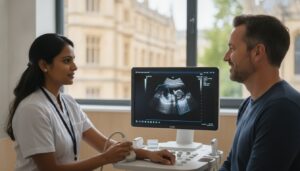
For patients traveling from locations like Didcot, Abingdon, or Headington, our clinical process is designed to be efficient and thorough. We prioritize a clear, step by step approach that ensures you understand every stage of your treatment. The entire procedure is performed in a clinical setting, typically taking less than an hour, which makes it a convenient option for those living in Central Oxford or Summertown. Our goal is to provide a seamless experience that transitions from diagnostic precision to active biological recovery.
- Step 1: Your journey begins with an initial consultation and a diagnostic ultrasound scan to precisely map the extent of the tendon damage.
- Step 2: A small amount of blood is drawn and processed in a centrifuge to isolate the concentrated platelet layer.
- Step 3: We perform the PRP for Achilles tendon repair by injecting the serum directly into the lesion under continuous ultrasound guidance.
- Step 4: You’ll remain under observation for a short period while we provide specific aftercare instructions to manage the initial healing phase.
- Step 5: We develop a structured rehabilitation plan that aligns with your personal mobility goals, whether you’re returning to walking in Kennington or running in West Oxford.
Why Ultrasound Guidance is Non-Negotiable
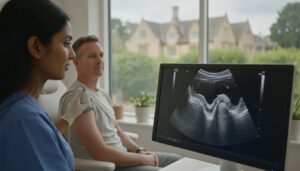
Precision is the most critical factor in the success of PRP for Achilles tendon repair. Some providers still perform “blind” injections, relying on touch and anatomical landmarks alone. This carries the risk of missing the damaged area or, worse, injecting into healthy tissue which can cause unnecessary irritation. At our clinic, we use real time imaging to ensure the growth factors are delivered exactly into the site of degeneration. This level of accuracy is why patients from Farmoor, Eynsham, and Marcham trust our specialist MSK imaging. It ensures the biological “boost” is placed where it can do the most good, providing the best possible foundation for tissue remodeling.
What to Expect During Your Recovery
Recovery is a gradual process that respects the natural timelines of biological healing. During the first 48 hours, it’s normal to experience local soreness or an “inflammatory flare” as the platelets begin their work. Between weeks 2 and 6, we transition you into a loading phase. This involves gentle, progressive exercises often coordinated with physiotherapy to strengthen the new collagen fibers. From month 3 to 6, most patients from Witney or Faringdon find they can return to impact sports and higher intensity activities. This period marks the long term remodeling phase where the tendon regains its full structural integrity. If you’re ready to start this journey, you can book your initial assessment at our Oxford clinic today.
Specialist Achilles Care at GB Clinic Oxford
GB Clinic Oxford provides a high level of clinical expertise in advanced MSK interventions. We recognize that PRP for Achilles tendon repair is most effective when it isn’t a standalone procedure. Unlike many generic providers, we bridge the gap between regenerative medicine and functional rehabilitation. Our specialists combine precise, ultrasound-guided injections with a tailored recovery roadmap. This ensures that patients from West Oxford or Headington don’t just receive an injection but also the expert guidance needed to load the tendon safely during its healing phase. This holistic approach is designed to restore both the strength and the elasticity of the tendon tissue.
Our commitment to rapid access is a cornerstone of our service. We understand the frustration of long waiting times for specialist MSK care through general practice. Residents in Central Oxford and Summertown can bypass these delays, receiving a comprehensive assessment and a clear treatment plan without the typical month-long wait. This proactive approach is essential for preventing chronic conditions from worsening. By addressing the injury early with biological tools, we help you avoid the cycle of persistent pain and the fear of a future re-rupture.
Accessible MSK Excellence Across Oxfordshire
We’ve designed our services to be the convenient, local choice for the entire region. Our facilities offer free parking and modern clinical environments, ensuring your visit is as comfortable as possible. We provide easy access for patients traveling from various surrounding towns. Our clinics serve the following communities:
- Abingdon and Kennington: Just a short drive for residents seeking specialist regenerative care.
- Marcham and Farmoor: Conveniently located for those needing local MSK expertise.
- Eynsham and Witney: Providing a clear alternative to long hospital wait times.
- Didcot and Faringdon: Accessible facilities designed for comprehensive patient recovery.
Whether you’re commuting from the surrounding Oxfordshire towns or based in the heart of the city, our clinics are positioned to serve you with professional, attentive care. We focus on delivering evidence-based treatments in a calm, clinical environment that builds your confidence in the recovery process.
Start Your Recovery Journey Today
Choosing PRP for Achilles tendon repair at GB Clinic means opting for a non-surgical, biological solution backed by local expertise. You gain a clear path to recovery that focuses on restoring your mobility and confidence without the risks associated with invasive operations. Our booking process is straightforward, starting with a thorough initial assessment to confirm your suitability for regenerative therapy. We prioritize your long-term health, ensuring that every step of your treatment is guided by clinical precision and a genuine consideration for your activity goals.
Don’t let persistent heel pain dictate your lifestyle or keep you from the sports you love. Our team is here to provide the clinical competence and interpersonal warmth you need to return to your peak physical state. You can Book your PRP consultation at GB Clinic to begin your specialist recovery plan today.
Restore Your Strength and Mobility in Oxford
Achieving a full recovery from a chronic Achilles injury requires more than just rest; it demands a precise intervention that addresses the root cause of tissue degeneration. By choosing PRP for Achilles tendon repair, you’re opting for a modern, biological treatment that leverages your body’s own healing potential. Our clinic integrates expert-led MSK ultrasound diagnostics with personalized rehabilitation protocols to ensure every patient receives a clear and effective path back to peak mobility. This comprehensive approach ensures the new collagen fibers are strengthened and ready for the demands of daily life.
We’ve made specialist care accessible for residents across the entire region. Our clinics are easy to reach for those living in Abingdon, Summertown, and Kennington. If you’re based in Marcham, Headington, or Farmoor, you can access advanced regenerative therapy without the delays often found in traditional healthcare routes. Patients from Eynsham, Didcot, and Witney find our modern facilities convenient and professional. Whether you’re in Faringdon, Central Oxford, or West Oxford, we’re dedicated to helping you return to the activities you love with confidence. Your journey toward a stronger, pain-free future starts with a clinical assessment tailored to your specific needs.
Book Your Specialist PRP Assessment in Oxford
We look forward to helping you regain your mobility and return to your active lifestyle with renewed strength.
Frequently Asked Questions
How many PRP injections will I need for my Achilles tendon?
Most patients require between one and three injections to achieve optimal healing results. The exact number depends on the severity of the tendon damage identified during your initial diagnostic ultrasound. Residents from Abingdon and Summertown often find a single session provides significant relief, while chronic cases in Headington might benefit from a structured course of three treatments spaced several weeks apart to ensure deep tissue repair.
Is PRP therapy for Achilles tendon repair painful?
You may experience mild discomfort during the blood draw and a temporary increase in soreness for 48 hours following the injection. This is known as an inflammatory flare and is a sign that the healing process has been successfully initiated. Our specialists use local anesthetic and ultrasound guidance to ensure the process is as comfortable as possible for patients visiting from Kennington or Marcham.
How soon can I return to running after a PRP injection?
A gradual return to running usually begins between three and six months after the treatment. While gentle loading exercises start within the first few weeks, the tendon needs time to remodel and regain its structural integrity. Patients in Farmoor and Eynsham are guided through a personalized rehabilitation protocol to ensure they don’t return to high impact sports too early, which reduces the risk of re-injury.
Are there any side effects or risks associated with PRP?
Risks are minimal because the treatment uses your own blood, eliminating the possibility of an allergic reaction or rejection. Common side effects include temporary swelling, redness, and local bruising at the injection site. These symptoms typically resolve quickly, allowing individuals from Didcot or Witney to return to light daily activities shortly after their appointment at our Oxford clinic without significant downtime.
Is PRP therapy covered by private health insurance in the UK?
Coverage for PRP for Achilles tendon repair varies significantly between private health insurance providers in the UK. Some insurers recognize it as an effective treatment for chronic tendinopathy, while others may classify it as an emerging therapy. We recommend that patients from Faringdon or Central Oxford contact their insurance provider directly to confirm their specific level of cover and any required authorization before booking.
What is the success rate of PRP for chronic Achilles tendinopathy?
Clinical studies report a success rate of up to 80% for chronic tendon injuries when the injections are paired with a structured rehabilitation program. This high success rate is specifically observed in patients with chronic tendinopathy rather than sudden, acute tears. For those in West Oxford, this biological approach offers a reliable, non-surgical alternative to traditional treatments that may have failed to provide long term relief.
Can PRP help with a total Achilles tendon rupture?
Current evidence suggests that PRP is significantly more effective for chronic tendinopathy than for acute, total ruptures. A 2019 study from the University of Oxford found that PRP did not provide additional benefits for acute ruptures compared to standard care. We focus on using PRP for Achilles tendon repair in cases where the tendon is degenerated or partially torn, where biological stimulation can truly accelerate the healing process.
Do I need a GP referral to have PRP at GB Clinic in Oxford?
You don’t typically need a GP referral to book a specialist assessment at our clinic. Many patients from across Oxfordshire choose to self-refer to avoid long waiting times and gain immediate access to diagnostic imaging. This direct access allows for a faster diagnosis and a quicker start to your recovery journey, helping you return to mobility without the administrative delays often found in general practice.