

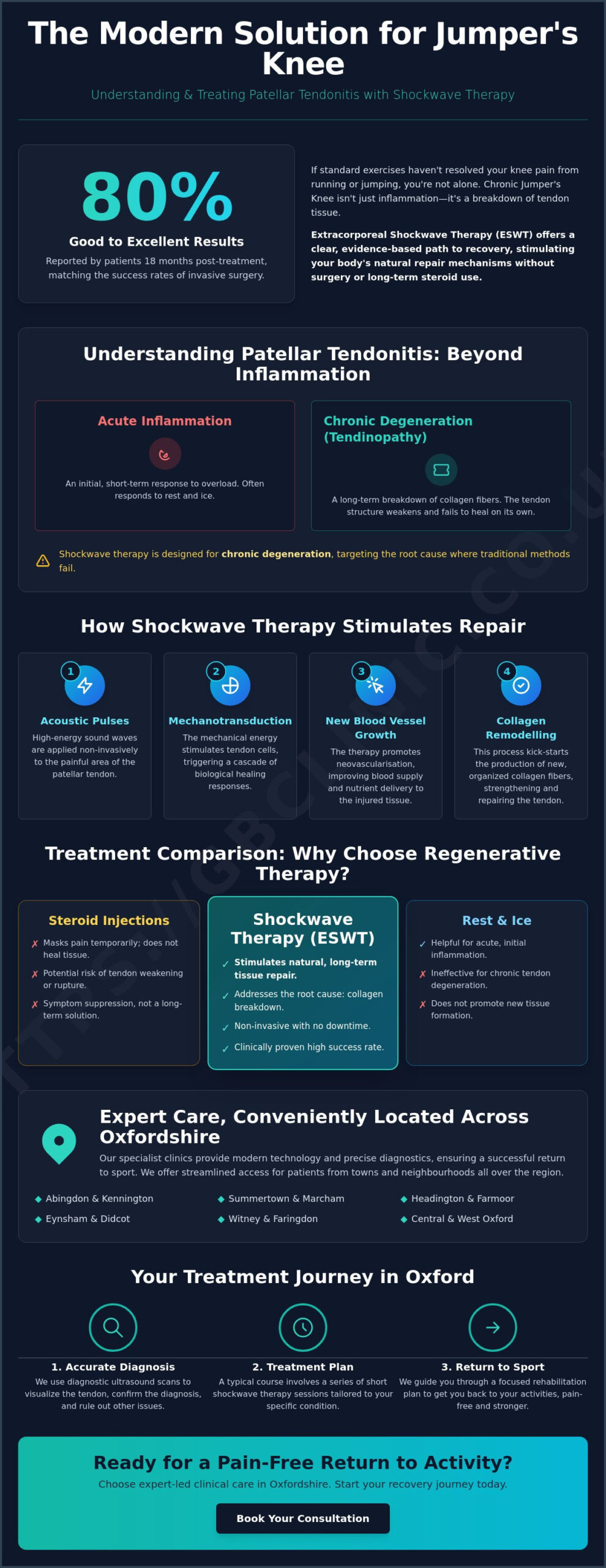
Did you know that up to 80% of patients struggling with chronic jumper’s knee report good to excellent results 18 months after treatment? This success rate nearly matches invasive surgery, making shockwave therapy for patellar tendonitis a leading choice for athletes and active individuals. If you’ve found that standard exercises haven’t resolved your persistent pain during running or jumping, you aren’t alone. It’s common to feel stuck between the limitations of traditional physiotherapy and the anxiety of potential surgery or long term steroid use.
We’re here to show you a clear, evidence-based path to recovery using Extracorporeal Shockwave Therapy (ESWT) to stimulate natural tissue repair and reduce tendon stiffness. You’ll learn how this modern intervention works and what to expect from a professional treatment plan. Our specialist clinics are strategically located to serve residents across Oxfordshire, ensuring expert care is easily accessible whether you’re in Abingdon, Summertown, Kennington, or Marcham.
We provide streamlined access for those living in Headington, Farmoor, Eynsham, and Didcot. From Witney and Faringdon to Central Oxford and West Oxford, our team focuses on getting you back to the sports you love without the need for invasive operations. This guide covers the clinical science behind ESWT and how our local expertise can help you achieve a pain-free return to activity.
Key Takeaways
- Understand the anatomical difference between simple inflammation and the collagen breakdown of chronic jumper’s knee to better target your recovery.
- Discover how shockwave therapy for patellar tendonitis uses non-invasive acoustic pulses to stimulate mechanotransduction and repair damaged tendon tissue.
- Evaluate the advantages of regenerative therapy over traditional steroid injections or the lubricating benefits of Hyaluronic Acid (HA) for joint health.
- Explore the specialist treatment pathway available at our clinics, conveniently accessible for patients in Summertown, Faringdon, and West Oxford.
- Learn why an expert-led clinical environment in Oxfordshire provides the modern technology and precise diagnostics necessary for a successful return to sport.
Understanding Patellar Tendonitis: Why “Jumper’s Knee” Becomes Chronic
Patellar tendinitis, also known as jumper’s knee, is a common overuse injury that affects the tendon connecting your kneecap (patella) to your shinbone (tibia). This vital structure acts like a spring, absorbing and releasing energy during explosive movements. When the load on this tendon exceeds its capacity, micro-tears develop. While many people believe this is simply “inflammation,” it’s actually a breakdown of collagen fibers within the tendon matrix. This transition from acute irritation to chronic degeneration is why standard “rest and ice” protocols often fail to provide long term relief.
To better understand how this condition develops and why advanced interventions are necessary, watch this helpful clinical overview:
For residents in Abingdon or Kennington who are active in sports, the pain often begins as a dull ache after exercise. It quickly progresses to sharp discomfort during training. Chronic patellar tendonitis occurs when the body’s natural repair process stalls, leading to a disorganized tendon structure. Factors such as rapid training increases, sport specialization, or biomechanical issues like poor quad flexibility contribute to this cycle. Because the tendon has a poor blood supply, it struggles to heal on its own without targeted stimulation like shockwave therapy for patellar tendonitis.
Symptoms and Risk Factors
The hallmark symptom is localized pain at the very base of the kneecap. You’ll likely feel this most intensely during stairs, deep squats, or landing from a jump. If you live in Marcham or Eynsham and find that your knee pain is limiting your daily mobility, it’s essential to look at modifiable risk factors. These include training volume and muscle imbalances. Some individuals may also have “patella alta,” a non-modifiable factor where the kneecap sits higher than average, increasing the strain on the tendon during movement.
The Importance of Accurate Diagnosis
Before beginning any treatment plan, an accurate clinical picture is vital. We often see patients from Didcot, Headington, and Farmoor who have been misdiagnosed with general knee strain when they actually have infrapatellar bursitis or fat pad impingement. A diagnostic ultrasound scan is the gold standard for visualizing the internal structure of the tendon. This allows us to see the exact degree of collagen breakdown and ensure that shockwave therapy for patellar tendonitis is the most appropriate course of action. Residents in Summertown, Central Oxford, and West Oxford can access these specialist scans easily at our local clinics. Whether you’re coming from Witney or Faringdon, our goal is to provide a clear diagnosis that moves you away from guesswork and toward a focused, regenerative recovery plan.
How Shockwave Therapy Repairs the Patellar Tendon
Extracorporeal Shockwave Therapy (ESWT) is a modern, non-invasive treatment that uses high energy acoustic pulses to treat damaged tissues. Unlike many traditional treatments that focus on suppressing symptoms, shockwave therapy for patellar tendonitis targets the root cause of the injury. For residents in Headington or Farmoor who’ve struggled with long term knee pain, this technology offers a way to stimulate repair without needles or downtime. The device delivers mechanical energy directly to the site of the collagen breakdown identified during your clinical assessment.
The primary process behind this repair is called mechanotransduction. This occurs when the mechanical pulses from the shockwave device convert into chemical signals within the tendon cells. This stimulation triggers the body to produce essential proteins and growth factors. Neovascularisation is the growth of new blood vessels to aid tendon repair by delivering much-needed nutrients to the damaged area. By encouraging this biological response, shockwave therapy for patellar tendonitis transforms a degenerative environment into a regenerative one. Patients across Central Oxford and West Oxford often find that this specialized approach provides the breakthrough they’ve been seeking when traditional methods have plateaued.
The Biological Mechanism
When a tendon injury becomes chronic, the natural healing cycle often stalls. ESWT effectively “restarts” this process by triggering metabolic activity and increasing collagen production. It also reduces the concentration of substance P, a neurotransmitter associated with persistent pain. This provides a window of relief that allows patients from Didcot and Witney to engage more effectively in their rehabilitation. Accessing this level of care is straightforward for those based in Abingdon or Summertown.
Clinically Proven Success Rates
Clinical evidence supports ESWT as a superior alternative to more invasive options. A recent systematic review of shockwave therapy effectiveness highlights its role in significantly reducing pain and improving function. Studies generally show success rates between 70% and 80% for chronic cases. This makes it a compelling choice for those in Faringdon or Eynsham who want to avoid surgical risks.
If you’re looking for a specialist clinic near Kennington or Marcham, our team provides comprehensive physiotherapy integrated with advanced regenerative technologies to ensure a safe and effective return to activity.
Shockwave vs. Steroids and Hyaluronic Acid: Which is Right for You?
Choosing between different clinical interventions can be confusing when you’re in pain. Corticosteroid injections are widely known for their powerful anti-inflammatory effects. They provide rapid pain relief by suppressing the immune response, which is helpful for acute bursitis or severe swelling. However, chronic jumper’s knee is characterized by tissue degeneration rather than active inflammation. This is why shockwave therapy for patellar tendonitis is often the superior choice for long term recovery. While steroids mask the pain, ESWT works to rebuild the tendon’s structural integrity from the inside out.
For some patients, the clinical picture is more complex. You might experience joint stiffness or mild arthritis alongside tendon pain. In these cases, Hyaluronic Acid (HA) injections serve as a high quality lubricating option. HA mimics the natural fluid in your knee joint, reducing friction and supporting overall mobility. If you’re traveling from Headington, Farmoor, or Eynsham, our specialists will determine if your pain stems solely from the tendon or if joint wear is also a factor. We often find that addressing both the joint environment and the tendon structure leads to the most comprehensive results.
When to Choose ESWT Over Injections
Structural repair should always be the priority for chronic injuries. Repeated steroid use carries a documented risk of weakening the tendon fibers, which can eventually lead to further damage or even rupture. A randomized controlled trial on shockwave therapy demonstrated that patients receiving ESWT showed significantly better functional outcomes compared to those using traditional conservative methods alone. This is particularly relevant for athletes in Didcot or Faringdon who need a resilient tendon to handle high impact loads. We follow a clear framework for every patient:
- Problem: Chronic tendon breakdown and stalled natural healing.
- Solution: Focused shockwave therapy for patellar tendonitis to restart the repair cycle.
- Benefit: Regenerated tissue, improved load tolerance, and a sustainable return to peak performance.
A Modern MSK Approach in Oxfordshire
Selecting the right pathway requires an expert eye and a modern clinical setting. Our clinicians help patients from Abingdon, Witney, and Summertown identify the precise source of their discomfort through detailed physical exams. Whether you’re in Kennington, Marcham, or West Oxford, we provide a clear pathway based on the latest musculoskeletal research. For a deeper look at how we structure our care across the region, you can read our private MSK physiotherapy Oxford guide. This ensures that residents of Central Oxford receive a bespoke treatment plan that prioritizes long term health over short term fixes.
What to Expect: Your Shockwave Treatment Journey in Oxford
Your recovery begins with a thorough clinical assessment. We serve patients from Didcot to Headington, providing a convenient location for those seeking specialist MSK care. During this initial consultation, we confirm the diagnosis and ensure that shockwave therapy for patellar tendonitis is the most effective path for your specific condition. This expert-led approach means we don’t just treat the pain; we evaluate your biomechanics and training history to prevent future issues. Residents of Abingdon and Summertown often choose our clinic for this detailed, patient-focused diagnostic process.
The actual treatment is efficient and straightforward. We use a handheld device to deliver focused acoustic pulses directly to the affected area. While you might feel some discomfort, it’s generally described as a deep, rhythmic tapping that is uncomfortable but tolerable. The sensations are manageable. You won’t need any local anesthetic, and you can drive home immediately after the session. A standard course of treatment involves 3 to 5 sessions, typically spaced 7 to 10 days apart. This specific timing is vital because it gives your body enough time to respond to the regenerative signals without being overwhelmed.
Step-by-Step Session Walkthrough
- Step 1: Localization. Your clinician will palpate the knee to identify the exact point of maximum tenderness on the patellar tendon. This ensures the energy is delivered precisely where the collagen breakdown is most significant.
- Step 2: Coupling Gel. We apply a clear ultrasound gel to the skin. This acts as a medium for the acoustic waves, allowing them to pass through the skin and into the deeper tendon tissue without losing intensity.
- Step 3: Treatment Delivery. We start the device at a low energy setting. As your tissues adjust, we gradually increase the intensity to your maximum tolerance level to ensure the highest therapeutic benefit.
Recovery and Post-Treatment Care
After your session, you might experience some mild soreness or redness. This is a normal sign that the healing response has been triggered. It’s essential to follow the 48-hour rule: avoid high-impact activities like running or jumping during this window. This protection period allows the neovascularisation process to begin undisturbed. For patients in Farmoor, Eynsham, and Marcham, our clinic provides easy access for follow-up rehabilitation. We integrate ESWT with a structured physiotherapy program. This includes progressive loading exercises that are crucial for long term tendon health. Whether you’re traveling from Witney, Faringdon, or Central Oxford, our team supports you through every stage of this journey. Those living in Kennington or West Oxford will find our facilities modern, welcoming, and easy to reach.
If you’re ready to start your recovery, book your initial assessment at GB Clinic today to see how our Oxfordshire specialists can help you return to sport pain-free.
Why Choose GB Clinic for Patellar Tendonitis Treatment?
GB Clinic is a leading musculoskeletal (MSK) specialist serving the Oxfordshire region. We provide a modern clinical environment where advanced technology meets patient-focused care. For individuals in Kennington, Faringdon, and West Oxford, accessing high level treatment shouldn’t require a trip to London or a long distance commute. We bring evidence-based, non-surgical solutions directly to your community. Our commitment to shockwave therapy for patellar tendonitis is backed by the latest MSK research and a suite of diagnostic tools that ensure your recovery is built on a solid clinical foundation.
While some providers offer a single-service approach, we integrate multiple advanced interventions to speed up your return to activity. We can combine diagnostic ultrasound scans with regenerative treatments to track your tendon’s healing progress accurately. If joint health is also a concern, we offer Hyaluronic Acid (HA) injections to support joint lubrication alongside your tendon repair. This comprehensive model ensures that patients from Headington, Farmoor, and Eynsham receive a bespoke plan that addresses every aspect of their knee health under one roof.
Expertise and Attentive Care
Our practitioners maintain a professional and reassuring demeanor, ensuring you feel confident in your path to recovery. We use direct client feedback as a primary tool to maintain our high standards, focusing on interpersonal warmth and clinical excellence. Whether you’re an athlete from Didcot or an active retiree in Marcham, you’ll find our team attentive to your specific goals. We avoid generic protocols, preferring a tailored approach that respects your individual experience and physical needs. This expert-led care is what sets us apart as a premier choice for shockwave therapy for patellar tendonitis in the region.
Booking Your Assessment
Starting your journey toward a pain-free life is straightforward and efficient. We offer a clear, professional assessment process for patients across Central Oxford and the surrounding towns. Our team is focused on avoiding unnecessary delays, ensuring you get the answers you need quickly. This risk-free entry point allows you to understand your condition without obligation, positioning us as the trustworthy choice for residents in Abingdon, Witney, and Summertown.
Book your MSK assessment at GB Clinic today and take the first step toward advanced, non-surgical recovery with our Oxfordshire specialists.
Take the Next Step Toward Pain-Free Performance
Chronic jumper’s knee doesn’t have to be a permanent barrier to your athletic goals. By choosing shockwave therapy for patellar tendonitis, you’re opting for a modern, regenerative solution that targets the root cause of tendon breakdown. Our specialist MSK practitioners use diagnostic ultrasound-guided assessments to ensure every treatment is precise and effective. This evidence-based approach provides a clear path back to the sports you love without the risks associated with invasive surgery or repeated steroid use.
We’ve made accessing this advanced care simple for residents across the county. Whether you’re based in Abingdon, Summertown, or Kennington, our clinics are within easy reach. We also serve active individuals from Marcham, Headington, and Farmoor, as well as those living in Eynsham, Didcot, and Witney. From Faringdon to Central Oxford and West Oxford, our team is ready to help you reclaim your mobility and load tolerance.
Don’t let persistent pain dictate your training schedule or daily life. Our expert-led environment is designed to build your confidence and restore your physical health through attentive, specialized care. Book Your Specialist Shockwave Assessment in Oxford today. We look forward to supporting your transition back to a comfortable, active state.
Frequently Asked Questions
Is shockwave therapy for patellar tendonitis a permanent fix?
Shockwave therapy for patellar tendonitis acts as a permanent fix by stimulating a regenerative healing response rather than just masking symptoms. It effectively restarts the body’s natural repair process for chronic collagen breakdown. While results are long lasting, maintaining tendon health requires ongoing biomechanical management. Patients from Abingdon and Witney find this approach provides a sustainable solution that prevents the cycle of recurring pain often seen with temporary treatments like steroid injections.
How many sessions of shockwave therapy will I need for jumper’s knee?
Most patients require between 3 and 5 sessions to achieve optimal biological results for jumper’s knee. These treatments are typically scheduled 7 to 10 days apart to allow the tendon’s metabolic activity to respond between applications. This frequency is manageable for residents in Summertown or Headington who need an efficient recovery plan. Following the full course is essential even if you feel immediate relief after the first session.
Does shockwave therapy for knee pain hurt?
The treatment is generally described as uncomfortable but tolerable, rather than painful. You’ll feel a deep, rhythmic tapping sensation as the acoustic pulses target the damaged tissue. Our clinicians adjust the intensity based on your feedback to ensure the session remains within your comfort level. Patients from Didcot and Faringdon appreciate that no local anesthetic is required, allowing them to return to their daily routine immediately after the appointment.
Can I continue training while receiving shockwave therapy?
You can usually continue with modified training, but you must avoid high impact activities for 48 hours after each session. This rest period is crucial to allow the initial healing signals to take effect without interruption. We encourage progressive loading exercises alongside your treatment to strengthen the tendon. Whether you’re an athlete in Kennington or Marcham, our specialists will provide a tailored exercise rehabilitation plan to support your recovery journey.
Are there any side effects of shockwave treatment on the knee?
Side effects are typically minor and temporary, lasting only a few days. You might notice slight redness, mild swelling, or a dull ache in the treated area immediately after the session. These are normal biological responses indicating that the healing process has been successfully triggered. Residents of Farmoor and Eynsham can be reassured that these symptoms are localized and don’t require any specific medical intervention beyond brief rest.
How soon will I see results after my first ESWT session?
While many people experience immediate pain reduction due to a decrease in pain signaling chemicals, structural tissue repair takes longer. You’ll likely see the most significant improvements in function and load tolerance between 6 and 12 weeks after completing your course. This timeline reflects the biological reality of collagen remodeling. Patients in Central Oxford should focus on the long term functional benefits rather than expecting an overnight cure for chronic issues.
Is shockwave therapy available on the NHS in Oxfordshire?
Access to shockwave therapy on the NHS in Oxfordshire is often limited and usually reserved for patients who haven’t responded to months of other conservative treatments. GB Clinic provides rapid, private access to this technology without the long waiting lists. This makes it a convenient choice for those in West Oxford or Headington who want to start their recovery immediately. We offer a professional clinical environment with modern ESWT equipment.
What is the difference between radial and focused shockwave therapy?
Radial shockwave therapy spreads energy over a larger, superficial area, while focused shockwave therapy penetrates deeper into specific tissues. Focused ESWT is often more effective for localized tendon pathology because it delivers energy precisely to the site of the injury. When considering shockwave therapy for patellar tendonitis, using the correct technology is vital for success. Our specialists help patients from Didcot and Witney determine which method best suits their specific anatomical needs.