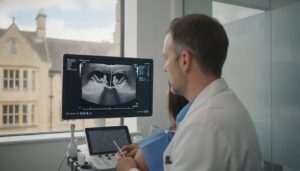

While it accounts for less than 1% of all back pain cases, chronic coccydynia can feel like a total disruption to your daily life. If you’re struggling with the sharp, stabbing sensation that occurs when transitioning from sitting to standing, you’ve likely found that standard advice offers little more than temporary comfort. Seeking specialized physiotherapy for tailbone pain relief is often the necessary step for those who can no longer sit through a workday or a commute.
It’s frustrating when recovery feels stagnant, especially when simple tasks like driving to Abingdon or sitting for dinner in Summertown become sources of intense discomfort. We understand the physical and emotional toll of persistent tailbone pain. This guide explains how our expert clinical interventions provide a clear path to recovery for residents across Oxfordshire, including those in Kennington, Marcham, Headington, and Farmoor. You’ll discover how a combination of manual therapy, exercise rehabilitation, and advanced options like shockwave therapy or ultrasound-guided injections can significantly reduce your daily pain levels. Whether you’re based in Eynsham, Didcot, Witney, and Faringdon, or live in Central and West Oxford, our local clinics offer the specialized care needed to help you sit for long periods without the constant reminder of coccydynia.
- Identify the primary causes of chronic coccydynia and why mechanical tailbone pain often persists without professional intervention.
- Discover how specialized physiotherapy for tailbone pain relief employs manual therapy and myofascial release to restore mobility and ease discomfort.
- Compare the benefits of clinical realignment against home management options like ‘donut’ cushions to understand which provides lasting results.
- Learn about advanced clinical options like diagnostic ultrasound and targeted injections available to patients in Witney, Headington, and Didcot.
- Access expert care at clinics conveniently located for residents in Abingdon, Summertown, Kennington, Marcham, Farmoor, Eynsham, Faringdon, and across Central and West Oxford.
Understanding Coccydynia: Why Tailbone Pain Persists
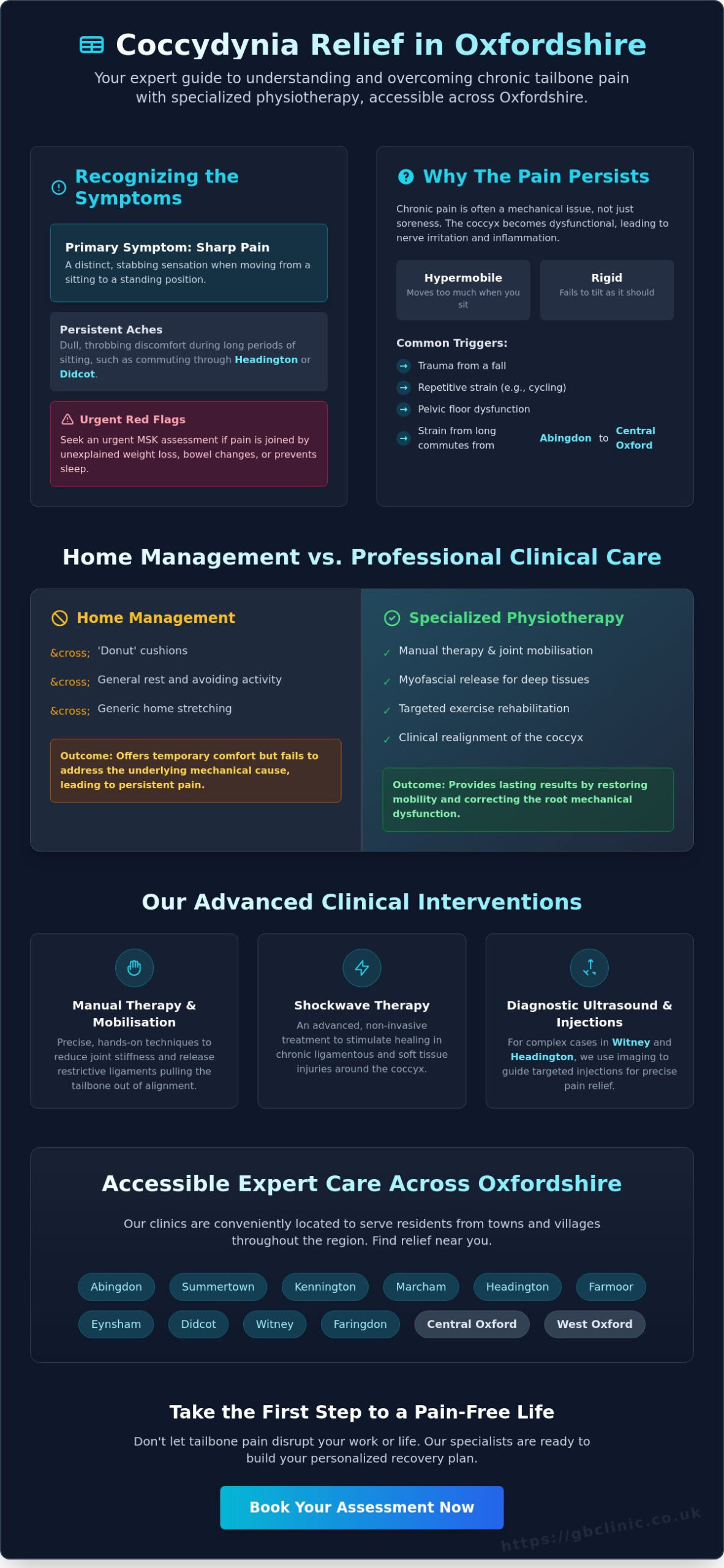
Coccydynia is defined as localized pain and tenderness at the coccyx, the small triangular structure at the very base of your spinal column. For many individuals across Oxfordshire, this condition manifests as a persistent, nagging discomfort that makes simple daily activities feel like a significant challenge. Gaining a clear Understanding Coccydynia is the first step toward effective recovery, as the pain is rarely just “soreness” but rather a sign of mechanical or inflammatory dysfunction. Seeking professional physiotherapy for tailbone pain relief ensures that the underlying cause is identified rather than just masking the symptoms with temporary fixes.
Chronic pain often develops when the coccyx becomes either hypermobile, moving too much when you sit, or excessively rigid, failing to tilt as it should. This mechanical failure is frequently triggered by trauma such as a fall, repetitive strain from cycling, or even pelvic floor dysfunction. Beyond the physical sensation, the psychological impact of being unable to sit comfortably at work is profound. It leads to frustration and a loss of focus, particularly for those commuting from Abingdon or working in Central Oxford who spend long hours in fixed positions.
To better understand the mechanics of this condition and how clinical movement can help, watch this helpful video:
Common Symptoms and Red Flags
The most recognizable symptom is a sharp, localized pain when transitioning from a seated position to standing. Many patients in Summertown and Kennington report a dull, throbbing ache during long commutes in Oxfordshire traffic, especially when driving through Headington or Didcot. You should seek an urgent MSK assessment if the pain is accompanied by unexplained weight loss, bowel changes, or if the discomfort is so severe it prevents sleep. Early intervention at our clinics in Witney or Faringdon can prevent the progression from acute irritation to chronic dysfunction.
The Anatomy of the Coccyx
Though small, the tailbone serves as a critical attachment point for various ligaments and pelvic floor muscles. When these tissues pull unevenly due to minor misalignments, it leads to significant nerve irritation and localized inflammation. This is why residents in Marcham, Farmoor, and Eynsham often find that standard rest doesn’t solve the issue; the mechanical pull remains until professionally addressed. Coccygeal tenderness is a clinical finding where direct pressure on the bone elicits significant pain, indicating that the joint segments are not absorbing load correctly during normal movement. Our specialists in West Oxford use this diagnostic clarity to build a targeted recovery plan that restores functional stability.
Specialised Physiotherapy for Tailbone Pain Relief
Recovery from chronic tailbone pain requires a shift from passive management to active, clinical intervention. While many people try to manage symptoms alone with cushions or rest, seeking professional physiotherapy for tailbone pain relief is the most reliable way to address the root mechanical cause. A personalised assessment at our clinics in Central Oxford or Summertown allows us to pinpoint whether your pain stems from joint stiffness, muscle tension, or ligamentous strain. We provide a clear path forward for patients from Kennington, Marcham, and Farmoor, ensuring that every treatment plan is tailored to the individual’s specific anatomical needs.
Manual Therapy and Mobilisation
Manual therapy is essential for restoring coccygeal mobility. Unlike generic home stretching, which often fails to reach the deep structures of the pelvic base, professional mobilisation involves precise, external techniques to reduce joint stiffness. We focus heavily on soft tissue work targeting the sacrotuberous ligaments. These ligaments can become thick and restrictive, pulling the tailbone into a painful position. By releasing this tension, we create the space needed for the joint to move naturally. This specialised approach is a fundamental component of effective Tailbone Pain (Coccydynia) Treatment, offering relief that home exercises simply cannot match.
The Pelvic Floor Connection
One of the most overlooked aspects of coccydynia is the role of the pelvic floor. These muscles attach directly to the tailbone and act as a dynamic support system. However, when these muscles become hypertonic, or chronically tight, they exert a constant pull on the coccyx, leading to persistent inflammation. Our practitioners in Headington and West Oxford use myofascial release and specific relaxation techniques to ease this tension. This isn’t just about temporary comfort; it’s about resetting the muscular balance of the pelvis. For residents in Eynsham, Didcot, and Witney, we integrate core stability work and exercise rehabilitation to ensure these improvements last. Strengthening the surrounding gluteal structures provides the long-term stability required to prevent future flare-ups. If you’re finding it difficult to manage daily tasks in Abingdon or Faringdon due to coccyx discomfort, a professional review can help. You can learn more about our integrated approach to pelvic and spinal health.
Home Management vs. Professional MSK Care
Many individuals in Oxfordshire begin their recovery journey by purchasing a ‘donut’ or wedge cushion. While these tools provide temporary symptomatic relief by offloading pressure from the coccyx, they do not address the underlying mechanical dysfunction. Relying solely on cushions can lead to a false sense of security while the joint remains restricted or hypermobile. Transitioning to professional clinical care is necessary when the pain persists for more than three weeks or if it begins to interfere with your ability to work or drive. Early intervention is the most effective way to prevent the development of chronic pain cycles, which often involve complex nerve sensitisation and compensatory movement patterns.
Rest often fails to resolve tailbone issues because the coccyx is a dynamic attachment point for several major muscle groups. If the joint is misaligned or the surrounding ligaments are strained, simply avoiding activity won’t restore functional mobility. Recent research on physiotherapy for coccydynia highlights that active, targeted interventions are significantly more effective than passive management. Seeking professional physiotherapy for tailbone pain relief ensures that the mechanical cause is corrected, rather than just managed with temporary aids.
Practical Self-Care Strategies
For office workers in Headington and West Oxford, sitting posture plays a critical role in daily comfort. We recommend a “forward-lean” sitting position, which shifts weight onto the ischial tuberosities (sit bones) and away from the tailbone. When managing inflammation, ice is generally most effective for sharp, acute pain, while heat can help relax tight gluteal muscles in chronic cases. Specific stretches, such as a modified pigeon pose or deep squats, can help decompress the lower sacral region. However, residents in Abingdon or Kennington should monitor their response closely; if a stretch increases your sharp pain, it’s a sign that professional realignment is required.
Why Professional Assessment is Critical
Pain at the base of the spine isn’t always local to the coccyx. It’s common for pain to be referred from the lumbar spine or the sacroiliac (SI) joint. Without a comprehensive screening for physiotherapy Oxford, you might spend months treating the wrong area. Our specialists in Summertown, Marcham, and Farmoor use clinical testing to differentiate between local coccygeal tenderness and referred spinal issues. If you suspect your lower back pain may involve the SI joint, our dedicated physiotherapy for sacroiliac joint pain service provides expert diagnosis and targeted relief for this commonly misidentified condition. Ignoring these symptoms often leads to “muscle guarding,” where the body tightens the pelvic floor to protect the painful area. This guarding eventually creates more pain, making the recovery process longer for those in Eynsham, Didcot, Witney, or Faringdon. A clear, clinical diagnosis allows for a direct and efficient path to recovery.
Advanced Treatment Options: When Physio Needs Support
While manual techniques and movement are foundational, some cases of coccydynia require more targeted clinical interventions. For residents in Central Oxford or West Oxford, we offer advanced treatments that work in tandem with advanced physiotherapy to break the cycle of chronic inflammation. These options are particularly effective when conservative physiotherapy for tailbone pain relief hasn’t fully resolved deep-seated mechanical issues. It’s about moving beyond just managing pain to actively promoting tissue repair in areas that have become stagnant in their recovery.
Ultrasound-Guided Injections for Tailbone Pain
Diagnostic tools are vital for a clear clinical picture. Unlike general assessments, a diagnostic ultrasound scan allows us to visualize the exact state of the coccygeal segments and surrounding soft tissues in real-time. This is crucial for patients in Headington, Didcot, and Witney who need a definitive answer for their persistent pain. By identifying localized inflammation or bursitis, we can then use guided steroid injections to deliver anti-inflammatory medication with millimetre precision. In some clinical scenarios, we might utilize Hyaluronic Acid (HA) injections as a lubricating agent to improve joint gliding, which offers an alternative for those who may not be suitable for steroids. This targeted approach ensures the medication reaches the specific joint space or ligamentous attachment causing the distress, providing a level of accuracy that “blind” injections simply cannot match.
Shockwave Therapy for Ligamentous Pain
Extracorporeal Shockwave Therapy (ESWT) is another modern solution for those in Abingdon, Summertown, and Kennington. The tailbone area is notoriously poorly vascularized, meaning it naturally receives limited blood flow to support repair. Shockwave therapy uses high-energy acoustic waves to create micro-trauma in the chronic tissue, which stimulates metabolic activity and triggers a fresh healing response in the sacrotuberous ligaments. It’s a preferred non-surgical alternative for individuals in Marcham, Farmoor, and Eynsham who want to avoid invasive procedures while still achieving significant functional gains.
Residents in Faringdon or those working in West Oxford can access these high-tech treatments without traveling outside the county. We combine these medical interventions with specific exercise rehabilitation to ensure the joint remains stable and supported once the initial pain subsides. If you’re ready to explore these advanced options, book a diagnostic assessment today to determine the most effective path for your recovery.
Your Path to Recovery at GB Clinic Oxfordshire
At GB Clinic, we provide a regional hub for individuals seeking specialised physiotherapy for tailbone pain relief. We recognize that patients from Abingdon to Witney require more than just general musculoskeletal advice; they need a clinical pathway that addresses the unique complexities of the coccyx. Our integrated approach ensures that you aren’t just passed from one practitioner to another. Instead, we combine expert manual therapy with advanced diagnostics under one roof to accelerate your return to comfort. Whether you’re based in Eynsham, Didcot, or Central Oxford, our goal is to provide a seamless experience that prioritises functional restoration.
Your journey begins with a comprehensive initial assessment. During this session, we conduct a detailed history of your symptoms and a physical examination to determine the precise mechanical cause of your discomfort. We don’t just look at the tailbone in isolation. We evaluate the surrounding pelvic floor, lumbar spine, and hip mechanics to ensure no contributing factor is overlooked. If your case is complex, we can immediately integrate a diagnostic ultrasound scan to visualise any underlying inflammation or structural changes, ensuring your treatment plan is based on clear clinical evidence.
Personalised Treatment Planning
We design every recovery programme to fit your specific lifestyle and geographic location. For a professional working in Headington or West Oxford, this might mean focusing on ergonomic sitting strategies alongside manual realignment. For those with more chronic, stubborn symptoms, we may involve our MSK specialists to discuss ultrasound-guided injections or shockwave therapy. Our clinical expertise in treating coccydynia allows us to move beyond trial-and-error treatments. We focus on what works, using evidence-based methods to reduce pain levels and restore your ability to sit, drive, and move without restriction.
Booking Your Assessment in Oxfordshire
Accessibility is a cornerstone of our service. Our clinics are positioned to offer easy access for residents in Kennington, Marcham, and Farmoor, as well as those traveling from Summertown and Faringdon. We advocate for a no-delay approach to chronic pain management. The longer a mechanical issue like coccydynia is left unaddressed, the more likely the body is to develop compensatory patterns that complicate recovery. By choosing a local, specialist clinic, you’re taking a proactive step toward ending the cycle of discomfort.
Don’t let persistent tailbone pain dictate your daily schedule or limit your mobility across the county. Our team is ready to provide the professional, expert-led care you need to regain your quality of life. Contact us today to schedule your comprehensive MSK evaluation and start your personalised path to lasting relief.
Take the First Step Toward Comfortable Sitting
Chronic coccydynia doesn’t have to be a permanent fixture in your life. By moving beyond temporary home fixes and seeking specialised physiotherapy for tailbone pain relief, you can address the mechanical misalignments and inflammatory triggers at the root of your discomfort. Our clinical approach integrates the expertise of expert MSK physiotherapists with advanced tools like ultrasound-guided injections to ensure your recovery is both precise and efficient.
We prioritize accessibility for residents across the region. Whether you’re commuting through Headington, working in Central Oxford, or living in Abingdon, Summertown, or Kennington, our clinics provide the expert care you need close to home. We also serve communities in Marcham, Farmoor, Eynsham, Didcot, Witney, Faringdon, and West Oxford, ensuring that professional relief is never out of reach. Our convenient Oxfordshire locations are designed to provide a clear, evidence-based path to physical restoration.
Book Your Specialist Tailbone Pain Assessment at GB Clinic and discover how our integrated clinical solutions can help you return to a pain-free, active lifestyle. We look forward to supporting your journey back to full mobility and comfort.
Frequently Asked Questions
How long does it take for physiotherapy to relieve tailbone pain?
Most patients experience a noticeable reduction in symptoms within four to six weeks of starting targeted physiotherapy for tailbone pain relief. The exact timeline depends on whether the condition is an acute injury or a long-standing chronic dysfunction. Residents in Abingdon and Summertown often find that consistent adherence to a clinical rehabilitation programme helps accelerate the recovery process and prevents future flare-ups.
Is tailbone pain a sign of something serious?
Tailbone pain is rarely a sign of a life-threatening condition and is typically caused by localized mechanical issues or minor trauma. However, you should seek a professional musculoskeletal assessment if the pain is accompanied by fever, unexplained weight loss, or persistent numbness. Our specialists in Kennington and Marcham provide thorough clinical screenings to rule out non-mechanical causes and ensure your symptoms are addressed correctly.
Can I drive with coccydynia while undergoing treatment?
You can continue to drive while undergoing treatment, provided you use ergonomic modifications to offload the coccyx. Navigating Headington traffic or commuting from Farmoor can be challenging, so we recommend using a wedge cushion to shift your weight forward. Proper seat adjustment is essential to prevent aggravating the sensitive joint during your daily travels across Oxfordshire.
Are tailbone injections painful?
Most patients describe the sensation of an injection as a brief pressure rather than intense pain, as we use a local anesthetic to numb the skin first. Using diagnostic ultrasound for guidance ensures the procedure is highly accurate and efficient. This is a common advanced option for those in Eynsham and Didcot who require more targeted relief than manual therapy alone provides.
What is the best sitting position for tailbone pain relief?
The most effective sitting position involves leaning slightly forward to shift your weight onto your ischial tuberosities, commonly known as the “sit bones.” This posture reduces direct pressure on the coccygeal segments and the surrounding ligaments. Patients in Witney and Faringdon find that this simple adjustment, combined with a firm chair, helps manage symptoms during long workdays.
Do I need a GP referral for private physiotherapy in Oxford?
You do not need a GP referral to access private physiotherapy for tailbone pain relief at our Oxfordshire clinics. Direct access allows for faster diagnosis and prevents the condition from becoming a chronic, long-term issue. This service is readily available to anyone in Central Oxford and West Oxford seeking immediate intervention from highly skilled MSK specialists.
Can pelvic floor exercises help with tailbone pain?
Pelvic floor relaxation exercises are highly effective because these muscles attach directly to the coccyx. When these muscles are hypertonic, or chronically tight, they exert a constant pull on the tailbone, causing persistent irritation. We teach specific relaxation techniques to residents in Didcot and Witney to reset this muscular balance and reduce the mechanical pull on the bone.
What happens if physiotherapy doesn’t work for my tailbone?
If conservative manual therapy does not provide sufficient relief, we move to advanced diagnostics and targeted clinical interventions. This may involve shockwave therapy to stimulate a fresh healing response or ultrasound-guided injections to address deep-seated inflammation. We ensure that patients across Oxfordshire have a clear, secondary path to recovery if initial rehabilitation methods are not enough to resolve the pain.