
Relying on temporary steroid injections for chronic spinal instability is often like patching a leak without fixing the pipe. If you’ve been searching for prolotherapy for lower back pain Oxford, you likely understand that true recovery requires addressing the underlying ligamentous laxity rather than just masking symptoms. It’s frustrating to feel that your spine lacks the stability needed for daily life, especially when you’re trying to avoid invasive surgery. We recognize that patients across Central Oxford, Summertown, and Headington are looking for evidence-based, regenerative solutions that offer more than a fleeting reprieve from discomfort.
This guide explains the latest clinical evidence and patient reviews regarding regenerative treatments for the lumbar spine. You’ll learn how targeted injections can stimulate the body’s natural healing processes to improve spinal stability and reduce pain intensity. We prioritize accessible care for residents in Abingdon, Witney, and Didcot, as well as those in Kennington, Marcham, and Farmoor. Whether you’re commuting from Eynsham, Faringdon, or West Oxford, this overview provides the clarity you need to decide if prolotherapy is the right non-surgical path toward lasting mobility.
Key Takeaways
- Understand how dextrose injections stimulate natural tissue healing to address underlying ligament laxity and sacroiliac joint instability.
- Explore the latest 2026 clinical evidence and patient reviews regarding success rates for regenerative injection therapy in the lumbar spine.
- Compare the long-term strengthening benefits of prolotherapy for lower back pain Oxford against the temporary anti-inflammatory effects of traditional steroid injections.
- Discover our comprehensive MSK assessment process and how we use diagnostic ultrasound to identify specific ligamentous triggers for patients across Oxfordshire.
- Learn about the convenient treatment options available for residents in Headington, Abingdon, Witney, and other surrounding areas like Summertown and Didcot.
What is Prolotherapy for Lower Back Pain?
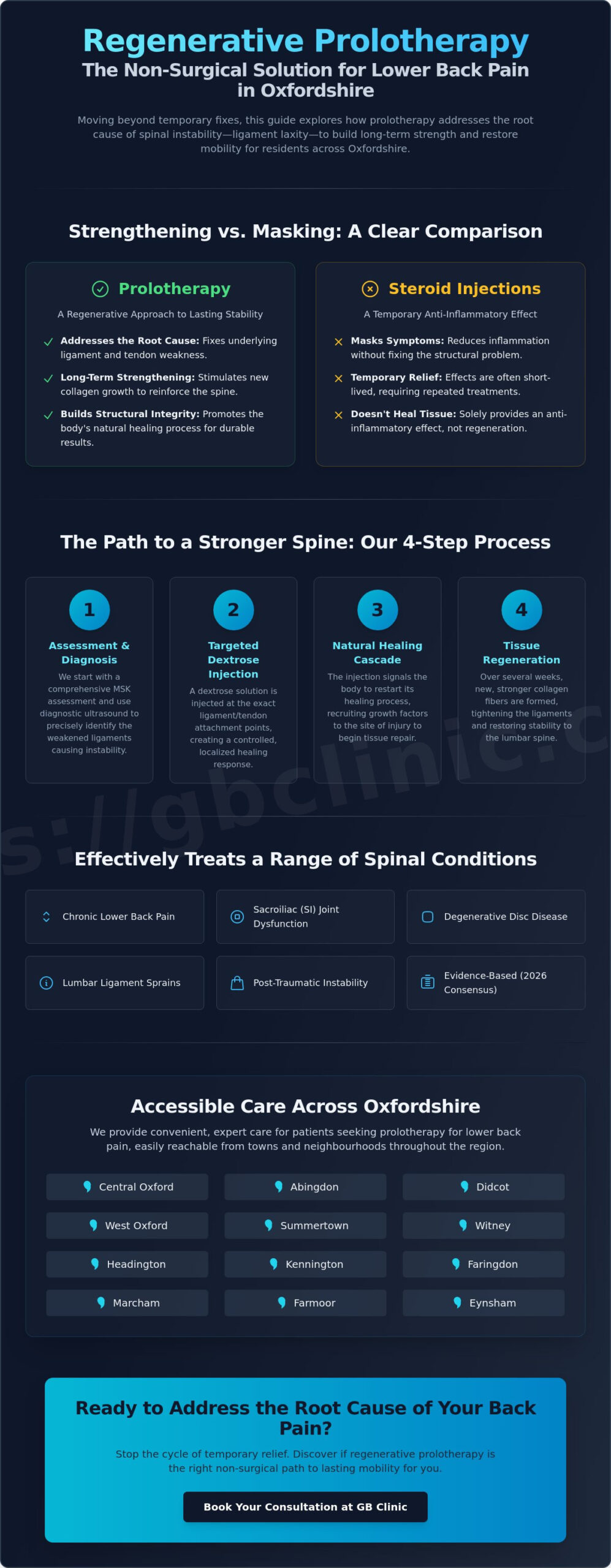
Prolotherapy is a specialized regenerative injection therapy designed to address the root causes of spinal instability. For many individuals seeking prolotherapy for lower back pain Oxford, the primary goal is to move beyond temporary symptom management. Unlike traditional treatments that focus on suppressing inflammation, this method uses a high-concentration dextrose solution to stimulate the body’s innate tissue-repair mechanisms. Residents in Summertown and Headington are increasingly turning to this non-surgical option to restore functional strength to the lumbar spine without the risks associated with invasive procedures.
The core objective of this treatment is to resolve ligament laxity and sacroiliac joint (SIJ) instability. When the ligaments supporting the spine become overstretched or weakened, they fail to maintain proper alignment, leading to chronic discomfort. To understand the foundational principles of this approach, it’s helpful to review What is Prolotherapy and how it has evolved into a modern MSK intervention. By inducing a precise, controlled inflammatory response, the treatment triggers the production of new collagen fibers, which eventually contract and tighten the surrounding connective tissues.
To better understand this concept, watch this helpful video:
The Science of Dextrose Injections
The process begins with the injection of a dextrose solution into the specific sites where tendons or ligaments attach to the bone. This creates an osmotic and irritant effect that signals the immune system to “re-start” the healing cascade in areas with poor blood supply. While standard injections often aim to mask pain, prolotherapy builds structural integrity. We often utilize diagnostic ultrasound scans to ensure the solution is delivered with clinical precision to the exact anatomical triggers. This “pro-inflammatory” phase is essential because it recruits growth factors to the site of injury. Over the course of several weeks, these factors lay down new tissue that reinforces the spine’s natural architecture. It’s a measured, logical approach to recovery.
Conditions Treated with Prolotherapy
This regenerative approach is particularly effective for chronic non-specific lower back pain and degenerative disc disease. We also see excellent results for patients from Abingdon, Witney, and Didcot suffering from sacroiliac joint dysfunction or lumbar ligament sprains. For those whose chronic lower back pain stems specifically from SIJ dysfunction, our dedicated physiotherapy for sacroiliac joint pain service provides a complementary, stability-first approach to accurate diagnosis and lasting relief. It’s a viable path for those in Kennington, Marcham, and Farmoor who experience post-traumatic instability following sports injuries or accidents. Whether you’re based in Eynsham, Faringdon, or West Oxford, addressing these conditions through tissue restoration can significantly reduce the need for long-term medication. Residents in Central Oxford often find that stabilizing the SIJ or lumbar ligaments allows them to return to active lifestyles more quickly. By strengthening the biological scaffolding of the back, we help patients avoid the cycle of recurring injury and regain their mobility.
Prolotherapy for Lower Back Pain Reviews: What the Research Says
Evaluating the success of prolotherapy for lower back pain Oxford involves looking at the most recent clinical consensus from 2025 and early 2026. While historical data has been varied, modern reviews highlight that success rates are closely tied to precise patient selection and the use of advanced imaging. A systematic review published in September 2025 indicated that functional improvement is most significant when the therapy targets specific ligamentous laxity rather than generalized muscle strain. This aligns with the 2026 expert consensus that regenerative injections are most effective for individuals with documented spinal instability who haven’t found relief through standard conservative care.
Current research on prolotherapy for back pain suggests that while outcomes can be heterogeneous, the best results are achieved when injections are part of a multi-modal recovery plan. We’ve observed that patients from Central Oxford and Summertown who combine these injections with structured rehabilitation report higher satisfaction scores. Success often depends on identifying the “responders”—those with sacroiliac joint dysfunction or lumbar instability—rather than applying a one-size-fits-all approach. For those considering their options, exploring our comprehensive MSK services can provide clarity on expected outcomes.
Analyzing Clinical Trial Outcomes
Findings within the Oxford University Research Archive often discuss the debate between dextrose and saline solutions. While some older trials showed minimal differences, modern protocols emphasize that high-concentration dextrose is necessary to trigger the cumulative regenerative effect. Most clinical trials now support a multi-session approach. This reflects the biological reality that collagen synthesis occurs over several months. Patients in Headington and Marston should anticipate three to six sessions to achieve the structural strengthening required for long-term spinal support.
Real-World Patient Experiences
In the Oxford MSK community, reviews often focus on the transition from the initial inflammatory phase to functional gain. Patients in Abingdon and Kennington frequently describe a brief period of localized stiffness followed by a gradual reduction in pain intensity. Feedback from residents in Marcham, Farmoor, and Eynsham emphasizes the importance of patience during the first few weeks of treatment. Many individuals find that the integration of private MSK physiotherapy Oxford is the turning point in their recovery. This combined approach is particularly popular among active residents in Witney, Didcot, and Faringdon, as it ensures the newly strengthened ligaments are supported by robust muscular control. Whether you’re based in West Oxford or the city center, the consensus among local patients is that regenerative care offers a path back to daily activities that steroid injections simply cannot match.
Prolotherapy vs. Steroid Injections: Which is Better?
Choosing between different injection therapies often depends on whether you’re managing a sudden flare-up or seeking a permanent structural solution. For those exploring prolotherapy for lower back pain Oxford, the distinction between ‘masking’ and ‘building’ is vital. Cortisone injections work by suppressing the immune system’s inflammatory response to provide rapid, short-term relief. In contrast, prolotherapy uses dextrose to intentionally stimulate a mild inflammatory reaction, encouraging the body to lay down new collagen. While steroids offer a quick fix, they don’t address the underlying ligament laxity that often causes chronic instability in the first place.
Patients from Didcot and Witney often weigh the immediate results of steroids against the cumulative benefits of regenerative care. It’s a cost-benefit analysis based on long-term goals. Repeated steroid use carries a documented risk of weakening local connective tissues and tendons. This can lead to a cycle of dependency where the relief periods become shorter and the structural integrity of the spine diminishes. Prolotherapy offers an alternative for residents in Abingdon and Summertown who want to avoid the potential for tissue atrophy associated with frequent cortisone shots. By focusing on restoration rather than suppression, you’re investing in the future stability of your spine.
When to Choose Cortisone
There are specific instances where a guided steroid injection is the most appropriate clinical choice. During an acute inflammatory flare, the priority is often to reduce pain levels enough to allow for movement. For individuals in Kennington and Marcham, steroids can act as a necessary bridge, providing a window of comfort that makes active rehabilitation possible. However, it’s essential to view these as a short-term tool rather than a long-term management strategy for chronic instability. If your symptoms return once the medication wears off, it’s a clear signal that the root cause hasn’t been resolved.
When Prolotherapy is the Superior Choice
Prolotherapy becomes the superior option when the goal is to resolve ligamentous laxity and restore functional strength. It’s particularly suitable for patients in Headington, Farmoor, and Eynsham who have failed traditional conservative management and want to avoid surgery. By combining the procedure with a diagnostic ultrasound scan, we can ensure definitive targeting of the weakened tissues. This precision is what sets regenerative medicine apart for residents in Faringdon, Central Oxford, and West Oxford. While newer biologics like PRP are also gaining traction, prolotherapy remains a time-tested, cost-effective standard for those seeking to rebuild their back’s natural support system and return to a mobile, pain-free life.
The Prolotherapy Procedure: What to Expect in Oxford
The clinical journey for prolotherapy for lower back pain Oxford is a structured process designed to maximize safety and effectiveness. It begins with a comprehensive MSK assessment at our clinic, where we evaluate your spinal mechanics and history of discomfort. We don’t just focus on the site of pain; we look for the underlying ligamentous triggers that contribute to instability. This thorough diagnostic phase ensures that every patient from Abingdon, Summertown, or Kennington receives a treatment plan tailored to their specific anatomical needs. By identifying the exact source of laxity, we can provide a clear and predictable path toward recovery.
The injection process is performed under local anaesthetic to ensure patient comfort throughout the session. Once the target area is numbed, the dextrose solution is administered to the weakened ligaments. Following the treatment, you’ll enter the “inflammatory window,” a vital three to five day period where the body begins its regenerative work. You might experience temporary stiffness or a mild increase in localized pain during this time. It’s a natural part of the healing cascade. Our clinic is conveniently positioned for residents in Marcham, Farmoor, and Eynsham, making follow-up care and monitoring easily accessible for those across the region.
Ultrasound-Guided Precision
The 2026 standard for regenerative spinal care emphasizes the use of real-time imaging over “blind” or landmark-based injections. We utilize diagnostic ultrasound of soft tissue to visualize the needle path and the target ligamentous structures simultaneously. This level of precision ensures the dextrose solution is delivered exactly where it’s needed to stimulate collagen production. By visualizing the internal environment, we significantly reduce risks and improve the overall comfort of the procedure. Whether you are traveling from Central Oxford or Headington, this guided approach provides the clinical reassurance that your treatment is being delivered with modern accuracy.
Recovery and Rehabilitation
True restoration happens in the weeks following your injections. We recommend specific physiotherapy protocols to support the newly strengthened tissues and improve muscular control. It’s essential to avoid anti-inflammatory medications (NSAIDs) during the initial recovery phase, as these can inadvertently suppress the regenerative response we’re aiming to achieve. Instead, we focus on a gradual return to activity. For our patients in Faringdon, West Oxford, Witney, and Didcot, this means a measured progression back to exercise and daily routines. If you’re ready to address the root cause of your instability, you can book your initial MSK assessment with our specialist team to discuss your options.
Why Choose GB Clinic for Prolotherapy in Oxfordshire?
Selecting the right specialist for prolotherapy for lower back pain Oxford is a decision that impacts your long-term recovery and spinal health. We prioritize an expert-led environment where practitioners are highly skilled in both MSK medicine and diagnostic imaging. This ensures that your treatment isn’t just a standard procedure, but a precision-based intervention. Our clinic is designed to be a local hub for regenerative excellence, providing a calm and clinical setting for patients seeking alternatives to invasive surgery. We maintain a patient-first approach, offering transparent consultations that provide a clear path forward with no obligation to proceed.
Our methodology often involves integrated care pathways to ensure comprehensive restoration. If your assessment reveals that joint inflammation is complicating your recovery, we can combine prolotherapy with hyaluronic acid injections to address multi-factorial pain. This holistic view of spinal health is why residents from Central Oxford, Headington, and Abingdon trust our clinical judgment. We focus on the duration of relief and the actual reduction of symptoms, positioning ourselves as a serious medical entity dedicated to evidence-based outcomes. It’s about restoring function so you can return to a comfortable, mobile state.
Local Excellence in MSK Care
We are committed to serving the diverse needs of the Oxfordshire community by providing advanced, non-surgical solutions. Our clinical audits and adherence to the latest regenerative protocols ensure that you receive care that is at the forefront of the field. We take pride in the positive descriptors shared by our patients in Summertown and Kennington, who often highlight the interpersonal warmth and professional demeanor of our staff. By choosing a local specialist, you benefit from a provider who understands the regional healthcare landscape and is easily accessible for ongoing monitoring and support.
Booking Your Assessment
Starting your journey toward improved spinal stability is straightforward. You can schedule an initial diagnostic consultation at our Oxford facility, which is conveniently located for those in West Oxford, Farmoor, and Eynsham. We recommend bringing any previous imaging reports or a summary of your medical history to your appointment. This allows us to conduct a more efficient and thorough evaluation of your condition. For patients living in Didcot, Witney, Faringdon, or Marcham, our clinic offers a central, easy-to-reach destination for specialized MSK care. Once your assessment is complete, we’ll provide a detailed explanation of your diagnosis and the recommended next steps for your recovery.
Restoring Your Spinal Stability and Mobility
Prolotherapy offers a structural alternative to symptom-masking injections by rebuilding weakened ligaments rather than merely suppressing inflammation. By utilizing expert ultrasound-guided injections, our highly rated Oxford MSK specialists ensure that regenerative solutions are delivered with clinical precision. This approach focuses on the root cause of instability, helping you avoid the cycle of temporary relief and the potential for long-term tissue weakening. Choosing prolotherapy for lower back pain Oxford provides a clear, non-surgical path toward lasting physical restoration.
Our clinics are conveniently located to serve patients across Central Oxford, Headington, and Abingdon. We also provide accessible care for residents in Summertown, Kennington, and Marcham. Whether you’re traveling from Farmoor, Eynsham, or West Oxford, or commuting from Didcot, Witney, and Faringdon, our team is ready to support your recovery journey. Taking the first step toward a more stable spine is simple and stress-free. Book Your MSK Assessment at GB Clinic Oxford today to discuss your personalized treatment plan. We look forward to helping you return to the active, comfortable lifestyle you deserve.
Frequently Asked Questions
Is prolotherapy for lower back pain safe?
Prolotherapy is a safe, non-surgical intervention when administered by qualified MSK practitioners. The solution is primarily dextrose, a naturally occurring sugar, which carries a lower risk of adverse reactions compared to synthetic medications. Patients in Headington and Summertown can feel confident that our ultrasound-guided approach minimizes risks to surrounding nerves and vessels.
How many sessions of prolotherapy will I need for my back?
Most patients require a series of three to six treatments to achieve optimal spinal stability. These sessions are spaced approximately four to six weeks apart to allow the body’s collagen production to mature. Individuals from Abingdon and Kennington often notice a cumulative improvement in their functional capacity as the ligamentous support strengthens with each successive visit.
Does prolotherapy hurt during or after the injection?
You may feel a brief period of pressure or localized discomfort during the injection, though we use local anesthetic to enhance your comfort. It’s normal to experience increased stiffness or a “full” sensation in the lower back for two to four days following the procedure. This is a positive sign that the regenerative inflammatory response has been triggered.
Can I drive home after a prolotherapy treatment in Oxford?
We advise patients to arrange for a driver after their appointment, particularly for treatments involving the lumbar spine. While many people feel capable of driving, the temporary effects of local anesthesia can occasionally influence leg sensation or reaction times. This is a standard safety precaution for our clients traveling back to Witney, Didcot, or Faringdon.
How much does prolotherapy cost at a private clinic in the UK?
Private treatment costs in the UK depend on the number of sessions and the specific anatomical areas being targeted. Since prolotherapy for lower back pain Oxford is a specialized service, we provide a detailed cost breakdown during your initial assessment. This ensures patients from Central Oxford and West Oxford have a clear understanding of their investment before starting care.
What is the difference between prolotherapy and PRP therapy?
Prolotherapy utilizes a dextrose solution to stimulate healing, while PRP (Platelet-Rich Plasma) uses concentrated growth factors from your own blood. Both are effective regenerative tools, but prolotherapy is often the primary choice for addressing widespread ligamentous laxity. Our specialists help residents in Marcham and Farmoor determine which biological intervention best suits their specific pathology.
Will my health insurance cover prolotherapy for back pain?
Most private health insurance providers in the UK don’t currently cover regenerative injection therapies like prolotherapy. These treatments are typically self-funded. We recommend that patients from Eynsham or other parts of Oxfordshire contact their insurance coordinator directly to verify their specific policy details and any potential for reimbursement.
How long do the results of prolotherapy typically last?
The results of prolotherapy for lower back pain Oxford are intended to be long-lasting because the treatment creates new, permanent connective tissue. Unlike steroid shots that wear off, the structural strengthening achieved through this process provides durable support for the spine. Maintaining these gains often requires following the personalized rehabilitation protocols we provide to our patients across the region. For patients who also experience discomfort in the lower coccygeal region, our dedicated physiotherapy for tailbone pain relief service offers targeted clinical interventions to address coccydynia alongside broader spinal recovery. Additionally, patients whose chronic back pain is rooted in SIJ dysfunction may benefit from exploring our specialist physiotherapy for sacroiliac joint pain, which provides an evidence-based, stability-first pathway to accurate diagnosis and lasting relief.