
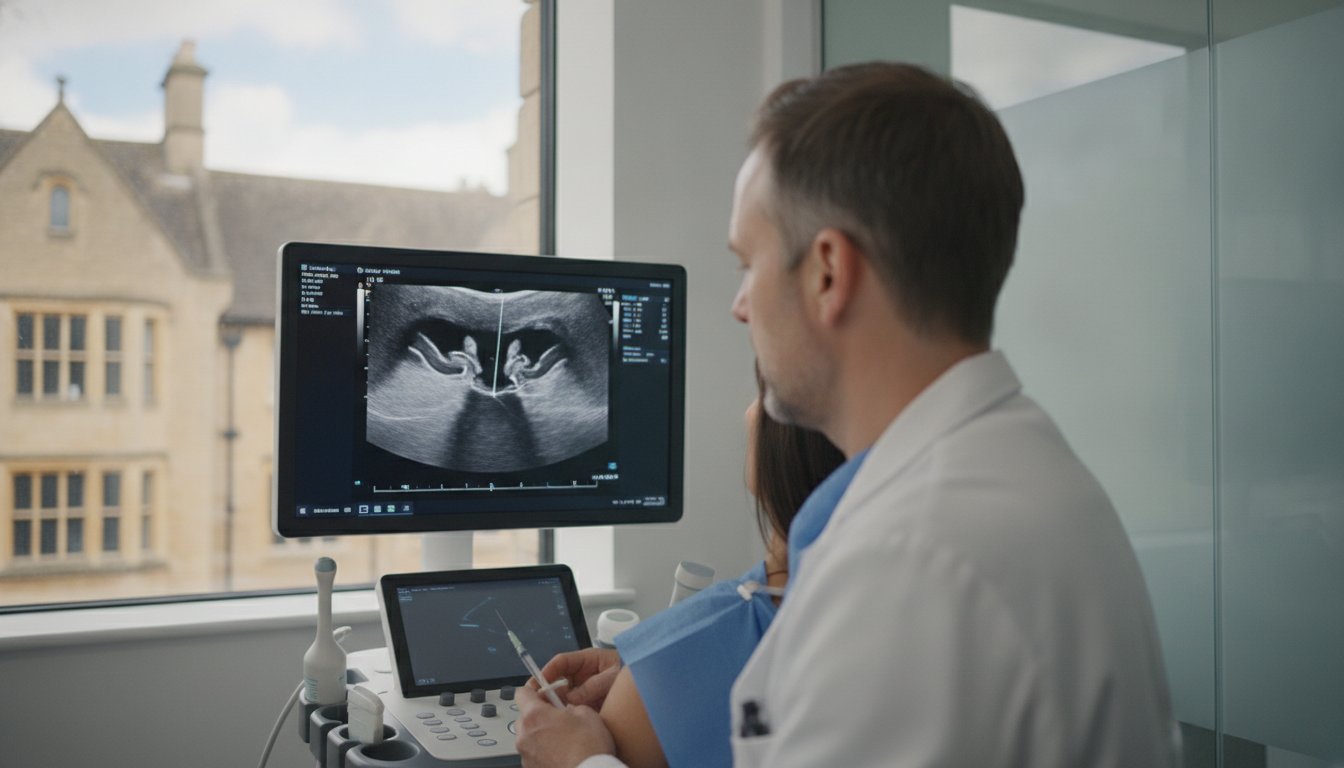
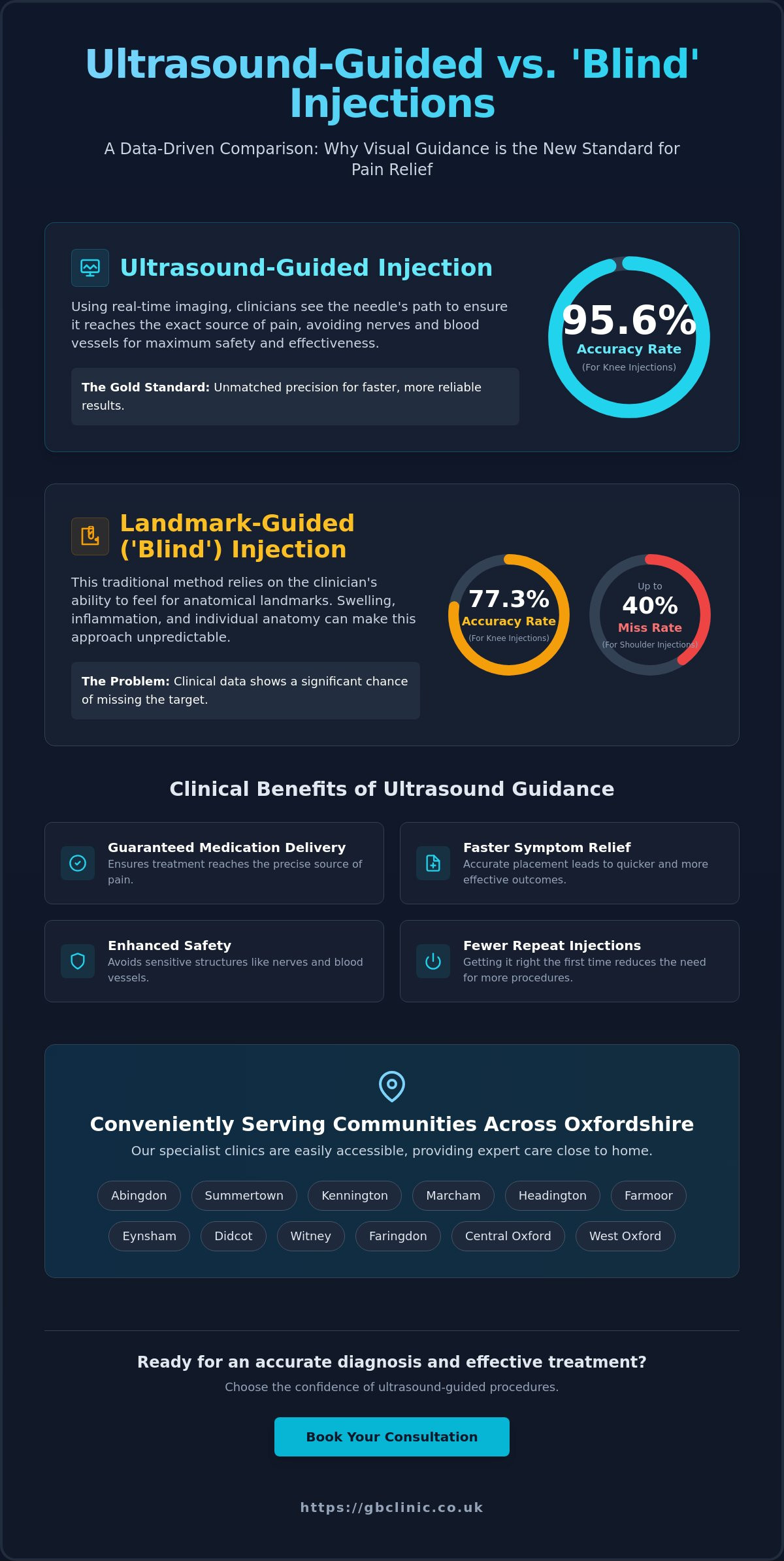
Did you know that traditional “blind” shoulder injections miss their intended target up to 40% of the time? It’s a common frustration for many patients who continue to experience persistent discomfort even after multiple treatments. If you’ve felt anxious about needle placement or wondered why different clinics offer varying methods, you aren’t alone. When comparing ultrasound guided injection vs blind injection accuracy, the clinical data is clear. Research shows that ultrasound-guided knee injections reach a 95.6% accuracy rate, while landmark-guided “blind” attempts often fall to around 77.3%.
We understand that you want maximum pain relief with the fewest possible attempts. This guide explains the clinical evidence behind visual guidance and why it’s now the gold standard for safety. You’ll discover the specific success rates for different joints and learn why visual confirmation is the only way to guarantee medication reaches the source of your pain. Our specialist services are easily accessible to residents in Abingdon, Summertown, Kennington, and Marcham. We also serve patients from Headington, Farmoor, Eynsham, and Didcot. Whether you’re in Witney, Faringdon, Central Oxford, or West Oxford, we provide a clear, evidence-based path to recovery that prioritizes your comfort and long-term mobility.
Key Takeaways
- Understand why clinical evidence now favors real-time visual guidance over landmark-guided methods for superior precision and safety.
- Examine the statistical data regarding ultrasound guided injection vs blind injection accuracy, which shows significantly higher success rates for major joints like the knee and shoulder.
- Learn how natural anatomical variance and localized swelling can make traditional “blind” injections less predictable and more uncomfortable for the patient.
- Discover how precise medication delivery leads to faster symptom relief and a reduced risk of side effects compared to non-guided procedures.
- Find out how residents in Abingdon, Witney, Didcot, and across Oxfordshire can access these specialist interventional services at our conveniently located clinics.
Defining Ultrasound Guided Injection vs Blind Injection Accuracy
The medical community uses the term “blind” to describe a procedure performed without the aid of real-time imaging. This isn’t a critique of a clinician’s skill, but rather a technical description of surface-level estimation. For decades, a standard joint injection relied entirely on tactile feedback and the practitioner’s knowledge of anatomy. Today, the debate surrounding ultrasound guided injection vs blind injection accuracy focuses on the transition from feeling for a joint to seeing exactly where the needle tip sits.
Residents in Abingdon, Summertown, and Kennington often seek our expertise because they’ve had previous injections that failed to provide relief. This often happens because the medication didn’t reach the precise pathology. By using a diagnostic ultrasound scan, we remove the guesswork. This modern approach ensures that every patient from Marcham to Headington receives treatment backed by visual confirmation.
To better understand the practical differences in these techniques, watch this helpful video:
How Landmark-Guided Injections Work
Landmark-guided injections rely on palpation, where the clinician feels for bony structures to identify the entry point. This method is heavily dependent on clinical experience. While many practitioners are highly skilled, surface anatomy doesn’t always reflect internal structures accurately. Factors like swelling, inflammation, or natural anatomical variance can obscure these landmarks. This makes it difficult to navigate deep or narrow joint spaces in the hip or shoulder. In these cases, even an expert may accidentally deliver medication into surrounding fat or muscle rather than the joint capsule.
The Ultrasound Advantage: Live Visualisation
The primary benefit of a guided steroid injection is the ability to track the needle tip in real-time. We can see the needle pass through tissue layers, ensuring it avoids nerves and blood vessels. This level of precision is essential for patients in Farmoor, Eynsham, and Didcot who are concerned about procedural safety. Beyond just hitting the target, we can confirm the spread of medication, such as Hyaluronic Acid, within the tissue. This ensures the treatment is delivered exactly where it’s needed for maximum efficacy. Whether you’re visiting from Witney, Faringdon, or Central Oxford, this visual precision offers a level of confidence that tactile feedback simply cannot match. It’s why we prioritize this method for all patients in West Oxford seeking reliable pain management.
Comparing Success Rates: What the Clinical Data Shows
Clinical evidence provides a clear perspective on ultrasound guided injection vs blind injection accuracy. While landmark-guided methods have been the traditional standard, modern data suggests a significant gap in precision. For knee injections, a systematic review of Level I studies demonstrated that ultrasound-guided procedures achieved a 95.6% accuracy rate. In contrast, landmark-guided injections fell to 77.3%. This difference isn’t just statistical; it determines whether the medication reaches the intra-articular space to provide the intended relief.
Many patients in Abingdon and Summertown believe that a clinician’s years of experience can compensate for a lack of imaging. However, research into the “Expert Myth” suggests otherwise. While expert accuracy is generally higher, one study highlighted that inexpert clinicians faced a failure rate of 21% with blind injections, compared to just 6% when using ultrasound guidance. This highlights that visual confirmation provides a safety net that tactile feedback alone cannot offer. If you’re seeking a diagnostic assessment before treatment, our specialists serving Kennington and Marcham provide the precision required for complex cases.
Knee and Shoulder Accuracy Comparison
The shoulder is particularly challenging for landmark-guided techniques. Studies show that blind shoulder injections miss the intended target up to 40% of the time. This is especially problematic for subacromial bursa injections, where the target tissue is narrow. When administering Hyaluronic Acid (HA) injections, precise placement is vital for the lubricant to function correctly within the joint capsule. A Cochrane review on clinical outcomes suggests that while accuracy is vastly improved with guidance, the clinical benefit can vary depending on the specific shoulder pathology, reinforcing the need for expert diagnosis in Headington and Farmoor.
Deep Joint Challenges: The Hip and SI Joint
- The Hip: Blind hip injections are rarely recommended by modern specialists. The depth of the joint and the proximity to major neurovascular structures make “feeling” for the joint capsule unreliable and potentially risky.
- The Sacroiliac Joint: Achieving accurate sacroiliac joint injections requires millimetre-level precision. Guidance ensures the medication is delivered into the joint rather than the surrounding ligaments, which reduces systemic absorption and improves local efficacy.
For residents in Eynsham and Didcot, ensuring that medication is delivered to the exact source of pain is the priority. Our team provides accessible care for those in Witney, Faringdon, and Central Oxford, ensuring every procedure is guided by the latest clinical data. If you’re ready to discuss your recovery path, you can book a consultation at our West Oxford clinic to ensure your treatment is as accurate as possible.
Why Anatomical Variance Makes Blind Injections Risky
Clinical textbooks often present human anatomy as a uniform map, but the reality is far more complex. No two patients are built exactly the same. Variations in the location of nerves, blood vessels, and joint capsules are common. When comparing ultrasound guided injection vs blind injection accuracy, this biological diversity is the primary reason why “feeling” for a landmark often falls short. For our patients in Abingdon, Summertown, and Kennington, we recognize that relying on surface palpation is an estimation rather than a certainty.
Inflammation and swelling further complicate the process. When a joint is acutely inflamed, the traditional landmarks used for a guided steroid injection can become obscured or shifted. Without a diagnostic ultrasound scan to see through the swelling, a clinician may inadvertently cause an iatrogenic injury. This occurs when the needle strikes a structure it wasn’t intended to, such as a peripheral nerve or a blood vessel. Beyond safety, there’s the risk of “fat pad” injections. If the needle doesn’t reach the joint space, medication can be deposited into the subcutaneous fat. This not only renders the treatment ineffective but can also cause localized skin thinning or pigment changes.
The Impact of Obesity and Tissue Depth
Body mass index (BMI) significantly affects the precision of landmark-guided procedures. As tissue depth increases, the ability to accurately palpate bony landmarks diminishes. For residents in Marcham and Headington, ultrasound is essential because it allows us to visualize structures several centimeters below the skin surface. High-frequency sound waves provide a clear path through adipose tissue, ensuring the needle reaches the target joint regardless of the patient’s size. This level of accuracy is why many individuals from Farmoor and Eynsham choose our specialist clinics over traditional methods.
Pathological Changes and Joint Space Narrowing
Advanced conditions like osteoarthritis physically alter the joint architecture. Severe wear can lead to joint space narrowing, where the gap between bones becomes incredibly small. In these cases, ultrasound guided injection vs blind injection accuracy becomes a matter of millimetres. Visualizing the joint allows us to navigate around osteophytes, or bone spurs, that might otherwise deflect a needle. This precision is vital for patients in Didcot, Witney, and Faringdon who require treatment for chronic degeneration. We ensure that residents of Central Oxford and West Oxford receive care that accounts for their unique internal anatomy, providing a safer and more effective path to recovery.
Clinical Benefits: Beyond Just Hitting the Target
When discussing ultrasound guided injection vs blind injection accuracy, the focus often stays on the final destination of the needle. However, the clinical benefits extend far beyond simply reaching the joint space. For patients in Abingdon and Summertown, the most immediate advantage is a significant reduction in procedural pain. Because we can see the internal structures in real-time, there is no need for multiple “pokes” or needle redirections to find the correct spot. This precision makes the experience much more comfortable, especially for individuals who feel anxious about needles.
Precise delivery also ensures a faster onset of relief. When medication is deposited exactly where the pathology exists, it begins working immediately without having to diffuse through unrelated tissue layers. This accuracy also protects your skin and soft tissues. Landmark-guided methods carry a higher risk of depositing steroids into superficial layers, which can lead to side effects like skin depigmentation or fat atrophy. Our patients in Kennington and Marcham value this clinical safety, as it ensures the treatment remains localized to the joint or tendon without affecting the surrounding appearance or health of the limb.
Optimising Regenerative Outcomes
For advanced interventions like PRP therapy, visual guidance is essential to the success of the treatment. Regenerative growth factors are most effective when they are placed exactly at the site of a tissue tear or within the specific damaged area of a tendon. By performing a diagnostic ultrasound scan first, we can map out the area of concern with high resolution. This ensures that patients from Headington and Farmoor receive a targeted treatment that maximizes the body’s natural healing response. Accuracy isn’t just a preference; it’s a requirement for modern regenerative medicine.
Cost-Effectiveness in the Long Term
Choosing a guided procedure is a more efficient path to recovery for residents in Eynsham and Didcot. A “blind” injection that misses its mark is essentially a wasted procedure that fails to provide the expected relief. This often leads to the frustration of repeat appointments and prolonged discomfort. By getting it right the first time, we help our patients in Witney and Faringdon avoid the cycle of failed treatments. This approach saves time and ensures that your path to mobility is as direct as possible. Residents across Central Oxford and West Oxford can rely on our expert-led clinics to provide a clear, evidence-based solution for persistent pain. If you’re ready to experience the difference that visual precision makes, book your specialist assessment with our clinical team today.
Accessing Specialist Guided Injections in Oxfordshire
GB Clinic prioritises ultrasound guidance for all musculoskeletal interventions to ensure the highest standards of clinical safety. While some healthcare settings still rely on traditional methods, our commitment to visual precision addresses the core debate of ultrasound guided injection vs blind injection accuracy. By providing both diagnostic and interventional expertise in a single location, we eliminate the delays often found in traditional referral pathways. This model means you can receive a definitive diagnosis and targeted treatment during the same visit, ensuring your recovery begins without unnecessary waiting.
Residents across the region don’t need to travel far for specialist care. We’ve positioned our services to be the local choice for those seeking relief from persistent joint or tendon pain. Our practitioners combine interpersonal warmth with clinical excellence, ensuring you feel supported throughout your journey back to full mobility.
Expert Care Across Oxfordshire
Accessibility is a central part of our service. We provide convenient access for patients living in Summertown, Headington, and Central Oxford. Our clinics are designed to serve the wider regional community, ensuring that those in Abingdon, Didcot, Witney, and Eynsham have a professional specialist within easy reach. We understand that physical discomfort makes long journeys difficult, so we prioritise local availability.
We also support residents in smaller surrounding towns and neighbourhoods. If you’re based in Faringdon, Marcham, or Kennington, our clinics offer a straightforward route to recovery. Patients from Farmoor and West Oxford find our locations easy to navigate, ensuring that expert-led care is always close to home. Our goal is to provide a seamless experience from the moment you book your assessment to the completion of your rehabilitation.
The GB Clinic Approach to Pain Recovery
Effective recovery requires more than just a single intervention. We integrate advanced physiotherapy with our guided injections to ensure long-term functional improvement. This holistic approach means your treatment plan is built on live diagnostic findings, allowing us to tailor every exercise and manual therapy session to your specific internal anatomy. We don’t believe in generic treatments; we believe in precision.
Our commitment to evidence-based care ensures that every patient receives a personalised path to restoration. We focus on several key pillars of care:
- Immediate visual confirmation of needle placement to ensure maximum procedural safety.
- Reducing the overall number of clinical visits by combining diagnosis and treatment in one appointment.
- Restoring mobility through a blend of expert-led rehabilitation and specialist injections.
- Clear communication that explains your condition in plain language without ambiguity.
If you’re tired of persistent pain and want a clear, accurate solution, booking a specialist assessment is the first step. Our team is ready to help you regain your quality of life with treatments that prioritise precision and patient comfort. Contact us to find your nearest clinic in Oxfordshire and begin your recovery path today.
Take Control of Your Recovery Journey
The clinical data regarding ultrasound guided injection vs blind injection accuracy confirms that visual precision is a necessity for effective pain management. By choosing real-time imaging, you ensure that medication reaches the exact source of your discomfort. This approach significantly reduces the risk of missed targets or procedural complications. Our expert-led MSK specialists utilize state-of-the-art diagnostic ultrasound equipment to deliver highly rated patient outcomes that tactile feedback alone cannot achieve.
We provide a professional and reassuring environment for patients across Oxfordshire. Whether you live in Abingdon, Summertown, or Kennington, our clinics are easily accessible. We’re proud to serve residents from Marcham, Headington, Farmoor, and Eynsham, as well as those in Didcot, Witney, and Faringdon. With convenient hubs in Central Oxford and West Oxford, specialist care is always within reach. Book your specialist ultrasound-guided injection assessment at GB Clinic Oxford today and experience an evidence-based approach to physical restoration. We’re here to help you return to the active, mobile lifestyle you deserve.
Frequently Asked Questions
Is an ultrasound-guided injection more painful than a blind one?
Ultrasound-guided injections are generally less painful than landmark-guided procedures because they involve fewer needle redirections. The clinician sees the target tissue immediately, which eliminates the need to “search” for the correct spot with the needle tip. This precision reduces trauma to the surrounding area, making the experience more comfortable for patients in Abingdon or Summertown who may have had negative experiences with traditional methods in the past.
How much more accurate is an ultrasound-guided injection for the knee?
An ultrasound-guided knee injection reaches the intra-articular space with a success rate of approximately 95% to 100%. In contrast, blind injections for the knee often fall between 75% and 85% accuracy depending on the entry site. When evaluating ultrasound guided injection vs blind injection accuracy, the visual confirmation ensures medication isn’t wasted in fat pads or muscle, which is a common issue for residents in Kennington and Marcham.
Can any doctor perform an ultrasound-guided injection?
Only clinicians with specific postgraduate training in musculoskeletal ultrasound are qualified to perform these guided procedures. In the UK, practitioners must demonstrate competence through a supervised logbook and formal certification. Our expert-led team serving Headington and Farmoor consists of highly trained specialists who maintain these strict standards. This ensures that patients in Eynsham and Didcot receive care from professionals who are fully proficient in modern imaging techniques.
Are there specific risks associated with guided injections?
The risks associated with guided injections are significantly lower than those of blind procedures because sensitive structures are visible throughout. By tracking the needle tip on the monitor, we avoid nerves, blood vessels, and tendons, which reduces the chance of accidental injury. This level of safety is a primary reason why individuals in Witney and Faringdon choose visual guidance for deep joint treatments, as it provides a much higher level of procedural control.
How long does an ultrasound-guided injection procedure take?
A typical appointment for a guided injection takes between 20 and 30 minutes to complete. This timeframe includes the initial diagnostic scan to map the anatomy, the sterile preparation, and the injection itself. We prioritize efficiency for our clients in Central Oxford and West Oxford, ensuring that the process is thorough but doesn’t cause unnecessary delays in your daily schedule. You’ll be able to leave the clinic shortly after the procedure is finished.
Will my insurance cover ultrasound-guided injections in Oxford?
Many private health insurance providers cover ultrasound-guided injections, though coverage depends on your specific policy and the clinical necessity of the procedure. We recommend checking with your provider before your visit to our Oxfordshire clinics. Our administrative team can provide the necessary clinical codes for patients in Abingdon or Didcot to facilitate the claims process with major UK insurers, ensuring a smooth and transparent experience.
What should I expect during my first guided injection appointment at GB Clinic?
Your first appointment involves a comprehensive assessment that begins with a diagnostic ultrasound scan. The clinician will explain the findings in real-time, showing you the exact source of your pain on the monitor. If an injection is required, it’s performed under live guidance to ensure ultrasound guided injection vs blind injection accuracy is maximized for your recovery. This integrated approach provides a clear path to restoration for all our patients across the region.