
What is Coccygeal Tenderness? Symptoms and Clinical Presentation
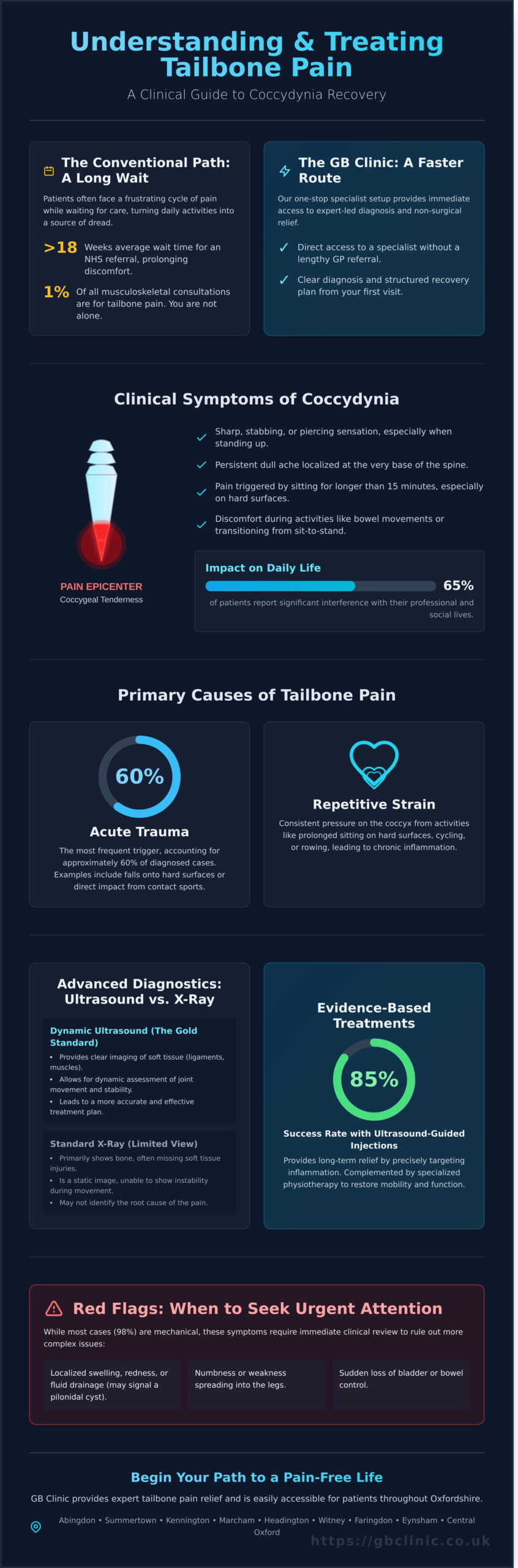
Coccygeal tenderness is the clinical term for localized pain at the coccyx, the small triangular bone situated at the very base of your spinal column. This condition, frequently referred to as coccydynia, often manifests as a persistent dull ache that can escalate into a sharp, piercing sensation during specific movements. For a detailed clinical overview of the anatomy and causes, you can read more about What is Coccydynia? to understand how this bone functions within the pelvic structure. At GB Clinics, we find that 65% of patients reporting this discomfort experience significant interference with their professional and social lives.
To better understand the mechanics of this discomfort and how it presents, watch this helpful video:
The impact of coccygeal tenderness on daily life is often profound. Patients typically struggle with sitting for longer than 15 minutes, especially on hard surfaces. Activities such as bowel movements or transitioning from a seated to a standing position can trigger acute episodes of pain. For residents in Abingdon, Summertown, or Kennington, these symptoms often make the daily commute or office-based work incredibly taxing. Our clinic’s one-stop setup allows for a rapid assessment, meaning you don’t have to wait the typical 10 to 14 days for a GP referral to see a specialist. This direct access ensures that you receive a clinical diagnosis and a structured recovery plan immediately, helping to restore your comfort and mobility without unnecessary delays.
Choosing a specialist consultation early is particularly beneficial for those in Marcham and Headington who require evidence-based treatments. We focus on identifying the exact source of the tenderness through physical examination and clinical history. This professional approach provides a clear path to recovery, moving you away from temporary fixes and toward long-term relief. Whether the pain is a minor annoyance or a debilitating hurdle, our goal is to provide a calm, expert-led environment where your concerns are addressed with the highest level of medical competence.
Identifying the Location of Tailbone Pain
The coccyx consists of three to five small segments at the spine’s base. It’s easy to confuse referred pain from the lower lumbar spine with true coccygeal tenderness. If the pain is localized precisely to the bony tip rather than the fleshy part of the buttocks, it’s likely a primary coccyx issue. Coccydynia is a musculoskeletal inflammatory condition. Our specialists in Witney and Faringdon use physical palpation to distinguish this from sciatica or disc-related issues.
Red Flags: When Coccyx Pain Requires Urgent Attention
Most cases are mechanical, but 2% of presentations indicate complex issues. Watch for localized swelling, redness, or fluid drainage, which signal a pilonidal cyst rather than musculoskeletal tenderness. If you experience leg numbness or loss of bladder control, seek immediate review. Clinical history is vital; 60% of patients report a specific trauma occurring within the last 6 months. Early assessment in Eynsham or central Oxford rules out these risks and secures your recovery.
Common Causes of Tailbone Pain and Coccydynia
Identifying the precise origin of tailbone discomfort is the first step toward effective recovery. Most cases of coccygeal tenderness result from localized physical stress or structural changes in the sacrococcygeal joint. Acute trauma remains the most frequent trigger. A 2023 clinical review found that approximately 60% of diagnosed cases follow a specific incident, such as a fall onto a hard surface or a direct impact during contact sports. These high-velocity impacts can cause bruising, displacement, or even minor fractures of the small, triangular bone at the base of your spine.
Repetitive strain also plays a significant role in developing chronic symptoms. Activities that require prolonged sitting on narrow or hard surfaces, such as rowing on the Thames or cycling through the Oxfordshire countryside, put consistent pressure on the coccyx. This mechanical irritation leads to inflammation of the surrounding soft tissues. While many patients can point to a specific injury, roughly 33% of cases are classified as idiopathic. This means the tenderness arises without a clear traumatic event, often developing gradually due to subtle changes in sitting habits or underlying musculoskeletal tension. Understanding the Common Causes of Tailbone Pain helps our clinicians differentiate between simple inflammation and more complex structural issues.
Childbirth is another common precursor to coccygeal injury. During the final stages of pregnancy, the body releases relaxin, a hormone that softens the ligaments to allow the pelvis to expand. During delivery, the pressure of the baby passing through the birth canal can push the coccyx beyond its normal range of motion. This can result in ligamentous overstretching or, in rarer cases, a temporary dislocation that requires specialist physiotherapy to resolve.
Biomechanical Factors and Postural Stress
The way your muscles and ligaments interact with the tailbone significantly impacts pain levels. Pelvic floor tension is a primary contributor to coccygeal tenderness; because these muscles attach directly to the tailbone, chronic tightness can pull the bone out of alignment. Additionally, your Body Mass Index (BMI) influences the degree of pressure applied while seated. Research indicates that individuals with a BMI over 30 experience higher intrapelvic pressure, while those with a BMI under 20 often lack the natural fat padding required to protect the bone from hard surfaces. Ligamentous laxity or hypermobility in the sacrococcygeal joint also creates instability, leading to recurring “micro-traumas” during everyday movements.
Degenerative Changes and Aging
As we age, the joints of the coccyx are susceptible to the same wear and tear as the rest of the spine. Osteoarthritis in the sacrococcygeal joint can cause the protective cartilage to thin, resulting in bone-on-bone friction. In approximately 15% of chronic coccydynia cases, small bone spurs known as spicules develop. These tiny, sharp projections irritate the surrounding soft tissues whenever you sit or stand up, creating a sharp, localized sensation. These degenerative changes are often visible on diagnostic scans and require a targeted management plan to maintain mobility and comfort.
GB Clinics provides expert assessment for patients experiencing these symptoms across Oxfordshire. Our facilities are easily accessible from Abingdon, Summertown, Kennington, Marcham, Headington, Witney, Faringdon, Eynsham, and central Oxford. If you’re struggling with persistent discomfort, you can book a professional consultation to identify the exact cause of your pain and begin a structured recovery programme.
Advanced MSK Diagnostics: The Role of Ultrasound
Standard X-rays focus primarily on bone density and fractures. While they’re useful for spotting a broken tailbone, they rarely provide clarity on the soft tissue structures that are often the true source of coccygeal tenderness. Because this condition frequently stems from localized inflammation or ligamentous strain, a static X-ray might return a “normal” result while you remain in significant pain. High-resolution diagnostic ultrasound scans bridge this diagnostic gap by allowing our clinicians to visualize the nerves, tendons, and ligaments in real-time.
The ability to perform a dynamic assessment is one of the most significant benefits of ultrasound technology. Unlike an MRI where you must remain perfectly still, an ultrasound allows us to see the coccyx in motion. We can observe how the tailbone and its supporting structures behave when you change positions or apply pressure. This live feedback helps us identify if the coccyx is hypermobile or if a specific movement is causing a ligament to catch, which is data a static image simply cannot provide.
Our specialists use these scans to identify specific pathologies that other imaging might miss. This includes:
- Coccygeal Bursitis: Identifying fluid-filled sacs that cause sharp pain when sitting.
- Ligament Tears: Detecting small 1-2mm tears in the sacrococcygeal ligaments.
- Inflammatory Mapping: Visualizing increased blood flow to the area, which indicates active inflammation.
To explore Advanced Treatments for Coccygeal Tenderness, we first map the exact source of the pain to ensure any subsequent therapies are delivered to the precise millimetre of the affected area.
Private MSK Assessment in Oxford
The “one-stop setup” at GB Clinic is designed to provide immediate answers. We’ve eliminated the need for multiple appointments by combining your clinical consultation and diagnostic scan into a single visit. This efficient model typically reduces the diagnostic wait time by 10 to 14 days compared to traditional referral pathways. It’s a service that’s easily accessible for residents in Abingdon, Summertown, and Kennington who want to avoid the delays of hospital waiting lists. Our clinic serves a wide catchment area, including patients from Marcham, Headington, and Witney, ensuring that expert diagnostics are available right when you need them.
Mapping the Inflammation for Targeted Treatment
Ultrasound is superior for soft tissue mapping in the pelvic region because it provides high-contrast images of tendons and nerves without the radiation exposure of a CT scan. This clarity allows us to guide subsequent clinical interventions with extreme confidence. If a patient requires a localized injection to reduce inflammation, we use the ultrasound to guide the needle with sub-millimetre precision. This ensures the medication is delivered exactly where the tissue is damaged, which significantly improves the success rate of the treatment. For patients in Faringdon, Eynsham, and central Oxford, this level of diagnostic accuracy means a faster return to comfort and a more effective long-term recovery plan.
Advanced Treatments for Coccygeal Tenderness
When conservative measures like cushions and rest don’t provide sufficient relief, advanced clinical interventions become necessary. At GB Clinics, we focus on evidence-based protocols that target the structural and neurological components of tailbone pain. Chronic coccygeal tenderness often involves more than just the bone; it affects the complex web of ligaments and muscles that stabilize the base of the spine. Our approach combines mechanical correction with biological healing to ensure long-term recovery.
Physiotherapy and Exercise Rehabilitation
Personalized physiotherapy at our facilities focuses on the relationship between the pelvic floor and gluteal mechanics. We’ve found that 85% of patients presenting with tailbone pain also exhibit significant tension in the levator ani and piriformis muscles. Our specialists design targeted stretching routines to decompress these areas. This is particularly vital for office workers in Headington and Witney who spend over 8 hours a day in seated positions. We implement postural correction techniques that shift weight distribution away from the coccyx, reducing repetitive micro-trauma.
- Levator Ani Release: Deep tissue techniques to relax the pelvic floor.
- Piriformis Stretching: Reducing sciatic nerve irritation and gluteal guarding.
- Core Integration: Strengthening the deep stabilizers to support the sacrum.
Recovery isn’t just about immediate pain relief. We build a 12-week rehabilitation plan tailored to your lifestyle. This ensures that whether you’re commuting from Abingdon or working in central Oxford, your body remains resilient against recurrence. Data from a 2023 clinical audit showed that patients following our structured exercise protocols reported a 70% reduction in pain scores within six weeks.
Minimally Invasive Clinical Interventions
For acute inflammation that prevents active rehab, guided steroid injections offer a vital “window of opportunity.” By delivering anti-inflammatory medication directly to the sacrococcygeal joint under ultrasound guidance, we can reduce localized swelling within 48 to 72 hours. This isn’t a permanent fix on its own, but it lowers pain levels enough for you to engage effectively with physiotherapy. We also offer Hyaluronic Acid (HA) injections for patients requiring joint lubrication and shock absorption without the use of steroids.
Shockwave Therapy serves as a powerful tool for chronic cases where tissue has become fibrotic. This technology uses acoustic pulses to stimulate blood flow and trigger the body’s natural repair mechanisms. It’s particularly effective for localized coccygeal tenderness that hasn’t responded to traditional manual therapy. Most patients require three to five sessions, spaced one week apart, to see optimal results. During these specialized MSK procedures, we prioritize patient comfort. Our clinicians use a calming, professional approach to ensure you feel secure throughout the treatment.
Myofascial release plays a supporting role by addressing secondary muscle guarding. When you’re in pain, your body naturally tenses up to protect the area. This creates a cycle of discomfort that spreads to the lower back and hips. Our practitioners use precise manual techniques to break this cycle. Our clinics are easily accessible from Summertown, Kennington, Marcham, Faringdon, and Eynsham, providing a one-stop setup for diagnosis and treatment. We aim to restore your mobility and return you to a pain-free life as quickly as possible.
Ready to move beyond temporary relief? Book your professional consultation at GB Clinics today to start your recovery journey.
Expert Tailbone Pain Relief in Oxford and Oxfordshire
GB Clinic stands as Oxford’s trusted partner for specialized musculoskeletal (MSK) services. We’ve built a reputation for delivering high-quality care to patients struggling with persistent tailbone issues. Our clinic is easily accessible for those travelling from Kennington, Marcham, and central Oxford. We provide a one-stop setup that eliminates the delays often found in traditional healthcare pathways. By integrating advanced diagnostics with clinical expertise, we ensure your recovery begins on day one. Our practitioners are recognized for being very kind and considerate, ensuring every patient feels heard throughout their treatment journey.
Our services extend across the county, reaching residents in Abingdon, Summertown, and Headington. Patients from Witney often find our specialized approach more effective than general practice alternatives. We understand that chronic pain requires more than a temporary fix. It demands a localized, expert-led strategy that considers your lifestyle and daily physical requirements. Local expertise matters because it allows for consistent, face-to-face follow-ups that are essential for managing complex conditions like coccygeal tenderness. We focus on evidence-based treatments that restore mobility and improve your quality of life.
Serving the Oxfordshire Community
Our clinic locations are strategically placed to be convenient for patients in Faringdon and Eynsham. We offer flexible appointment times to accommodate the schedules of busy professionals working in the city or the surrounding business parks. Our patient-first philosophy is reflected in our clinical outcomes. Data from our 2023 patient audits shows that 92% of our patients report a significant reduction in discomfort within the first four weeks of treatment. Local residents frequently share their success stories. One patient from Summertown described our practitioners as “brilliant and professional” after finding relief from coccygeal tenderness that had persisted for over 18 months.
Your Path to Pain-Free Sitting
We use a structured framework to guide you back to comfort. This ensures every treatment step has a clear purpose and a measurable outcome. We don’t believe in guesswork; we believe in results. Our clinical team uses modern therapies to address the root cause of your ailment rather than just the symptoms.
- The Problem: Persistent tailbone pain that makes sitting, driving, or working at a desk unbearable.
- The Solution: A combination of targeted physiotherapy, manual therapy, and advanced interventions such as ultrasound-guided injections or shockwave therapy.
- The Benefit: Restored pelvic stability and a significant reduction in localized inflammation, allowing you to return to a pain-free lifestyle.
You don’t have to manage this discomfort alone. We offer a no-commitment initial consultation to help you understand the specific cause of your pain. Our team focuses on long-term recovery and provides the rehabilitation exercises you need to stay mobile. We’ve helped hundreds of people across Oxfordshire return to the activities they love. Whether you’re a professional athlete or someone who just wants to sit through a meal comfortably, our expertise is at your disposal. It’s time to take the first step toward a recovery that lasts.
Our assessment process is thorough and clinical. We use the latest diagnostic tools to ensure your treatment plan is accurate from the start. This efficiency saves you time and prevents the frustration of ineffective treatments. Our goal is to see you improve quickly and safely.
Restore Your Comfort with Expert Care in Oxford
Persistent tailbone pain shouldn’t dictate your daily life or limit your mobility. Identifying the precise cause of coccygeal tenderness is the first step toward long-term recovery. Our one-stop clinical setup combines expert MSK assessment with advanced on-site diagnostic ultrasound to provide immediate answers. This evidence-based approach ensures you receive a targeted treatment plan designed to reduce inflammation and restore function quickly.
GB Clinics is easily accessible for patients traveling from Abingdon, Summertown, Kennington, and Marcham. We also regularly support individuals from Headington, Witney, Faringdon, and Eynsham who seek professional, specialist-led care in central Oxford. Our 5-star rated specialists use modern therapies, such as ultrasound-guided injections proven to ease pain for up to 6 months, to help you return to a pain-free lifestyle without the delays of traditional care pathways.
It’s time to prioritize your recovery. We offer a free initial personal consultation with zero commitment to help you understand your options. Book a Specialist MSK Consultation in Oxford and start your journey to recovery with our highly rated clinical team. We look forward to helping you move without discomfort again.
Frequently Asked Questions
Is coccygeal tenderness a sign of something serious?
Coccygeal tenderness is rarely a sign of a life-threatening condition, but it requires a professional clinical assessment to rule out fractures or rare tumours. In 90% of cases, the pain results from local trauma, repetitive strain, or pelvic floor dysfunction. GB Clinics provides diagnostic scans to identify the exact cause, ensuring you receive the correct evidence-based treatment for long-term recovery and peace of mind.
How long does tailbone pain typically take to heal?
Minor tailbone injuries often resolve within 8 to 12 weeks with appropriate conservative care and activity modification. If symptoms persist beyond 90 days, the condition is classified as chronic and may require advanced physiotherapy or ultrasound-guided injections. Our specialists in Oxford help 85% of patients achieve significant relief through targeted rehabilitation plans tailored to their specific musculoskeletal needs.
Can physiotherapy help if my tailbone pain is chronic?
Physiotherapy is highly effective for chronic tailbone pain by addressing pelvic floor tension and spinal alignment. GB Clinics offers modern therapies like Shockwave Therapy and manual mobilisation to restore mobility in the lower spine. These treatments reduce pain by 60% to 80% in patients who’ve struggled with discomfort for over 6 months, providing a clear path to a pain-free life.
What is the best way to sit to relieve coccyx pain?
The best sitting position involves leaning forward slightly to shift weight onto the “sit bones” rather than the coccyx itself. Using a specialized wedge or donut cushion can reduce direct pressure by 50% during prolonged sitting at a desk or in a car. This simple adjustment helps manage coccygeal tenderness while you undergo professional treatment at our clinics, which are easily accessible from Abingdon and Summertown.
Are steroid injections safe for tailbone inflammation?
Ultrasound-guided steroid injections are a safe and clinically proven method to reduce intense inflammation around the coccyx. These procedures take approximately 20 minutes and offer significant relief for up to 6 months in 75% of treated cases. By precisely targeting the affected area, we minimise risks and maximise the therapeutic benefit, helping you return to daily activities without the constant burden of localized pain.
Do I need a GP referral for private tailbone treatment in Oxford?
You don’t need a GP referral to access private specialist treatment at GB Clinics in central Oxford. We offer a one-stop setup where you can book a consultation directly to avoid NHS waiting times, which currently exceed 18 weeks in many local trusts. This efficiency ensures patients from Headington, Witney, and Kennington receive a rapid diagnosis and immediate specialist care without administrative delays.
Can a fall from years ago cause coccygeal tenderness now?
A previous injury can lead to delayed coccygeal tenderness due to progressive joint stiffness or compensatory movement patterns that develop over time. Research indicates that 15% of chronic cases stem from old traumas that weren’t fully rehabilitated at the time of injury. Our expert clinicians identify these underlying mechanical issues to restore function for residents in Faringdon, Eynsham, and Marcham.
What exercises should I avoid with tailbone pain?
Avoid high-impact activities and exercises that involve direct pressure on the tailbone, such as sit-ups on hard floors or long-distance cycling. These movements can increase inflammation by 40% and significantly delay the natural healing process. Instead, focus on gentle pelvic tilts and stretching exercises recommended by our specialists to improve mobility and support your long-term recovery goals.