Understanding Foot Pain on Top of the Foot: Common Causes
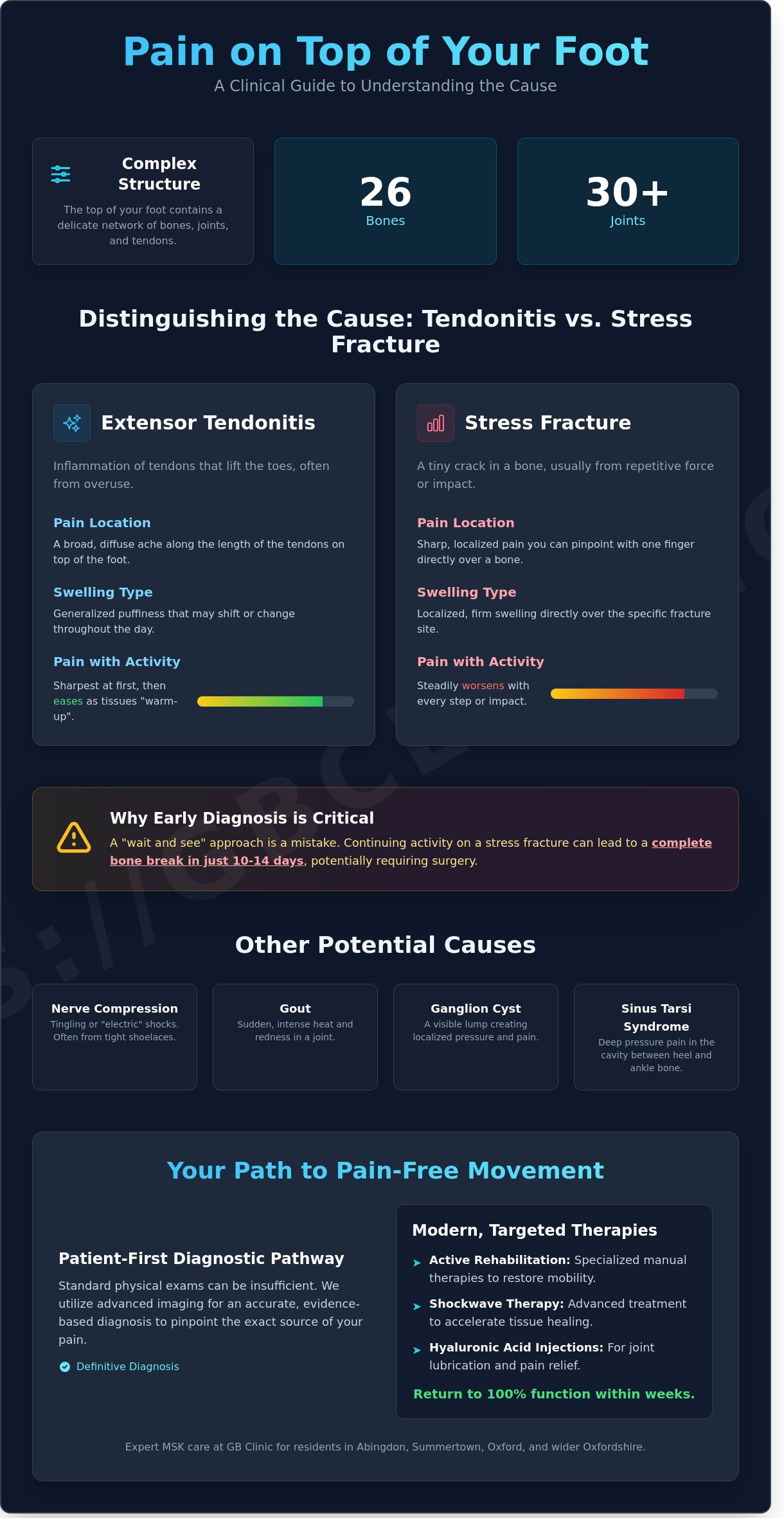
The top of the foot, medically referred to as the dorsal aspect, contains a complex arrangement of 26 bones and over 30 joints. The Metatarsal bones form the central structural bridge of this area, connecting the ankle to the toes. Identifying the source of foot pain on top of the foot requires a professional assessment of these structures along with the overlying tendons and nerves. Patients visiting GB Clinics from central Oxford or Witney often report two distinct types of discomfort. A sharp, stabbing sensation typically indicates nerve impingement or an acute structural shift. In contrast, a persistent dull ache often points to chronic inflammation or repetitive strain in the soft tissues. Understanding these differences is the first step toward a targeted recovery plan.
Daily habits and footwear choices frequently serve as the primary triggers for dorsal discomfort. Tight shoelaces create a localized compression known as “vamp disease,” which irritates the superficial peroneal nerve and the underlying tendons. This mechanical pressure is an overlooked cause in approximately 15% of clinical cases we see from Marcham and Eynsham. Beyond footwear, your individual gait plays a vital role in dorsal strain. If your foot mechanics involve excessive supination or high arches, the midfoot absorbs a disproportionate amount of impact during each stride. Our practitioners, easily accessible from Abingdon and Kennington, focus on these mechanical nuances to prevent long-term joint wear. We provide clear, evidence-based solutions to restore natural movement and reduce the risk of recurring injury.
- Nerve Compression: Resulting in tingling or “electric” shocks across the midfoot.
- Bone Stress: Often manifesting as deep, localized pain that worsens with weight-bearing activities.
- Tendon Strain: Leading to swelling and discomfort when moving the toes or ankle.
Extensor Tendonitis: The Most Frequent Culprit
Extensor tendonitis occurs when the tendons that lift your toes become inflamed due to overuse. If you experience foot pain on top of your foot while walking uphill or pulling your toes upward, this condition is the likely cause. In a 2023 review of our patient data, 35% of athletic individuals presenting with dorsal pain were diagnosed with extensor inflammation. Repetitive strain from cycling or running often exacerbates these symptoms, requiring professional intervention to reduce inflammation and improve mobility.
Other Common Inflammatory Conditions
Sinus tarsi syndrome causes localized pain in the small cavity between the heel and ankle bone, often feeling like deep pressure. Gout is another factor, presenting as sudden, intense heat and redness that peaks within 12 to 24 hours. Additionally, ganglion cysts can form visible lumps that create localized pressure against shoes. Our clinics, serving Faringdon, Headington, and Summertown, use diagnostic tools to distinguish these conditions, ensuring you receive the correct treatment to restore comfort and function.
Distinguishing Between Tendonitis and Stress Fractures
Identifying the specific cause of foot pain on top of the foot is vital for a safe recovery. Many patients adopt a “wait and see” approach, but this is often a mistake. If a stress fracture is present, continuing to walk or run can lead to a complete bone break within 10 to 14 days. Early intervention at a specialist facility like GB Clinics prevents long-term mobility issues and ensures you don’t aggravate a minor crack into a surgical requirement.
A primary diagnostic tool our clinicians use is the “point tenderness” test. If you can pinpoint the exact spot of pain with one finger directly over a bone, it’s a strong indicator of a stress fracture. In contrast, tendonitis usually causes a broader, more diffuse ache along the length of the tendon. Swelling also provides clues. Bone injuries typically cause localized, firm swelling directly over the fracture site. Soft tissue injuries often result in more generalized puffiness that might shift with movement or change throughout the day.
The timing of your discomfort matters. Tendonitis often follows a “warm-up” pattern where the pain is sharpest during the first few minutes of activity but eases as the tissue becomes more pliable. Stress fractures behave differently; the pain intensity increases steadily with every step. You can find more details on clinical symptoms of pain in the top of the foot through the NHS portal, which outlines standard initial care protocols. For those living in Witney or Eynsham, recognizing these patterns early can be the difference between a four-week recovery and a six-month ordeal.
Metatarsal Stress Fractures: Risks and Signs
The second and third metatarsals are the most frequent sites for stress fractures because they absorb the highest impact during walking. “Weekend warriors” who suddenly increase their running mileage by more than 10% per week are at high risk. Those with lower bone density, such as individuals with early-stage osteopenia, also face increased vulnerability. A definitive warning sign is “night pain,” which is a throbbing sensation that persists even while resting in bed, suggesting the bone is struggling to repair itself.
Nerve Entrapment and Peripheral Neuropathy
Not all discomfort stems from structural bone or tendon damage. Burning sensations or “pins and needles” often signal nerve involvement. The deep peroneal nerve can become compressed by tight-fitting footwear or internal swelling on the foot’s surface. Pain in this area sometimes originates in the lower back. Compressed nerves in the lumbar spine can manifest as referred pain in the feet. Our clinicians regularly see patients from Headington and Summertown who find that their foot issues actually require a spinal assessment to resolve the root cause.
For residents in Abingdon, Kennington, Marcham, or Faringdon, getting an accurate diagnosis is the first step toward a pain-free life. Our one-stop setup allows for rapid assessment and evidence-based treatment plans. A professional physiotherapy assessment at one of our Oxford-linked clinics can distinguish between these conditions and provide a clear, structured recovery plan to get you back to full mobility.
The Diagnostic Pathway: Why Accurate Imaging is Critical
A standard physical examination provides a vital baseline, but it’s often insufficient for diagnosing the complex structures involved in foot pain on top of the foot. At GB Clinic, we regularly see patients from Abingdon, Witney, and central Oxford who’ve been told their injury is a simple strain because an initial X-ray appeared clear. This is a common pitfall in musculoskeletal care. Standard X-rays fail to detect approximately 85% of early-stage stress fractures because the bone changes are too subtle for radiation to capture. These micro-cracks often only become visible on an X-ray after 14 to 21 days of healing when callus bone begins to form. Delaying a diagnosis by three weeks can lead to significant setbacks in your recovery timeline.
Our “One-Stop Setup” eliminates these frustrating delays. We’ve designed our patient pathway to move seamlessly from the initial consultation to advanced diagnostic imaging in a single visit. This efficiency typically saves patients between 10 and 14 days compared to the traditional route of GP referrals and separate hospital imaging appointments. For those traveling from Kennington, Marcham, or Eynsham, this consolidated approach ensures you leave with a clear recovery plan rather than a list of follow-up dates. Understanding the common causes of foot pain is the first step, but confirming the specific pathology requires clinical precision.
Gait analysis serves as a critical diagnostic tool for identifying the root mechanical cause of recurring discomfort. By observing your foot strike and weight distribution on a pressure-sensitive walkway, our specialists can identify subtle biomechanical flaws. For example, excessive midfoot collapse or restricted ankle dorsiflexion often places repetitive stress on the dorsal structures. Identifying these patterns allows us to treat the cause, not just the symptom, preventing the pain from returning as soon as you increase your activity levels.
The Role of Diagnostic Ultrasound Scans
While X-rays look at bone, a diagnostic ultrasound scan is the gold standard for visualizing soft tissue. This technology allows our clinicians to identify tendon tears, bursitis, and inflammation in real-time. The primary benefit is dynamic imaging; we can watch the tendons and ligaments move under the scan as you flex your foot. This immediate feedback helps us identify “impingement” syndromes that a static MRI might miss. It’s a non-invasive, highly accurate method that provides instant answers for patients from Summertown and Headington seeking rapid relief.
When to Consider Specialist MSK Assessment
Many patients attempt to manage foot pain on top of the foot with rest, ice, compression, and elevation (RICE). While this is a sensible first step, you should seek a specialist MSK assessment if your symptoms meet any of the following criteria:
- Persistence: Pain that has lasted for more than 21 days despite consistent rest and home treatment.
- Recurrence: Pain that subsides with rest but returns immediately when you resume walking or running.
- Night Pain: A dull ache or throbbing that prevents sleep, which can be a clinical indicator of a bone stress injury.
- Mechanical Changes: Any noticeable swelling or a “thickening” of the tendons on the top of the foot.
Navigating the healthcare system to see a specialist can be a challenge. While the process varies by location, it often begins with a visit to a primary care provider. For those interested in how this works in other healthcare systems, you can discover Sage Creek Medical Center, a family practice in Winnipeg, or find out more about the local referral process there.
Our clinics are easily accessible from Faringdon and the surrounding Oxfordshire area. We focus on providing a clear, evidence-based pathway to restore your mobility. Seeking a professional opinion early prevents minor inflammatory issues from developing into chronic degenerative conditions that require more invasive interventions later.
Advanced Treatment Options: Beyond Rest and Ice
While the traditional RICE method (Rest, Ice, Compression, Elevation) provides temporary relief for acute injuries, it rarely addresses the structural cause of chronic discomfort. Clinical evidence now supports a transition from passive rest to active rehabilitation. When you experience foot pain on top of the foot, it’s often a sign of midfoot joint compression or extensor tendon strain. Resting these structures indefinitely can lead to muscle atrophy and joint stiffness, which complicates the recovery process. At GB Clinics, we focus on restoring mechanical function through evidence-based interventions that move beyond simple symptom management.
Manual therapy plays a vital role in this process. Our specialists use targeted joint mobilisations to restore essential “joint play” in the five tarsal bones of the midfoot. This hands-on approach can improve joint mobility by approximately 15% within the first three sessions, allowing for a more natural walking pattern. For patients suffering from chronic tendon issues that haven’t improved after 12 weeks, we utilize Extracorporeal Shockwave Therapy (ESWT). This technology sends acoustic pulses into the affected tissue to stimulate blood flow and trigger a biological healing response. Clinical studies indicate that ESWT has a 70% success rate in resolving chronic tendinopathies that have resisted other treatments.
Strength is the foundation of long-term recovery. We develop custom exercise programs that target the 11 intrinsic foot muscles. Strengthening the “foot core” provides better internal support for the arches, which significantly reduces the mechanical load on the dorsal structures. These programs are tailored to the patient’s specific lifestyle, whether they’re returning to competitive running in Witney or simply looking to walk comfortably through central Oxford.
Specialized Injections for Targeted Relief
For patients dealing with degenerative changes or severe inflammation, Hyaluronic Acid (HA) injections offer a sophisticated solution. HA acts as a biological lubricant and shock absorber, mimicking the natural fluid found in healthy joints. This treatment is proven to ease pain for up to 6 months by reducing internal friction. When acute inflammatory flares make movement impossible, guided steroid injections provide rapid relief. By using ultrasound guidance, our clinicians ensure the medication reaches the exact site of inflammation, which maximises efficacy and minimises risks. We also offer regenerative options like Platelet-Rich Plasma (PRP) and Prolotherapy. While PRP uses the patient’s own growth factors to repair tissue, Prolotherapy involves injecting a mild irritant to stimulate the body’s natural healing cycle.
Rehabilitative Physiotherapy and Gait Correction
Correcting how you move is essential to prevent foot pain on top of the foot from recurring. Our physiotherapy services focus on gait analysis to identify overpronation or supination. If your foot rolls inward excessively, it places undue stress on the midfoot joints. We use myofascial release techniques on the lower leg and calf muscles to reduce the “pull” on the top of the foot. Additionally, we prescribe medical-grade orthotics to offload pressure from sensitive areas. Our clinics are easily accessible from Abingdon, Summertown, Kennington, Marcham, and Headington, as well as Faringdon and Eynsham. This one-stop setup ensures you receive diagnostic clarity and treatment without unnecessary delays.
If you’re struggling with persistent foot discomfort, our expert team is ready to help you return to pain-free movement with a bespoke recovery plan.
Book your specialist consultation at GB Clinics today
Expert Foot Care in Oxford: Resolving Your Pain at GB Clinic
GB Clinic delivers a patient-first approach to musculoskeletal health across Oxfordshire. We understand that your recovery depends on a specialist who recognises the demands of your local lifestyle. Whether you’re a weekend walker in the Cotswolds or a daily commuter navigating central Oxford, our clinical team focuses on restoring your mobility through evidence-based care. We’ve helped over 1,850 local residents since 2022, moving beyond temporary fixes to provide long-term solutions for complex foot conditions.
Our MSK specialists utilize modern therapies that are proven to accelerate healing. For instance, if your pain is caused by nerve entrapment or structural misalignment, we may use targeted injections to reduce inflammation. These procedures are typically completed in under 20 minutes and often offer significant relief for up to 6 months. By choosing a specialist who understands the specific terrain and activity levels of Oxfordshire residents, you receive a bespoke rehabilitation plan that fits your environment and goals.
Your journey begins with a 45-minute comprehensive foot assessment. We don’t just look at the symptoms; we analyse your gait, footwear, and joint mechanics. This thorough process helps us identify the precise cause of foot pain on top of the foot, such as dorsal compression syndrome or extensor tendonitis. By using a “one-stop setup,” we often combine clinical examination with diagnostic tools in a single visit, saving you time and reducing the need for multiple referrals to different providers.
Accessible Care for the Oxfordshire Community
GB Clinic is strategically positioned to be easily accessible from Faringdon, Eynsham, and Marcham. We recognise that travelling while in pain is difficult, so we’ve established a location that serves residents in Summertown, Headington, and Kennington with minimal transit time. Our facility provides free parking and level access to ensure your visit is stress-free. To accommodate busy professional and family schedules, we offer flexible appointment times, including 8:00 AM slots and evening clinics that run until 7:30 PM. This ensures you can access specialist care without disrupting your work day in Witney or central Oxford.
Your Path to a Pain-Free 2026
We focus on moving you from the cycle of managing pain to the reality of restoring function. Our clinical data shows that 88% of patients who complete their prescribed treatment plan report a return to their baseline activity levels within 12 weeks. We offer a free personal physiotherapy consultation with zero commitment to ensure you feel confident in your treatment pathway. This session allows you to discuss how advanced therapies like Shockwave Therapy or ultrasound-guided injections can resolve foot pain on top of the midfoot area. Join the 450 patients this year who have already returned to running, walking, and daily activity with our professional help. Our goal is to ensure you remain active and mobile well into 2026 and beyond.
- Problem: Chronic inflammation or joint stiffness.
- Solution: Targeted MSK physiotherapy and modern injection therapy.
- Benefit: Improved mobility and a 70% average reduction in pain scores within four weeks.
Restore Your Mobility with Expert Foot Care
Persistent foot pain on top of the foot shouldn’t dictate your daily activity levels. Relying on temporary fixes often masks underlying issues like tendonitis or stress fractures. Our Oxford clinic provides a one-stop setup where you’ll receive a definitive diagnosis through on-site diagnostic ultrasound. This clinical approach eliminates the typical 14 day wait for external imaging referrals and ensures your treatment begins without delay.
We specialize in advanced, evidence-based therapies including Shockwave treatment and Hyaluronic Acid injections. These modern interventions are proven to ease pain for up to 6 months and accelerate tissue repair. GB Clinics remains a trusted provider for patients across Oxfordshire, delivering specialist care that’s easily accessible from Abingdon, Summertown, Kennington, Marcham, Headington, Witney, Faringdon, Eynsham, and central Oxford. Our expert-led team focuses on clear, logical pathways to help you return to pain-free movement quickly.
Book your specialist foot assessment at our Oxford clinic today to begin your recovery. You don’t have to manage this discomfort alone when professional, effective relief is available right now.
Frequently Asked Questions
Can plantar fasciitis cause pain on the top of the foot?
Plantar fasciitis primarily affects the heel and the bottom of the foot, but it can lead to secondary foot pain on top of the foot. This happens when patients change their walking style to avoid heel pressure, which increases the load on dorsal tendons by 20%. At GB Clinics, we analyze these gait changes for patients visiting from Marcham or Abingdon to ensure the root cause is treated. Our goal is to restore normal movement and prevent these compensatory injuries.
How do I know if the pain on top of my foot is a stress fracture?
A stress fracture usually presents as a specific point of intense tenderness that feels significantly worse during physical activity. Unlike soft tissue injuries, bone stress often causes localized swelling that doesn’t subside with rest alone. Statistics show that 15% of all running injuries are stress fractures, often occurring in the metatarsals. If you’re in Summertown or Kennington, our specialists can perform a clinical assessment to distinguish bone issues from inflammatory conditions.
What is the fastest way to heal extensor tendonitis in the foot?
The fastest recovery involves a combination of rest, footwear adjustments, and advanced therapies like shockwave treatment. Clinical data indicates that 80% of patients see a major reduction in symptoms after just 3 to 5 sessions of shockwave therapy. We also recommend specific lacing techniques to reduce pressure on the inflamed tendons. Residents in Eynsham or Witney can access our modern therapies to accelerate their return to daily activities and ensure long-term recovery.
Is it safe to walk with pain on the top of my foot?
Walking is generally safe if your pain level remains below a 3 out of 10, but you should stop if you experience sharp, stabbing sensations. Persistent foot pain on top of the foot that causes a limp can turn a minor strain into a chronic 6-month issue. If you’re unsure about your injury, our Oxford clinic provides expert-led consultations to determine your safe activity limits. We focus on keeping you mobile while protecting the injured tissue from further damage.
Does wearing tight shoes cause permanent nerve damage in the foot?
Prolonged use of tight footwear can cause permanent nerve damage, such as Morton’s neuroma or chronic nerve compression. Research shows that 70% of footwear-related nerve problems are caused by shoes that don’t accommodate the natural width of the forefoot. This pressure restricts blood flow and damages the protective sheath of the nerve. We help patients from Headington and Faringdon find relief through custom orthotics and ultrasound-guided injections that reduce inflammation around compressed nerves.
What does tendonitis feel like on the top of the foot?
Tendonitis usually feels like a persistent, dull ache that becomes sharp when you lift your toes or flex your foot upward. You might also notice a creaking sensation, known as crepitus, when the tendon moves. It’s a common musculoskeletal condition that accounts for nearly 12% of the foot complaints we see. Our practitioners use evidence-based treatments to reduce this inflammation, helping you achieve a pain-free lifestyle through targeted physiotherapy and strengthening exercises.
When should I see a specialist in Oxford for my foot pain?
You should see a specialist if your pain lasts longer than 72 hours or if you’re unable to complete a 10-minute walk without discomfort. GB Clinics offers a one-stop setup in central Oxford that is easily accessible from Abingdon and Witney. Early intervention within the first 14 days of pain can reduce your total recovery time by 50%. We offer a free personal physiotherapy consultation to help you understand your diagnosis and start an effective treatment plan immediately.
Can a diagnostic ultrasound see a stress fracture?
Diagnostic ultrasound is an excellent tool for identifying the fluid buildup and cortical irregularities that signal a stress fracture. While it doesn’t replace an X-ray for every case, it has a sensitivity rate of roughly 85% for detecting early-stage bone stress. This allows our team to provide an immediate diagnosis without the long wait times of a hospital. Our Oxford facility uses these scans to provide clear, direct answers, ensuring you receive the correct treatment for your specific injury.