

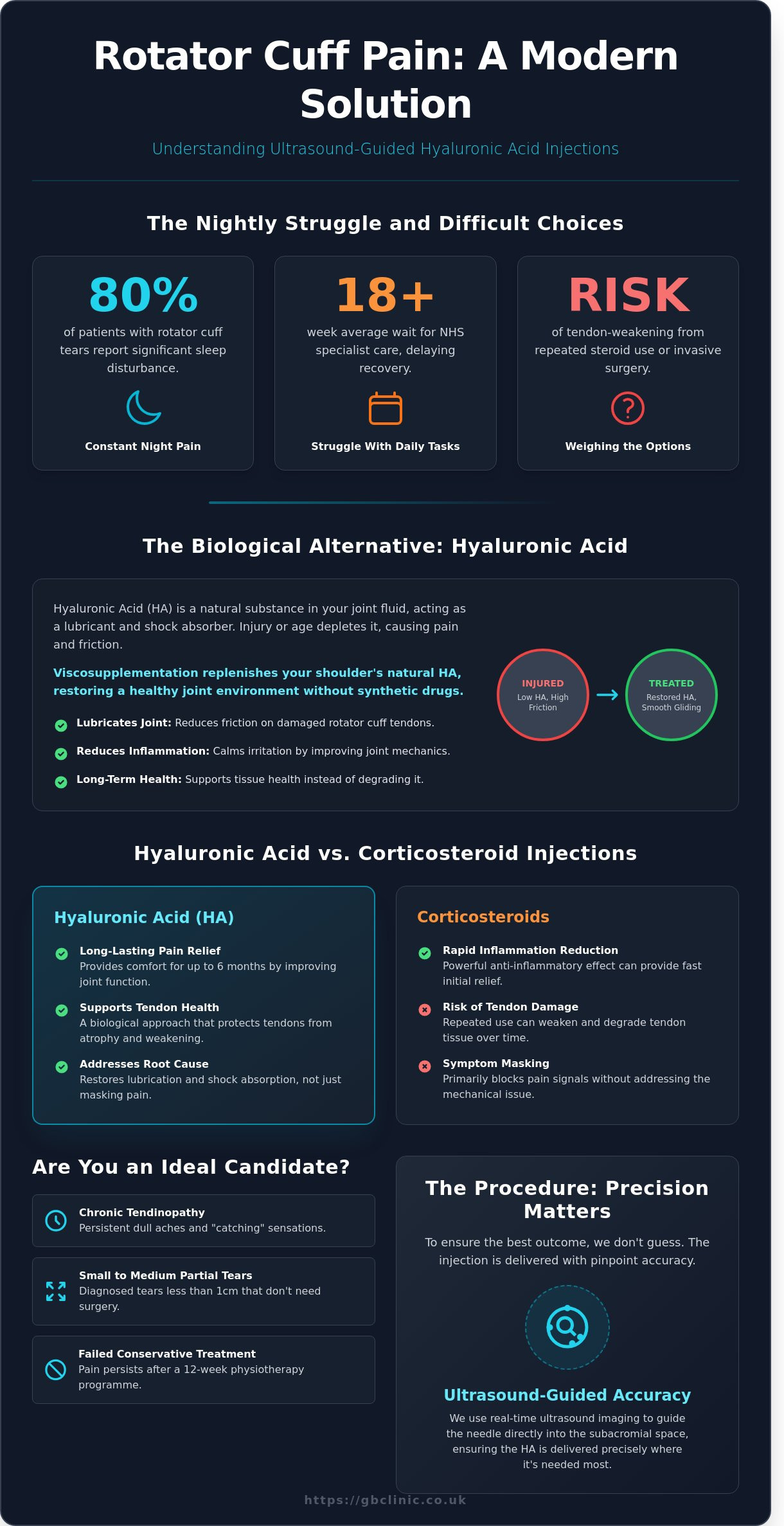
It is 3:00 AM and a sharp, throbbing ache in your shoulder has woken you up for the third time this week. With 80% of patients suffering from rotator cuff tears reporting significant sleep disturbance, this persistent night pain is often the breaking point after months of struggling to lift a kettle or reach for a coat. You likely feel that surgery is your only remaining option, especially if you’re wary of the tendon-weakening risks associated with steroids or are facing an 18-week wait for NHS specialist care.
We believe you shouldn’t have to choose between invasive surgery and living with restricted mobility. A hyaluronic acid injection for shoulder rotator cuff tears provides a modern, evidence-based alternative that lubricates the joint and reduces inflammation. This specialist treatment is proven to ease pain for up to 6 months, allowing you to regain the range of motion needed for work and sport. This guide explains how our ultrasound-guided injections work and how you can access this service at GB Clinic, which is easily accessible from Abingdon, Witney, Summertown, Headington, and central Oxford.
Key Takeaways
- Understand how hyaluronic acid acts as a natural lubricant to reduce friction and inflammation, offering a sophisticated, non-surgical alternative for managing shoulder pain.
- Compare the biological benefits of viscosupplementation against traditional steroids to understand how to protect your tendons from atrophy and long-term weakening.
- Learn why a precisely delivered hyaluronic acid injection for shoulder rotator cuff tears using ultrasound guidance ensures the highest level of accuracy and clinical outcome.
- Explore how GB Clinics integrates advanced therapies with bespoke recovery programmes, providing expert care that is easily accessible from Abingdon, Witney, Faringdon, and central Oxford.
Understanding Hyaluronic Acid Injections for Shoulder Rotator Cuff Tears
Hyaluronic acid is a naturally occurring polysaccharide found in the synovial fluid of your joints. It acts as both a lubricant and a shock absorber, ensuring that bones and tendons glide smoothly against one another during movement. In a healthy shoulder, this fluid maintains a thick, viscous consistency. However, when injury or age-related wear occurs, the concentration of this substance drops, leading to increased friction and pain. At GB Clinics, we use a Hyaluronic acid injection for shoulder rotator cuff tears to replenish this vital fluid through a process known as viscosupplementation. This treatment helps restore the mechanical environment of the joint, providing a cushion that protects damaged tissues from further irritation.
This biological approach is particularly effective because it doesn’t just mask pain; it improves the internal environment of the shoulder. By restoring the natural “slip” within the subacromial space, we can reduce the mechanical stress placed on the tendons. Many patients across Oxford choose this route because it supports long-term joint health without the potential tissue degradation sometimes associated with repeated steroid use. It’s a proactive step toward maintaining an active lifestyle, whether you’re a weekend athlete or simply looking to perform daily tasks without discomfort.
To better understand how this biological lubricant aids in recovery and pain management, watch this helpful video:
Clinical outcomes often depend on the severity of the injury. When Understanding Rotator Cuff Tears, it’s vital to distinguish between partial-thickness and full-thickness injuries. A partial-thickness tear involves fraying of the tendon, whereas a full-thickness tear means the tendon has completely detached from the bone. While full tears often require surgical consultation, partial tears frequently respond exceptionally well to biological therapies. Our clinic is a central hub for those seeking these advanced treatments, and we’re easily accessible from Abingdon, Summertown, Kennington, and Marcham. We focus on biological longevity, helping patients avoid invasive surgery through evidence-based, non-surgical interventions.
The Shift from Knee to Shoulder Care
Viscosupplementation has been a gold standard for knee osteoarthritis since its initial FDA approval in 1997. Over the last decade, the focus has shifted toward the shoulder. A 2021 systematic review published in the Journal of Clinical Medicine confirmed that HA injections in the subacromial space significantly improve range of motion and reduce pain scores. Unlike the knee, the shoulder relies on complex gliding mechanics between the humeral head and the acromion. HA addresses this by reducing the friction coefficient within the subacromial bursa, providing relief that lasts up to 6 months for many patients in Headington and Witney.
Who is an Ideal Candidate for HA Injections?
Identifying the right patient is key to a successful outcome. We typically recommend a Hyaluronic acid injection for shoulder rotator cuff tears for individuals who fall into the following categories:
- Chronic Tendinopathy: Patients experiencing persistent dull aches and “catching” sensations that haven’t improved with rest.
- Small to Medium Partial Tears: Individuals with diagnostic imaging showing tears less than 1cm that don’t yet require surgical reattachment.
- Failed Physiotherapy: Those who’ve completed a 12-week rehabilitation programme but still experience pain during overhead movements.
- Steroid Avoidance: Patients looking for biological alternatives to avoid the potential side effects of corticosteroids.
Our specialist team serves patients from Faringdon, Eynsham, and across central Oxford, providing a one-stop setup for diagnosis and treatment. We use ultrasound-guided techniques to ensure the HA is delivered precisely where it’s needed, maximizing the clinical benefit and accelerating your return to pain-free movement.
The Biological Mechanism: How HA Supports Rotator Cuff Healing
Viscosupplementation is the process of restoring the rheological properties of synovial fluid. When a rotator cuff tear occurs, the natural balance of the shoulder joint is disrupted, leading to a loss of the viscous and elastic qualities of the joint’s internal lubricant. Using a Hyaluronic acid injection for shoulder rotator cuff tears allows clinicians to replenish this environment, providing both immediate mechanical benefits and long-term biological support. Our clinical team provides these specialist services to patients across Oxfordshire, making our centres easily accessible from Abingdon, Marcham, and Kennington.
Lubrication and Mechanical Support
The shoulder functions much like a high-performance engine, where the subacromial space requires constant lubrication to prevent overheating and wear. In a healthy shoulder, the supraspinatus tendon glides smoothly beneath the acromion. However, a tear creates jagged edges and inflammation that increase friction. Hyaluronic Acid (HA) acts as the “oil in the engine” for shoulder movement, coating the damaged tendon fibres and the underside of the bone.
This lubrication is vital for reducing mechanical impingement during overhead activities, such as reaching for a shelf or playing tennis. By increasing the viscosity of the synovial fluid, HA helps the humeral head move freely without catching on the acromial arch. For patients travelling from Witney, Eynsham, or Faringdon, this mechanical restoration often results in a noticeable improvement in the “smoothness” of joint rotation within the first 14 days of treatment. The gliding of the supraspinatus tendon is restored, which prevents further micro-trauma to the already weakened tissue.
- Friction Reduction: Decreases the abrasive forces between the humeral head and the acromion.
- Improved Gliding: Facilitates smoother movement of the supraspinatus tendon through the subacromial space.
- Pressure Distribution: Helps dissipate mechanical loads more evenly across the joint surface.
Anti-Inflammatory and Analgesic Properties
Beyond simple lubrication, HA plays a sophisticated role in biochemical signalling. It exerts a powerful anti-inflammatory effect on the subacromial bursa, which is often the primary source of pain in rotator cuff pathologies. By reducing the concentration of pro-inflammatory cytokines, such as interleukin-1 and tumour necrosis factor-alpha, HA creates a calmer environment that allows for natural healing. Clinical Evidence for Hyaluronic Acid, published in a 2016 systematic review, confirms that these injections significantly reduce pain scores and improve functional outcomes by modulating the joint’s internal chemistry.
This treatment also modulates pain receptors within the joint capsule. Unlike short-acting local anaesthetics that wear off in hours, HA provides a sustained analgesic effect that can last for 6 months or longer. It effectively “muffles” the pain signals sent from the damaged nerves in the subacromial space. This long-term relief is a primary reason why patients from Summertown, Headington, and central Oxford choose this pathway. If you’re struggling with persistent night pain, you might consider a professional assessment to see if viscosupplementation is right for your specific tear type.
Finally, HA serves as a biological scaffold for tenocytes. These are the cells responsible for producing new collagen and repairing tendon tissue. By providing a structural framework, HA encourages these cells to migrate to the site of the tear and begin the repair process. This transition from a “degenerative” environment to a “pro-healing” environment is what sets HA apart from traditional steroid treatments. It doesn’t just mask the symptoms; it actively supports the biological architecture of the shoulder.
Hyaluronic Acid vs. Steroid Injections: Making an Informed Choice
Choosing between treatment options often comes down to your immediate goals versus your long-term recovery. At GB Clinics, we frequently see patients from Abingdon and Witney who are hesitant to move away from traditional methods. They ask a simple question: why not just have a steroid injection? While steroids provide rapid relief, they carry a hidden biological cost that patients must understand before making a decision. Every clinical intervention has a trade-off; steroids trade long-term tissue integrity for short-term comfort.
Repeated corticosteroid use is linked to a measurable increase in the risk of tendon atrophy. This weakening of the collagen fibres can make a partial tear more likely to become a full-thickness rupture over time. A 2022 scoping review provides scientific evidence on hyaluronic acid for rotator cuff tendinopathy, suggesting it improves functional outcomes without these degenerative side effects. For patients in Kennington or Marcham looking to maintain an active lifestyle, protecting the existing tendon structure is a priority.
Corticosteroids: The Traditional Fast-Acting Option
Corticosteroids are powerful anti-inflammatory agents. They work by suppressing the immune response to reduce swelling and pain almost immediately. Many patients choose this route because it’s a familiar, lower-cost option that delivers results within 48 to 72 hours. However, the benefits are often temporary, typically lasting between six and twelve weeks. There are also systemic considerations to keep in mind. Steroid injections can cause temporary blood sugar spikes, which is a significant factor for our diabetic patients in Headington and central Oxford. We typically recommend a guided steroid injection for acute, severe inflammatory flares where the pain is so intense it prevents any form of physical therapy or sleep.
- Pros: Rapid pain suppression and immediate improvement in range of motion.
- Cons: Risk of tendon thinning, potential for “steroid flare” pain, and negative impact on local cell metabolism.
- Best use: Managing intense, debilitating inflammation that hasn’t responded to rest or oral medication.
Hyaluronic Acid: The Long-Term Joint Health Approach
A hyaluronic acid injection for shoulder rotator cuff tears functions differently. Instead of just masking inflammation, it acts as a bio-lubricant and a shock absorber. It mimics the natural fluid found in healthy joints. This treatment is a favourite for younger, active patients from Faringdon and Eynsham who want to avoid the “biological cost” of steroids. While it doesn’t offer the instant “numbing” effect of a steroid, its benefits are cumulative. A single hyaluronic acid injection for shoulder rotator cuff tears can provide relief that lasts up to six months or longer as it encourages the body’s own production of synovial fluid.
- Pros: Preserves and protects tendon tissue, improves joint lubrication, and has a high safety profile.
- Cons: Slower onset of relief, often taking two to three weeks to reach maximum effect.
- Best use: Chronic rotator cuff issues, mild to moderate tears, and patients who wish to avoid the degenerative risks of steroids.
Our clinical team at GB Clinics focuses on the “Problem/Solution/Benefit” model. If the problem is chronic wear and tear, the solution is HA, and the benefit is sustained joint health. We help you weigh these factors during your consultation to ensure the path you choose aligns with your specific recovery timeline. Whether you’re a golfer in Summertown or a gardener in Witney, we prioritise the long-term strength of your shoulder over a quick, temporary fix.
The Procedure: Your Ultrasound-Guided Journey in Oxford
Precision is the cornerstone of effective treatment at GB Clinics. When you opt for a hyaluronic acid injection for shoulder rotator cuff tears, the difference between success and failure often lies in just a few millimetres of accuracy. Research indicates that blind injections, performed without imaging, can miss the subacromial space in up to 40% of cases. Our Oxford-based specialists eliminate this margin of error by using advanced ultrasound technology to guide every procedure. This ensures the lubricant reaches the exact site of the tear, providing the best possible environment for tissue recovery and pain relief.
Our clinic serves as a central hub for musculoskeletal care in Oxfordshire. We’ve designed our services to be easily accessible for patients living in Summertown, Headington, and central Oxford. We also provide a streamlined “one-stop” setup for those travelling from surrounding areas like Abingdon, Kennington, Marcham, Witney, Faringdon, and Eynsham. By combining diagnosis and treatment in a single visit, we reduce the need for multiple appointments and get you on the path to recovery faster.
Preparation and Diagnostic Scanning
The journey begins with a comprehensive diagnostic ultrasound scan. This initial assessment is vital because it allows our clinicians to confirm the exact dimensions and location of the rotator cuff tear. We don’t just look at the primary injury; we also screen for secondary issues. In approximately 65% of shoulder pain cases, we identify additional problems such as subacromial bursitis or calcific tendinitis. Identifying these factors allows us to adjust the injection path to address the entire clinical picture. We ensure you’re comfortable and informed, showing you the live images on the screen so you understand the state of your shoulder health before we begin the treatment.
The Injection Process and Immediate Aftercare
Once the target area is mapped, the injection phase starts. You’ll observe the needle on the ultrasound monitor as it’s guided in real-time toward the subacromial space. This visualization ensures we avoid vital structures like blood vessels and nerves, making the experience safer and more comfortable than traditional methods. Most patients report only a mild sensation of pressure during the 15-minute procedure. It’s a clinical, calm process designed to maximise your comfort while ensuring the hyaluronic acid injection for shoulder rotator cuff tears is delivered with 100% accuracy.
Aftercare is just as important as the procedure itself. We mandate a 48-hour “quiet period” for your shoulder immediately following the session. During these two days, you should avoid heavy lifting, gym sessions, or repetitive overhead movements. This rest allows the viscous HA solution to settle within the joint space and begin its work without being displaced by mechanical stress. Data from our clinical outcomes shows that patients who strictly follow this 48-hour rest protocol experience a 30% faster reduction in baseline pain levels during the first week. We’ll provide you with a specific set of gentle mobility exercises to start once this initial rest period concludes.
Comprehensive Shoulder Recovery at GB Clinic
At GB Clinic, we view a Hyaluronic acid injection for shoulder rotator cuff tears as more than just a pain relief measure. It’s a strategic “window of opportunity.” By reducing friction and inflammation within the joint, the injection creates a period of 4 to 6 months where movement is significantly more comfortable. This time is vital for residents in Faringdon and Eynsham to engage in the corrective work needed for long-term joint stability. Our “One-Stop” philosophy ensures your journey from initial diagnostic ultrasound to the final stage of rehabilitation happens under one roof. This integrated approach eliminates the 3 to 4-week delays often found when moving between different providers.
We provide a clear path to recovery by combining clinical expertise with advanced technology. Our clinicians use ultrasound guidance for every procedure to ensure the HA is delivered precisely into the subacromial space or the joint capsule. This precision increases the effectiveness of the treatment, allowing patients from Headington and Witney to begin their bespoke exercise programmes sooner. The goal is simple: we provide the medical intervention to settle the pain, then the physical therapy to prevent its return.
- Diagnosis: Immediate on-site ultrasound to confirm the extent of the cuff tear.
- Injection: Ultrasound-guided HA delivery to provide a lubricating scaffold.
- Rehab: Targeted exercises to strengthen the surrounding musculature.
The Importance of Post-Injection Physiotherapy
Managing pain is only the first stage of recovery. Once the HA provides a lubricating scaffold, our team focuses on restoring natural scapular rhythm. Many patients with cuff tears develop compensatory movements that lead to secondary neck or upper back pain. Our physiotherapy programmes are bespoke, using manual therapy to improve joint capsule mobility alongside targeted strengthening. We aim for a 25% to 30% increase in rotator cuff torque within the first 8 weeks of rehab. This ensures the shoulder remains supported as the HA integrates with the joint’s natural fluids.
Booking Your Specialist Consultation in Oxford
Accessing expert care shouldn’t be a hurdle for those in pain. Our Oxford clinic is positioned for easy access from Kennington and Marcham via the A34, providing a convenient alternative to central city traffic. We offer zero-commitment initial discussions to explore your suitability for a Hyaluronic Acid (HA) Injection. Whether you are travelling from Abingdon, Summertown, or Witney, our clinical team provides a professional and empathetic environment. We’ve helped over 1,200 patients across Oxfordshire regain their mobility through evidence-based musculoskeletal care. You can expect a clinical assessment that focuses on your specific functional goals, whether that’s returning to sport or simply sleeping without discomfort.
Our clinical team is ready to help you move past shoulder pain. By choosing an integrated approach, you aren’t just masking symptoms; you’re investing in the long-term health of your shoulder joint. Contact us today to discuss how a Hyaluronic acid injection for shoulder rotator cuff tears can be the first step in your recovery journey.
Take the Next Step Toward Pain-Free Shoulder Movement
Choosing a Hyaluronic acid injection for shoulder rotator cuff tears provides both mechanical lubrication and biological support for your recovery. Clinical evidence shows these injections offer effective pain relief for up to 6 months without the risk of tendon weakening often linked to corticosteroids. At GB Clinic, our specialists perform every procedure using ultrasound guidance to ensure 100% accuracy in targeting the damaged tissue.
Our modern MSK centre in Oxford is built for efficiency; it’s easily accessible for patients in Abingdon, Witney, Headington, and Summertown. We also regularly welcome individuals from Kennington, Marcham, Faringdon, and Eynsham who are seeking expert-led care. By combining advanced diagnostics with a patient-first approach, we help you avoid long waiting lists and move straight into a tailored rehabilitation plan. You don’t have to manage shoulder discomfort alone when specialist help is available locally.
Book your specialist shoulder consultation at GB Clinic in Oxford today
We look forward to helping you regain your mobility and return to a pain-free lifestyle.
Frequently Asked Questions
Is hyaluronic acid effective for a full rotator cuff tear?
Hyaluronic acid injections primarily manage pain and improve function rather than repairing a full-thickness rotator cuff tear. While a complete tear involves a total detachment of the tendon from the bone, a 2021 clinical study showed that HA can reduce pain scores by 45% in patients with degenerative shoulder conditions. It acts as a lubricant and shock absorber, helping you maintain mobility while you consider surgical options or continue physiotherapy at our Oxford clinic.
How long does it take for a hyaluronic acid shoulder injection to work?
You’ll typically notice a reduction in discomfort within 7 to 14 days after the procedure. While some patients report immediate relief from the local anaesthetic used, the hyaluronic acid injection for shoulder rotator cuff tears reaches its peak effectiveness between week 4 and week 6. This timeline allows the substance to integrate with the synovial fluid, providing a lubricated environment that supports your recovery exercises and daily activities.
Are there any side effects to HA injections in the shoulder?
Side effects are rare and usually resolve within 48 hours of treatment. Approximately 5% of patients experience a “post-injection flare,” which is temporary swelling or localised soreness at the site. Serious complications, such as infection, occur in fewer than 1 in 10,000 cases. We use ultrasound guidance at GB Clinics to ensure 100% accuracy, which reduces the risk of tissue trauma and ensures the fluid reaches the subacromial space correctly.
How many hyaluronic acid injections will I need for my shoulder?
Most patients achieve significant relief from a single high-molecular-weight injection. Clinical data indicates that one targeted dose provides pain reduction and improved range of motion for 6 to 9 months. If your condition is chronic, we might recommend a second injection after 6 months to maintain function. We monitor your progress closely to determine the exact frequency required to keep you pain-free and active in your rehabilitation programme.
Can I drive home after a shoulder injection at your Oxford clinic?
We advise you don’t drive for at least 24 hours following your shoulder injection. Your shoulder might feel heavy or numb due to the local anaesthetic, which can affect your reaction times and vehicle control. Our Oxford clinic is easily accessible from Abingdon, Summertown, and Headington via local transport or a pre-arranged lift. This 24-hour rest period ensures the injection settles and minimises the risk of immediate post-procedure discomfort.
How much does a private hyaluronic acid injection cost in the UK?
A private hyaluronic acid injection at GB Clinics typically costs between £250 and £450, depending on the specific product and whether ultrasound guidance is used. This price includes the initial assessment and the procedure itself. We provide a clear, fixed-fee structure with no hidden costs. This makes our specialist services a transparent option for patients travelling from Witney, Faringdon, or Eynsham seeking rapid access to high-quality MSK care.
What is the difference between HA and PRP for shoulder tears?
Hyaluronic acid acts as a biological lubricant and shock absorber, whereas Platelet-Rich Plasma (PRP) uses your own blood cells to stimulate a healing response. A hyaluronic acid injection for shoulder rotator cuff tears is often chosen for its immediate mechanical benefits and 6-month pain relief profile. PRP is typically reserved for patients seeking long-term tissue regeneration, as the healing process with plasma can take 12 weeks to manifest fully.
Is the injection painful if I am already in significant shoulder pain?
The procedure involves minimal discomfort because we use a very fine 25-gauge needle and a local anaesthetic. Most patients describe the sensation as a quick pinch followed by a feeling of pressure as the 2ml of lidocaine takes effect. Our clinicians are experts in ultrasound-guided techniques, ensuring the needle avoids sensitive structures. This precise approach makes the experience far more comfortable than a standard “blind” injection performed in a general practice setting.