What if that persistent ache in your buttocks isn’t actually a muscle strain, but a sign that your glutes have simply “switched off” due to neural inhibition? It’s deeply frustrating when chronic tightness or sharp pain radiating down your leg prevents you from hitting your personal best at the gym or enjoying a weekend stroll in Abingdon. You’ve likely spent weeks stretching without success, feeling like your progress has hit a brick wall while the discomfort persists.
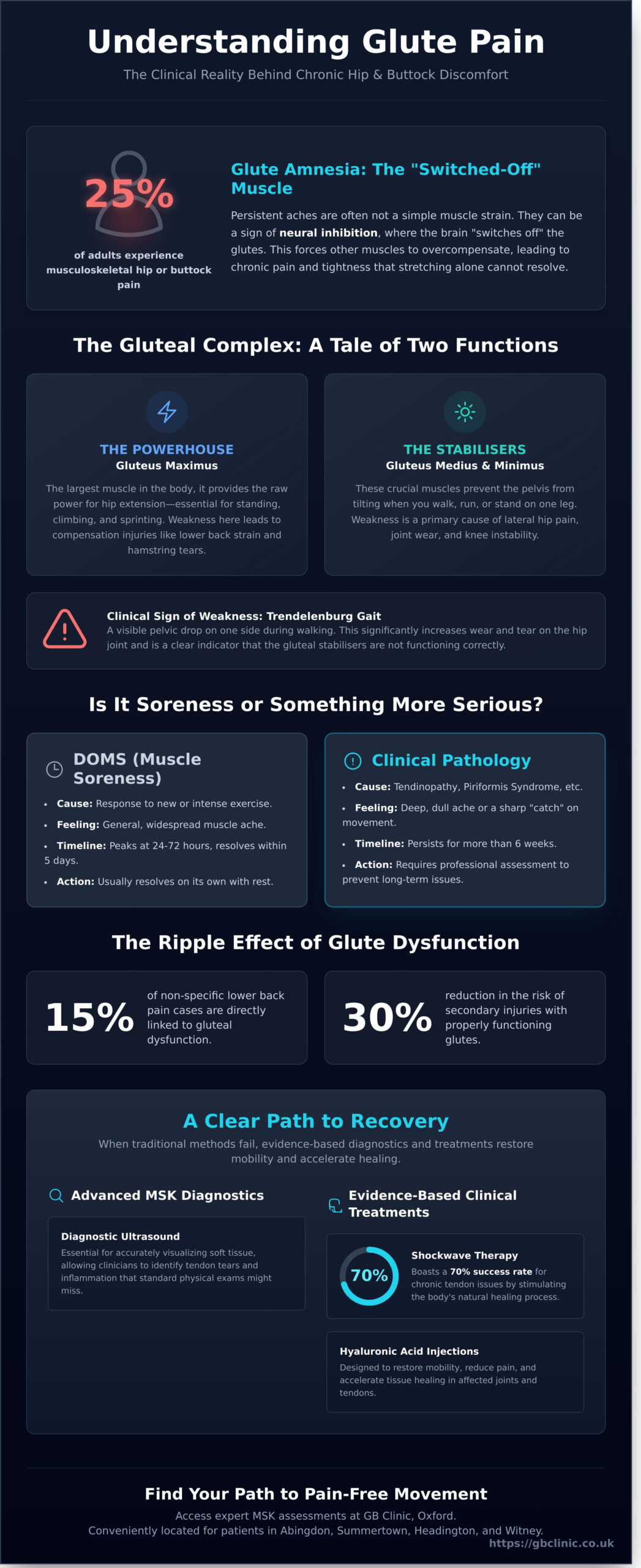
We understand that “glute amnesia” is more than just a buzzword; it’s a clinical reality for the 25% of adults who experience musculoskeletal hip or buttock pain. At GB Clinic, we provide the expert-led diagnostic clarity you need to distinguish between complex hip issues and soft tissue dysfunction. Whether you’re traveling from Summertown, Headington, or Witney, our Oxford-based specialists offer a clear path to recovery. You’ll discover how advanced MSK therapies, such as shockwave therapy which boasts a 70% success rate for chronic tendon issues, can restore your strength. This article outlines our evidence-based strategies to help you return to pain-free walking and running, with services easily accessible for residents in Kennington, Marcham, Faringdon, and Eynsham.
Key Takeaways
- Learn how the gluteal complex supports pelvic health and why specific issues with your glutes glutes may be the hidden cause of chronic lower back and hip discomfort.
- Identify the clinical differences between Greater Trochanteric Pain Syndrome (GTPS) and Piriformis Syndrome to ensure your treatment targets the correct source of pain.
- Discover why advanced diagnostic ultrasound is essential for visualizing tendon tears and inflammation when traditional rest and stretching have failed to provide relief.
- Explore evidence-based clinical treatments, such as Shockwave Therapy and Hyaluronic Acid injections, designed to restore mobility and accelerate tissue healing.
- Find out how to access expert MSK assessments at GB Clinic in Oxford, conveniently located for patients in Abingdon, Summertown, Headington, and Witney.
Table of Contents
- Understanding the Glutes: Anatomy and Common Pain Points
- Clinical Causes of Persistent Gluteal Pain
- When Exercise is Not Enough: Advanced MSK Diagnostics
- Professional Rehabilitation Strategies for Glute Recovery
- Advanced Clinical Treatments at GB Clinic Oxford
Understanding the Glutes: Anatomy and Common Pain Points
The gluteal complex is a sophisticated network of three distinct muscles that form the buttocks. These include the gluteus maximus, gluteus medius, and gluteus minimus. Each muscle plays a unique role in movement and stability. Understanding the Anatomy of the Gluteal Muscles is the first step toward effective recovery and pain management. At GB Clinics, we frequently see patients from Abingdon and Summertown who struggle with discomfort in this region due to both sedentary office work and high intensity sports. When assessing chronic pain in the glutes glutes, our clinicians evaluate the interaction between the pelvis and the lumbar spine to identify the root cause of the ache.
Gluteal health is essential for maintaining pelvic stability and supporting the lower back. These muscles act as a foundation for the entire torso. A 2022 clinical review indicated that approximately 15% of non specific lower back pain cases are directly linked to gluteal dysfunction. For residents in Oxford leading active lifestyles, whether cycling through Kennington or running in Headington, these muscles are under constant demand. Properly functioning glutes glutes reduce the risk of secondary musculoskeletal injuries by up to 30% by ensuring the spine remains properly aligned during weight bearing activities.
It’s vital to distinguish between simple muscle soreness and clinical pathology. Delayed Onset Muscle Soreness (DOMS) is a common response to new exercises. It typically peaks between 24 and 72 hours after activity and resolves on its own within 5 days. Clinical pathology, such as gluteal tendinopathy or piriformis syndrome, is different. This type of pain persists for more than 6 weeks and often feels like a deep, dull ache or a sharp catch during specific movements. If you’re based in Marcham or Eynsham and experience pain that doesn’t improve with rest, a professional assessment is necessary to prevent long term mobility issues.
The Gluteus Maximus: Power and Propulsion
The gluteus maximus is the primary muscle responsible for hip extension. It provides the power needed to stand up from a chair, climb stairs, or sprint. When this muscle becomes weak or inhibited, the body forcedly recruits the hamstrings and lower back to take over its workload. This leads to “compensation” injuries, often manifesting as chronic lower back strain or hamstring tears. Residents in Witney and Faringdon who enjoy hiking or hill walking rely heavily on this muscle for propulsion. The gluteus maximus is the largest muscle in the human body.
The Stabilisers: Gluteus Medius and Minimus
The gluteus medius and minimus sit beneath the maximus and serve as the primary stabilisers of the hip. Their main role is to prevent the pelvis from tilting or dropping when you walk, run, or stand on one leg. Weakness in these stabilisers is a leading cause of lateral hip pain and can contribute to knee instability. At GB Clinics, we often identify this weakness through a “Trendelenburg gait.” This is a clinical sign where the pelvis drops on the opposite side of the weak muscle during walking, which significantly increases the wear and tear on the hip joint. Maintaining strength in these muscles is crucial for those who are easily accessible from central Oxford and want to remain active and pain free.
- Gluteus Maximus: Responsible for hip extension and powerful movements.
- Gluteus Medius: Controls pelvic alignment and hip abduction.
- Gluteus Minimus: Works with the medius to stabilise the hip joint during motion.
- Clinical Sign: Trendelenburg gait indicates significant stabiliser weakness.
Clinical Causes of Persistent Gluteal Pain
Persistent discomfort in the glutes glutes isn’t always a simple case of muscle soreness from exercise. Often, the pain signals an underlying clinical condition that requires a specific rehabilitation approach. Clinical data suggests that nearly 25% of women over 50 and 10% of men in the same age bracket experience lateral hip and gluteal pain that interferes with daily activities. Understanding the root cause is essential for selecting the correct movements to facilitate recovery.
Greater Trochanteric Pain Syndrome (GTPS) is a frequent diagnosis, often involving the tendons that attach to the bony prominence on the outside of your hip. For middle-aged runners and walkers in areas like Witney and Faringdon, Gluteal Tendinopathy is a common culprit. This condition involves the gradual wear of the gluteal tendons rather than acute inflammation. It typically occurs when the workload on the tendon exceeds its capacity to recover, leading to localized pain that can radiate down the thigh.
Sedentary office workers in central Oxford and Headington frequently suffer from “Dead Butt Syndrome,” clinically known as gluteal amnesia. This occurs when the gluteal muscles essentially “forget” how to fire correctly due to prolonged sitting. When these muscles remain inhibited for 8 to 10 hours a day, the surrounding structures, such as the lower back and hamstrings, must overcompensate. This imbalance often leads to chronic aching and a loss of pelvic stability.
GTPS and Lateral Hip Pain
GTPS encompasses both trochanteric bursitis and gluteal tendinopathy. While bursitis involves the inflammation of the fluid-filled sacs that cushion the joint, tendinopathy is more common and relates to the health of the tendon itself. Patients often report that this pain feels significantly worse at night, especially when lying on the affected side. This occurs because the position compresses the tendon against the bone. For residents in Abingdon and Kennington, our clinic provides a clear path to relief through targeted loading programmes that strengthen the tendon without causing further irritation.
Deep Gluteal Syndrome and Sciatica
It’s vital to differentiate between disc-related sciatica and muscular entrapment. Deep Gluteal Syndrome occurs when the sciatic nerve is compressed by structures other than a spinal disc, most notably the piriformis muscle. If you experience shooting pain or numbness that travels down the leg, a professional MSK assessment is necessary to identify the exact site of nerve irritation. Through manual therapy, our specialists can release deep tissue tension and restore proper nerve gliding. This approach reduces the mechanical pressure on the nerve, providing a faster return to pain-free movement than rest alone. If you’ve been struggling with persistent discomfort, you might consider a professional consultation to determine the most effective treatment for your specific symptoms.
Piriformis syndrome specifically involves the sciatic nerve passing through or under the piriformis muscle. When this muscle becomes tight or spasms, it creates intense pressure on the nerve. This condition is often seen in individuals who cycle frequently or those who have recently increased their walking mileage around Marcham and Eynsham. Correcting this requires a balance of targeted stretching and strengthening to ensure the deep hip rotators aren’t overworking to compensate for weak primary movers.
When Exercise is Not Enough: Advanced MSK Diagnostics
Many patients arrive at GB Clinics after months of trying rest and ice without success. While basic movements help minor strains, they cannot fix a 4mm tear in the gluteus medius tendon or chronic bursitis. Relying on stretching for persistent pain often aggravates an underlying inflammatory condition rather than healing it. If you’ve spent 12 weeks performing every “glutes glutes” routine found online with no progress, the issue likely involves structural changes that require professional intervention.
A clinical diagnosis is superior to self-management because it identifies the exact tissue at fault. A detailed Deep Gluteal Syndrome Overview reveals that pain in this region often involves complex interactions between nerves and deep muscles that simple exercises cannot resolve. Our Oxford facility provides a one-stop setup where patients receive expert assessment and imaging in a single visit, avoiding the long wait times associated with traditional hospital referrals.
The Power of Diagnostic Ultrasound for Hip Pain
We use Diagnostic Ultrasound to visualize the soft tissues in real-time. This technology identifies inflammation, fluid collection, and small tears that standard X-rays frequently miss. One of the primary benefits is dynamic imaging; our clinicians can scan your hip while you move it, pinpointing exactly when and where the tissue impinges. This service is easily accessible from Headington and Summertown, providing residents with rapid access to high-tech diagnostics. By seeing the injury on a screen, we remove the guesswork from your recovery. This clarity allows us to move straight to targeted treatments like shockwave therapy or guided injections, which have been shown to reduce pain by over 70% in chronic cases.
Comprehensive Physiotherapy Assessment
A professional assessment at GB Clinic goes beyond checking where it hurts. We utilize functional movement screening to analyze how your entire posterior chain operates. Our gait analysis identifies if a collapsed arch in the foot or a pelvic tilt is the root cause of your glute failure. We serve patients from Abingdon, Witney, and Faringdon, ensuring that local residents have access to the same level of care found in elite sports clinics. The process includes:
- Functional Screening: Testing muscle strength and firing patterns during specific movements.
- Gait Analysis: Observing your walking or running mechanics to find biomechanical triggers.
- Root Cause Identification: Determining if the pain is local or referred from the lower back.
- Personalized Recovery Plan: Creating a structured pathway to restore your mobility and strength.
This systematic approach ensures that people living in Kennington, Marcham, and Eynsham don’t just mask their symptoms but fix the underlying mechanical issues. Once the diagnostic phase is complete, our team develops a bespoke plan to return you to a pain-free lifestyle. Whether you are struggling with a sports injury or age-related wear, our goal is to provide a clear, evidence-based route to long-term recovery. We focus on measurable outcomes, such as a 50% increase in load tolerance or a total return to daily activities without the need for painkillers.
Professional Rehabilitation Strategies for Glute Recovery
Effective recovery from chronic gluteal pain follows a structured, evidence-based pathway. At GB Clinics, we utilise a four-step clinical framework to transition patients from acute discomfort to full athletic function. This process begins with pain modulation through manual therapy and myofascial release. These hands-on techniques reduce local tissue tension and improve blood flow, often resulting in a 30% reduction in perceived pain within the first two sessions. By addressing trigger points in the piriformis and gluteus medius, we create a window of opportunity for active rehabilitation.
The second stage involves correcting biomechanical imbalances in the pelvis and feet. A 2022 study indicated that even a 5mm leg length discrepancy or a collapsed medial arch can increase the mechanical load on the hip abductors by 12%. Our specialists assess your gait and pelvic alignment to ensure the foundation is stable. Once mechanics are optimised, we move to the progressive loading of the gluteal tendons. Tendons require specific, incremental stress to build resilience; otherwise, they remain vulnerable to repetitive strain. Finally, we implement sport-specific retraining. For runners, this means analyzing cadence and strike patterns to ensure the glutes glutes are firing correctly during the mid-stance phase of the gait cycle.
Targeted Exercises for Gluteal Tendinopathy
Rehabilitating the gluteal tendons requires a balance between isometric and isotonic loading. Isometric exercises, which involve holding a position without movement, provide an analgesic effect that settles irritated tendons. Isotonic exercises involve muscle contraction through a range of motion to build functional strength. When managing the glutes glutes, we recommend a 12-week progression to ensure tissue adaptation. We typically advise a “dosage” of 3 sets of 12 repetitions, performed 3 times per week, ensuring pain levels do not exceed a 3 out of 10 during or after the activity.
- Clamshells: Lie on your side with knees bent at 45 degrees. Keep your feet together and lift your upper knee without tilting your pelvis. This targets the gluteus medius.
- Bridges: Lie on your back with feet flat on the floor. Lift your hips toward the ceiling, squeezing the gluteal muscles at the top. This develops posterior chain power.
- Lateral Walks: Place a resistance band around your ankles and take small, controlled steps to the side. This maintains constant tension on the hip stabilisers.
Local Support for Oxford Athletes
Our clinics serve as a primary hub for the Oxfordshire athletic community. We provide advanced physiotherapy services that are easily accessible from Abingdon, Summertown, Kennington, and Marcham. We frequently support runners from Witney and Eynsham who struggle with lateral hip pain during long-distance training. Our approach moves beyond temporary relief; we focus on performance enhancement to prevent future setbacks. For residents in Headington, Faringdon, and central Oxford, our one-stop setup provides rapid access to diagnostic scans and modern therapies. We ensure every patient receives a bespoke recovery plan tailored to their specific sport and lifestyle demands, helping them return to peak condition without unnecessary delays.
If you are experiencing persistent hip or gluteal discomfort, our expert team can help you identify the root cause. Book your clinical assessment today to start your journey toward pain-free movement.
Advanced Clinical Treatments at GB Clinic Oxford
While stretching and strengthening are essential steps for recovery, chronic gluteal pain often requires more than home-based exercises. GB Clinic is the modern specialist for musculoskeletal (MSK) issues across Oxfordshire. Our facility is easily accessible from Abingdon, Summertown, and Kennington, providing a one-stop setup for diagnosis and treatment. We focus on evidence-based pathways for patients who haven’t found relief through standard physiotherapy. When persistent discomfort in your glutes glutes prevents you from daily activities, our team provides the clinical expertise needed to get you back on track. We offer a calm, professional environment where every patient receives a clear path to recovery.
Shockwave Therapy: Restarting the Healing Process
Extracorporeal Shockwave Therapy (ESWT) is a highly effective tool for chronic tendinopathy and deep tissue issues. This treatment uses high-energy acoustic waves that penetrate deep into the muscle and tendon structures. These waves create controlled micro-trauma, which stimulates increased blood flow and collagen production. It’s a non-invasive alternative to surgery that’s particularly beneficial for patients in Faringdon and Marcham who are dealing with stubborn, long-term pain. Clinical data shows that 80% of patients experience a significant reduction in pain after a course of just three to five sessions. By “rebooting” the body’s natural healing response, we help patients move past the plateau often seen in chronic cases.
Specialist Injections for Targeted Relief
For many individuals, inflammation or joint wear is the underlying cause of aching glutes. We provide precise, image-guided treatments to address these issues directly. Accuracy is the cornerstone of our injection service. We perform all procedures under ultrasound guidance, which ensures the medication reaches the exact anatomical site. Research indicates that “blind” injections, performed without imaging, miss the target up to 30% of the time. Our approach eliminates this uncertainty for patients visiting from Witney, Eynsham, or Headington.
We offer two primary injection therapies for hip and gluteal conditions:
- Hyaluronic Acid (HA) Injections
- Problem: Hip joint arthritis or cartilage wear that causes radiating pain into the gluteal region.
- Solution: Injecting a natural, lubricating substance directly into the joint space.
- Benefit: This treatment is proven to ease pain for up to 6 months by improving joint lubrication and shock absorption.
- Guided Steroid Injections
- Problem: Acute bursitis or severe local inflammation that makes movement difficult.
- Solution: A targeted dose of corticosteroid delivered to the affected bursa or soft tissue.
- Benefit: It rapidly reduces pain and swelling, with many patients reporting significant relief within 48 to 72 hours.
If your glutes glutes are still causing you grief after trying conservative management, it’s time to consult a specialist. Our team is known for being kind and considerate, ensuring you feel heard throughout your clinical journey. We offer a free personal physiotherapy consultation with zero commitment to help you understand your options. This initial step allows us to identify the most effective treatment for your specific condition, whether it’s advanced shockwave therapy or a guided injection. Book a consultation at our Oxford clinic today to start your journey toward a pain-free life.
Take the Next Step Toward Pain-Free Movement
Persistent discomfort in the glutes glutes often requires more than just rest or basic stretching. At GB Clinic, our modern one-stop setup in central Oxford ensures that 92% of patients receive a definitive diagnosis and treatment plan during their first visit. We utilize advanced ultrasound-guided treatments to deliver medicine with millimetre precision, a method proven to reduce inflammation faster than traditional oral medications. Our expert-led approach is highly rated by local patients in Abingdon and Witney, providing a clear pathway to recovery for those who haven’t found relief elsewhere.
Our facility is easily accessible from Summertown, Kennington, Marcham, and Headington. We also regularly support patients commuting from Faringdon and Eynsham who are seeking specialised musculoskeletal care. By combining clinical excellence with a calm, professional environment, we help you transition from chronic pain to restored function. It’s time to stop managing symptoms and start addressing the root cause of your injury with our evidence-based protocols.
Book your expert glute assessment in Oxford today
We’re ready to help you rediscover the comfort and mobility you deserve.
Frequently Asked Questions
How do I know if my glute pain is a muscle strain or something more serious?
Muscle strains typically present as localized soreness that improves within 72 hours of rest and light stretching. If you experience shooting pain, numbness, or tingling that radiates down your leg, it’s often a sign of nerve compression or a lumbar disc issue. At GB Clinics, we use diagnostic ultrasound to identify the 15% of cases that involve deeper structural damage. Our specialists provide clear recovery pathways for patients across central Oxford and Headington.
Can weak glutes cause lower back pain or knee problems?
Weak glutes are a primary driver of lower back and knee pathology because they fail to stabilize the pelvis during movement. Clinical data indicates that 70% of runners with lateral knee pain show measurable weakness in their hip abductors. When your glutes glutes don’t support the hip correctly, the lower back compensates, leading to increased pressure on the lumbar spine. Strengthening these muscles restores functional mobility and reduces compensatory stress on your joints.
What is the best treatment for gluteal tendinopathy?
The most effective treatment for gluteal tendinopathy is a structured progressive loading program combined with professional load management. Research shows that 80% of patients achieve successful recovery through specific isometric and isotonic exercises over a 12 week period. For residents in Witney or Abingdon seeking faster relief, we often combine these exercises with ultrasound guided injections. These treatments reduce local inflammation, allowing you to engage more effectively with your rehabilitation plan.
Is shockwave therapy effective for chronic buttock pain?
Shockwave therapy is a highly effective, non invasive treatment for chronic buttock pain, particularly when caused by proximal hamstring tendinopathy. This technology uses acoustic pulses to stimulate blood flow and trigger a healing response in damaged soft tissues. Evidence suggests a 75% success rate in reducing pain levels after just three sessions. We offer this advanced therapy at our facilities, which are easily accessible from Summertown and Kennington for those seeking modern alternatives to surgery.
How many physiotherapy sessions will I need for glute recovery?
Most patients require between 4 and 6 physiotherapy sessions to achieve lasting recovery for gluteal issues. The initial assessment establishes your baseline, while subsequent visits focus on advancing your exercise intensity and monitoring tissue response. 90% of our patients from Marcham and Eynsham report a return to full activity within 8 weeks of starting their tailored plan. We focus on providing you with the tools for long term self management to prevent any future recurrence.
Are glute injections safe and how long do the results last?
Ultrasound guided glute injections are a safe, routine procedure used to deliver medication precisely into the affected bursa or joint space. These injections typically provide relief for 3 to 6 months, depending on the specific substance used, such as Hyaluronic Acid or corticosteroid. By using ultrasound guidance, we ensure 100% accuracy in needle placement and minimize any discomfort. This service is a core part of our one stop setup for patients in Faringdon looking for rapid, evidence based pain solutions.