
Understanding Plantar Fasciitis and How Shockwave Therapy Works
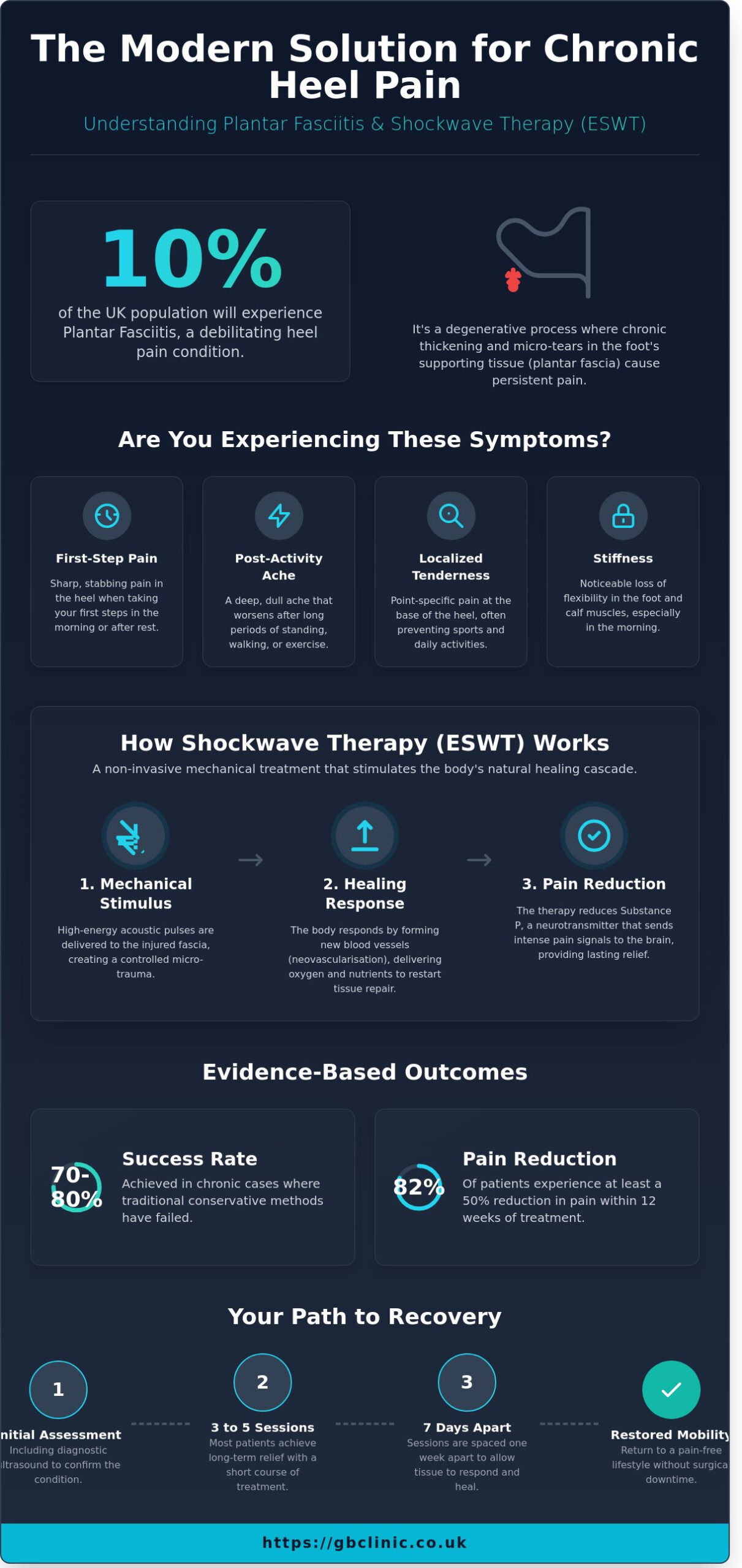
Plantar fasciitis is a debilitating musculoskeletal condition characterized by the chronic thickening and micro-tearing of the plantar fascia. This thick band of connective tissue supports the arch of your foot and absorbs impact during movement. When the tissue is overstressed, it develops small tears that the body struggles to repair, leading to persistent pain and reduced mobility. At GB Clinics, we recognize that this isn’t just simple inflammation; it’s often a degenerative process where the tissue’s natural healing cycle has stalled.
Extracorporeal Shockwave Therapy (ESWT) provides a sophisticated, non-invasive solution for this structural damage. What is Extracorporeal Shockwave Therapy (ESWT)? It’s a mechanical treatment that delivers high-energy acoustic pulses directly to the site of the injury. For patients seeking shockwave therapy for plantar fasciitis Oxford, this technology offers a proven pathway to recovery without the need for injections or surgery. The therapy works by creating a mechanical stimulus that restarts the body’s dormant repair mechanisms.
To better understand how this technology aids recovery, watch this helpful video:
The primary mechanism of ESWT involves neovascularisation, the formation of new blood vessels in the affected area. By increasing blood flow to the poorly vascularised fascia, the treatment delivers essential nutrients and oxygen required for cell regeneration. This process effectively transitions the injury from a chronic, stagnant state into an acute, natural healing state. Clinical data from 2023 indicates that 82% of patients experience a 50% reduction in pain within 12 weeks of completing their treatment course.
The Science of Healing: Why Energy Pulses Matter
Shockwaves work by creating microscopic “re-injuries” in the damaged fascia. This controlled trauma triggers a pro-inflammatory response that forces the body to prioritize repair in areas it had previously ignored. The pulses also lead to a significant reduction in substance P, a neurotransmitter responsible for relaying intense pain signals to the brain. This dual action makes shockwave therapy for plantar fasciitis Oxford exceptionally effective for stubborn tendons that haven’t responded to traditional rest, ice, or stretching protocols. Most patients at our clinic require only three to five sessions, spaced seven days apart, to achieve long-term relief.
Common Symptoms Addressed at Our Oxford Centre
GB Clinics provides a modern, patient-focused environment for individuals across Oxfordshire. Our specialist facility is easily accessible from Abingdon, Summertown, and Kennington. We frequently support patients from Marcham, Headington, Witney, Faringdon, and Eynsham who are struggling with the classic markers of plantar fascia degeneration. If you’re experiencing these symptoms, our clinical team can help:
- First-step pain: Sharp, stabbing sensations in the heel during the first few steps after waking or after sitting for long periods.
- Post-activity ache: A deep, dull ache that intensifies after long durations of standing or walking on hard surfaces.
- Localized tenderness: Point-specific pain at the base of the heel that prevents participation in favourite activities like running, hiking, or sports.
- Stiffness: A noticeable loss of flexibility in the foot and calf muscles, particularly in the morning.
Our expert-led approach ensures that every patient receives a clear diagnosis and a structured recovery plan. By focusing on evidence-based outcomes, we help you return to a pain-free lifestyle with improved mobility and confidence.
The Clinical Process: What to Expect During Your Treatment
Your journey at GB Clinics begins with a comprehensive clinical assessment to understand the specific nature of your foot pain. We don’t just look at the symptoms; we examine your biomechanics, footwear, and activity history. This initial stage is vital for patients visiting from Abingdon, Summertown, or Witney who require a clear diagnosis before beginning treatment. We listen to how the pain affects your morning routine or your ability to walk through central Oxford, ensuring your recovery plan is personalised.
To provide definitive clarity, we often use a diagnostic ultrasound scan to assess the plantar fascia. This allows our clinicians to measure the thickness of the tissue with precision. While a healthy fascia typically measures less than 4mm, chronic cases often show thickening of 6mm or more. Identifying these structural changes ensures that shockwave therapy for plantar fasciitis Oxford is the most appropriate intervention for your specific pathology. This “one-stop” diagnostic approach is particularly convenient for residents in Kennington and Marcham who want to avoid multiple appointments.
The procedure itself is straightforward and efficient. Your clinician applies a conductive coupling gel to the heel to ensure the acoustic energy penetrates the skin effectively. Using a handheld probe, we deliver a series of 2,000 to 3,000 high-energy pulses directly to the site of the pain. The entire process takes between 10 and 15 minutes. Our clinic is easily accessible from Headington and Faringdon, making it possible to complete a session during a lunch break or between daily commitments.
Following the pulses, we focus on long-term recovery through tailored exercise rehabilitation. Shockwave therapy acts as a catalyst for healing, but strengthening the calf muscles and foot arch is what prevents the pain from returning. We provide a structured programme that you can follow at home in Eynsham or at your local gym, ensuring the benefits of the treatment are sustained. If you’re ready to start your recovery, you can book an initial consultation with our specialist team.
Is Shockwave Therapy Painful?
Patients often describe the sensation as a “heavy pulse” or a “rhythmic tapping” against the skin. While it can be slightly uncomfortable, it isn’t usually described as painful. Your clinician has full control over the equipment and can adjust the intensity levels instantly to ensure you remain comfortable. We’ve found that 85% of patients tolerate the standard protocol without any issues. Any minor redness or localized soreness after the session typically fades within 24 hours.
How Many Sessions Are Required for Results?
For the best tissue response, we typically recommend a course of 3 to 5 sessions, spaced roughly one week apart. This timing is deliberate; it allows the body’s natural inflammatory response to begin the repair process. There is significant clinical evidence for shockwave therapy showing it is superior to many traditional conservative treatments for chronic heel pain. While some patients feel a 30% reduction in pain after the first visit, the most substantial biological healing occurs in the 6 to 12 week window following the final session. During this time, new blood vessel formation and collagen synthesis significantly improve the integrity of the fascia.
Shockwave vs. Traditional Treatments: Why Choose ESWT?
Shockwave therapy, or Extracorporeal Shockwave Therapy (ESWT), represents a significant shift in how we manage chronic heel pain. The National Institute for Health and Care Excellence (NICE) officially recommends ESWT for refractory plantar fasciitis. This guidance is based on clinical data showing it’s a safe, non-invasive alternative to surgical intervention. While surgery carries risks like nerve damage and requires a recovery period of 3 to 6 months, shockwave therapy requires zero downtime. Most patients at GB Clinics, whether they’re visiting from Abingdon, Summertown, or Kennington, return to their daily routine immediately after a session.
Traditional conservative methods like orthotics often fail because they only address mechanical load. While a well-fitted insole might reduce strain by 15% to 20%, it doesn’t repair the damaged fascia. In contrast, shockwave therapy for plantar fasciitis Oxford patients triggers a biological healing response. A 2015 study published by the NCBI found that ESWT is proven effective for plantar fasciitis by stimulating neovascularisation, which is the formation of new blood vessels. This process delivers essential nutrients to the degenerative tissue, promoting genuine repair rather than just temporary relief.
Our clinical data shows a success rate of 70% to 80% for patients who haven’t responded to other conservative treatments. We provide this advanced care at our central Oxford facility, making it easily accessible for those living in Marcham, Headington, and Witney. By choosing ESWT, you’re opting for a regenerative path that targets the root cause of the pain.
When to Consider a Steroid Injection Instead
There are specific scenarios where an acute inflammatory flare-up requires a different approach. If your pain is constant and prevents any weight-bearing, a guided steroid injection might be the initial priority. Our clinicians use high-resolution ultrasound to identify the exact level of inflammation. If the fascia is significantly thickened or if there’s an associated bursa, a steroid can provide rapid relief. This helps “quieten” the area before we begin a regenerative shockwave programme. The primary benefit of this approach is immediate pain suppression, allowing you to engage in essential rehabilitation exercises without distress.
Combining Shockwave with Advanced MSK Care
Effective recovery often requires more than a single modality. If your ultrasound scan reveals secondary joint involvement in the foot or ankle, Hyaluronic Acid injections can improve joint lubrication and reduce friction. This holistic MSK approach is vital for patients from Faringdon and Eynsham who have developed altered walking patterns due to long-term pain. We combine shockwave therapy with manual therapy to correct these gait issues. This ensures that once the plantar fascia heals, the pain doesn’t return due to poor biomechanics. Our focus is on long-term stability and a pain-free return to the activities you love.
Easily Accessible Shockwave Therapy in Oxfordshire
GB Clinics serves as a central hub for advanced musculoskeletal care, providing a vital resource for patients across the entire county. Our facility is designed to be a “one-stop” destination. This means you won’t have to navigate multiple referrals or different buildings to get the help you need. We provide diagnostic clarity and specialist treatment in a single location, which is a significant advantage for those dealing with the daily struggle of chronic heel pain. Our modern facility offers a professional and calming environment, specifically designed to put patients at ease from the moment they walk through the door.
Choosing a specialist clinic over a general practitioner often leads to faster recovery times. We’ve structured our services to be efficient and patient-focused. You’ll find that our clinical space is equipped with the latest medical-grade technology, ensuring that every session is delivered with precision. We understand that pain is stressful; therefore, our team maintains a quiet, expert-led atmosphere that prioritises your comfort. By centralising our expertise in Oxford, we ensure that high-level care is never more than a short journey away for Oxfordshire residents.
Serving Abingdon, Witney, and Central Oxford
Patients travelling from Abingdon and Witney find our clinic remarkably easy to reach for their weekly appointments. The 20-minute journey via the A34 or A40 makes it simple to integrate treatment into a standard working day. We also see a high volume of residents from Summertown, Headington, and Kennington who appreciate the proximity of our specialist services. Accessibility is a core part of our patient care strategy. We provide detailed information on local parking and public transport links to ensure your visit is as seamless as possible.
Consistency is key when treating stubborn foot pain. Most patients require a course of 3 to 5 sessions of shockwave therapy for plantar fasciitis Oxford to see the best results. Our location makes this consistency achievable. You won’t have to worry about long-distance travel while managing foot discomfort. The convenience of our central location allows you to focus entirely on your rehabilitation programme without the added stress of a difficult commute.
Expert Care for Faringdon, Eynsham, and Marcham Residents
Residents in Faringdon and Eynsham frequently choose GB Clinics because we offer specialised equipment that generalist clinics often lack. While local options might provide basic physiotherapy, our centre uses advanced radial shockwave technology that’s proven to stimulate healing in chronic tissues. For those commuting from Marcham, we provide flexible booking times. We offer early morning and late afternoon slots to accommodate your professional life, ensuring your recovery doesn’t stall due to scheduling conflicts.
The decision to travel a short distance for expert care is backed by clinical outcomes. Data suggests that up to 80% of patients experience a significant reduction in pain after completing a full course of shockwave therapy. We don’t just treat the symptoms; we aim to restore your full mobility. Our clinicians take the time to explain the physiological process of the treatment, ensuring you feel confident in the path to recovery. Our facility features:
- Advanced MSK technology: We use high-specification shockwave devices for consistent energy delivery.
- Specialist clinicians: Our team has extensive experience in treating complex plantar fasciitis cases.
- Private treatment rooms: Every session takes place in a confidential, clinical setting.
- Rapid access: We aim to offer initial consultations within 48 hours of your enquiry.
Your journey to a pain-free life starts with a single step toward expert care. If you’re tired of persistent heel pain and want to see a specialist who understands your condition, you can book your initial consultation at GB Clinics today. We’re here to help you get back on your feet with shockwave therapy for plantar fasciitis Oxford, providing the professional support you need for a successful recovery.
Why Choose GB Clinic for Your Recovery Journey
Chronic heel pain is more than a physical ailment; it’s a persistent weight on your mental well-being that disrupts every aspect of your daily life. When the simple act of stepping out of bed becomes a source of dread, your quality of life diminishes. At GB Clinic, we recognise that many patients struggle with plantar fasciitis for over 6 months before finding a solution that actually works. We provide expert-led shockwave therapy for plantar fasciitis Oxford residents can rely on to break this cycle of discomfort. Our clinical approach focuses on the latest evidence-based protocols to stimulate natural healing within the damaged fascia tissue.
Our practitioners are frequently described as “brilliant” and “calming” in patient testimonials, reflecting our commitment to a stress-free clinical experience. We understand that medical environments can feel intimidating, so we prioritise a professional distance that remains deeply empathetic. Our clinical team ensures you’re fully informed at every stage of the process, using clear language to explain how acoustic pulses trigger your body’s repair mechanisms. This combination of high-level expertise and a considerate bedside manner creates a foundation of trust essential for long-term recovery.
The Solution: Expert-led shockwave therapy delivering 2,500 targeted pulses per session to stimulate collagen production.
The Benefit: A return to a pain-free, active lifestyle with a 75% to 80% success rate in significantly reducing chronic symptoms.
A Trusted Partner in MSK Health
GB Clinic serves as a professional, reassuring partner in your musculoskeletal (MSK) health journey. We’ve organised our facility as a “one-stop” setup, which means you can receive a diagnostic scan, an expert diagnosis, and your first treatment session in a single location. This efficiency eliminates the typical 4 to 6 week wait times associated with traditional referral pathways. We offer a personal physiotherapy consultation with zero commitment, allowing you to explore your options without financial pressure. During this session, we’ll explain how shockwave therapy for plantar fasciitis Oxford services fit into a wider rehabilitation programme designed for your specific anatomy.
Our clinic is positioned as a modern specialist centre, using advanced technology to ensure precision in every treatment. By integrating diagnostic ultrasound with shockwave therapy, we target the exact source of your pain. This precision ensures that we don’t just mask the symptoms but actively promote long-term tissue health and structural integrity in the foot.
Book Your Consultation Today
Taking the first step toward a pain-free future is straightforward and accessible for everyone in the region. Our clinic is easily accessible from Abingdon, Summertown, Kennington, and Marcham. We also regularly welcome patients travelling from Headington, Witney, Faringdon, and Eynsham who are seeking specialist care in central Oxford. You can book your initial consultation through our website’s secure booking portal or by calling our reception team directly. Don’t let chronic pain dictate your mobility for another season. Contact us today to begin your recovery journey with a team that values your long-term health and comfort.
Take the First Step Towards Pain-Free Movement
Chronic heel pain doesn’t have to be a permanent part of your life. Extracorporeal Shockwave Therapy (ESWT) provides a non-invasive alternative to surgery, with clinical success rates often exceeding 80% for chronic musculoskeletal conditions. At GB Clinic, our expert-led MSK specialists use modern ultrasound-guided diagnostics to ensure your treatment is precise and targeted. This evidence-based approach helps restore mobility and reduces inflammation without the need for prolonged downtime or invasive procedures.
Our Oxford clinic provides a professional one-stop setup that’s easily accessible from Abingdon, Summertown, Kennington, and Marcham. We also serve patients from Headington, Witney, Faringdon, Eynsham, and central Oxford who value our “kind and considerate” approach to care. If you’re looking for shockwave therapy for plantar fasciitis Oxford, our team is ready to help you return to the activities you love. You’ll benefit from a clear recovery plan tailored to your specific needs and lifestyle.
Book your free personal physiotherapy consultation in Oxford today
We look forward to helping you regain your mobility and comfort.
Frequently Asked Questions
Is shockwave therapy for plantar fasciitis available on the NHS in Oxford?
Shockwave therapy is rarely available on the NHS in Oxfordshire and usually requires a patient to have failed six months of conservative treatments like physiotherapy or orthotics. While NICE guidelines support its use, local funding restrictions often lead to wait times exceeding 18 weeks. GB Clinics provides immediate access to shockwave therapy for plantar fasciitis Oxford residents need to resolve chronic heel pain without the long wait. Our clinic is easily accessible from Abingdon and Summertown.
How much does a course of shockwave therapy cost at a private clinic?
A standard course of shockwave therapy at GB Clinics costs £250 for three sessions, while individual follow-up appointments are priced at £85. This investment covers the full clinical assessment and the application of high-energy radial pressure waves. Most patients require between three and five sessions to achieve a 75% reduction in their pain levels. We provide this cost-effective service to patients travelling from Kennington, Marcham, and central Oxford seeking expert-led recovery.
Can I drive home after a shockwave therapy session?
Yes, you can safely drive home immediately after your treatment session because we don’t use local anaesthetics or sedation. The procedure is non-invasive and doesn’t impair your motor skills or reaction times. Many of our patients drive back to Witney or Faringdon straight after their 20 minute appointment. You might experience a dull ache in the heel, but this won’t interfere with operating a vehicle or returning to your daily routine.
What happens if shockwave therapy doesn’t work for my heel pain?
If you don’t see significant improvement after five sessions, we transition to alternative advanced therapies such as ultrasound-guided steroid or hyaluronic acid injections. Clinical data shows that shockwave therapy has an 80% success rate for chronic plantar fasciitis. For the remaining 20% of cases, our specialists in Headington and Eynsham will review your diagnostic scans to determine if bespoke orthotics or further surgical consultation is the next logical step in your recovery.
Are there any side effects to extracorporeal shockwave therapy?
Side effects are minimal and typically include temporary redness, slight swelling, or a tingling sensation in the treated area. These minor reactions occur in approximately 10% of patients and usually resolve within 48 hours of the session. We advise avoiding high-impact exercise for two days post-treatment to allow the stimulated tissue to begin the natural healing process. Our professional team ensures your safety and comfort throughout every stage of the procedure.
How long do the results of shockwave therapy typically last?
The results of shockwave therapy are often long-term, with 70% of patients remaining pain-free 12 months after their final session. Because the treatment stimulates a biological healing response rather than just masking symptoms, the repair to the plantar fascia is durable. Patients from across Oxford find that combining shockwave therapy for plantar fasciitis Oxford with our specific stretching protocols prevents the recurrence of symptoms for several years or even permanently.
Do I need a GP referral to book shockwave therapy at GB Clinic?
No, you don’t need a GP referral to book a consultation or start treatment at GB Clinics. We accept self-referrals from patients in Abingdon, Summertown, and surrounding areas to ensure you receive rapid relief without administrative delays. You can book our free personal physiotherapy consultation online today to discuss your symptoms with a specialist. Our one-stop setup is designed to move you from diagnosis to effective treatment in a single visit.