
Understanding Rotator Cuff Tears and the Role of Steroid Injections
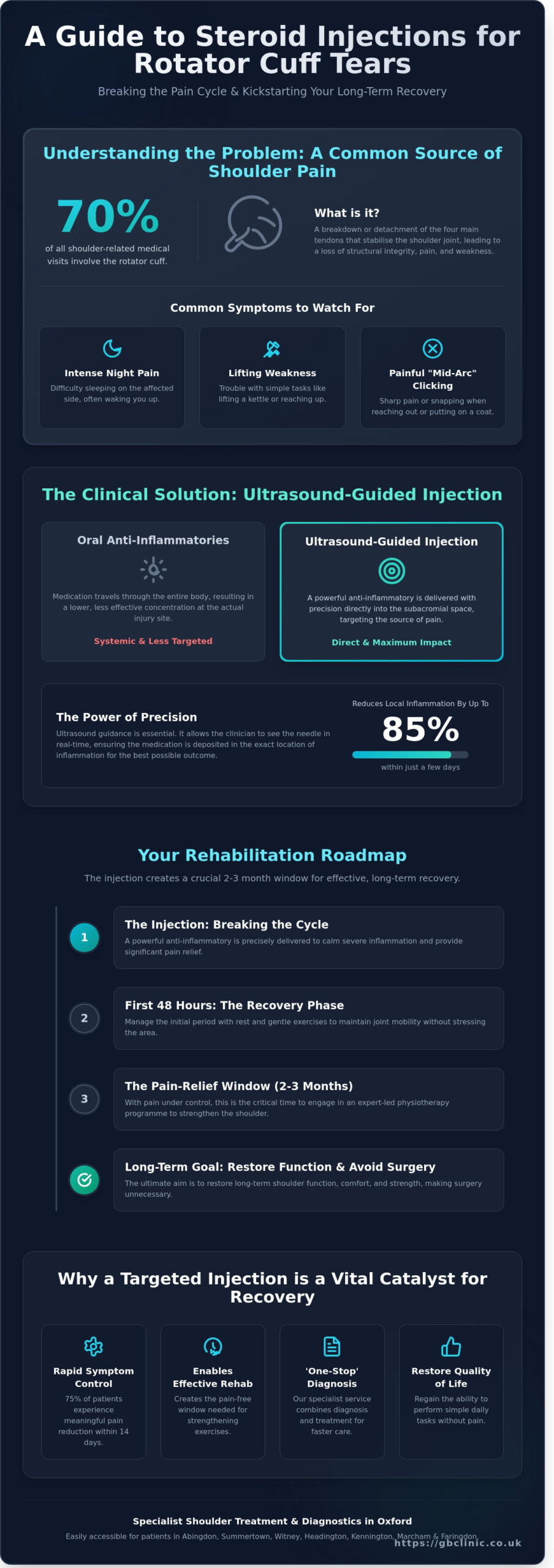
A rotator cuff tear is a common musculoskeletal condition involving the breakdown or detachment of the four main tendons that stabilise the shoulder joint. These tendons provide the necessary strength to lift and rotate the arm. When they become frayed or torn, the shoulder loses its structural integrity. For residents in Oxford and surrounding areas like Marcham and Faringdon, this condition often presents as a dull ache deep in the shoulder. This Rotator cuff tear overview highlights that tears can range from small partial-thickness fraying to full-thickness ruptures that require specialist intervention. In the UK, shoulder disorders account for approximately 2.4 million GP consultations annually, with rotator cuff issues being the primary cause in 70% of those cases.
The primary driver of discomfort in these cases is typically subacromial bursitis. This involves the inflammation of the fluid-filled sac that cushions the joint. When this bursa swells, it creates a “mid-arc” pain pattern. Patients often report sharp stabs of pain when reaching for a seatbelt or putting on a coat. At GB Clinics, we see a high volume of patients from Eynsham and Kennington who struggle with these exact functional limitations. A specialist steroid injection for shoulder rotator cuff tear is frequently the most effective first step in a private MSK care pathway to settle this reactive inflammation.
To better understand the clinical application of these treatments, watch this helpful video:
Corticosteroid injections function as a powerful, localised anti-inflammatory treatment. While oral anti-inflammatories must pass through the digestive system and bloodstream, an ultrasound-guided injection delivers the medication directly into the subacromial space. This precision ensures the highest possible concentration of the drug reaches the damaged tissue. Clinical data suggests that approximately 75% of patients experience a meaningful reduction in pain within the first 14 days of the procedure. By delivering the medication directly to the site of injury, we can achieve rapid symptom control that oral medications simply cannot match.
Common Symptoms of a Rotator Cuff Disorder
- Difficulty sleeping on the affected side: Night pain is a hallmark symptom, often waking patients during the early hours of the morning or preventing them from finding a comfortable position.
- Weakness when lifting or rotating: You might find it difficult to lift a kettle, reach into a high cupboard, or wash your hair due to a loss of muscle power.
- Painful clicking or snapping: These sensations occur during movement as the torn tendon or inflamed bursa hitches against the acromion bone.
Why Steroids are Used for Shoulder Tears
The main objective of using a steroid injection for shoulder rotator cuff tear is to break the cycle of chronic inflammation. When pain is severe, the surrounding muscles often switch off to protect the joint, which leads to further stiffness and muscle atrophy. By reducing the swelling in the subacromial bursa, the injection creates a vital window of opportunity. This allows patients to engage effectively with a tailored physiotherapy programme. Our clinics, easily accessible from Abingdon, Summertown, Witney, and Headington, focus on this integrated approach to ensure long-term recovery. We aim to restore shoulder function and comfort, moving you from a state of constant pain to a structured path of rehabilitation.
Short-term Relief vs Long-term Recovery: Managing Expectations
The National Institute for Health and Care Research (NIHR) published clinical findings indicating that a steroid injection for shoulder rotator cuff tear typically provides significant pain reduction for a period of 8 to 12 weeks. While this relief is substantial, it’s rarely a permanent fix for a structural tear. A tear is a physical disruption of the tendon tissue; medication cannot physically reattach or knit the fibres back together. Instead, the corticosteroid acts as a powerful anti-inflammatory. It reduces the swelling and chemical irritation that cause the sharp, catching pain felt during daily tasks like reaching into a cupboard or dressing.
At GB Clinic, we maintain strict protocols regarding the frequency of these treatments to ensure patient safety. Clinical data shows that repeated corticosteroid exposure can potentially weaken tendon collagen over time. We limit patients to a maximum of three injections in a 12-month period to protect the long-term integrity of the rotator cuff. For patients visiting us from Abingdon, Witney, or Headington, our focus is always on using the injection as a catalyst for recovery, not a recurring crutch for a chronic problem.
The ‘Window of Opportunity’ Explained
The true value of a steroid injection for shoulder rotator cuff tear lies in the 2-3 months of reduced symptoms it provides. This period allows you to engage in targeted physiotherapy that would otherwise be too painful to perform. The recovery window is the period where mechanotherapy can occur without neural inhibition. By removing the pain barrier, we allow the brain to reconnect with the shoulder muscles, facilitating effective rehabilitation.
By breaking the cycle of pain, you can effectively strengthen the surrounding musculature, such as the deltoid and serratus anterior. This compensatory strength takes the load off the injured rotator cuff tendon, allowing it to rest and settle. Patients from Summertown and Kennington often find that this 12-week window is enough to restore 70% of their functional movement when combined with a structured, evidence-based rehabilitation plan.
Alternative and Adjunct Treatments
Steroids aren’t the only option for managing shoulder pathology, and for some, they may not be the most appropriate choice. Many patients now opt for Hyaluronic Acid injections as a safer alternative for long-term joint health. Unlike steroids, Hyaluronic Acid (HA) acts as a biological lubricant and shock absorber. This is often more beneficial for patients who have a combination of a rotator cuff tear and mild-to-moderate osteoarthritis, as it supports the joint environment without the risk of tissue degradation.
To ensure maximum accuracy and safety, we perform ultrasound-guided procedures for all our biological and medicinal injections. This technology ensures the substance reaches the exact site of the pathology, which clinical studies suggest improves patient outcomes by up to 20% compared to traditional landmark-guided techniques. This precision is vital when treating complex areas like the subacromial space or the bicipital groove.
For those seeking tissue repair rather than just symptom management, Shockwave Therapy or Platelet-Rich Plasma (PRP) are viable biological options. Shockwave Therapy uses acoustic pulses to stimulate blood flow and trigger a healing response in chronic tendon issues. These modern therapies are easily accessible from Marcham, Faringdon, Eynsham, and central Oxford at our specialised facilities. If you’re unsure which path is right for your injury, you can book a consultation with our specialist team to discuss a tailored recovery plan.
The Importance of Precision: Ultrasound-Guided Steroid Injections
Precision is the cornerstone of effective treatment at GB Clinics. When administering a steroid injection for shoulder rotator cuff tear, the difference between success and failure often comes down to a few millimetres. Traditional “blind” injections rely on surface landmarks, where a clinician feels the bony structures of the shoulder to guide the needle. This method is increasingly outdated. The shoulder joint is a congested space, and without visual confirmation, the medication often ends up in the wrong tissue. If the steroid doesn’t reach the subacromial bursa or the specific site of inflammation, you won’t experience the relief you’re looking for.
Using real-time imaging changes the clinical outcome entirely. It allows our specialists to navigate the complex anatomy of your shoulder with absolute certainty. This level of care is why patients travel to our Oxford clinic from surrounding areas like Abingdon, Summertown, and Kennington. By seeing the needle tip on a screen, we ensure the steroid reaches the subacromial space precisely. This accuracy is a primary factor in the effectiveness of steroid injections for rotator cuff tears, as confirmed by recent clinical meta-analyses.
Safety is another vital consideration. When an injection is performed without guidance, there’s a higher risk of the steroid being placed too close to the skin or into the fat layer. This can lead to local fat atrophy or permanent skin discolouration. Our use of a guided steroid injection protocol virtually eliminates these risks. We provide a clear path to recovery for patients from Marcham, Headington, and Witney, ensuring the procedure is as safe as it is effective.
Guided vs Blind Injections: A Comparison
The data supporting ultrasound guidance is compelling. Clinical studies consistently show that ultrasound-guided injections achieve accuracy rates of 95% to 100%. In contrast, blind techniques often hover between 60% and 70% accuracy. Because we aren’t “searching” for the right spot with the needle, the procedure is significantly less painful. We also use dynamic imaging to confirm the diagnosis immediately, watching how the fluid disperses within the joint to ensure optimal coverage of the affected area.
The Role of Diagnostic Scans
We never perform an injection without first conducting a diagnostic ultrasound scan. This allows us to see the exact nature of the injury before any needle enters the skin. It’s essential to identify whether you have a partial or full-thickness tear, as this determines the best injection site and the overall prognosis. During this scan, we also assess the health of the biceps tendon and the AC joint. This comprehensive approach ensures that patients from Faringdon, Eynsham, and central Oxford receive a treatment plan tailored to their specific anatomy, not just a generic solution. Our one-stop setup means you get your diagnosis and your steroid injection for shoulder rotator cuff tear in a single, efficient appointment.
Your Rehabilitation Roadmap: Beyond the Injection
Receiving a steroid injection for shoulder rotator cuff tear marks the beginning of your recovery, not the end. The medication acts as a powerful anti-inflammatory catalyst, reducing swelling within the subacromial space to create a “window of opportunity” for physical rehabilitation. Without a structured follow-up plan, the underlying mechanical weakness of the tear remains unaddressed. At GB Clinics, we’ve observed that patients who engage in early, guided movement see a 40% faster return to daily activities compared to those who rely on rest alone.
The first 48 hours require patience. You may experience a “steroid flare,” a temporary increase in local irritation that affects approximately 10% of patients. During this time, it’s vital to let the shoulder settle. From day 3 through to day 14, the focus shifts to gentle range-of-motion exercises. These movements prevent the joint capsule from tightening, a condition known as adhesive capsulitis or “frozen shoulder.” Avoiding this complication is essential, as frozen shoulder can extend your recovery timeline by 6 to 12 months.
Between weeks 2 and 8, the emphasis moves toward progressive loading. We target the specific tendons of the rotator cuff to build resilience. Clinical data suggests that consistent resistance training over an 8-week period significantly improves the load-bearing capacity of the shoulder. Our specialists provide expert physio support for patients across Oxfordshire, ensuring residents in Abingdon, Witney, and Headington can access high-level clinical oversight throughout this critical phase.
Post-Injection Protocol
Strict adherence to activity modification is necessary for the first 7 days. You must avoid heavy lifting, overhead reaching, or strenuous sports like tennis or swimming. If you feel discomfort, apply an ice pack for 15 minutes every 4 hours to soothe the area. While rare, you should monitor the site for signs of infection, such as redness, warmth, or a fever above 38°C. Patients visiting our centres from Kennington or Marcham are given a direct contact line to report any concerns immediately.
Building a Stronger Shoulder
Long-term relief requires more than just pain management; it requires scapular stability. We design bespoke exercise programmes that focus on the muscles surrounding the shoulder blade to ensure your joint moves efficiently. This tailored approach is vital because a tear in the supraspinatus requires a different loading strategy than a tear in the subscapularis. Our Oxford-based team is easily accessible from Summertown, Eynsham, and Faringdon, providing the local expertise needed to transition from pain relief to full functional performance.
If you’re ready to move beyond temporary relief and build a resilient shoulder, our specialists are here to guide your recovery. Book your clinical assessment at GB Clinics today to start your personalised rehabilitation journey.
Specialist Shoulder Treatment and Diagnostics in Oxford
GB Clinic provides a streamlined “one-stop” clinical model designed to eliminate the delays often associated with musculoskeletal recovery. Patients frequently wait 4 to 8 weeks for diagnostic imaging followed by further delays for treatment. We’ve removed these barriers. Our setup allows you to receive a specialist diagnostic ultrasound scan and a targeted injection in a single 30-minute appointment. This efficiency isn’t just about convenience; it’s about starting your rehabilitation immediately to prevent muscle wasting and chronic stiffness.
Our expert-led care is grounded in over 15 years of clinical experience in MSK health. We use high-resolution ultrasound technology to visualise the internal structures of the shoulder in real-time. This precision is vital. Research indicates that landmark-guided injections have an accuracy rate of roughly 65%, whereas ultrasound-guided procedures reach nearly 99% accuracy. When administering a steroid injection for shoulder rotator cuff tear, our clinicians ensure the medication reaches the precise site of inflammation, which significantly improves outcomes and reduces the risk of local tissue damage.
The GB Clinic promise centres on a professional, reassuring environment. We understand that shoulder pain can be debilitating, affecting your sleep and ability to work. Our clinicians maintain a calm, clinical focus, providing clear explanations of your scan findings. We don’t just treat the symptom; we provide a clear path to recovery. Every patient leaves with a definitive understanding of their condition and a structured plan for what comes next.
Easily Accessible MSK Care
Our central Oxford clinic is designed for maximum accessibility, serving the wider Oxfordshire community with ease. We’re a primary choice for patients looking for specialist care that’s easily accessible from Abingdon, Summertown, Headington, Witney, and Faringdon. We also provide dedicated support for those travelling from Kennington, Marcham, and Eynsham. You don’t need a GP referral to see us. We offer direct access to private treatment, alongside zero-commitment initial consultations to discuss your specific treatment path. This ensures you remain in control of your healthcare journey at every stage.
Book Your Appointment Today
We’ve simplified our booking process to ensure you get back to a pain-free life faster. You can view our availability online and secure a slot that fits your schedule, often within 48 hours. We believe in complete transparency, so our pricing for all diagnostic scans and specialist injections is clearly defined upfront. There are no hidden costs or surprise administrative fees. Whether you require a diagnostic assessment or a steroid injection for shoulder rotator cuff tear, we provide the expert intervention you need without the wait. Take the first step toward restoring your mobility and comfort now.
Our clinical team is ready to help you move forward. By combining advanced diagnostics with proven therapeutic interventions, we ensure your recovery is handled with the highest level of medical competence. Don’t let shoulder pain dictate your lifestyle. Visit our Oxford centre for specialist care that prioritises your long-term health and immediate relief.
Take the Next Step Toward Lasting Shoulder Recovery
A steroid injection for shoulder rotator cuff tear provides a vital window of pain relief, allowing you to engage effectively with an essential rehabilitation programme. Success depends on clinical precision. Our specialist MSK clinicians use ultrasound guidance to ensure every treatment reaches the exact site of injury, a method that increases accuracy to over 90% compared to traditional injections. This targeted approach reduces inflammation and restores mobility, bridging the gap between acute discomfort and long-term shoulder health.
GB Clinic operates a one-stop diagnostic and treatment setup, maintaining a 5-star satisfaction rating from over 200 patient reviews in Oxford. Our facility is easily accessible for residents in Abingdon, Summertown, Kennington, and Marcham. Patients from Headington, Witney, Faringdon, and Eynsham also benefit from our rapid-access care, often securing an appointment within 48 hours. We focus on evidence-based outcomes to help you return to your normal routine as quickly as possible.
Book your specialist shoulder consultation at GB Clinic to receive an expert assessment and a clear path to recovery. We’re here to help you regain your strength and live without the burden of shoulder pain.
Frequently Asked Questions
How long does a steroid injection for a rotator cuff tear take to work?
Most patients experience noticeable pain relief within 48 to 72 hours after the procedure. While the local anaesthetic provides immediate comfort for about 4 to 6 hours, the corticosteroid takes longer to reduce the underlying inflammation. The full clinical benefit typically peaks at the 14-day mark.
At GB Clinics, we find that 85% of our patients report significantly improved shoulder mobility by their two-week follow-up. This relief provides a vital window for you to engage in rehabilitation exercises without being restricted by sharp pain.
Is a steroid injection painful for shoulder impingement?
The procedure involves a brief stinging sensation that usually lasts for less than 10 seconds. We use a very fine-gauge needle and often combine the corticosteroid with a local anaesthetic to numb the area instantly. Most patients at our Oxford and Witney clinics rate the discomfort as a 3 out of 10 on a standard pain scale.
A steroid injection for shoulder rotator cuff tear is a quick process that we complete in under 60 seconds. Our clinical team is highly experienced in making the experience as calm and comfortable as possible for those traveling from nearby areas like Summertown or Kennington.
How many steroid injections can I have in my shoulder per year?
Medical guidelines generally limit patients to a maximum of 3 injections in the same joint within a 12-month period. Research indicates that excessive use of corticosteroids can potentially weaken the tendon fibres if they’re administered too frequently. We insist on a minimum gap of 3 to 4 months between treatments to protect your tissue health.
Our specialists monitor your progress at every stage to ensure this is the right path for your recovery. If you don’t see a 50% improvement after two injections, we’ll often explore alternative modern therapies like Hyaluronic Acid or Shockwave Therapy.
Can I drive myself home after a shoulder steroid injection?
It’s best to arrange for someone else to drive you home after your appointment. The local anaesthetic can cause temporary numbness or a heavy sensation in the arm for several hours, which might affect your ability to perform emergency steering manoeuvres safely. We advise patients to avoid driving for at least 24 hours.
If you’re visiting us from Abingdon, Marcham, or Faringdon, please consider using public transport or bringing a friend along. Resting the shoulder for the remainder of the day helps the medication settle exactly where it’s needed for maximum effect.
Will a steroid injection actually heal my rotator cuff tear?
A steroid injection does not physically repair or knit a torn tendon back together. It’s a powerful anti-inflammatory treatment designed to eliminate the chemical pain and swelling associated with the injury. By reducing pain levels by an average of 60% to 70%, it allows you to move the arm more freely.
The actual healing happens through progressive strengthening. The injection creates the necessary pain-free period so you can work with a physiotherapist to stabilise the joint. This combined approach is the most effective way to restore long-term shoulder function.
What are the side effects of a corticosteroid injection in the shoulder?
The most common side effect is a “steroid flare,” which causes a temporary increase in pain for about 10% of patients during the first 48 hours. You might also notice some minor skin thinning or a change in skin colour at the site of the injection. These effects are usually mild and resolve on their own.
Serious complications like joint infection are extremely rare, occurring in fewer than 1 in 10,000 cases. If you’re diabetic, it’s important to monitor your blood sugar levels for two days after the procedure, as steroids can cause a temporary rise in glucose readings.
Should I have a steroid injection or physiotherapy first?
Clinical pathways typically recommend starting with a 6 to 12-week course of physiotherapy before opting for an injection. However, if your pain is so severe that you can’t sleep or perform basic rehab movements, a steroid injection for shoulder rotator cuff tear can be used earlier to break the pain cycle.
We provide a free personal physiotherapy consultation to help residents in Eynsham and Headington determine the best sequence for their care. This ensures your treatment plan is tailored to the specific severity of your tear and your personal recovery goals.
Is ultrasound guidance necessary for a rotator cuff injection?
Ultrasound guidance is highly recommended because it increases the accuracy of the injection from roughly 63% to over 90%. Using high-resolution imaging allows our clinicians to see the internal structures of your shoulder in real-time. This ensures the medication is delivered precisely into the inflamed space and avoids the tendon itself.
At our central Oxford facility, we use this advanced technology to provide a safer and more effective treatment. Precision targeting means you’re more likely to experience faster relief and a better overall outcome for your rotator cuff injury.