
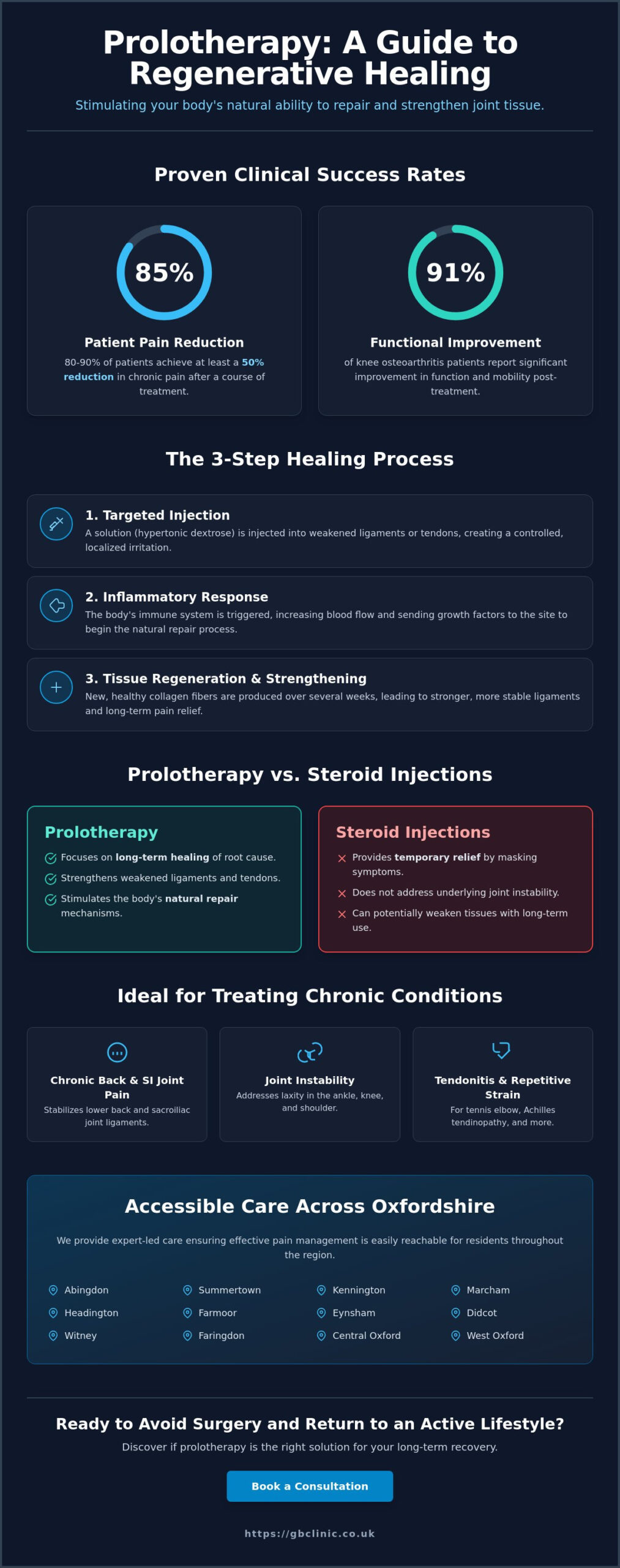
Did you know that 80-90% of patients experience at least a 50% reduction in chronic pain after completing a course of regenerative injections? If you’re managing persistent joint instability or feel frustrated by the temporary nature of steroid relief, you’ve likely asked: what is prolotherapy and does it work? It’s exhausting to wait for long NHS consultations while your mobility declines. You deserve a clear path to recovery that focuses on long-term tissue restoration rather than just masking symptoms.
In this comprehensive guide, you’ll discover the clinical reality of prolotherapy and how it stimulates your body’s natural healing response to strengthen weakened ligaments. We’ll examine success rates, such as the 91% of knee osteoarthritis patients who report significant functional improvement after treatment. We also highlight how these specialist services are locally accessible to residents in Abingdon, Summertown, Kennington, and Marcham. Whether you’re based in Headington, Farmoor, or Eynsham, our goal is to help you avoid surgery and return to an active lifestyle. We provide expert-led care for those in Didcot, Witney, Faringdon, and throughout Central and West Oxford, ensuring that effective pain management is never out of reach.
Key Takeaways
- Understand how prolotherapy uses controlled inflammation to trigger the body’s natural repair mechanisms for long-term tissue strengthening.
- Learn exactly what is prolotherapy and does it work by examining clinical success rates for conditions like knee osteoarthritis and persistent joint instability.
- Discover how regenerative injections compare to treatments like Hyaluronic Acid or PRP therapy to determine the most effective path for your physical restoration.
- Identify the clinical criteria for treatment candidacy, focusing on individuals seeking to avoid surgery and return to an active lifestyle in Oxfordshire.
- Explore the accessibility of these specialist services for residents in locations such as Abingdon, Witney, Didcot, and Central Oxford.
What is Prolotherapy? Defining Regenerative Injection Therapy
Prolotherapy, also known as proliferation therapy, is a specialized injection technique designed to resolve chronic musculoskeletal pain by stimulating the body’s natural repair mechanisms. It targets tissues that have failed to heal correctly after an initial injury, such as weakened tendons, ligaments, and joint capsules. By injecting a mild irritant solution into these structures, clinicians can restart the healing cycle. This approach is a preferred option for individuals in Central Oxford and West Oxford who are looking for evidence-based alternatives to invasive surgery.
Patients often ask, what is prolotherapy and does it work for persistent joint instability? The treatment is rooted in the biological principle that controlled inflammation leads to tissue restoration. While modern clinical practice has refined these methods using advanced imaging, the concept of using irritants to prompt healing dates back to ancient medical traditions. Today, it serves as a sophisticated tool for residents in Headington and Farmoor who need a reliable path toward physical restoration. To better understand this concept, watch this helpful video:
The Components of a Prolotherapy Injection
The primary ingredient in most prolotherapy sessions is hypertonic dextrose, which is a concentrated sugar water solution. This substance acts as an irritant by creating a local osmotic gradient that dehydrates cells at the injection site. This process triggers a localized immune response without causing significant damage. To ensure patient comfort, the solution is typically mixed with lidocaine or another local anaesthetic. In some complex cases, clinicians may include specific co-factors to further enhance the inflammatory response and support the growth of new, healthy collagen fibers. For precise delivery, a diagnostic ultrasound scan is often used to visualize the exact anatomical target, ensuring the solution reaches the specific ligaments requiring reinforcement.
Common Conditions Treated with Prolotherapy
Prolotherapy is highly effective for conditions characterized by ligament laxity or chronic tendon wear. It provides a structured solution for individuals across Oxfordshire who have not found success with traditional physiotherapy alone. Common targets include:
- Chronic Back and SI Joint Pain: Stabilizing the sacroiliac joint and lower back ligaments to reduce persistent discomfort for residents in Abingdon and Kennington.
- Joint Instability: Addressing ligament laxity in the ankle, knee, and shoulder, which is a frequent concern for active individuals in Witney and Didcot.
- Repetitive Strain and Tendonitis: Treating chronic tendon issues such as tennis elbow or Achilles tendinopathy for patients in Summertown, Marcham, and Eynsham.
This treatment is particularly beneficial for those in Faringdon who are seeking long-term pain reduction rather than the temporary relief offered by steroids. By focusing on the underlying structural integrity of the joint, prolotherapy helps patients return to their active lifestyles with greater confidence and mobility.
The Science of Healing: How Prolotherapy Works
To fully answer the question of what is prolotherapy and does it work, we must examine the biological mechanism known as the “Irritant Theory.” When a high-concentration dextrose solution is injected into a damaged ligament or tendon, it creates a local osmotic gradient. This physical change causes nearby cells to dehydrate slightly, which acts as a chemical signal to the immune system. It effectively alerts the body that a specific area requires urgent attention. Recent evidence, including a systematic review of prolotherapy efficacy, highlights how this targeted irritation is essential for treating osteoarthritis and ligament laxity by initiating a controlled inflammatory response.
While many patients in Abingdon and Summertown are accustomed to taking anti-inflammatories to suppress swelling, prolotherapy takes the opposite approach. It uses temporary, therapeutic inflammation as the catalyst for long-term repair. This process triggers the deposition of new collagen fibers. As these fibers mature, they tighten the connective tissues, restoring structural stability to the joint. For individuals in Kennington and Marcham dealing with “loose” joints, this increased tension directly leads to a significant reduction in mechanical pain. If you are struggling with persistent instability, you might consider a professional assessment to see if your injury is suitable for this biological reset.
The Three Phases of Tissue Repair
The transition from an injection to a stronger joint follows a predictable clinical timeline. This structured recovery is why the treatment is becoming a popular choice for residents in Headington and Farmoor:
- Phase 1: Inflammation (Days 1-3): Healing cells, such as granulocytes and macrophages, are recruited to the site to clear debris and begin the repair process.
- Phase 2: Proliferation (Weeks 2-4): Fibroblasts migrate to the area to lay down new collagen, forming the foundation of new connective tissue.
- Phase 3: Remodelling (Months 1-6): The newly formed tissue matures and strengthens, becoming denser and more organized to support the joint’s weight-bearing needs.
Why Chronic Injuries Fail to Heal Naturally
Many injuries in the ligaments and tendons don’t heal on their own because these tissues have a poor blood supply, a condition known as hypovascularity. Without adequate blood flow, the body cannot deliver the necessary nutrients and growth factors to complete the repair cycle. This often leaves patients in Eynsham and Didcot stuck in a state of chronic, non-productive inflammation that causes pain without providing a cure. Prolotherapy “restarts” the biological clock of an old injury, forcing the body to address the damage it previously ignored. This expert-led approach is easily accessible for those in Witney, Faringdon, and across Central or West Oxford, providing a local solution for complex musculoskeletal concerns.
Does Prolotherapy Work? Examining Evidence and Success Rates
When investigating what is prolotherapy and does it work, the clinical evidence provides a reassuring perspective for those in chronic pain. Most clinicians report that 80-90% of patients experience at least a 50% reduction in pain after completing a full series of injections. This high success rate is a primary reason why residents from Summertown to Abingdon are increasingly choosing regenerative options over traditional palliative care. As detailed by the Cleveland Clinic on Prolotherapy, the treatment’s efficacy is particularly evident in stabilizing joints that have become lax due to injury or age.
Success isn’t uniform across all patients, however. Factors such as patient age, the severity of the initial injury, and lifestyle habits play significant roles in the final outcome. For instance, a 2020 review found that 91% of patients with knee osteoarthritis reported significant improvement in pain and function after just 3 to 4 sessions. Similar results are seen in chronic shoulder pain, where 85% of patients noted improvement after six months of treatment. This makes it a compelling choice for those in Kennington and Marcham who wish to avoid more invasive procedures while seeking long-term physical restoration.
It’s vital to understand that prolotherapy is not a one-time “quick fix.” It requires a series of treatments, typically between 3 and 6 sessions, to achieve optimal tissue density. Each session builds upon the previous one, gradually strengthening the connective tissues. This structured approach ensures that individuals in Headington and Farmoor receive comprehensive care that targets the root cause of their instability rather than just the symptoms.
Prolotherapy vs. Cortisone (Steroid) Injections
Many patients in Eynsham and Didcot are familiar with a guided steroid injection for immediate relief. While steroids are excellent at suppressing acute inflammation, they are palliative and don’t repair the underlying structure. In contrast, prolotherapy promotes inflammation to trigger regeneration. While the relief is delayed, the long-term outcomes are often superior because it prevents future tissue breakdown by reinforcing the joint’s natural support system, which is essential for an active lifestyle.
What the Research Says About Back and Neck Pain
Research into spinal and pelvic stability has shown promising results for those suffering from whiplash-associated disorders or neck instability. In a 2025 study, 58.7% of patients in a prolotherapy group for sacroiliac joint pain reported 50% or more relief at 15 months, compared to only 10.2% in the steroid group. This data provides a clear path forward for residents in Witney, Faringdon, and Central or West Oxford who are seeking lasting functional restoration through modern clinical offerings.
Comparing Prolotherapy to Other Advanced MSK Treatments
Choosing between various regenerative options depends on the specific nature of your physical discomfort. While Hyaluronic Acid (HA) Injections focus on providing lubrication and cushioning within a joint, prolotherapy targets the structural integrity of the surrounding ligaments and tendons. For residents in Abingdon and Summertown, the question of what is prolotherapy and does it work is best answered by its role as a strengthening tool. It addresses the underlying instability that lubrication alone cannot fix, making it a primary choice for chronic laxity.
When compared to PRP Therapy, prolotherapy uses a simple dextrose irritant to trigger healing rather than the concentrated growth factors found in blood plasma. Prolotherapy is often more cost-effective and serves as an excellent foundational treatment for ligament issues. Determining what is prolotherapy and does it work for your specific condition requires a thorough physical examination and precise imaging. To ensure the highest level of accuracy, clinicians use Diagnostic Ultrasound to guide the needle. This technology allows for the precise visualization of the injury site, ensuring the solution is delivered exactly where it’s needed for patients in Kennington, Marcham, and Headington.
The Regenerative Hierarchy
Clinical specialists often view regenerative care as a tiered system. This hierarchy helps patients in Farmoor and Eynsham choose the most appropriate intervention based on their specific diagnostic findings:
- Level 1: Prolotherapy. This is the foundational regenerative tool used to strengthen weakened ligaments and joint capsules.
- Level 2: PRP (Platelet-Rich Plasma). This level is typically utilized for more complex tissue tears or when the body requires a more potent biological stimulus.
- Level 3: Advanced orthobiologics. These treatments are reserved for cases of severe degeneration where standard regenerative options have been exhausted.
Combining Prolotherapy with Physiotherapy
Regenerative injections don’t operate in a vacuum. Engaging in a structured program of physiotherapy is essential during the remodelling phase, which often spans several months. Specific exercise rehabilitation helps the newly deposited collagen fibers align correctly, which is critical for restoring full joint function. For those living in Didcot, Witney, and Faringdon, planning a clear rehabilitation timeline ensures a smooth transition back to an active lifestyle. If you’re seeking a local expert opinion, you can arrange a clinical consultation at our facilities conveniently located for residents across Central and West Oxford.
Is Prolotherapy Right for You? Accessing Care in Oxfordshire
Determining if a specific treatment is the right path requires a clinical evaluation of your injury history and current functional limitations. Generally, the ideal candidate for regenerative therapy is someone who has lived with chronic musculoskeletal pain for longer than 3 to 6 months. If you’ve tried traditional physiotherapy or rest without success, you’re likely asking what is prolotherapy and does it work for your specific joint instability. While highly effective for most, certain contraindications exist. Individuals with active systemic infections or those with severe underlying bleeding disorders should avoid the procedure until these issues are fully resolved.
Our clinics are strategically positioned to serve the entire Oxfordshire region, ensuring that specialist MSK care is never out of reach. We provide residents in Abingdon, Summertown, and Kennington with local access to advanced treatments without the long wait times often found in other healthcare settings. For those traveling from Marcham, Headington, or Farmoor, our facilities offer modern clinical environments focused on efficiency and patient comfort. By understanding what is prolotherapy and does it work in the context of your own recovery goals, you can take a proactive step toward avoiding surgery.
Accessibility Across the Region
We’ve designed our service to be the convenient, local choice for individuals throughout the county. Whether you’re coming from Eynsham, Didcot, or Witney, reaching our specialists is straightforward and stress-free. Patients in Faringdon and those working in Central Oxford or West Oxford find our locations easily accessible via major road and transport links. We provide dedicated parking and clinic facilities tailored for patients with limited mobility, ensuring that physical discomfort isn’t a barrier to receiving the care you need.
Your Consultation and Procedure at GB Clinic
During your initial assessment, we focus on a precise diagnosis to determine the best intervention for your long-term restoration. A key component of our approach is the use of an ultrasound-guided injection. This technology ensures that the dextrose solution is delivered with pinpoint accuracy into the affected ligament or tendon, which is vital for achieving the high success rates reported in clinical literature.
Before your procedure, we advise avoiding anti-inflammatory medications (NSAIDs) for at least one week. Since prolotherapy relies on a controlled inflammatory response to trigger healing, suppressing that inflammation can reduce the treatment’s effectiveness. Following the session, it’s normal to experience a temporary “healing flare” where the joint feels stiff or slightly more painful for 24 to 72 hours. This is a positive sign that your body’s biological repair cycle has been restarted. Our expert-led team provides comprehensive post-treatment guidance to help you manage this phase as you return to a mobile, active lifestyle.
Restoring Your Mobility with Specialist Regenerative Care
Prolotherapy offers a clinically proven alternative for those struggling with chronic ligament laxity and joint instability. By choosing a regenerative path, you shift from temporary symptom management to active tissue restoration. We’ve explored the biological mechanisms and high success rates that answer the fundamental question: what is prolotherapy and does it work for long-term recovery? Our expert-led team utilizes ultrasound-guided precision to ensure every injection targets the specific site of injury, providing a modern solution for individuals seeking to avoid surgery.
Accessing this advanced MSK care is convenient for residents throughout the county. We are proud to serve patients in Abingdon, Summertown, Kennington, and Marcham, as well as those living in Headington, Farmoor, and Eynsham. Our facilities are easily reachable for individuals in Didcot, Witney, and Faringdon, ensuring that expert treatment is available across Central Oxford and West Oxford. You don’t have to manage persistent pain on your own. Book an MSK Assessment at GB Clinic Oxford today to begin your journey back to a comfortable, active lifestyle. We look forward to supporting your physical restoration with attentive, evidence-based care.
Frequently Asked Questions
Is prolotherapy painful during or after the injection?
Most patients experience only mild discomfort during the procedure because we use a local anaesthetic to numb the area. After the injection, it’s common to feel a “healing flare” which involves temporary stiffness or a dull ache for 24 to 72 hours. This is a positive sign that the body’s inflammatory repair process has started. Patients in Abingdon and Summertown typically manage this successfully with simple paracetamol and rest.
How many sessions of prolotherapy will I need for my back pain?
A standard course of treatment for chronic back pain usually requires 3 to 6 sessions to achieve lasting stability. These appointments are spaced approximately 4 to 6 weeks apart to allow new collagen fibers to mature and strengthen. For residents in Kennington and Marcham, we develop a tailored plan based on the severity of your ligament laxity and your specific goals for returning to physical activity.
Can I drive home after a prolotherapy treatment in Oxford?
Most individuals are able to drive themselves home after the session, provided they feel comfortable and the injection site doesn’t limit their movement. If you’re visiting us from Headington or Farmoor, we suggest having a friend or family member accompany you for your first appointment just in case you feel stiff. We prioritize your safety and will provide specific advice based on the joint we’ve treated during your visit.
Why do I have to stop taking ibuprofen before prolotherapy?
You must stop taking ibuprofen and other anti-inflammatories because they block the very inflammatory response that prolotherapy is trying to create. The treatment relies on controlled inflammation to signal the body to repair damaged tissues. If you live in Eynsham or Didcot and are planning a procedure, we recommend avoiding these medications for at least seven days prior to your appointment to ensure the best results.
Is prolotherapy available on the NHS in Oxfordshire?
Prolotherapy is not routinely offered on the NHS in Oxfordshire as it’s currently classified as a complementary and alternative medicine (CAM). Many people choose our specialist clinic to avoid long waiting lists and to access expert-led regenerative care. We provide a convenient, local option for those in Witney and Faringdon who want to understand what is prolotherapy and does it work for their persistent musculoskeletal pain.
What are the risks or side effects of dextrose prolotherapy?
Dextrose prolotherapy is a low-risk procedure with the most frequent side effect being temporary localized swelling or soreness. Rare complications can include minor bruising or infection at the site of the needle entry. To maximize safety for our patients in Central Oxford and West Oxford, we use ultrasound guidance for every injection. This precision ensures we avoid nerves and blood vessels while delivering the solution exactly where it’s needed.
How long does it take to see results from prolotherapy?
Functional improvements are typically noticed after the second or third session as the new connective tissue begins to stabilize the joint. Because the biological remodelling phase takes time, the most significant results usually appear between 3 and 6 months after starting treatment. This gradual strengthening process is what provides the long-term pain reduction that many of our patients across Oxfordshire are seeking for their chronic injuries.
Can prolotherapy help with osteoarthritis in the knee?
Clinical evidence strongly suggests that prolotherapy is an effective non-surgical treatment for knee osteoarthritis. Studies show that 91% of patients experience significant improvements in both pain levels and joint function after 3 to 4 injections. By reinforcing the ligaments and joint capsule, the treatment reduces mechanical instability. This is a vital option for individuals in the region who wish to maintain an active lifestyle and delay invasive surgical operations.