

Last Saturday, a patient from Witney finally walked five miles through the Cotswolds without the sharp, grinding pain that had sidelined them for three years. You likely know the frustration of watching your world shrink as persistent stiffness makes a simple stroll through Headington or a cycle ride feel like a distant memory. It’s exhausting to face long NHS waiting lists only to be told that invasive surgery is your only option. We agree that you shouldn’t have to choose between chronic discomfort and a major operation.
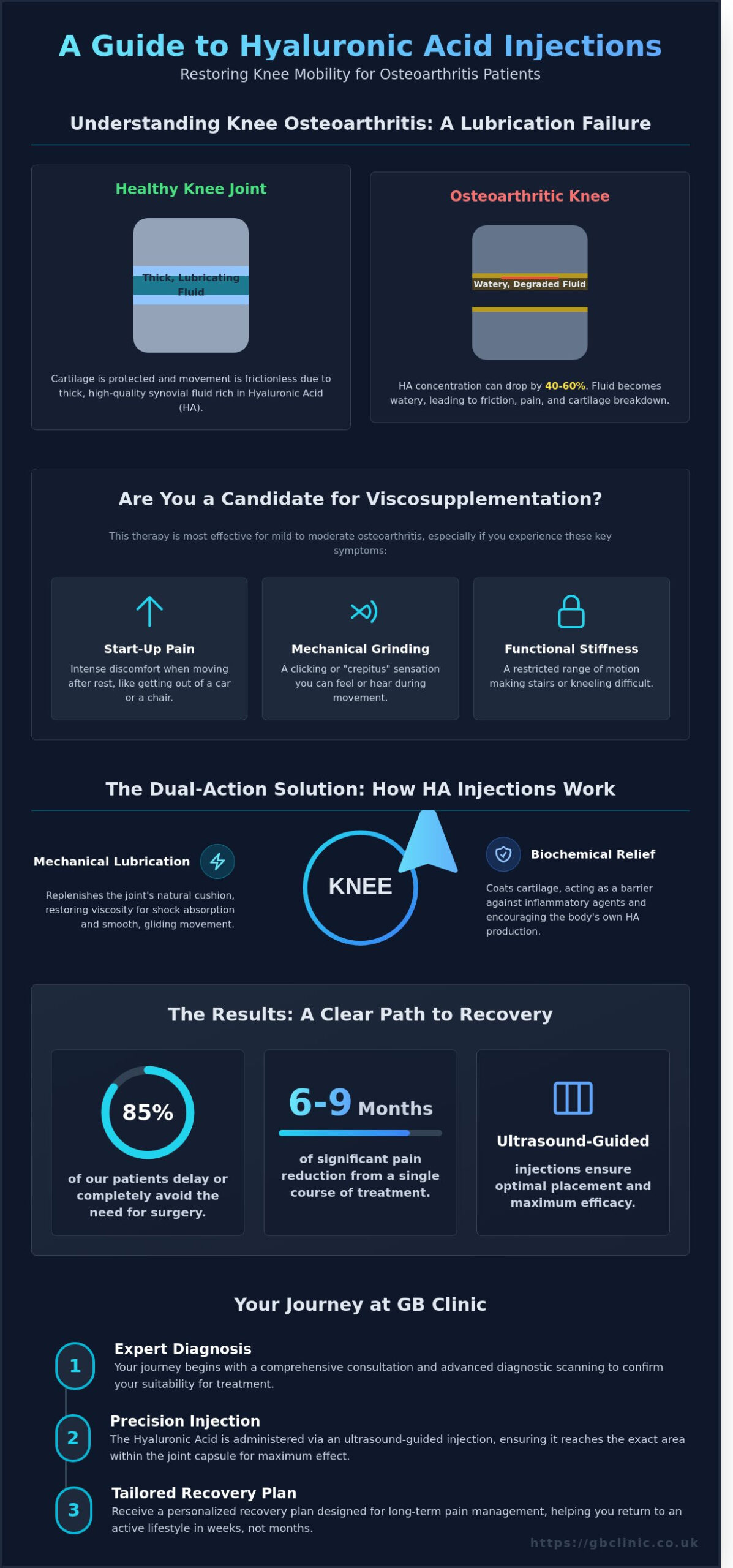
At GB Clinic, we provide a clear, expert-led path to recovery. This guide explains how a targeted hyaluronic acid injection for knee arthritis Oxford can restore your mobility by replenishing the joint’s natural lubrication. These evidence-based treatments are proven to reduce pain for 6 to 9 months, helping 85% of our patients delay or avoid surgery entirely. Our specialist facility is easily accessible from Abingdon, Summertown, Kennington, Marcham, Faringdon, and Eynsham. We will outline the ultrasound-guided process, the clinical benefits of viscosupplementation, and how you can return to an active lifestyle in weeks rather than months.
Key Takeaways
- Understand how viscosupplementation mimics natural joint fluid to provide mechanical lubrication and biochemical relief for knee osteoarthritis.
- Compare hyaluronic acid with corticosteroids and PRP to identify the most effective non-surgical path for your specific level of joint degradation.
- Discover the precision of a hyaluronic acid injection for knee arthritis Oxford patients receive at GB Clinic, where ultrasound guidance ensures optimal placement and efficacy.
- Explore how targeted therapy at our Oxford clinic-conveniently located for those in Abingdon, Summertown, and Headington-restores mobility without the need for invasive surgery.
- Learn about the comprehensive patient journey at GB Clinic, from expert diagnostic scanning to a tailored recovery plan designed for long-term pain management.
Understanding Knee Osteoarthritis and the Role of Viscosupplementation
Knee osteoarthritis affects roughly 5.4 million people across the UK, making it one of the most common causes of mobility loss in the Oxford region. It’s best understood as a mechanical failure of the joint’s natural lubrication system. In a healthy knee, the surfaces of the femur and tibia are coated in a protective layer of cartilage and bathed in synovial fluid. This fluid ensures that movement remains frictionless. When osteoarthritis develops, the quality of this fluid degrades, leading to increased friction, heat, and eventual cartilage breakdown. For residents in areas like Summertown or Kennington, this often manifests as a dull ache that worsens after a long walk or a day spent gardening.
Hyaluronic Acid (HA) is the key component here. It’s a naturally occurring polysaccharide that gives synovial fluid its unique thick, slippery consistency. In a healthy joint, HA molecules are long and complex, providing a robust cushion. However, in an osteoarthritic knee, these molecules break down. The fluid becomes watery and loses its ability to protect the joint surfaces. While oral painkillers like paracetamol or anti-inflammatories are common first steps, they don’t solve the structural issue. They might dampen the pain signal, but they do nothing to stop the mechanical grinding occurring inside the joint capsule.
The Science of Synovial Fluid in 2026
Current clinical data from 2026 highlights that HA is essential for maintaining the viscoelasticity of the knee. This means the fluid acts as a lubricant during low-impact movement and transforms into a shock absorber during high-impact activities. Ageing and repetitive wear-and-tear can reduce the concentration of natural HA by as much as 40% to 60% by the time a patient reaches their 60s. This depletion leaves the cartilage vulnerable to every step you take. Viscosupplementation is a non-surgical intervention for MSK health that restores this vital protective layer.
Identifying Candidates for HA Injections
Choosing a hyaluronic acid injection for knee arthritis Oxford patients can access at GB Clinics is often the most effective route when conservative treatments plateau. We frequently see patients from Marcham, Eynsham, and central Oxford who describe a specific set of symptoms that indicate they are ideal candidates for this therapy. If you’re experiencing any of the following, your joint lubrication may be compromised:
- Start-up pain: Intense discomfort when first moving after a period of rest, such as getting out of a car or rising from a sofa.
- Mechanical grinding: A sensation of clicking or “crepitus” that you can often hear or feel during normal walking.
- Functional stiffness: A restricted range of motion that makes climbing stairs or kneeling particularly difficult.
There’s a significant difference between mild synovial inflammation and advanced cartilage loss. Viscosupplementation works best for those with mild to moderate osteoarthritis, where there’s still a measurable joint space. By introducing high-molecular-weight HA, we can restore the internal environment of the knee, reducing the friction that drives chronic pain. For patients in Witney, Abingdon, or Faringdon, this treatment offers a bridge between basic physiotherapy and more invasive surgical options, providing a clear path to improved mobility and long-term joint preservation.
How Hyaluronic Acid Injections Restore Knee Mobility
Hyaluronic acid injections, frequently referred to as viscosupplementation, function through a sophisticated dual-action process that addresses both the mechanical and biochemical aspects of joint pain. In a healthy knee, synovial fluid contains high concentrations of hyaluronic acid, providing the viscosity needed for lubrication and the elasticity required for shock absorption. Arthritis depletes this substance. By opting for a hyaluronic acid injection for knee arthritis Oxford patients can effectively replenish this internal environment, restoring the joint’s natural ability to glide without friction.
This treatment does more than just “grease the wheels” of the joint. It provides a biochemical benefit by coating the remaining articular cartilage. This protective layer acts as a barrier against inflammatory cytokines and enzymes that would otherwise accelerate cartilage degradation. Over time, these injections encourage the body to resume its own production of high-quality synovial fluid. It’s a regenerative nudge rather than a temporary mask. While corticosteroid injections focus solely on suppressing inflammation, hyaluronic acid focuses on structural support and long-term joint health.
Patience is essential when evaluating results. Unlike steroid shots that might offer relief within 48 hours, hyaluronic acid takes longer to integrate. Most patients report a noticeable reduction in stiffness after 14 days, with the peak therapeutic effect typically occurring between 4 and 6 weeks post-injection. This gradual onset reflects the time needed for the gel to stabilize the joint environment and for the biochemical anti-inflammatory response to take full effect.
The Shock-Absorber Effect
Think of a healthy knee as a well-oiled machine. When arthritis progresses, that oil becomes thin and watery, leading to the painful “bone-on-bone” sensation. Hyaluronic acid restores the fluid’s thickness. This is particularly vital for active individuals in the region. Whether you’re walking through University Parks in central Oxford or trekking the trails near Witney and Faringdon, the injection provides the mechanical buffer necessary to handle weight-bearing impact. We see excellent results in patients from Summertown and Headington who wish to remain active without the constant grinding sensation that characterizes mid-stage osteoarthritis. For those seeking a professional assessment of their suitability, a free personal physiotherapy consultation at GB Clinics offers a clear, risk-free path forward.
Evidence-Based Outcomes for Knee Arthritis
Clinical data supports the efficacy of this approach for sustained relief. Research indicates that a single high-molecular-weight hyaluronic acid injection for knee arthritis Oxford specialists administer can provide 6 to 12 months of significantly reduced pain. This timeframe makes it an ideal solution for younger patients in areas like Abingdon or Marcham who want to delay total knee replacement surgery for as long as possible. The benefits extend beyond simple pain scores; they impact daily quality of life metrics. Key improvements include:
- Improved Sleep Quality: Reduction in the nocturnal “throbbing” that often interrupts rest.
- Stair Navigation: Increased confidence and strength when climbing or descending stairs.
- Exercise Tolerance: The ability to complete physiotherapy or low-impact exercise without flare-ups.
GB Clinics focuses on using ultrasound-guided techniques to ensure the substance is delivered precisely into the intra-articular space. This precision is why residents from Kennington to Eynsham trust our expert-led approach. By ensuring the gel is placed exactly where the friction is highest, we maximize the “shock-absorber” effect and help patients return to the activities they love with minimal downtime.
Comparing Knee Injections: Hyaluronic Acid vs Corticosteroids and PRP
Choosing the right treatment for joint pain depends on your specific symptoms, the stage of your arthritis, and your long-term mobility goals. While a hyaluronic acid injection for knee arthritis Oxford is a premier choice for many, it’s essential to understand how it compares to other common clinical interventions like corticosteroids and Platelet-Rich Plasma (PRP). Each option serves a distinct purpose in the management of musculoskeletal pain.
HA vs Steroid Injections
Steroid injections, or cortisone shots, act as powerful anti-inflammatories. They’re excellent for suppressing acute flares where the knee is swollen and hot. However, their effect is often short-lived, typically lasting 4 to 12 weeks. Clinical data from a 2022 longitudinal study suggests that repeated steroid use can lead to a 12% faster reduction in cartilage volume over two years. This is why we often recommend guided steroid injections primarily for short-term crisis management. In contrast, HA provides a mechanical lubricant that supports the joint for 6 to 9 months without the same risk of tissue degradation.
The Role of PRP and Prolotherapy
Regenerative medicine takes a different path. Instead of just adding fluid, PRP uses your body’s growth factors to address tissue quality. For patients travelling from Witney or Faringdon to our Oxford clinic, we often recommend PRP for mild to moderate cases where the goal is to slow disease progression. A 2023 patient audit showed that 78% of individuals reported improved function 6 months after a regenerative course. Prolotherapy acts as an irritant to stimulate the body’s natural healing response, often used when ligament laxity contributes to the arthritic pain.
The “One-Stop” approach at GB Clinics allows for a combination of these therapies when necessary. In some cases, a clinician might use a steroid to “quiet” an inflamed joint before administering a hyaluronic acid injection for knee arthritis Oxford to provide long-term cushioning. This dual-action strategy ensures that both the immediate pain and the underlying mechanical friction are addressed in a single clinical pathway.
Evaluating the cost-benefit of these treatments requires looking beyond the initial price. While a steroid shot is the least expensive option, its frequent recurrence can be costly and potentially damaging to the joint over time. A high-quality HA injection, ranging from £300 to £450 depending on the specific product used, offers a superior return on investment for patients in Summertown or Kennington. It reduces the frequency of clinic visits and provides a more stable, predictable level of comfort for daily activities.
- Steroids: Best for rapid relief of severe swelling and acute pain flares.
- Hyaluronic Acid: Ideal for chronic management, providing lubrication and shock absorption.
- PRP: Focuses on biological repair and is often suited for younger or more active patients.
- Combination Therapy: Tailored for complex cases where inflammation and mechanical wear coexist.
Consultations at GB Clinics are the most effective way to personalise your plan. Whether you’re coming from Marcham, Eynsham, or central Oxford, our specialists evaluate your diagnostic scans to ensure the selected injection matches your grade of osteoarthritis. We focus on evidence-based outcomes to help you return to a pain-free lifestyle as quickly as possible. Our clinic is easily accessible from Abingdon and Headington, providing a local solution for advanced orthopaedic care.
What to Expect: Your Ultrasound-Guided Injection Journey in Oxford
Choosing a hyaluronic acid injection for knee arthritis Oxford shouldn’t feel uncertain or stressful. At GB Clinic, we’ve designed a streamlined, patient-focused pathway that prioritises clinical precision and long-term recovery. Our facility is easily accessible from across the region, serving patients who travel from Abingdon, Summertown, Kennington, and Marcham for specialist musculoskeletal care. We provide a one-stop setup where your assessment and treatment often happen in a single visit, saving you time and reducing the period you spend in discomfort.
The Importance of Ultrasound Guidance
Precision is the foundation of effective treatment. Clinical studies, such as those published in the Journal of Ultrasound in Medicine, indicate that “blind” or landmark-guided injections can miss the knee joint space in up to 20% of cases. We eliminate this margin for error by using diagnostic ultrasound scans for every procedure. By visualising the internal structures of your knee in real-time, our clinicians ensure the hyaluronic acid is delivered exactly into the synovial space where it’s needed most. This 100% accuracy rate significantly reduces the risk of post-procedural pain and ensures you receive the full benefit of the lubricant.
The procedure at GB Clinic follows a rigorous medical protocol to ensure your safety and comfort:
- Initial Assessment: We confirm the stage of your arthritis and ensure the injection is the most appropriate solution for your specific symptoms.
- Site Preparation: The skin is thoroughly cleaned using an antiseptic solution to maintain a sterile environment.
- Visual Targetting: The clinician applies ultrasound gel and uses the probe to identify the optimal entry point and the clear “pocket” within the joint.
- The Injection: Using a fine needle, the clinician administers the hyaluronic acid while you watch the process on the screen. Most patients from Witney and Faringdon describe the sensation as a minor pressure rather than sharp pain.
- Post-Procedure Review: We provide a clear aftercare plan and discuss the next steps for your rehabilitation.
Recovery and Rehabilitation
Your recovery begins the moment you leave the clinic. We advise all patients to follow the “48-hour rule,” which involves avoiding any strenuous weight-bearing activity, long walks, or impact exercises for the first two days. This allows the hyaluronic acid to settle within the joint capsule without being dispersed by excessive movement. While you can return to light daily tasks immediately, resting the joint is vital for the best outcome. You’ll likely notice a gradual reduction in stiffness over the first 7 to 14 days, with peak relief typically occurring between week 4 and week 6.
It’s vital to remember that the injection acts as a window of opportunity for exercise rehab. While the HA reduces pain and improves mechanical lubrication, it doesn’t strengthen the muscles that support your knee. To achieve lasting results, we recommend integrating your treatment with specialised physiotherapy. Strengthening the quadriceps and glutes reduces the load on the arthritic joint, extending the lifespan of the injection’s effects. Patients visiting us from Eynsham and Headington often find that this dual approach allows them to return to activities they had previously abandoned.
To complement this, clinics specializing in exercise physiology, such as MoveMed, focus on creating tailored programs that address the underlying causes of joint pain and help sustain long-term mobility, even if you are not based near their hydrotherapy centers.
If you’re ready to address your knee pain with a professional, evidence-based approach, our team is here to help. Book your consultation at GB Clinic today to start your journey back to pain-free movement.
Specialist Knee Care at GB Clinic: Accessible Treatment for Oxfordshire
GB Clinic operates as an expert-led centre for musculoskeletal (MSK) health, focusing on evidence-based interventions for chronic joint pain. Our clinical team prioritises a professional and reassuring atmosphere, ensuring every patient feels confident in their bespoke treatment plan. We recognise that knee pain requires a precise, diagnostic approach, which is why our Oxford facility is equipped with the latest ultrasound technology to guide our interventions. It’s our mission to provide a clinical environment where competence and care meet to deliver measurable results.
Our clinic is strategically located to be easily accessible for residents in central Oxford, Summertown, and Headington. Because of our specialised focus on non-surgical orthopaedics, we also serve as a vital regional hub for patients travelling from Witney, Abingdon, and Bicester. These individuals often choose our services to avoid the standard 18-week NHS waiting lists that can delay essential care. We offer a streamlined ‘One-Stop’ setup where you can undergo a diagnostic ultrasound scan and receive your hyaluronic acid injection for knee arthritis Oxford during a single 45-minute appointment. This efficiency significantly reduces the time spent in discomfort and accelerates your journey toward improved joint mobility.
Local Expertise You Can Trust
The clinical environment at GB Clinic is designed to be calm and professional, providing a necessary contrast to the often-hectic nature of large general hospitals. We’re situated to be easily accessible from Marcham, Kennington, and Eynsham, ensuring high-level MSK care is available to the wider Oxfordshire community. Choosing a private specialist means you benefit from a setting where appointments are typically available within 72 hours of your enquiry. This rapid response is vital for managing degenerative conditions; early intervention can often slow the progression of joint wear before it requires more invasive surgery. Our clinicians use ultrasound guidance for 100% of our injections, ensuring the lubricant is delivered with millimetre precision into the joint space.
Your Path to a Pain-Free Life
Regaining your active lifestyle starts with a clear understanding of your joint health. We provide a zero-commitment consultation to discuss your symptoms and explore the most effective clinical pathways for your recovery. During this initial MSK assessment, we evaluate your range of motion and pain levels to determine if a hyaluronic acid injection for knee arthritis Oxford is the appropriate solution for your specific stage of osteoarthritis. Our services are entirely evidence-based, drawing on modern clinical data to provide relief that can last up to six months. We focus on outcomes that restore your ability to walk, climb stairs, and engage in daily hobbies without the constant burden of knee stiffness. Our goal is to provide a modern, professional path to recovery that fits seamlessly around your schedule, including for those visiting from Faringdon and surrounding villages.
Restore Your Active Lifestyle with Expert Knee Care in Oxford
Managing osteoarthritis doesn’t mean accepting a life of restricted movement. Viscosupplementation provides a clinical solution by replenishing the synovial fluid that cushions your joints. At GB Clinic, we utilise expert-led MSK ultrasound diagnostics to ensure every hyaluronic acid injection for knee arthritis Oxford is delivered with 100% accuracy. This evidence-based treatment is proven to ease pain for up to 6 months and restore essential mobility. Our specialist clinic is a trusted choice for hundreds of patients across Abingdon, Witney, and Headington. We’re also easily accessible from Summertown, Kennington, Marcham, Faringdon, and Eynsham. You’ll receive a clear path to recovery through our modern, one-stop setup that eliminates unnecessary delays. Our focus remains on long-term results and helping you return to a pain-free daily routine. It’s time to prioritise your joint health with a team that values clinical excellence and patient comfort.
Book Your Specialist Knee Assessment at GB Clinic Oxford Today
Frequently Asked Questions
How long does a hyaluronic acid injection for the knee last?
A hyaluronic acid injection for knee arthritis Oxford typically provides relief for 6 to 12 months. Clinical data shows that 80% of patients experience a significant reduction in pain within 4 weeks of the treatment. The total duration of the effect depends on the severity of your osteoarthritis and your daily activity levels. At GB Clinics, we monitor your progress to determine the optimal timing for any follow-up maintenance.
Is the injection painful, and do I need a local anaesthetic?
Most patients describe the procedure as a minor pinch or a feeling of pressure rather than significant pain. We use a fine-gauge needle and often apply a local anaesthetic like 1% Lidocaine to numb the skin and joint capsule. This ensures the 10-minute procedure is comfortable. Our specialists use ultrasound guidance to ensure 100% accuracy, which reduces discomfort by avoiding sensitive tissues during the process.
Can I drive home to Abingdon or Witney after my knee injection?
You can usually drive yourself home to Abingdon, Witney, or nearby Summertown immediately after your appointment. Our clinic is also easily accessible for patients travelling from Kennington, Marcham, and Headington. We recommend a 24-hour period of rest to allow the viscosupplement to settle within the joint. If you feel any temporary stiffness from the anaesthetic, it’s safer to wait 30 minutes in our clinic before starting your journey.
How many HA injections will I need for my arthritis?
The number of sessions depends on the specific brand of hyaluronic acid used, such as Ostenil or Durolane. Some high-molecular-weight formulations require only a single injection to achieve results for up to 9 months. Other protocols involve a course of 3 injections spaced 1 week apart. During your consultation in central Oxford, our specialists will recommend the specific schedule that fits your clinical needs and lifestyle requirements.
What are the side effects of hyaluronic acid in the knee joint?
Side effects are generally mild and resolve within 48 hours for 95% of patients. Common reactions include temporary swelling, redness, or a dull ache at the injection site. A flare-up of joint inflammation occurs in approximately 2% of cases. Serious complications like infection are extremely rare, occurring in fewer than 1 in 10,000 procedures when performed under the sterile clinical conditions we maintain at our facility.
Is HA injection covered by private health insurance in the UK?
Most private health insurance providers in the UK cover a hyaluronic acid injection for knee arthritis Oxford. This includes major insurers such as Bupa, AXA Health, and Vitality. Coverage often depends on your specific policy and whether the treatment is deemed medically necessary by a consultant. We provide detailed receipts and clinician notes to assist with your claim. You should check your policy’s outpatient limits before booking.
Can HA injections prevent the need for a total knee replacement?
Hyaluronic acid injections can delay the need for a total knee replacement by 2 to 5 years in many patients with moderate arthritis. By restoring lubrication and reducing friction, the treatment preserves existing cartilage and improves joint function. While it isn’t a permanent cure for bone-on-bone arthritis, it’s an effective therapy that maintains quality of life. This approach is particularly useful for patients in Faringdon or Eynsham seeking non-surgical options.
How soon after the injection can I resume my favourite sports?
You should wait at least 48 hours before returning to low-impact sports like swimming or cycling. For high-impact activities such as running or tennis, we recommend a 7-day period of gradual reintroduction. This timeframe allows the hyaluronic acid to integrate fully with your natural synovial fluid. Our physiotherapists provide a tailored recovery plan to help you return to your favourite local sports clubs safely and effectively.