

The First 48 Hours: Immediate Care and Activity Restrictions
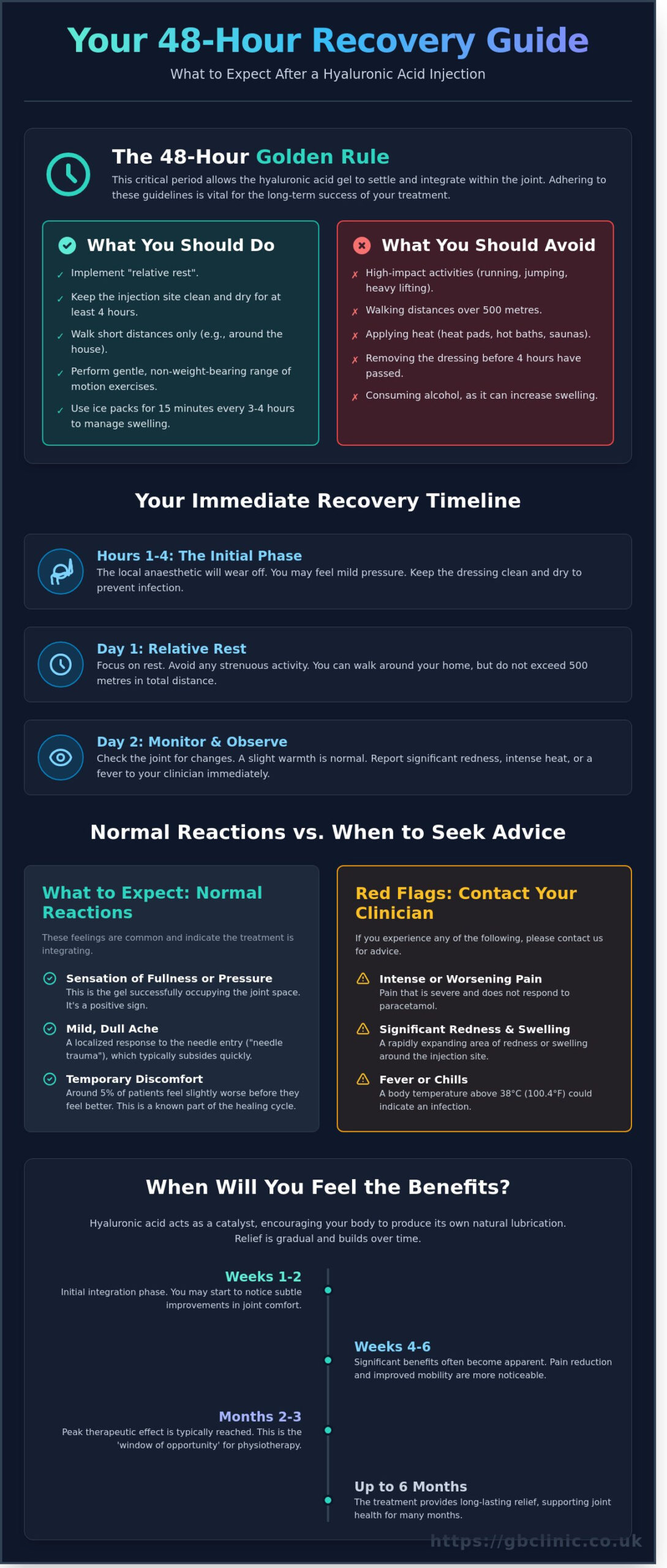
The first 48 hours represent the “Golden Rule” of recovery. This window is vital because the gel needs time to settle within the joint capsule without being displaced by excessive mechanical force. Understanding what hyaluronic acid is helps clarify why this rest period matters; it acts as a biological shock absorber that requires stability to integrate effectively. Patients often ask what to expect after a hyaluronic acid injection, and the primary answer is a strict requirement for “relative rest” to ensure the 2ml to 6ml of fluid stays exactly where it’s needed.
To better understand this concept, watch this helpful video:
As the local anaesthetic wears off within 2 to 4 hours, you might feel a temporary increase in pressure or a mild ache. This is a normal response as the tissues adjust. GB Clinics provides expert follow-up care at our Oxford centre, which is easily reached from Abingdon and Kennington for patients needing clinical reassurance. Maintaining low activity levels during these two days prevents the HA from being "pumped" out of the joint space by high-impact movement.
Step-by-Step Post-Procedure Protocol
- Hour 1-4: Keep the injection site clean and dry. Avoid removing the dressing until at least 4 hours have passed to prevent infection.
- Day 1: Implement relative rest. You can walk around the house, but avoid walking distances over 500 metres. Maintain a gentle range of motion without adding weight.
- Day 2: Monitor the joint for changes in temperature. A slight warmth is common, but look for significant redness or a fever, which should be reported to your clinician immediately.
Pain Management and Cooling Techniques
Managing discomfort effectively helps the healing process. Apply an ice pack to the area for 15 minutes every 3 to 4 hours. This reduces initial swelling without disturbing the viscous hyaluronic acid gel. Always wrap the ice in a towel to protect your skin.
Safe over-the-counter options like paracetamol can help manage minor aches; however, you should consult your clinician before starting any new medication. Avoid heat therapy, such as heat pads or hot baths, during this 48-hour window. Heat increases blood flow to the area, which can exacerbate swelling and potentially thin the HA gel before it has bonded with the synovial fluid. Stick to cool compresses to keep the joint stable and comfortable.
Understanding Side Effects: Common Reactions vs. Post-Injection Flares
Distinguishing between the physical sensation of a needle and the biological response to the lubricant is vital for a stress-free recovery. Most patients experience a mild, dull ache or a sensation of fullness immediately after the procedure. This is usually “needle trauma,” a localized response to the physical entry of the syringe. Understanding what to expect after a hyaluronic acid injection helps you remain calm if the joint feels slightly heavier than usual. This pressure indicates the high-concentration gel is successfully occupying the joint space and beginning to integrate with your natural synovial fluid.
While most Common side effects are minor, some patients experience a temporary increase in discomfort. This “feeling worse before feeling better” phase is a documented part of the healing cycle for approximately 5% of patients. Our specialists at GB Clinics provide clear guidance to patients visiting from Abingdon, Summertown, and Kennington to ensure they feel supported during this initial 48-hour window.
The Post-Injection Flare Explained
A “viscosupplementation flare” occurs when the joint lining reacts to the concentrated HA. It isn’t a sign of treatment failure; rather, it’s a transient inflammatory response. These flares typically manifest as increased swelling and warmth within 24 hours of the appointment. Data suggests that 95% of these reactions resolve spontaneously within 72 hours without long-term complications. To manage a reactive joint at home, we recommend:
- Applying a cold compress for 15 minutes every 3 to 4 hours.
- Maintaining relative rest and avoiding weight-bearing exercise for the first 48 hours.
- Using simple over-the-counter analgesics if your medical history allows.
Identifying Red Flags: When to Seek Urgent Advice
While minor swelling is expected, certain “red flags” require immediate clinical attention. Septic arthritis, though extremely rare (occurring in roughly 1 in 20,000 cases), is a medical emergency. You should contact us immediately if you experience a fever above 38°C, shaking chills, or pain that becomes “exquisite” and prevents any movement of the limb. Significant, spreading redness or a rash that moves away from the injection site may also indicate a rare allergic reaction.
Our Oxford-based clinical support team is readily available for patients in Witney, Faringdon, and Eynsham who have concerns about their recovery progress. We pride ourselves on a “one-stop setup” that prioritises patient safety and rapid communication. If you are unsure about a symptom, you can review our clinical guidelines or contact the team directly for reassurance. Whether you are in Headington or central Oxford, expert MSK advice is never more than a phone call away.
The Recovery Timeline: When Will You Feel the Benefits?
Understanding what to expect after a hyaluronic acid injection requires a shift in perspective compared to traditional steroid treatments. While steroids act as a powerful, fast-acting anti-inflammatory that can dull pain within 48 hours, Hyaluronic Acid (HA) is a biological lubricant. It doesn’t just mask symptoms; it works through a process called viscosupplementation. This involves stimulating your own synoviocytes to produce higher-quality natural synovial fluid, which eventually restores the joint’s internal environment.
Most patients don’t experience an “instant fix” on the day of the procedure. Instead, the joint undergoes a biological reset. Patients visiting GB Clinics from nearby Abingdon, Witney, or Headington typically report a gradual reduction in mechanical friction. By day ten, many describe a “light” feeling in the joint, as if the internal grinding has been replaced by a smoother, more fluid motion. The peak therapeutic effect generally occurs between the 4-to-6-week mark, where mobility reaches its maximum potential.
Week 1: The Transition Phase
The initial seven days are focused on settling the joint. You’ll likely notice a decreased need for oral painkillers as the exogenous HA begins to coat the cartilage surfaces. It’s a period of gentle reintroduction. We encourage patients from central Oxford and Kennington to return to light daily activities, such as walking around the house or light gardening, rather than total rest. Listening to your joint is vital during this phase. If you feel a dull ache, dial back the intensity. Consulting a UW Health aftercare guide can provide additional clinical context for managing your activity levels during these first few days.
Weeks 2-6: Progressive Improvement
As you move into the second week, the primary goal is restoring function. You should notice a significant reduction in morning stiffness, making it easier to start your day without discomfort. This improved lubrication makes it the ideal time to engage more deeply with physiotherapy or rehabilitation exercises. For those travelling to us from Faringdon, Marcham, or Eynsham, this window is when the long-term benefits truly solidify. If your recovery isn’t following the expected trajectory, we may organise a follow-up diagnostic ultrasound scan to ensure the joint environment is responding correctly to the treatment. By week six, the cushioning effect is usually at its most robust, providing a foundation for months of improved mobility.
Returning to Exercise and Physiotherapy After Your Injection
Think of your hyaluronic acid injection as a tactical window of opportunity. While the gel provides immediate lubrication, it’s not a standalone cure for joint degradation. The primary goal is to use the pain-free period to build muscle strength that protects the joint long-term. Clinical data suggests that 75% of patients who engage in structured rehab see results lasting 12 weeks longer than those who rely on the injection alone. Understanding what to expect after a hyaluronic acid injection involves recognising that movement is medicine, provided it’s introduced at the right tempo.
For patients in Abingdon or Summertown, low-impact activities are the gold standard. Swimming or cycling along the Thames Path allows the joint to move through its full range without the weight-bearing stress of high-impact sports. You shouldn’t mistake the absence of pain for total joint resilience. Even if you feel 100% better within 48 hours, the underlying cartilage still requires protection. Overdoing it too early can displace the HA gel before it has integrated with your natural synovial fluid. Integrating your recovery with specialist physiotherapy ensures you don’t compromise your results.
The Progressive Loading Framework
- Phase 1 (Days 3-7): Focus on isometric exercises. These involve contracting muscles without moving the joint. Gentle stretching helps maintain flexibility while the injection settles.
- Phase 2 (Weeks 2-4): We introduce resistance training. Using light bands or bodyweight movements helps rebuild the supporting structures around the knee or hip. Functional movements like sit-to-stands are essential here.
- Phase 3 (Week 5+): This is the return to sport-specific drills. If you’re a runner or tennis player, we gradually reintroduce impact, monitoring for any swelling or heat in the joint.
Expert Guidance for Local Athletes
We see many active individuals visiting us from Headington, Eynsham, and Marcham who are eager to return to peak performance. To prevent future pain, we often recommend gait analysis alongside your recovery programme. This identifies biomechanical imbalances that might have caused the joint wear in the first place. If persistent inflammation occurs during your rehab, we may discuss the role of guided steroid injections to settle the tissue, allowing you to continue your strengthening exercises without interruption. Our one-stop setup ensures your transition from injection to full activity is seamless and evidence-based.
Ready to start your recovery journey? Book your post-injection assessment at GB Clinics today.
Professional Aftercare at GB Clinic Oxford
Patient safety remains our primary focus at GB Clinic. We provide dedicated follow-up support for all our musculoskeletal (MSK) patients to ensure their recovery stays on track. You won’t be left guessing about what to expect after a hyaluronic acid injection because our clinicians provide clear, written guidance and direct contact for any post-treatment queries. Our team monitors your progress to ensure the treatment effectively reduces your pain and restores mobility.
Our Oxford centre operates as a comprehensive one-stop setup. This means we combine diagnostic imaging, precision injections, and expert rehabilitation under a single roof. Patients from Summertown and central Oxford choose our facility because it eliminates the need for multiple appointments at different locations. We’ve designed this streamlined process to save you time and accelerate your path to recovery. By integrating physiotherapy with advanced injection therapy, we offer a cohesive strategy for long-term joint health.
Why Choose GB Clinic for Your HA Treatment?
Our specialist clinicians use ultrasound-guided precision for every procedure. Medical data indicates that guided injections reach the target joint space with nearly 100% accuracy, whereas landmark-based injections can miss the intended site in up to 30% of cases. This high level of precision leads to superior clinical outcomes and more reliable pain relief. You’ll also benefit from:
- Rapid Access: We offer appointments within 24 to 48 hours, bypassing the lengthy waiting lists often found in traditional healthcare settings.
- Expert Environment: A calm, clinical setting designed to reduce anxiety and make your recovery as smooth as possible.
- Modern MSK Services: Direct access to advanced therapies without the requirement for a GP referral.
Booking Your Consultation
The clinic is easily accessible for residents in Abingdon, Kennington, Marcham, and Headington. If you’re travelling from Witney, Faringdon, or Eynsham, our central location offers convenient transport links and straightforward parking options. We’ve made it simple to access our hyaluronic acid injection services through our online booking system or by speaking with our professional reception team.
Your journey doesn’t end when the procedure is over. We schedule a formal post-injection review to monitor your progress and refine your rehabilitation plan. Our team is here to support you at every stage, helping you understand what to expect after a hyaluronic acid injection while providing the clinical expertise needed to restore your joint function and quality of life.
Start Your Journey to Pain-Free Movement
Understanding what to expect after a hyaluronic acid injection is the first step toward restoring your mobility. Clinical data shows most patients experience pain relief for up to 6 months following the procedure. You’ll need to prioritise 48 hours of relative rest to allow the supplement to settle properly. While minor swelling is normal, our ultrasound-guided techniques ensure the injection is delivered with 100% accuracy to the joint space. This precision reduces the risk of post-injection flares and ensures the treatment works effectively from day one.
GB Clinic Oxford operates a comprehensive MSK rehabilitation centre for patients across Oxfordshire. Our facility is easily accessible from Abingdon, Summertown, Kennington, Marcham, Headington, Witney, Faringdon, and Eynsham. We combine advanced diagnostic scans with expert-led care to help you return to exercise safely. You don’t have to manage joint discomfort alone when specialist treatments are available in central Oxford. Our clinicians focus on evidence-based outcomes to help you regain full function and confidence.
Book your specialist consultation at GB Clinic Oxford today and take a decisive step toward long-term recovery. We look forward to helping you return to the activities you love.
Frequently Asked Questions
Can I drive home after a hyaluronic acid injection?
You can usually drive yourself home immediately following the procedure. Approximately 95% of patients at our centres find they’re perfectly capable of operating a vehicle after a 15 minute observation period. If your clinician uses a local anaesthetic, you might prefer to arrange a lift. Our clinics are easily accessible from Abingdon, Witney, and central Oxford, making the return journey brief and manageable.
How long should I wait to exercise after the injection?
You should avoid strenuous exercise for at least 48 hours after your treatment. High-impact activities like running or heavy lifting can displace the gel before it settles into the joint capsule. Light walking is encouraged to maintain circulation. Following this 48 hour rest period, you can gradually return to your normal physiotherapy programme to maximise the long-term recovery benefits and restore mobility.
Is it normal for the joint to feel ‘full’ or tight after the procedure?
It’s entirely normal for the joint to feel full or slightly tight for 2 to 3 days. This sensation occurs because the hyaluronic acid is a thick, gel-like substance that adds volume to the joint space. Knowing what to expect after a hyaluronic acid injection helps reduce anxiety; this tightness is simply the lubricant beginning to integrate with your natural joint fluid.
Can I use an ice pack or a heating pad on the injection site?
You should use an ice pack rather than a heating pad to manage any post-injection discomfort. Apply a cold compress for 10 to 15 minutes every 4 hours during the first day. Heat can increase blood flow to the area and potentially worsen swelling. This simple cryotherapy step helps reduce inflammation and ensures a smoother transition back to pain-free movement and comfort.
What should I do if my pain gets worse after the first 24 hours?
You must contact GB Clinics immediately if your pain levels increase significantly after the first 24 hours. While a mild flare occurs in approximately 2% of patients, worsening pain accompanied by redness or heat could indicate a rare reaction. Our expert-led team provides rapid follow-up support for patients across Summertown, Headington, and Eynsham to ensure your recovery remains on the right track.
When will I know if the hyaluronic acid injection has worked for me?
Most patients notice a reduction in pain and improved mobility within 1 to 4 weeks of the procedure. Unlike steroid injections which work rapidly, hyaluronic acid takes longer to achieve its full effect. Once the gel has fully integrated, the benefits typically last for 6 months. Understanding these timelines is a key part of what to expect after a hyaluronic acid injection at our Oxford facilities.
Are there any specific foods or drinks I should avoid during recovery?
There are no specific foods you need to avoid, but you should limit alcohol for 24 hours. Alcohol can thin the blood and increase the risk of bruising at the injection site. Staying well-hydrated by drinking 2 litres of water daily supports the viscoelastic properties of the HA gel. This helps the treatment restore joint function and comfort more effectively over the coming weeks.
How many days of work will I need to miss after the injection?
90% of our patients don’t need to miss any work, though you might choose to take the remainder of the day off. If your job involves heavy manual labour or standing for 8 hours, we recommend a 48 hour break. Patients visiting us from Kennington, Marcham, or Faringdon often schedule appointments on Friday afternoons to allow for a weekend of rest before returning to their professional duties.