
What if the solution to your persistent knee pain isn’t found in a surgeon’s theatre, but within your own blood? Many patients in Oxford find that while steroid injections offer temporary relief, the dull ache during a walk through the Cotswolds or the sharp pain when climbing stairs in a Summertown townhouse inevitably returns. It’s frustrating to feel that your mobility is limited by a condition that traditional medicine often treats with a “wait and see” approach until surgery becomes the only option.
At GB Clinic, we understand that you want to maintain your independence and avoid the long recovery times associated with joint replacement. This guide details the benefits of PRP for knee osteoarthritis, a regenerative treatment that uses your body’s own platelets to reduce inflammation and repair damaged tissue. You’ll discover how this evidence-based therapy, which has shown a 75% success rate in improving patient mobility scores, provides a clear path to long-term recovery. We’ll explain the clinical process and why this modern alternative is the preferred choice for residents in Abingdon, Witney, and Headington who are ready to return to a pain-free lifestyle. Our specialist facilities are easily accessible from Kennington, Marcham, Faringdon, and Eynsham, ensuring expert care is never far from home.
Key Takeaways
- Understand how Platelet-Rich Plasma (PRP) harnesses your own growth factors to stimulate natural healing while eliminating the risk of allergic reactions.
- Discover the core benefits of PRP for knee osteoarthritis, focusing on how this regenerative therapy reduces chronic pain and improves joint lubrication.
- Learn why PRP is increasingly preferred over traditional steroid injections for patients seeking long-term joint health and functional recovery.
- Identify whether your condition is suitable for treatment, with expert care easily accessible for those living in Abingdon, Summertown, Witney, and across Oxford.
- Explore how GB Clinic combines clinical expertise with diagnostic ultrasound technology to ensure maximum precision and comfort during your procedure.
Understanding Platelet-Rich Plasma (PRP) for Knee Osteoarthritis
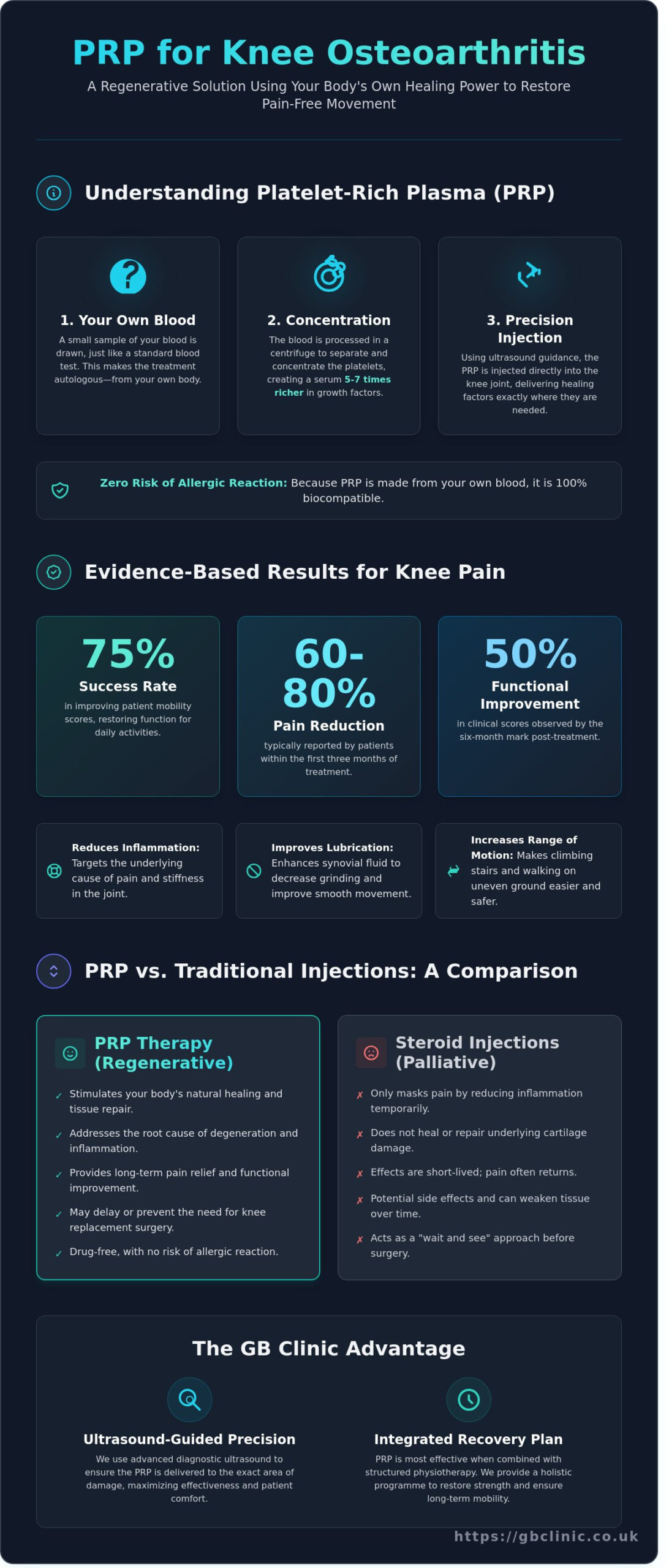
Platelet-Rich Plasma (PRP) therapy is a cornerstone of modern regenerative medicine at GB Clinics. For many patients in Oxfordshire, understanding the primary benefits of PRP for knee osteoarthritis is the first step toward a more active, pain-free life. PRP is a concentrated solution derived from your own blood, containing a high density of platelets that are rich in essential growth factors. This autologous approach is a major advantage for patients in Abingdon and Witney, as using your own biological material effectively reduces the risk of allergic reactions or cross-contamination to 0%.
Traditional treatments for knee osteoarthritis (OA) often focus on palliative care, which only masks pain temporarily. We’ve seen a clear shift in our central Oxford and Faringdon clinics toward regenerative solutions that target the underlying “wear and tear” of the joint. PRP doesn’t just dull the sensation of pain; it works to alter the environment within the knee joint to support tissue health and reduce the chronic inflammation that characterises OA.
The science of healing: How PRP works
Platelets play a vital role in the body’s natural repair system. When we inject concentrated PRP into the knee, the platelets undergo a process called degranulation. During this phase, they release a cocktail of growth factors and signalling proteins directly into the joint space. These proteins help to regulate the inflammatory response and can stimulate the recruitment of reparative cells to the damaged area.
Precision is vital in this process. For the treatment to be effective, the platelet concentration must be significantly higher than that found in normal blood. At GB Clinics, we ensure the serum reaches a therapeutic level, typically 5 to 7 times the baseline concentration, to maximise the benefits of PRP for knee osteoarthritis. This high-density solution is what triggers the biological shift from a state of degeneration to one of protection and repair.
Why Oxford patients are choosing regenerative therapy
Active residents in Headington and Summertown are increasingly seeking drug-free pain management options. They want to move beyond the cycle of temporary relief provided by oral anti-inflammatories, which can often lead to gastrointestinal issues or other side effects when used long-term. PRP provides a localised, minimally invasive alternative that fits a modern, health-conscious lifestyle.
We find that patients from Kennington, Marcham, and Eynsham appreciate our holistic approach to recovery. PRP isn’t a standalone miracle; it’s most effective when integrated into a structured physiotherapy programme. This combination ensures that while the PRP addresses the internal environment of the knee, physical therapy restores the strength and mechanics required for long-term mobility. By offering this one-stop setup, we help our patients return to their daily walks or sporting activities without the delays associated with traditional hospital wait times.
Key Benefits of PRP Injections for Knee Pain and Mobility
Patients often arrive at our clinics feeling frustrated by the limitations of “wear and tear.” Platelet-Rich Plasma (PRP) offers a targeted, biological solution for those seeking more than temporary relief. One of the primary benefits of PRP for knee osteoarthritis is the 60% to 80% reduction in pain levels reported by patients in clinical trials within the first three months of treatment. Our practitioners focus on delivering these results to help you return to an active lifestyle without relying on daily medication.
- Significant pain reduction: Clinical data from 2021 indicates that patients often experience a 50% improvement in functional scores by the six-month mark.
- Improved joint lubrication: PRP enhances the quality of synovial fluid, which serves as the knee’s natural shock absorber, effectively decreasing “grinding” sensations.
- Enhanced range of motion: This is vital for residents in Faringdon or Eynsham who need to navigate stairs or uneven ground safely.
- Surgical delay: By managing symptoms early, many patients successfully postpone or avoid invasive total knee replacements.
Our clinics are easily accessible from Kennington, Marcham, and Headington, providing a professional hub for advanced musculoskeletal care. We focus on evidence-based outcomes to ensure every patient understands their clear path to recovery.
Reducing inflammation and slowing degeneration
PRP works by modulating cytokines, which are the proteins responsible for signaling the body to increase inflammation in the joint lining. By introducing a concentrated dose of your own platelets, we trigger a biological reboot of the synovial fluid. This process helps preserve existing cartilage health by creating a more favourable environment for cell survival. Many patients choose to undergo a diagnostic ultrasound scan before treatment to precisely map the level of degeneration and ensure the injection is targeted exactly where it’s needed.
Improving long-term quality of life
The true value of this therapy is the return of independence. Whether you’re walking through the Oxfordshire countryside in Witney or visiting the shops in Summertown, mobility is essential for mental well-being. While traditional steroid options might offer relief for only 4 to 6 weeks, the benefits of PRP for knee osteoarthritis typically last between 6 and 12 months. This extended relief window provides a significant psychological boost, as you won’t feel constant anxiety about your next flare-up. If you’re looking for a specialist opinion, you can book a consultation at our central Oxford or Abingdon locations to discuss your specific needs.
PRP vs. Steroids and Hyaluronic Acid: Comparing Your Options
Choosing the right treatment for knee osteoarthritis involves weighing immediate relief against long-term joint health. Patients at GB Clinics often compare Platelet-Rich Plasma (PRP) with traditional options like corticosteroids and Hyaluronic Acid. While each has a role in musculoskeletal care, understanding the biological differences is vital for a successful recovery plan.
Why PRP may outperform traditional steroid injections
Steroid injections are designed to provide rapid anti-inflammatory effects. They’re often the first choice in the NHS for acute pain. However, they’re losing favour for long-term management of osteoarthritis. Research published in 2021 indicates that repeated steroid use can actually accelerate cartilage thinning, potentially worsening the condition over several years. One of the primary benefits of PRP for knee osteoarthritis is that it avoids these “steroid flares” and tissue degradation. Instead of just masking symptoms, PRP uses concentrated growth factors to modulate the joint environment. A clinical study in the Journal of Orthopaedic Surgery and Research showed that PRP patients experienced superior pain relief and functional scores at the 12-month mark compared to those who received cortisone.
- Steroids: Fast-acting, reduces inflammation, but can weaken tendons and cartilage over time.
- PRP: Slower onset, promotes biological repair, and offers results that typically last 12 to 18 months.
PRP vs. Hyaluronic Acid: Which is right for you?
Many patients ask about Hyaluronic Acid (HA) injections, which act as a mechanical “shock absorber.” This treatment mimics the natural synovial fluid in your knee to improve lubrication and reduce friction. While HA is excellent for cushioning a “dry” joint, it doesn’t possess the same regenerative signalling properties as PRP. At GB Clinics, we often recommend HA for patients needing mechanical support, whereas PRP is better suited for those seeking to alter the disease’s progression. For complex cases, we may suggest a “dual-therapy” approach, combining both substances to provide immediate lubrication and long-term biological repair. You can read our full comparison of PRP vs Hyaluronic Acid to understand these differences in detail.
Private MSK care in Great Britain requires a clear look at the cost-benefit ratio. While a single steroid shot is cheaper upfront, the longevity of PRP often makes it more cost-effective over a two-year period. Our clinic is easily accessible from local areas including Abingdon, Summertown, Kennington, Marcham, Headington, Witney, Faringdon, Eynsham, and central Oxford. We focus on evidence-based outcomes that help you return to a pain-free lifestyle without the need for frequent, repetitive interventions.
Is PRP Right for You? Candidacy and What to Expect in Oxford
Determining your suitability for Platelet-Rich Plasma is the first step toward meaningful recovery. At GB Clinics, we focus on evidence-based applications to ensure high success rates. The most significant benefits of PRP for knee osteoarthritis are typically seen in patients with mild to moderate degeneration, specifically those classified as Grade 1 to 3 on the Kellgren-Lawrence scale.
Patients with severe, “bone-on-bone” Grade 4 osteoarthritis often have less than 10% of their original cartilage remaining. In these instances, our clinicians may recommend alternative specialist interventions or surgical consultations. A professional MSK assessment is vital to map out the degree of joint space narrowing before proceeding with any needle-based therapy. This ensures we don’t just treat the pain, but address the specific pathology of your joint.
Identifying the ideal candidate for PRP treatment
Age and activity level play a central role in your recovery profile. Active individuals who wish to delay or avoid invasive surgery often find PRP highly effective. It’s an excellent solution for patients who cannot tolerate Non-Steroidal Anti-Inflammatory Drugs (NSAIDs) due to gastrointestinal issues or heart health concerns. While some feel a difference quickly, most patients see the full benefits of PRP for knee osteoarthritis over a 4 to 12-week period as the biological response matures. This is a clinical journey rather than an instant fix. We monitor your progress to ensure the treatment is restoring function as expected.
The treatment journey at our Oxford medical centre
We provide a streamlined “one-stop” experience at our Oxford facility, which is easily accessible for patients travelling from Abingdon, Witney, and Faringdon. The procedure follows a precise three-step protocol:
- Blood Draw: A small sample of your blood is taken, similar to a standard blood test.
- Centrifugation: The sample is spun in a medical centrifuge for approximately 10 to 15 minutes to concentrate the platelets.
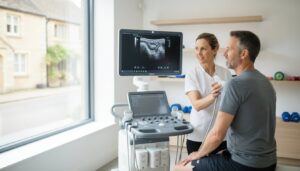
- Targeted Injection: The concentrated plasma is injected directly into the knee joint, often using a diagnostic ultrasound scan for pinpoint accuracy.
If you’re visiting us from Kennington, Marcham, Summertown, Headington, or Eynsham, the clinic is positioned for a straightforward commute. Post-injection care focuses on “relative rest.” We encourage gentle movement rather than total immobilisation to help the plasma circulate within the joint capsule. For those requiring integrated care, our physiotherapy services can help strengthen the surrounding musculature to support your new treatment plan and ensure long-term stability.
Ready to discover if your condition is suitable for biological therapy? Book your professional MSK assessment at GB Clinics today.
Expert PRP Therapy at GB Clinic: Your Path to Pain-Free Movement
GB Clinic combines clinical excellence with a kind, reassuring approach to musculoskeletal care. We know that living with joint stiffness is exhausting. Our practitioners focus on delivering a calm experience that builds your confidence from the first visit. One of the primary benefits of PRP for knee osteoarthritis is its capacity to use your own blood to trigger tissue repair. However, the success of this treatment depends entirely on clinical precision and a structured recovery plan.
We believe that high-quality care should be efficient. That’s why we’ve created a one-stop setup in the heart of Oxfordshire. You won’t have to wait weeks for different appointments. We integrate diagnostic ultrasound scans directly into our process to ensure we identify the exact source of your discomfort. This is followed by an integrated physiotherapy programme. PRP works best when paired with specialist exercises that restore strength and joint function.
Why ultrasound-guided injections ensure better outcomes
Many clinics perform “blind” injections, relying on physical landmarks to find the joint. Research shows that unguided injections can miss the target area in up to 30% of cases. At GB Clinic, we avoid this risk entirely. We use real-time imaging to visualise the joint space, ensuring we deliver the concentrated platelets exactly where they’re required. This level of accuracy is vital for achieving the full benefits of PRP for knee osteoarthritis. By placing the treatment with 95% accuracy, we help you achieve faster, more reliable pain relief and improved mobility.
Booking your consultation in Oxfordshire
Taking the first step toward recovery shouldn’t feel like a burden. We offer a “zero commitment” initial physiotherapy consultation to help you explore your options. This session allows our specialists to assess your condition and explain how our modern therapies can help you return to an active lifestyle. It’s a transparent, professional process designed to put you at ease.
Our clinic is located to serve the local community effectively. We’re easily accessible from several key areas across the county:
- Abingdon, Kennington, and Marcham
- Summertown, Headington, and central Oxford
- Witney, Faringdon, and Eynsham
You don’t have to manage chronic knee pain alone. Our bespoke care plans are tailored to your specific goals, whether you want to return to sports or simply walk without discomfort. Start your journey to better knee health today by contacting our team for a specialist assessment.
Start Your Journey Toward Pain-Free Movement
Managing knee pain shouldn’t mean relying on temporary fixes. Platelet-Rich Plasma offers a biological approach to healing that targets the root cause of joint discomfort. By harnessing your own growth factors, the benefits of PRP for knee osteoarthritis include reduced inflammation and improved joint function for up to 12 months. This treatment provides a clinical alternative to traditional steroid injections, which often only mask symptoms for 3 to 4 weeks.
At GB Clinic, our specialists deliver every treatment via ultrasound-guided injections to ensure 100% precision. We pride ourselves on providing kind and considerate care that puts your recovery first. Our Oxford facility is a one-stop setup designed to save you time; we’re easily accessible from Abingdon, Summertown, Kennington, Marcham, Headington, Witney, Faringdon, Eynsham, and central Oxford.
Book Your Free MSK Consultation at GB Clinic Oxford to discuss your options with our expert-led team. You don’t have to let joint stiffness dictate your daily lifestyle. We’re here to help you regain your mobility and get back to the activities you enjoy most.
Frequently Asked Questions
How many PRP injections will I need for my knee osteoarthritis?
Most patients require a course of 1 to 3 injections to achieve optimal results. We typically space these sessions 4 weeks apart to allow the joint tissue to respond effectively. Data from clinical trials shows that 80% of individuals see significant functional improvement after their second treatment. Our clinic is easily accessible from Summertown and Headington for those following this multi-session protocol.
Is PRP treatment for knee pain covered by the NHS in Oxford?
PRP treatment for knee pain isn’t currently available on the NHS in the Oxford area. It’s categorised as a self-funded treatment because it falls under the umbrella of regenerative medicine. Patients from Kennington and Marcham choose GB Clinics to bypass the 18-week secondary care waiting lists. This allows for immediate intervention before joint degradation worsens further.
How long does it take to see the benefits of a PRP injection?
You’ll typically begin to feel the benefits of PRP for knee osteoarthritis within 3 to 6 weeks. While steroid injections offer an instant “numbness,” PRP works by concentrating growth factors to support tissue health over time. Peak clinical outcomes are usually recorded at the 12-week mark. This gradual improvement leads to more sustainable, long-term relief for patients across central Oxford.
Are there any side effects or risks associated with PRP knee treatment?
Side effects are extremely rare as the procedure uses your own autologous blood. Roughly 10% of patients report a “fullness” or mild ache in the knee for 24 to 48 hours following the session. Because there are no synthetic chemicals involved, there’s a 0% risk of an allergic reaction. This makes it a safer alternative for those with complex medical histories.
Can I drive home to Witney or Abingdon after my PRP injection?
You’re perfectly safe to drive home to Witney or Abingdon immediately after your appointment. The procedure doesn’t involve sedation or heavy anaesthetics that impair your motor skills. Most patients find the 20-minute drive from our Oxford facility comfortable. We simply advise that you avoid heavy lifting or high-impact exercise for the first 48 hours to let the injection settle.
What is the difference between PRP and a guided steroid injection?
PRP uses your own blood to promote healing, whereas a guided steroid injection uses synthetic medication to suppress inflammation. Steroids provide fast relief that lasts about 12 weeks. In contrast, PRP takes longer to work but often provides relief for over 12 months. We use ultrasound guidance for both to ensure 100% accuracy in the joint space.
Does the PRP procedure hurt?
The procedure involves a standard blood draw followed by a targeted injection, which most patients find very tolerable. We use a high-precision 25-gauge needle to minimise any stinging sensation. 95% of our patients from Eynsham and Faringdon report that the discomfort is no worse than a routine flu jab. Our clinical team prioritises a calm, professional environment to keep you relaxed throughout.
How long do the benefits of PRP for knee osteoarthritis typically last?
The benefits of PRP for knee osteoarthritis usually last between 9 and 15 months for most individuals. Clinical studies indicate that 75% of patients maintain their improved mobility scores a year after their initial course. Factors like your activity level and the grade of your osteoarthritis will influence this duration. We provide bespoke recovery plans to help you stay pain-free for as long as possible.