

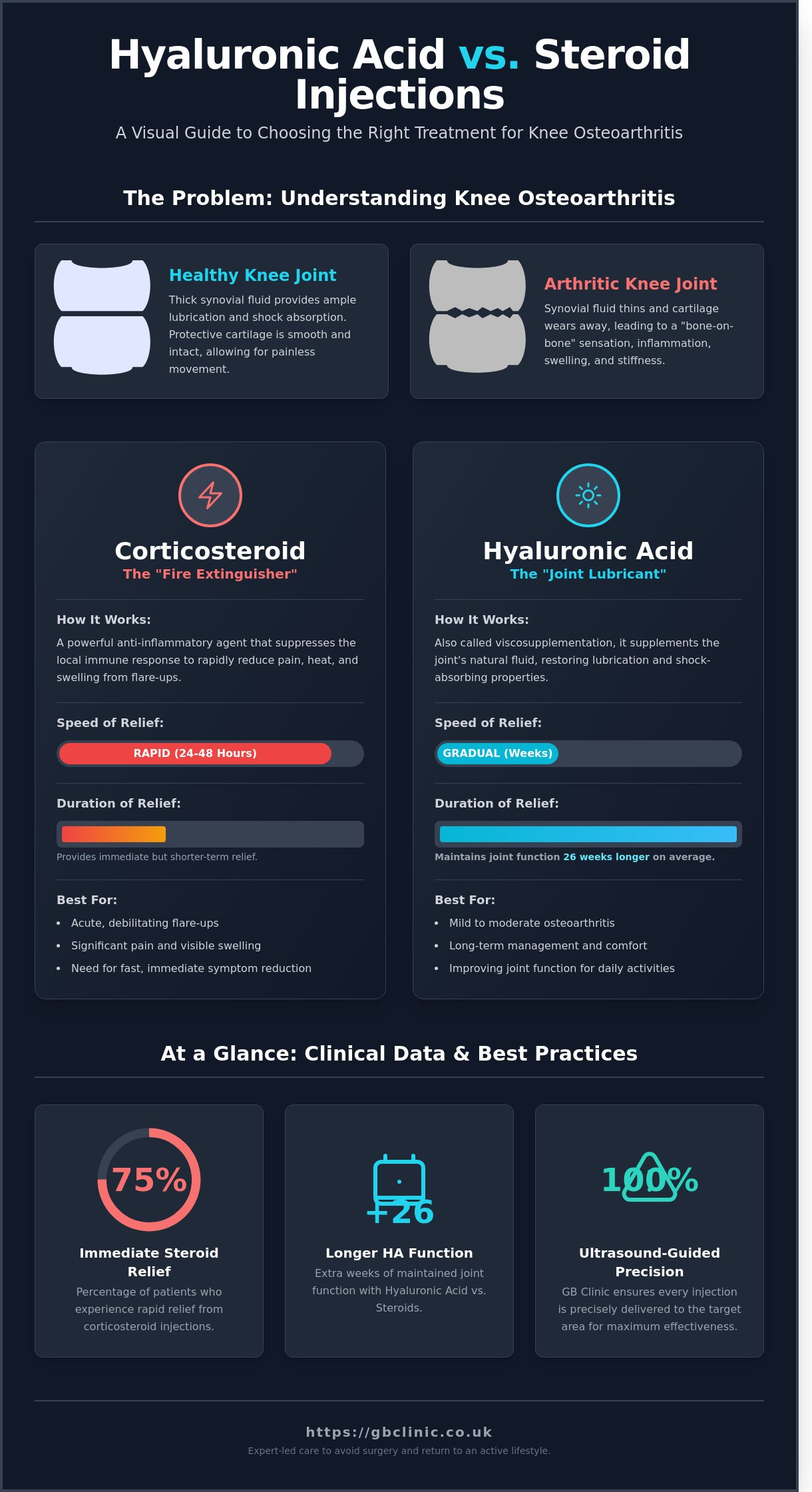
Clinical data from 2023 shows that while 75% of patients receive immediate relief from corticosteroids, those opting for viscosupplementation often maintain their joint function for 26 weeks longer. You’ve likely experienced that sharp, grinding stiffness that makes a morning walk through Summertown or Kennington feel like a chore. It’s a common struggle for our patients who want to stay active but fear that a total knee replacement is their only remaining option. At GB Clinics, we provide expert-led care to help you avoid surgery and return to the activities you enjoy. This guide explores the essential differences between hyaluronic acid vs steroid injection for knee pain to help you select the most effective treatment for your lifestyle. We’ll detail the recovery timelines and clinical benefits for those living in Abingdon, Marcham, or Headington. You’ll learn how these targeted therapies provide a clear path to reduced pain and improved mobility for residents across Witney, Faringdon, and Eynsham, ensuring you can walk comfortably through central Oxford once again.
Key Takeaways
- Understand the biological mechanisms of the “fire extinguisher” steroid effect versus the “lubricant” hyaluronic acid effect for managing knee osteoarthritis.
- Compare the rapid onset of steroids with the long-lasting mobility benefits of a hyaluronic acid vs steroid injection for knee to determine the best duration for your recovery.
- Learn how to assess your pain severity and activity goals to select the most appropriate treatment for long-term joint health and comfort.
- Discover the clinical importance of ultrasound-guided accuracy used at our Oxford clinic to ensure 100% precision for every musculoskeletal injection.
- Identify how to access specialist MSK care that is easily accessible from Abingdon, Witney, and Headington to restore your active lifestyle.
Understanding Knee Osteoarthritis and Your Injection Options in Oxford
Chronic knee pain acts as a significant barrier to an active lifestyle for thousands of residents across Oxfordshire. Whether you’re walking through Summertown, commuting from Abingdon, or enjoying the parks in Headington, persistent joint discomfort can dictate your daily schedule. At GB Clinic, we see patients who’ve struggled with mobility for months or even years before seeking specialized care. A formal diagnosis remains the most critical step before proceeding with clinical interventions. Understanding the nuances of hyaluronic acid vs steroid injection for knee pain is essential for anyone looking to avoid or delay invasive surgery.
Our clinical team provides a structured path for patients seeking medial knee soreness treatment in Oxford. We focus on evidence-based outcomes to restore joint function and improve your quality of life. By offering a “one-stop” setup, we ensure that diagnosis and treatment occur efficiently, saving you time and reducing the period you spend in discomfort.
To better understand these treatment concepts, watch this helpful video from a clinical perspective:
The Problem: Why “Bone on Bone” Pain Occurs
Knee pain often stems from the gradual degradation of the joint’s natural environment. Healthy knees rely on a thick, viscous substance called synovial fluid to lubricate movement and absorb shock. As Knee arthritis progresses, this fluid thins and the protective cartilage wears away. This leads to the “bone on bone” sensation that many patients describe. These mechanical changes trigger inflammatory flare-ups, which cause the joint to swell and stiffen. Standard oral painkillers often fail to provide long-term relief because they don’t address the internal environment of the joint directly. When daily movement becomes a struggle, it’s a sign that the joint requires a more targeted approach to manage the underlying inflammation and friction.
The Solution: Targeted Intra-articular Injections
Targeted injections serve as a vital bridge between conservative physiotherapy and major surgical options. For patients in Kennington, Marcham, and Witney, these treatments offer a way to regain independence without the recovery time associated with an operation. We utilise a “One-Stop” approach in Oxfordshire, combining a diagnostic ultrasound scan with the treatment itself to ensure precision. The primary options include:
- Guided Steroid Injections: These provide a rapid reduction in symptoms by aggressively tackling localized inflammation.
- Hyaluronic Acid Injections: These act as a lubricant to supplement the joint’s natural fluid, often providing longer-lasting relief for mild to moderate wear.
Our clinic is easily accessible from Faringdon, Eynsham, and central Oxford, ensuring that professional MSK care is never far away. By choosing the right hyaluronic acid vs steroid injection for knee health, you can expect a significant improvement in mobility and a faster return to the activities you enjoy.
Steroid vs Hyaluronic Acid: How Each Injection Works
Choosing between a hyaluronic acid vs steroid injection for knee pain requires an understanding of how these substances interact with your joint biology. While both treatments aim to reduce discomfort, they target different aspects of joint pathology. One acts as a rapid response to inflammation, while the other serves as a mechanical supplement to the joint fluid.
Corticosteroids: Rapid Anti-Inflammatory Action
Corticosteroids are powerful anti-inflammatory agents that function like a biological fire extinguisher. When a joint is in an acute flare-up, it produces an excess of inflammatory chemicals that cause pain, heat, and swelling. Steroids work by suppressing the local immune response and inhibiting the production of prostaglandins. This process leads to a significant reduction in pain, often within 24 to 48 hours of the procedure.
The ideal candidate for a steroid injection is someone experiencing sharp, debilitating pain or visible swelling that limits basic movement. Clinical data indicates that these injections are highly effective for short-term relief, typically lasting between 4 and 12 weeks. When patients ask, Do knee injections help?, the evidence strongly supports steroids for breaking the cycle of acute inflammation so that physiotherapy can begin.
Hyaluronic Acid: Restoring Joint Viscosupplementation
Hyaluronic acid (HA) works differently by addressing the mechanical environment of the knee. In a healthy joint, synovial fluid is rich in natural HA, which provides high viscosity and elasticity. This fluid acts as both a lubricant and a shock absorber. In cases of mild-to-moderate osteoarthritis, the concentration of HA drops, leaving the cartilage vulnerable to friction.
Injecting HA, a process known as viscosupplementation, restores the “greasing of the wheels” within the joint. It doesn’t provide the instant relief of a steroid; instead, it builds up over several weeks to improve joint gliding and shock absorption. The primary benefit is long-term management, with many patients reporting improved mobility for up to 6 months. For a deeper look at the science, read our complete guide to hyaluronic acid injections.
The choice between these two often depends on your current state of inflammation. If the joint is “hot” and swollen, a steroid is usually the first line of defence. If the joint is “cold” but stiff and grinding, HA is often the superior choice for 2026 clinical standards. Our specialist clinics are easily accessible from Abingdon, Summertown, and Kennington. Patients from Marcham, Headington, and Witney benefit from our streamlined diagnostic process, as do those living in Faringdon, Eynsham, and central Oxford. You can book an initial assessment to discuss which biological mechanism is most appropriate for your specific stage of recovery.
Comparing Efficacy, Duration, and Recovery Times
Viscosupplementation acts as a biological lubricant for knee joints, restoring the natural cushioning properties of the synovial fluid that often degrades with age or injury. When patients weigh the choice of hyaluronic acid vs steroid injection for knee pain, the decision usually depends on whether they need an immediate “fire extinguisher” for inflammation or a long-term “engine oil” for joint health. Steroid injections are pharmacological powerhouses that target the chemical pathways of pain, providing relief within 24 to 72 hours. In contrast, Hyaluronic Acid (HA) therapy works by improving the mechanical environment of the joint, which involves a more gradual recovery curve.
Short-term vs Long-term Outcomes
The timeline for relief varies significantly between these two options. Steroids reach their peak efficacy within 1 week, making them highly effective for patients in Headington or Summertown who are struggling with an acute, debilitating flare-up. However, this relief is generally short-lived, with most clinical data showing benefits tapering off after 12 weeks. Hyaluronic Acid injections require more patience, as the peak effect typically occurs between 4 and 6 weeks after the procedure. The benefit of this slower onset is longevity; many patients from Witney and Faringdon report sustained pain reduction for 6 to 12 months. HA is also associated with joint preservation, as it helps maintain the health of the remaining cartilage. While clinical guidelines recommend limiting steroids to 3 or 4 applications per year to prevent tissue damage, HA can be administered annually as part of a long-term mobility plan.
Side Effects and Safety Considerations
Both treatment pathways are exceptionally safe when performed by experienced MSK specialists at our clinics, which are easily accessible from Abingdon, Kennington, and Marcham. A “steroid flare” is the most common side effect, occurring in roughly 5% of cases and causing a temporary increase in discomfort for 48 hours. Long-term, repeated use of steroids carries a risk of cartilage thinning, which is why we monitor frequency so closely. HA injections have a different safety profile, with about 3% of patients experiencing mild localised stiffness or redness that resolves quickly. We use ultrasound guidance for both guided steroid injections and HA treatments to ensure 100% accuracy. This precision, available to those in Eynsham and central Oxford, reduces the risk of fat atrophy or skin changes and ensures the medication is delivered directly into the intra-articular space for the best possible outcome.
Decision Criteria: Selecting the Right Injection for Your Condition
Choosing between a hyaluronic acid vs steroid injection for knee pain requires a clinical assessment of your specific symptoms and physical goals. If you’re experiencing acute flare-ups, the choice differs significantly from managing long-term wear and tear. At our Oxford-based facility, we evaluate pain severity, the presence of effusion (swelling), and your personal activity requirements. For a patient in Witney or Abingdon looking to return to golf within a fortnight, the priority is different from a resident in Summertown seeking to delay knee replacement surgery by several years.
A diagnostic ultrasound scan is the critical first step in this process. It allows our clinicians to see inside the joint in real-time. We don’t guess; we visualise the exact state of the cartilage and the level of inflammation. This precision ensures your investment in private MSK healthcare delivers the highest possible clinical return. Patients travelling from Kennington, Marcham, or Eynsham benefit from this “one-stop” approach where diagnosis and treatment planning happen in a single visit.
When to Choose Steroid Injections
Steroids are the primary choice for patients suffering from severe inflammation, “locked” joints, or pain that prevents sleep. If your knee is red, hot, or visibly swollen, a steroid can provide relief within 24 to 48 hours. This rapid action creates a vital window of opportunity to begin a structured rehabilitation programme. We provide precision ultrasound-guided steroid injections to ensure the medication reaches the exact site of bursitis or synovitis. This method maximises efficacy while minimising the risk of systemic absorption.
When to Choose Hyaluronic Acid (HA)
For those with mild to moderate osteoarthritis who want to maintain an active lifestyle, HA is often the superior option. It acts as a lubricant and shock absorber, mimicking the body’s natural joint fluid. Unlike steroids, HA doesn’t carry the risk of cartilage thinning with repeated use. Our specialist hyaluronic acid (HA) injections are designed for long-term comfort. Results typically last between 6 and 12 months, making it a proactive choice for slowing OA progression without metabolic side effects.
The Combined Approach: Steroid and HA Together
In specific cases, a “dual-effect” approach is most effective. We may recommend injecting both substances simultaneously to address separate clinical issues. The steroid settles the immediate, “angry” inflammation that causes sharp pain, while the HA provides the long-term lubrication needed for smooth joint movement. This consultation-led decision making is a hallmark of our Oxford clinic, serving patients from Headington and Faringdon. We tailor the treatment ratio based on your clinical presentation to get you back to pain-free movement quickly. Our goal is to provide a clear path to recovery that fits your specific lifestyle and budget.
Professional Injection Services at GB Clinic: The Oxford Advantage
GB Clinic stands as Oxford’s premier destination for advanced musculoskeletal care. Our team consists of highly specialised MSK clinicians who focus on delivering evidence-based treatments for chronic knee pain. We understand that choosing between a hyaluronic acid vs steroid injection for knee relief depends on your specific pathology. This is why we provide a comprehensive clinical assessment before any procedure. We prioritise precision. Our clinicians are experts. By combining clinical excellence with a patient-first approach, we ensure you receive the most appropriate intervention for your recovery goals.
Precision Ultrasound Guidance Explained
Standard “blind” injections rely on anatomical landmarks and “feel,” which can result in accuracy rates as low as 60% in certain joints. We don’t settle for guesswork. At GB Clinic, we use real-time diagnostic imaging to achieve 100% injection accuracy. This ensures the therapeutic fluid reaches the joint capsule directly every time.
- Maximised Efficacy: Direct delivery to the joint space ensures the medication or lubricant works exactly where it’s needed.
- Enhanced Safety: By visualising the needle path, we minimise the risk of injecting into surrounding tendons, nerves, or fat pads.
- Reduced Discomfort: Guided procedures are typically faster and less painful than traditional methods.
The precision of ultrasound guidance is particularly vital when comparing a hyaluronic acid vs steroid injection for knee osteoarthritis. Hyaluronic acid requires exact intra-articular placement to effectively supplement the joint’s natural synovial fluid. Our modern imaging technology removes the margin for error, providing you with the best possible outcome from your treatment.
Easily Accessible Care for Oxfordshire Residents
Our clinic is strategically located to serve the wider Oxfordshire community. We’re easily accessible from Witney, Eynsham, and Marcham, ensuring that high-quality care isn’t restricted to the city centre. Patients from Headington, Summertown, and Faringdon regularly visit our Oxford facility for our streamlined “one-stop” setup. We also see many residents from Abingdon and Kennington who appreciate our efficient, professional environment.
We offer a zero commitment initial consultation to help you understand your options without any pressure. During this session, we’ll discuss your symptoms and determine which injection protocol fits your lifestyle. Whether you need the rapid anti-inflammatory effects of a steroid or the long-term cushioning of hyaluronic acid, we provide a clear path to recovery. Our focus remains on long-term health, not just temporary fixes. This philosophy of personalized care and patient well-being is also championed by Sage Creek Pharmacy.
You can book your private MSK physiotherapy Oxford assessment today to begin your journey toward a pain-free life. From your first diagnostic scan to your final rehabilitation exercise, our team supports you at every step. We help you restore mobility and return to the activities you love.
Taking the Next Step Toward Pain-Free Movement
Deciding between hyaluronic acid vs steroid injection for knee pain depends on your clinical needs and recovery goals for 2026. Steroid injections often deliver rapid anti-inflammatory relief within 48 hours, making them ideal for acute flare-ups. Alternatively, hyaluronic acid acts as a long-term lubricant that can improve joint function for 6 to 12 months. At GB Clinic, our expert-led MSK specialists ensure every procedure is performed with 100% ultrasound-guided accuracy to maximise your results. We’ve built a reputation for excellence, trusted by patients across Oxfordshire for providing evidence-based care in a professional, clinical environment.
Our Oxford centre is easily accessible from Abingdon, Summertown, Kennington, and Marcham. We also regularly welcome patients from Headington, Witney, Faringdon, and Eynsham seeking advanced musculoskeletal treatments. You don’t have to manage chronic discomfort alone. By choosing a specialist-led clinic, you’re opting for a clear path to recovery and improved mobility. We’re here to help you return to the activities you love with confidence and ease.
Book your expert knee injection consultation at GB Clinic Oxford today
Frequently Asked Questions
Is hyaluronic acid better than steroid for knee pain?
The choice between hyaluronic acid vs steroid injection for knee pain depends on whether you require immediate relief or long-term joint lubrication. Steroids reduce inflammation within 48 hours, while hyaluronic acid mimics natural joint fluid to provide comfort over several months. Research indicates that 75% of patients prefer the long-term profile of hyaluronic acid for managing chronic wear and tear. Our clinicians in Oxford help you decide which pathway fits your recovery goals based on your specific symptoms.
How long do hyaluronic acid injections last in the knee?
Hyaluronic acid injections typically provide relief for 6 to 9 months, with clinical data showing sustained improvement in 80% of patients at the 24-week mark. The duration depends on the grade of your osteoarthritis and your activity levels following the procedure. Many patients find that an annual top-up is sufficient to maintain mobility. This treatment is a popular choice for residents across Abingdon and Summertown looking for a non-surgical way to stay active and pain-free.
Can I walk after a steroid or HA injection in my knee?
You can walk immediately after your appointment, but it’s essential to rest the joint for the first 48 hours to ensure the medication remains concentrated in the target area. Avoid high-impact activities like running or heavy lifting during this two-day window. Most patients find they can return to light daily routines, such as walking around their home in Kennington or Marcham, straight away. We provide a specific post-injection care plan to help you achieve the best possible outcome.
Are there side effects to having too many steroid injections?
Receiving more than 3 or 4 steroid injections in a single year can lead to local tissue changes, including cartilage thinning and skin discolouration. Clinical studies suggest that excessive corticosteroid use may accelerate joint degradation in 15% of chronic cases. To protect your long-term joint health, we often suggest alternating treatments or combining injections with a structured physiotherapy programme. This approach ensures we manage your pain without compromising the structural integrity of your knee joint.
Is the HA injection for the knee available on the NHS?
Hyaluronic acid injections aren’t routinely offered on the NHS because current NICE guidelines prioritise other conservative treatments for cost-effectiveness. Most patients access this advanced therapy through private providers like GB Clinics to avoid long waiting lists and restrictive eligibility criteria. Our setup in Oxford allows patients from Headington and Witney to receive a diagnosis and treatment in a single visit. This provides a faster route to recovery than traditional public health pathways.
What happens if the injection doesn’t work for my knee pain?
If an injection doesn’t resolve your symptoms, we’ll perform a detailed follow-up assessment to identify underlying mechanical issues or alternative pain sources. Approximately 10% of patients may require a different type of injection or a more intensive rehabilitation programme to see results. We often use diagnostic ultrasound to ensure any follow-up care is precisely targeted. For those in Faringdon or Eynsham, we offer a seamless referral process to specialist consultants if surgical intervention becomes necessary.
How much does a private knee injection cost in Oxford?
A private ultrasound-guided steroid injection at our Oxford clinic costs £250, while hyaluronic acid treatments typically range between £350 and £450 per dose. These prices include the clinical assessment and the use of high-resolution imaging to ensure 100% accuracy during the procedure. Our central Oxford facility is easily accessible from Abingdon, Summertown, and Witney, providing a cost-effective alternative to hospital-based private care. We offer clear, transparent pricing with no hidden consultation fees for our patients.