
You might believe that total rest is the only way to safeguard your joint after a steroid or hyaluronic acid treatment, but complete immobility can actually lead to unnecessary stiffness. It’s natural to feel hesitant about moving when you’re worried about “washing out” the medication or undoing the clinical work of your specialist. Many patients at GB Clinics report this exact confusion, feeling caught between the need for recovery and the fear of causing further irritation.
This guide clarifies the recovery process by outlining the safest exercises to do after a knee injection to ensure you maximise your results while protecting the joint. We provide a structured day by day plan designed to reduce inflammation and restore your mobility, helping you return to your favourite walks in Oxford parks or Port Meadow. Our evidence based approach ensures patients from Abingdon, Witney, and Summertown can move with confidence. You’ll discover exactly how to balance activity with rest to achieve long term relief and a faster return to your daily routine in central Oxford and surrounding areas like Headington, Kennington, Marcham, Faringdon, and Eynsham.
Key Takeaways
- Understand the critical “Protection Phase” and why the first 48 hours are essential for settling inflammation and ensuring the injectate is distributed effectively.
- Learn how to tailor your recovery timeline based on your specific treatment, including the differing requirements for Hyaluronic Acid, corticosteroids, and PRP therapies.
- Discover the safest exercises to do after a knee injection, focusing on gentle mobility movements like heel slides to restore range of motion without overstressing the joint.
- Identify the correct time to progress to functional loading and low-impact cardiovascular activities to support long-term mobility and joint health.
- Explore how our specialist team in Oxford provides bespoke rehabilitation plans and diagnostic monitoring for patients across Abingdon, Witney, and the surrounding areas.
Why the Right Exercises Matter After a Knee Injection
Movement isn’t just a part of recovery; it’s a functional requirement for the treatment’s success. When a clinician performs an intra-articular injection, the fluid needs to coat the joint surfaces evenly. Gentle movement acts as a mechanical pump, distributing the injectate throughout the joint capsule. This ensures the entire cartilage surface benefits from the treatment, rather than the fluid pooling in a single recess. Understanding the specific exercises to do after a knee injection allows patients to transition from the initial inflammatory phase to active recovery without risking injury.
For regenerative treatments such as Hyaluronic Acid injections, blood flow is essential. Increased local circulation delivers oxygen and nutrients to the site, accelerating the healing response. Without targeted movement, the knee can become stiff, leading to muscle inhibition where the quadriceps and hamstrings “switch off” to protect the joint. Targeted activity prevents this muscle atrophy and maintains the range of motion required for long-term joint health.
To better understand the physiological benefits of movement following a knee procedure, watch this helpful video:
The Initial 48-Hour Rest Period
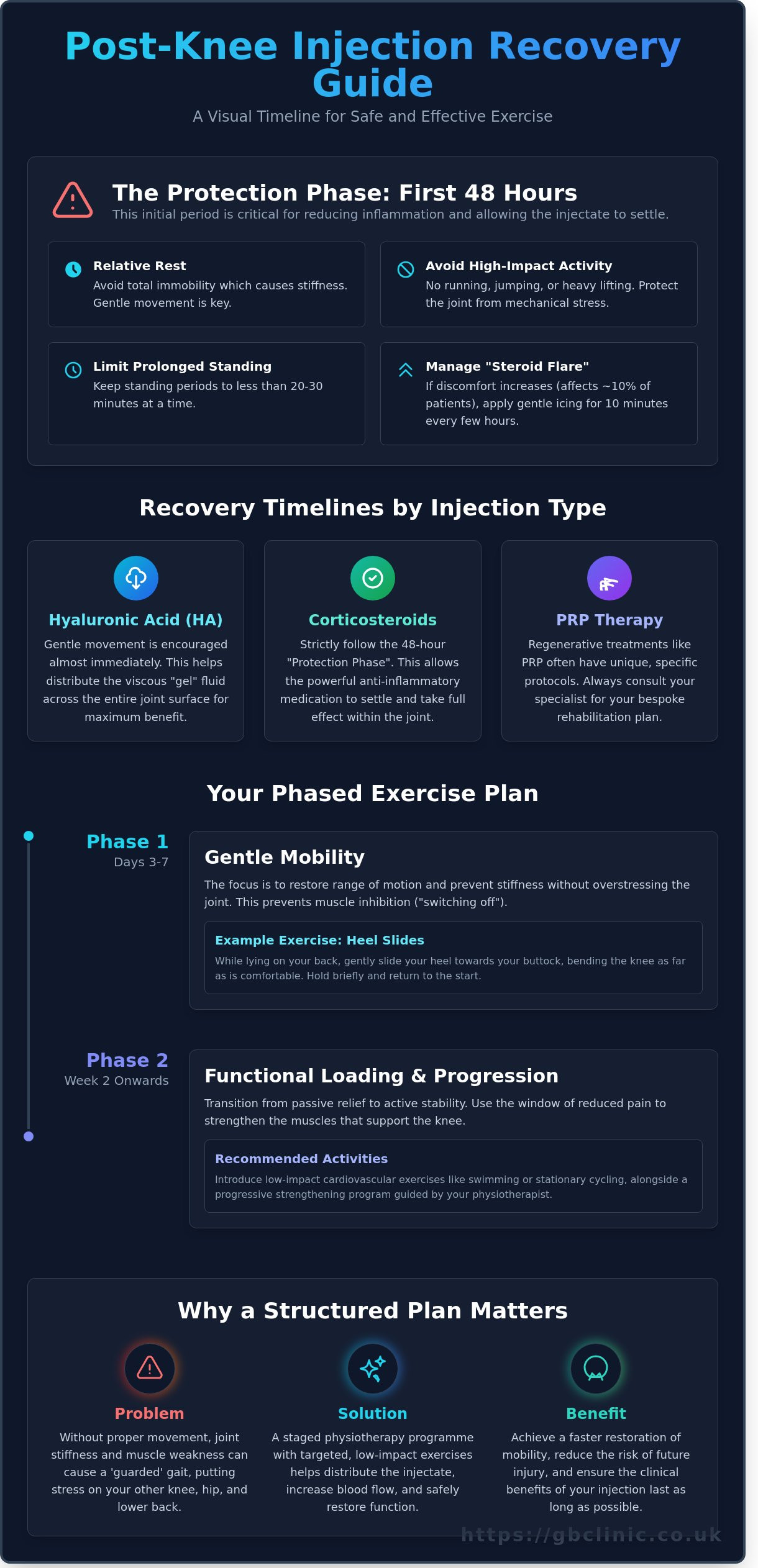
Patients visiting our clinics from Summertown, central Oxford, and Headington are advised to follow a protocol of “relative rest” for the first 48 hours. Total immobilisation is rarely recommended. Instead, you should avoid high-impact activities like running, heavy lifting, or standing for more than 20 to 30 minutes at a time. During this “Protection Phase,” the joint is settling. If you experience a “steroid flare,” which is a temporary increase in discomfort reported by approximately 10% of patients, apply gentle icing for 10 minutes every few hours. This phase is critical for allowing the medication to settle without being dispersed too quickly by heavy mechanical loading.
Understanding the Problem-Solution-Benefit Arc
Our clinical approach at GB Clinics focuses on a structured pathway to recovery. We serve patients from across Abingdon, Witney, and Faringdon, ensuring every procedure is backed by a clear rehabilitation plan.
- Problem: Post-procedure joint stiffness and muscle inhibition can lead to a “guarded” gait, which puts undue stress on the opposite hip and lower back.
- Solution: A staged physiotherapy programme tailored to your specific pathology, focusing on low-impact exercises to do after a knee injection.
- Benefit: You achieve faster restoration of function and improved mobility for daily life, ensuring the clinical benefits of the injection last as long as possible.
By following a professional guidance plan, patients from Kennington, Marcham, and Eynsham can safely return to their normal routines. The goal is to move from passive relief to active stability, using the window of reduced pain provided by the injection to strengthen the supporting structures of the knee.
Tailoring Your Exercise Timeline to the Injection Type
The specific substance used in your treatment dictates the timeline for exercises to do after a knee injection. Different compounds interact with the synovial fluid and joint tissues in unique ways, meaning a “one size fits all” approach to rehabilitation often leads to setbacks. Our clinicians focus on the biological response of the tissue to ensure that movement supports, rather than hinders, the medicinal benefits of the procedure.
Hyaluronic Acid and Steroid Timelines
Patients visiting from Headington or Marston for Hyaluronic Acid (HA) injections, often referred to as gel injections, are encouraged to engage in gentle movement almost immediately. This helps distribute the viscous fluid across the joint surfaces to provide maximum lubrication. Steroid injections require a different approach because they are typically administered with a local anaesthetic. You must wait for this anaesthetic to wear off, usually within 4 to 6 hours, before testing the joint. Engaging in strenuous activity while the area is numb can lead to accidental overstrain because your body’s natural pain signals are temporarily silenced.
Regenerative Medicine: PRP and Prolotherapy
Regenerative therapies like Platelet-Rich Plasma (PRP) work by triggering a controlled inflammatory cascade to stimulate tissue repair. Because we want this natural healing process to occur, we advise patients to avoid anti-inflammatory medications and heavy exercise for 1 to 2 weeks. The PRP exercise window typically starts 5-7 days post-procedure. During this phase, we focus on a gradual re-introduction of weight-bearing movements to stimulate the production of healthy collagen. Utilizing a structured Knee Conditioning Program helps ensure that the new tissue is strong enough to handle daily stresses. This measured approach is essential for patients travelling from Witney or Faringdon who seek long term recovery rather than a quick fix.
Professional MSK physiotherapy at GB Clinics focuses heavily on the “loading response.” This is the clinical observation of how your knee reacts to incremental weight. If a patient from Abingdon, Summertown, or Eynsham experiences a flare-up after a specific movement, we adjust the load to stay within a safe therapeutic window. This ensures the exercises to do after a knee injection promote healing without causing structural irritation.
Identifying red flag symptoms is vital for a safe recovery. Stop exercising and seek medical advice if you notice any of the following:
- A body temperature exceeding 38°C or localized heat at the injection site.
- Sudden, severe swelling in the calf or lower leg.
- Pain that increases significantly 24 hours after activity and does not settle with rest.
- Redness spreading away from the needle entry point.
Our clinics remain easily accessible from Kennington, Marcham, and central Oxford, ensuring you have expert support throughout your recovery. If you have concerns about your progress or wish to advance your rehabilitation, you can book a follow-up consultation with our specialist team.
Phase One: Gentle Mobility Exercises (Days 3-7)
Once the initial 48-hour rest period concludes, the focus shifts to restoring function. During this window, the goal isn’t high-intensity training but gentle reactivation. These early exercises to do after a knee injection prevent stiffness and encourage the therapeutic agent to distribute effectively within the joint capsule. Clinical evidence suggests that controlled movement during this phase helps reduce the risk of internal adhesions and promotes long-term joint health.
- Step 1: Ankle Pumps – While lying flat, flex your feet up toward your shins and then point them away. This simple movement acts as a mechanical pump for your calf muscles, which is vital for maintaining healthy circulation and reducing post-injection oedema.
- Step 2: Heel Slides – Slowly slide your heel toward your buttocks while keeping your foot on the bed. This restores range of motion without placing weight-bearing stress on the knee.
- Step 3: Static Quadriceps (Quad Sets) – Contract the muscle on the front of your thigh by pushing the back of your knee down into the surface beneath you. Hold for 5 seconds.
- Step 4: Straight Leg Raises – Keeping the leg straight, lift it 15 to 20 centimetres off the bed. This builds hip and thigh strength without requiring the knee joint to bend under load.
Range of Motion Movements
To perform heel slides effectively, use a smooth surface like a wooden floor with a sock or a plastic bag under your heel to reduce friction. We recommend completing 2 sets of 10 repetitions, three times daily during this first week. These movements are particularly beneficial for medial knee soreness recovery, as they gently mobilise the inner joint compartment. For a structured approach, patients can refer to a formal Knee Conditioning Program to track their progress safely. This ensures the exercises to do after a knee injection follow a clinically proven progression.
Isometric Strengthening Basics
Isometrics involve muscle contraction without visible joint movement. This science is crucial because it allows patients in Abingdon and Kennington to maintain muscle mass even when the joint is sensitive. Quad sets serve as the foundation of knee health by ensuring the quadriceps provide adequate support. When performing these, focus on the vastus medialis, which is the inner thigh muscle. Proper activation ensures the patella tracks correctly in its groove, preventing future alignment issues. GB Clinics’ specialists often find that 10 repetitions held for 5 seconds each provides the optimal stimulus for recovery without over-exerting the joint. This targeted approach is essential for residents in Oxford seeking a swift return to daily activities.
Phase Two: Progression and Functional Loading (Week 2 Onwards)
By the second week, your focus shifts from joint protection to restoring functional capacity. You’ll move from floor-based movements to standing exercises that replicate daily activities. This transition is vital for building the muscle support necessary to protect the joint long-term. To ensure safety, follow the 24-hour rule. If any exercises to do after a knee injection cause a spike in pain that doesn’t return to your baseline within 24 hours, reduce the intensity or volume of your next session. Seeking guidance from private msk physiotherapy Oxford helps ensure your technique is precise and your load progression is measured.
Our clinical team recommends a gradual increase in weight-bearing activities. Don’t rush the process. A measured approach allows the injected substance, whether it’s a steroid or lubricant, to work effectively alongside your natural biomechanics. This phase is about quality of movement rather than high repetitions.
Low-Impact Cardio and Walking
Walking is a fundamental part of recovery. Start with flat, predictable surfaces to avoid shearing forces on the knee. Local routes in Witney or Faringdon are ideal if they avoid steep inclines or loose gravel. Begin with 10 to 15 minutes of continuous walking and increase your duration by 10% each week if you remain pain-free. For patients who have received specialist knee arthritis joint injections, stationary cycling is particularly beneficial. The circular motion helps distribute the hyaluronic acid across the cartilage surfaces, promoting better joint lubrication. Keep the resistance low and maintain a steady cadence. Avoid uneven terrain in parks around Headington or Eynsham until at least week four to prevent sudden twisting of the joint.
Functional Balance and Stability
This phase introduces mini-squats and wall sits to engage the larger muscle groups. Keep your range of motion comfortable, typically between 0 and 45 degrees of flexion. These movements strengthen the quadriceps, which act as the primary shock absorbers for the knee. Incorporate single-leg balance drills to improve proprioception. This is the body’s ability to sense its position in space, which is often diminished by chronic joint pain. Using myofascial release techniques, such as gentle foam rolling on the calves or hamstrings, can support muscle recovery and reduce secondary tension. Our clinics are easily accessible from Abingdon, Summertown, Kennington, and Marcham for those needing supervised rehabilitation and technique correction.
- Mini-Squats: Perform 3 sets of 10 repetitions within a pain-free range.
- Single-Leg Balance: Aim for 30 seconds on each leg to improve joint stability.
- Wall Sits: Hold for 20 seconds to build isometric strength without joint irritation.
Book a consultation at GB Clinics to refine your recovery plan.
Expert Rehabilitation at GB Clinic Oxford
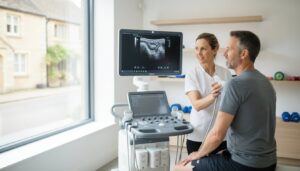
Achieving long-term relief from joint pain requires more than a single clinical procedure. At GB Clinic, we bridge the gap between medical intervention and functional movement by providing a structured pathway to recovery. Our Oxford-based team uses diagnostic ultrasound scans to monitor the success of your treatment. This technology allows us to visualise the internal state of the joint and confirm that inflammation is subsiding as expected.
Our clinicians create bespoke rehabilitation programmes tailored to your specific biomechanics. These plans focus on the exact exercises to do after a knee injection that will strengthen the supporting musculature without overloading the joint. By integrating advanced manual therapy with clinical injections, we ensure that the initial pain relief translates into improved mobility and long-term joint health. This comprehensive approach is designed to prevent the recurrence of symptoms and restore your confidence in daily activities.
Our clinic is easily accessible from Abingdon, Summertown, Kennington, Marcham, Headington, Witney, Faringdon, Eynsham, and central Oxford. We provide a professional, clinical environment where patients receive expert-led care from initial diagnosis through to the final stages of physical recovery.
Our One-Stop Setup in Oxford
We operate a streamlined, one-stop setup that manages your entire journey under one roof. This model eliminates the delays often found when moving between different providers for scans, injections, and follow-up care. Integrating physiotherapy into your post-injection routine is vital. It ensures the treatment isn’t just a “quick fix” but the start of a sustainable recovery. GB Clinic provides ultrasound-guided injections for 100% accuracy.
Book Your Consultation
Finding our clinic is straightforward for those travelling from Summertown or central Oxford. We’ve designed our services to be patient-focused and efficient, ensuring you spend less time in waiting rooms and more time on your recovery. It’s often difficult to know which path to take when dealing with chronic knee pain, which is why we provide a clear, evidence-based roadmap for every patient.
We offer a “Zero Commitment” initial consultation to help you understand your options without any financial pressure. This session allows our specialists to assess your condition and determine if you’re a candidate for our advanced therapies. Take the first step toward a pain-free life by booking an appointment with our expert team today.
Take the Next Step Towards Lasting Knee Relief
Recovery doesn’t end with the needle. Success depends on following a structured timeline, starting with gentle mobility between days 3 and 7 before moving to functional loading from week 2 onwards. Choosing the right exercises to do after a knee injection ensures the treatment works effectively to restore your range of motion and protect the joint. Our MSK specialists use modern ultrasound-guided injection technology to target the source of your pain with clinical precision. This accuracy, combined with a tailored rehabilitation plan, helps you return to your daily routine without unnecessary delays.
GB Clinic Oxford is easily accessible for patients in Abingdon, Summertown, Kennington, and Marcham, as well as those in Headington, Witney, Faringdon, Eynsham, and central Oxford. Local patients frequently describe our team as kind and professional, reflecting our commitment to expert-led, empathetic care. We focus on evidence-based results that reduce inflammation and improve long-term mobility through a one-stop clinical setup.
Book your free personal physiotherapy consultation at GB Clinic Oxford today to secure your path to recovery. You’ve already taken the first step by seeking treatment; let’s work together to ensure your knee remains strong and pain-free.
Frequently Asked Questions
Can I walk for exercise immediately after a knee injection?
You should limit walking to essential daily movements for the first 24 to 48 hours after your procedure. While light movement around your home in Abingdon or central Oxford is safe, don’t engage in dedicated fitness walks or tackle hilly terrain during this initial period. This rest window allows the medication to settle effectively into the joint space.
After the first 48 hours, you can gradually increase your step count as your comfort levels improve. Starting with short, flat walks ensures you don’t overstress the joint while the treatment begins to reduce inflammation and restore mobility.
How long after a cortisone injection can I return to the gym?
You can typically return to the gym for light upper-body work after 48 hours, but you must wait 5 to 7 days before performing heavy leg exercises. Cortisone requires this brief period of reduced load to effectively target musculoskeletal inflammation without interference. Patients at our clinics in Headington and Witney receive a tailored timeline to ensure a safe return to their routine.
Once you return to leg training, start with 50% of your usual weight and gradually increase the intensity over two weeks. This cautious approach helps you achieve long-term recovery and maintains the benefits of the injection.
What exercises should I avoid after a hyaluronic acid injection?
You must avoid high-impact movements, heavy weightlifting, and deep squats for at least 48 hours following a hyaluronic acid injection. These activities put excessive pressure on the joint while the lubricant is integrating with your natural synovial fluid. Focusing on gentle range-of-motion exercises to do after a knee injection, such as seated leg extensions, helps maintain mobility without risking a post-injection flare.
Avoid any activity that involves twisting or sudden changes in direction during the first week. By protecting the joint during this phase, you allow the treatment to provide the best possible relief and improve your long-term joint function.
Is it normal for the knee to feel stiffer after starting post-injection exercises?
It’s common for the knee to feel temporarily stiffer or “full” for 24 to 72 hours after starting your rehabilitation movements. This sensation occurs because the injected fluid adds volume to the joint capsule. Clinical data shows that approximately 10% of patients experience a minor “flare” or temporary discomfort as the body adjusts to the treatment.
If the stiffness persists beyond 3 days or is accompanied by significant heat, contact our specialist team for a review. Most patients find that this fullness subsides quickly, leading to the “pain-free” results often highlighted in our clinical testimonials.
When can I resume high-impact sports like running or tennis?
You should wait 7 to 14 days before resuming high-impact sports like running, tennis, or football. This duration ensures the injection has fully addressed the underlying inflammation and the joint is stable enough for multi-directional force. Our specialists, easily accessible from Marcham and Kennington, recommend a phased return to sport to prevent re-injury.
Start with short jogging intervals on soft surfaces before returning to competitive matches or long-distance road running. This measured transition helps you maintain the “improved mobility” gained from your treatment at GB Clinics.
What happens if I do too much exercise too soon after my injection?
Exercising too aggressively too soon can trigger a painful inflammatory response and potentially reduce the treatment’s clinical success rate. Excessive load can cause the medication to disperse too quickly or irritate the injection site. This often leads to increased swelling and a longer recovery period than expected.
If you experience a sharp increase in pain, we recommend resting and applying a cold pack for 10 minutes. Following our structured recovery guidance ensures you achieve the best possible outcome and avoids the need for additional corrective treatments.
Do I need a physiotherapist to supervise my exercises after an injection?
While you can perform basic movements alone, working with a physiotherapist ensures your exercises to do after a knee injection are safe, effective, and personalised. Our advanced physiotherapy services are designed to restore full function and prevent future issues. Residents in Summertown, Eynsham, and Faringdon can access our expert-led sessions to receive a programme that complements their ultrasound-guided injection.
A specialist can monitor your technique and adjust your load based on how your knee responds. This professional oversight builds confidence and provides a clear path to a more active, comfortable lifestyle.
Can I use a cross-trainer or exercise bike in the first week?
You can use a cross-trainer or exercise bike starting 48 hours after your injection, provided you use low resistance settings. These low-impact machines are excellent for improving mobility without the jarring force of road running. Start with a 10-minute session to monitor how your knee responds to the circular motion.
Controlled, rhythmic movement helps circulate the medication and promotes healthy joint function. If you feel any pinching or sharp pain, stop the session and wait another 24 hours before trying again at an even lower intensity.