
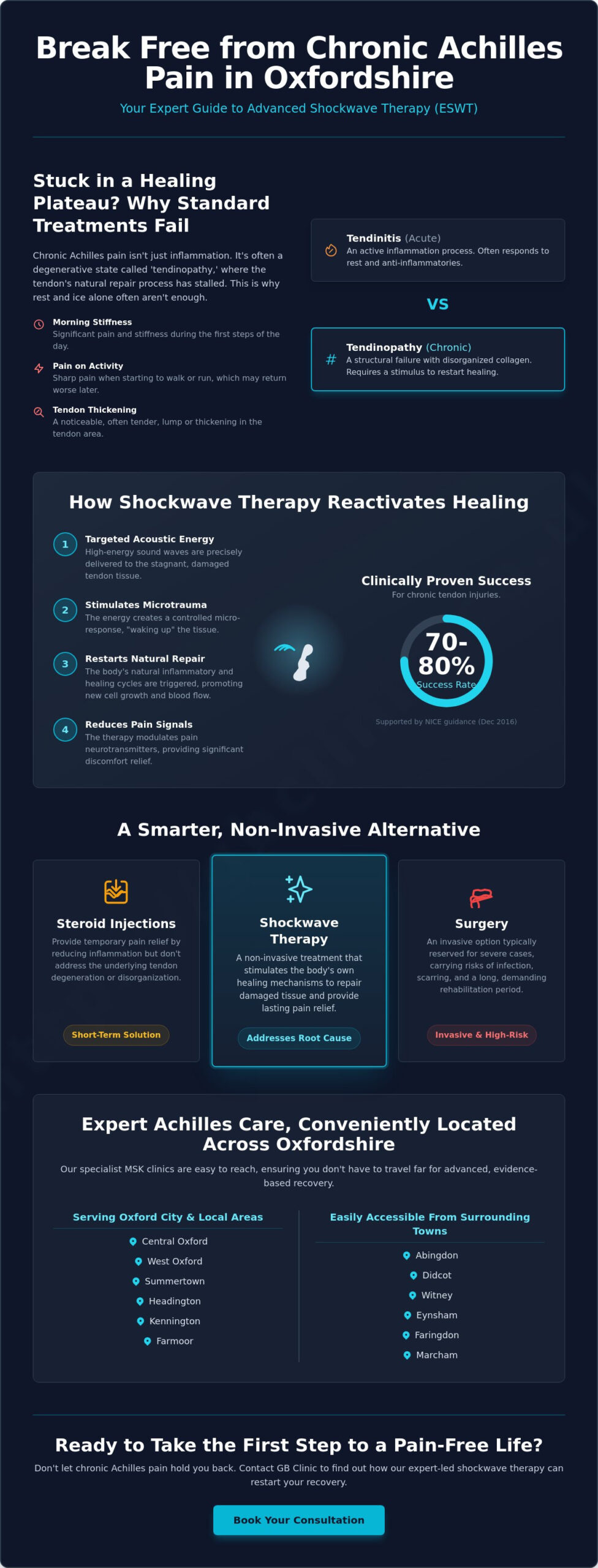
Research indicates that success rates for clinical shockwave treatments are between 70% and 80% for chronic tendon injuries. If you’re dreading those first painful steps every morning or feel frustrated by a stubborn inability to return to running, it’s likely your recovery has reached a biological plateau. We provide specialized shockwave therapy for Achilles tendinopathy Oxford patients can trust to restart the healing process when standard physiotherapy has failed.
You deserve a clear path back to an active lifestyle without the risks associated with surgical operations. Our expert-led MSK clinics are conveniently accessible for residents in Central Oxford, West Oxford, and Summertown, as well as those commuting from Headington, Kennington, or Farmoor. We also ensure that advanced care is within easy reach for the communities of Abingdon, Marcham, Eynsham, Didcot, Witney, and Faringdon. This guide explores how our non-invasive interventions bridge the gap between persistent pain and functional restoration, helping you move comfortably once again.
Key Takeaways
- Understand why chronic Achilles pain stems from biological stagnation rather than simple inflammation, meaning it’s often unable to repair itself without a specific clinical stimulus.
- Learn how acoustic energy triggers natural healing and reduces discomfort by stimulating biochemical responses that restart the tendon’s repair cycle.
- Discover why shockwave therapy for Achilles tendinopathy Oxford is a preferred non-invasive alternative to surgical operations or short-term steroid injections.
- Find out how to access specialist care from Central Oxford, Summertown, and Headington, or from nearby towns like Abingdon, Didcot, Witney, Eynsham, and Faringdon.
- Learn about our convenient clinics serving West Oxford, Kennington, Marcham, and Farmoor, ensuring you don’t have to travel far for expert MSK rehabilitation.
Understanding Achilles Tendinopathy and Why Standard Treatments Fail
Many people in Central Oxford and Headington assume that persistent heel pain is simply a matter of inflammation that will eventually subside with rest. However, chronic Achilles pain is rarely driven by inflammation alone. It is often a degenerative process where the tendon enters a biological stagnation phase. In this state, the tissue fails to repair itself despite reduced activity. For residents in Abingdon or Didcot dealing with this frustration, understanding this shift is the first step toward effective recovery.
Typical symptoms include a noticeable thickening of the tendon and significant stiffness during those first steps in the morning. You might also experience sharp pain when you begin to walk or run; this discomfort sometimes eases slightly as you warm up, only to return with greater intensity later. When standard “rest and ice” protocols fail, it’s usually because the internal structure of the tendon has changed. Finding effective shockwave therapy for Achilles tendinopathy Oxford is often the necessary catalyst to break this cycle of non-healing.
To better understand how this condition progresses and how advanced treatments help, watch this helpful video:
Tendinitis vs. Tendinopathy: Why the Distinction Matters
While “tendinitis” refers to acute inflammation, “tendinopathy” describes a deeper structural failure. In chronic cases, the collagen fibers that make up the tendon become disorganized and lose their ability to handle load. This is why anti-inflammatory medications often provide only temporary relief; they don’t address the underlying structural disarray. The Science of Extracorporeal Shockwave Therapy shows that targeted energy is required to stimulate cellular repair in these damaged areas, moving the tissue out of a degenerative state and back into an active healing phase.
The Limitations of Traditional Physiotherapy
Many of our patients from Witney, Faringdon, and Summertown have already tried eccentric loading exercises before visiting us. While these are a cornerstone of recovery, some tendons reach a plateau where exercise alone isn’t enough to trigger a healing response. This frustration is common when the tendon’s repair mechanisms have essentially “switched off.” At this point, advanced interventions like ESWT are utilized to restart the biology of the tissue. We serve individuals across Kennington, Marcham, Eynsham, Farmoor, and West Oxford, providing a clear path forward when standard rehabilitation stalls and persistent pain prevents a return to sport or daily activity.
The Science of Extracorporeal Shockwave Therapy (ESWT) for Tendon Repair
Extracorporeal Shockwave Therapy (ESWT) operates on the principle of mechanotransduction, where mechanical energy from high-energy sound waves is converted into a biological cellular response. When these waves penetrate the damaged Achilles tissue, they create controlled microtrauma. This process effectively “shocks” the tendon out of its stagnant state, forcing the body to restart its natural inflammatory and healing cycles. For patients across Central Oxford and West Oxford, this represents a sophisticated bridge between failed conservative care and more invasive options.
The clinical impact of this technology is well-documented. Research has shown success rates for shockwave therapy to be between 70% and 80% for chronic tendon issues. The National Institute for Health and Care Excellence (NICE) provided guidance on ESWT for Achilles tendinopathy in December 2016, supporting its use as an evidence-based intervention. Beyond structural repair, the therapy provides significant pain modulation by stimulating Substance P, a neurotransmitter that helps reduce the transmission of pain signals from the affected area. If you’re seeking this advanced care, you can view our clinical locations to find the nearest specialist in Oxfordshire.
Biological Mechanism: How Sound Waves Heal Tissue
The healing process is further supported by neovascularisation, which is the growth of new blood vessels in the treated area. This improved blood supply ensures that essential nutrients and oxygen reach the poorly vascularised tendon tissue. Shockwave is also highly effective at breaking down calcific deposits that often form within the Achilles during chronic degeneration. Cavitation is the formation of bubbles that help break down scar tissue. This multi-layered biological response ensures that the tendon doesn’t just feel better, but actually begins to remodel its internal architecture.
Why Diagnostic Accuracy is Vital Before Treatment
Success in treating Achilles pain depends heavily on an accurate initial assessment. We utilize diagnostic ultrasound scans to confirm the exact nature of the pathology before any energy is applied. This is crucial for distinguishing between mid-portion tendinopathy and insertional tendinopathy, as each requires specific machine settings and applicator placement. We also use ultrasound to ensure there are no underlying high-grade tears, as these would contraindicate high-energy shockwave application. Our clinics are easily accessible for residents in Summertown, Headington, and Kennington, as well as those traveling from Farmoor, Eynsham, or Marcham. Having a precise diagnosis ensures that your Shockwave Treatment Journey is both safe and tailored to your specific recovery needs. We provide these specialist diagnostic and therapeutic services to patients from Abingdon, Didcot, Witney, and Faringdon, ensuring that advanced MSK care is available throughout the region.
Shockwave Therapy vs. Traditional Methods: When to Choose Advanced Intervention
Choosing the right path for chronic Achilles pain involves weighing modern clinical evidence against older, more traditional approaches. While many patients in Central Oxford and Summertown are initially offered “rest and wait” strategies, these often lead to the biological stagnation discussed earlier. Shockwave therapy for Achilles tendinopathy Oxford represents a proactive shift toward regeneration rather than just symptom management. Unlike surgical debridement, which requires significant downtime and carries operative risks, ESWT is entirely non-invasive. You don’t have to worry about hospital stays or long absences from work in Headington or West Oxford.
Recovery timelines are a major factor for active individuals in Didcot and Eynsham. After a shockwave session, you can typically maintain modified activity levels immediately. This contrasts sharply with the weeks of immobilization often required after more aggressive interventions. From a financial perspective, investing in a targeted course of 3 to 5 sessions is often more cost-effective than months of unresolved pain medication or repeated, inconclusive appointments. You can find more detail on patient expectations in this guide from Oxford University Hospitals on Shockwave Therapy, which highlights the safety and local clinical standards for this procedure.
ESWT vs. Steroid Injections for Achilles Pain
Corticosteroid injections are frequently used for joint pain, but they require extreme caution when applied to the Achilles tendon. Repeated steroid use in this area is associated with an increased risk of tendon rupture because it can weaken the already compromised collagen structure. We generally reserve guided steroid injections for inflammatory conditions like retrocalcaneal bursitis, where the target is the fluid-filled sac rather than the tendon itself. For patients in Kennington and Farmoor, shockwave therapy is the safer, evidence-based choice for stimulating structural tendon repair without compromising the integrity of the tissue.
The Role of Hyaluronic Acid in Tendon Health
In some complex cases, we look beyond mechanical stimulus alone. Hyaluronic Acid injections provide a biochemical approach by offering lubrication and reducing friction within the tendon sheath. While shockwave therapy provides the mechanical trigger to restart healing, HA injections offer a biochemical environment that supports smoother movement. Combining these methods can be particularly beneficial for residents in Abingdon, Marcham, Witney, or Faringdon who have long-standing, multi-factorial heel pain. This integrated approach ensures every patient receives a plan tailored to their specific pathology, ensuring the best possible outcome for long-term mobility.
Your Shockwave Treatment Journey: Accessibility Across Oxfordshire
Beginning a course of shockwave therapy for Achilles tendinopathy Oxford starts with a comprehensive clinical assessment. During your first session, a specialist identifies the exact area of discomfort to ensure precise applicator placement. A conductive gel is applied to the skin, which allows the acoustic waves to penetrate the tissue effectively. You’ll experience a rhythmic “pulsing” sensation as the device delivers energy to the tendon. While this can feel intense, we adjust the settings to your tolerance level throughout the procedure to ensure the experience is manageable.
A typical protocol consists of 3 to 6 sessions, usually spaced one week apart. Each clinical visit lasts approximately 15 to 20 minutes, making it an efficient option for those with busy schedules. It’s normal to feel a temporary “inflammatory” ache for 24 to 48 hours after treatment. This is a sign that the body’s repair mechanisms are active. We advise avoiding anti-inflammatory medication or ice during this time, as these can interfere with the healing process we’ve initiated. Once the initial course is complete, integrating advanced physiotherapy is essential to build the tendon’s load-bearing capacity and prevent future recurrence.
Convenient Specialist Care for Oxfordshire Residents
We’ve designed our services to be accessible for everyone across the county. Patients traveling from Summertown or Headington will find our facilities easy to reach, minimizing the time spent in transit. We also serve a wide range of communities in South Oxfordshire, including Abingdon, Didcot, and Kennington. If you’re coming from Witney, Eynsham, or Faringdon, our clinical locations are strategically placed to ensure you receive expert MSK care without the stress of a long commute. Even residents in Marcham can quickly access the advanced therapeutic interventions they need.
Preparing for Your Appointment in Central or West Oxford
Our clinics in Central Oxford and West Oxford are well-connected for those traveling from Farmoor and the surrounding neighborhoods. When preparing for your appointment, we recommend wearing loose-fitting clothing or shorts to allow easy access to the ankle. Please bring a summary of your medical history and any previous imaging results for your MSK specialist to review. Choosing a local clinic with state-of-the-art equipment ensures you receive modern care in a professional, clinical environment. You can book your initial assessment today to begin your recovery journey with our expert team.
Expert Achilles Care at GB Clinic: Evidence-Based Recovery in Oxford
At GB Clinic, our commitment to patient recovery is built on a structured “Problem/Solution/Benefit” framework. We recognize that chronic pain is not just a physical symptom but a significant barrier to your daily life and athletic goals. By providing specialized shockwave therapy for Achilles tendinopathy Oxford patients can access a clear, evidence-based pathway to tissue repair. Our approach ensures that you understand the anatomical cause of your discomfort, the specific mechanism of the intervention, and the clear functional benefits you can expect as you progress through your treatment plan.
Choosing a private specialist means you benefit from clinicians who remain at the forefront of physiotherapy and MSK medicine. We combine the mechanical stimulus of extracorporeal shockwave therapy with tailored exercise rehabilitation to ensure the tendon is not only healed but also strong enough to handle future loads. Local residents trust our professional, reassuring, and expert-led environment because we prioritize long-term results over short-term fixes, maintaining a clinical standard that builds genuine confidence in your recovery.
A Personalised Path to Pain-Free Movement
The journey from acute discomfort to full functional restoration requires more than just a single intervention. We focus on the transition from reducing pain to improving your ability to walk, run, and jump without restriction. Long-term tendon health monitoring and follow-up care are integral parts of our service, ensuring that the improvements you gain during your sessions are sustained. Our practice is dedicated to providing comprehensive care without unnecessary delays, allowing you to move through the recovery process efficiently and safely.
Book Your Assessment Today
We believe that high-quality MSK care should be easily accessible to everyone in the region. Our clinics are a convenient choice for residents across Oxfordshire, including those living in Central Oxford, West Oxford, Summertown, and Headington. We also provide a vital local resource for individuals in Kennington, Marcham, Farmoor, and Eynsham who are seeking advanced alternatives to standard care. If you’re traveling from surrounding towns like Abingdon, Didcot, Witney, or Faringdon, you’ll find our specialist services are positioned to minimize travel stress while maximizing clinical outcomes.
Our “patient-first” philosophy ensures that every evidence-based treatment is delivered with empathy and a deep respect for your individual experience. You don’t have to settle for persistent pain or failed standard treatments. Regain your mobility and return to the activities you love by scheduling your initial consultation with our expert team. We look forward to helping you achieve a comfortable, active, and mobile state once again.
Take the Next Step Toward Pain-Free Mobility
Persistent Achilles pain doesn’t have to be a permanent barrier to your active lifestyle. By addressing the biological stagnation of chronic tendon issues, you can move beyond the limitations of failed standard treatments. Our clinics utilize NICE-approved shockwave technology to stimulate natural repair and provide lasting relief from discomfort. Whether you’re struggling with morning stiffness or an inability to return to running, shockwave therapy for Achilles tendinopathy Oxford offers a clinically proven, non-invasive solution delivered by expert MSK clinicians with years of specialist experience.
We’ve made advanced care accessible for residents across the region. Our facilities are easy to reach from Central Oxford, West Oxford, Summertown, and Headington. We also provide convenient clinical options for those living or working in Abingdon, Witney, Didcot, and Faringdon. Residents in Kennington, Marcham, Farmoor, and Eynsham can also access our professional services without the need for long-distance travel or unnecessary delays. You can Book Your Initial Achilles Assessment at GB Clinic to receive a personalized recovery plan tailored to your specific needs. We’re here to help you regain your confidence and return to the sports and daily activities you love.
Frequently Asked Questions
Is shockwave therapy for Achilles tendinopathy painful?
Patients typically describe the sensation as a rhythmic, intense pulsing that is uncomfortable but manageable. We adjust the energy levels to your tolerance during the procedure to ensure you remain comfortable throughout the session. This expert-led approach is available at our facilities serving Summertown and Headington, where we prioritize a calm, clinical environment for every individual seeking relief.
How many sessions of shockwave therapy will I need for my Achilles?
A standard course of treatment involves 3 to 5 sessions spaced approximately one week apart. Each session lasts between 10 and 20 minutes, providing an efficient path to recovery for those traveling from Abingdon or Kennington. We monitor your progress at every stage to ensure the intervention is effectively restarting the healing process in your tendon tissue.
Can I run or exercise immediately after a shockwave treatment?
You should avoid high-impact exercise or running for at least 48 hours following your treatment session. It’s also important to avoid using ice or anti-inflammatory medications on the treated area, as these can hinder the natural healing response we are trying to stimulate. Patients from Marcham and Central Oxford find that following this advice leads to better long-term functional restoration.
Is shockwave therapy for Achilles tendinopathy covered by private health insurance?
Many major private health insurance providers cover Extracorporeal Shockwave Therapy, although coverage depends on the details of your specific policy. We recommend contacting your insurer directly to confirm your level of cover before your initial appointment. Our clinics are a local choice for insured patients across Witney, Didcot, and the wider Oxfordshire region seeking advanced MSK interventions.
What are the potential side effects of ESWT for the Achilles tendon?
Potential side effects are generally mild and include temporary redness, slight swelling, or a dull ache in the heel area. These symptoms usually resolve within a few days and are a normal part of the body’s inflammatory response to the acoustic waves. We provide clear post-treatment guidance to help patients from Eynsham and Farmoor manage these minor, short-term sensations safely.
How soon will I see results from shockwave therapy for my heel pain?
Some individuals report an immediate reduction in pain, while others notice significant improvement after several weeks of treatment. The full biological repair of the tendon continues for several months following the final session as the tissue remodels. Our specialists provide shockwave therapy for Achilles tendinopathy Oxford residents can rely on for sustainable, evidence-based results that support a return to full mobility.
Do I need a GP referral for shockwave therapy at GB Clinic in Oxford?
You don’t require a GP referral to book an assessment or receive treatment at our clinical facilities. We accept self-referrals from individuals in West Oxford, Faringdon, and throughout the county who are frustrated by persistent pain. This direct access ensures there are no unnecessary delays in starting your recovery journey with our expert and attentive MSK team.
Is shockwave therapy more effective than a steroid injection for Achilles pain?
Shockwave therapy is often more effective for long-term repair because it stimulates the tendon’s natural healing rather than just masking symptoms. Steroid injections carry a higher risk of tendon rupture when used for the Achilles and primarily target short-term inflammation. For residents seeking shockwave therapy for Achilles tendinopathy Oxford clinics offer a safer, regenerative alternative that focuses on structural restoration and lasting comfort.