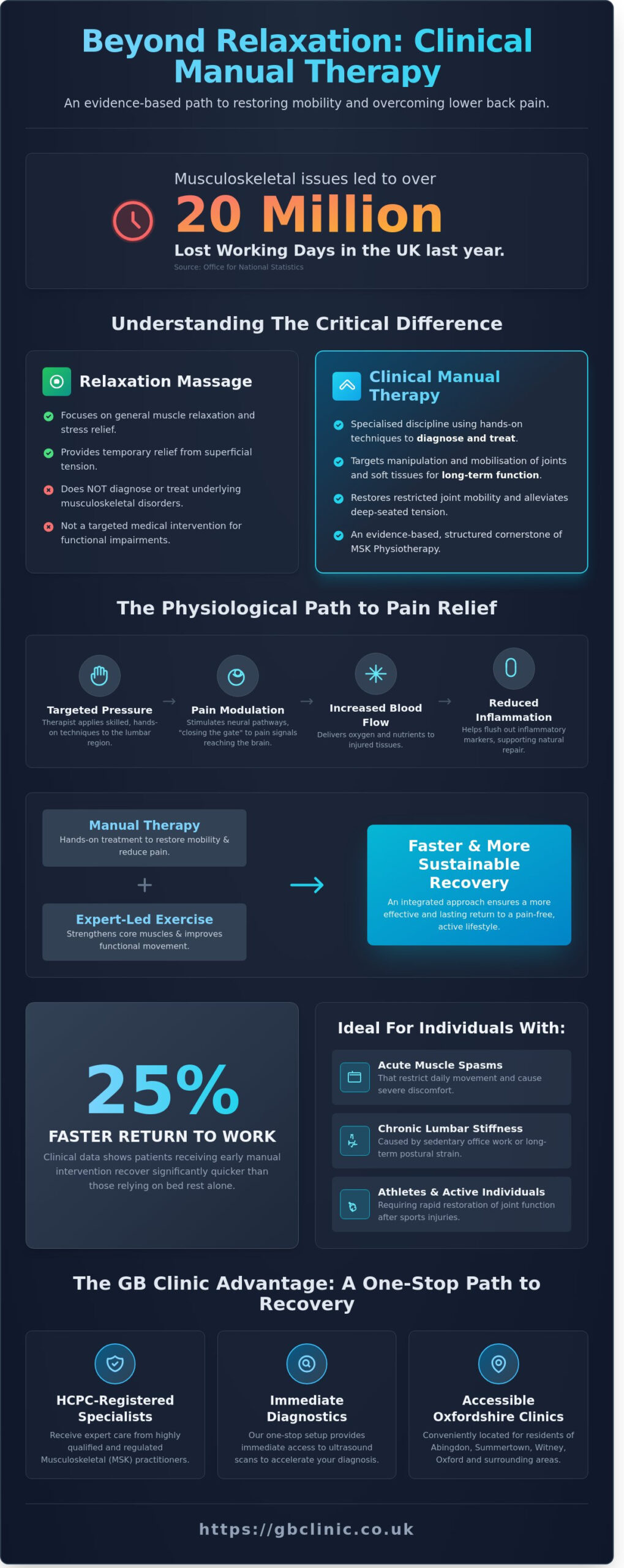
Did you know that musculoskeletal issues accounted for over 20 million lost working days in the UK last year according to data from the Office for National Statistics? Chronic discomfort often leaves you feeling trapped in a cycle of temporary relief. It’s common to feel confused about whether you need a standard relaxation massage or the targeted manual therapy for lower back pain required for a clinical recovery. At GB Clinics, we recognize that persistent stiffness limits your daily activities and creates unnecessary stress.
We’re here to provide a clear diagnosis and an evidence-based path to restoring your mobility. This guide explains how our musculoskeletal specialists use advanced techniques to reduce inflammation and improve joint function. You’ll also learn how to access our expert care at locations that are easily accessible from Abingdon, Summertown, Kennington, Marcham, Headington, Witney, Faringdon, Eynsham, and central Oxford. We’ll outline exactly how our one-stop setup ensures you receive professional treatment without the long wait times or difficult commutes. Our goal is to move you from chronic discomfort to a more active, pain-free lifestyle through specialist care.
Key Takeaways
- Understand the critical distinction between general relaxation massage and clinical manual therapy for targeted relief of the lumbar spine.
- Discover how specialist manual therapy for lower back pain, including spinal mobilisation, clears the path for more effective and pain-free rehabilitation.
- Learn why an integrated approach combining hands-on clinical care with expert-led exercise ensures a faster and more sustainable return to mobility.
- Identify how to access HCPC-registered MSK specialists at our Oxfordshire clinics, which are easily accessible from Abingdon, Summertown, and Witney.
- Explore the benefits of our “one-stop” diagnostic setup, providing immediate access to ultrasound scans to accelerate your path to recovery.
Understanding Manual Therapy for Lower Back Pain Relief
Manual therapy is a specialised clinical discipline involving skilled, hands-on techniques to diagnose and treat musculoskeletal disorders. While many patients initially equate hands-on care with a standard relaxation massage, What is Manual Therapy? actually refers to a targeted medical intervention. It focuses on the manipulation and mobilisation of joints and soft tissues to resolve functional impairments. At GB Clinics, this approach serves as a fundamental cornerstone of our private MSK physiotherapy in Oxford, providing a structured and evidence-based path to recovery.
To better understand how these clinical techniques are applied during a treatment session, watch this helpful video:
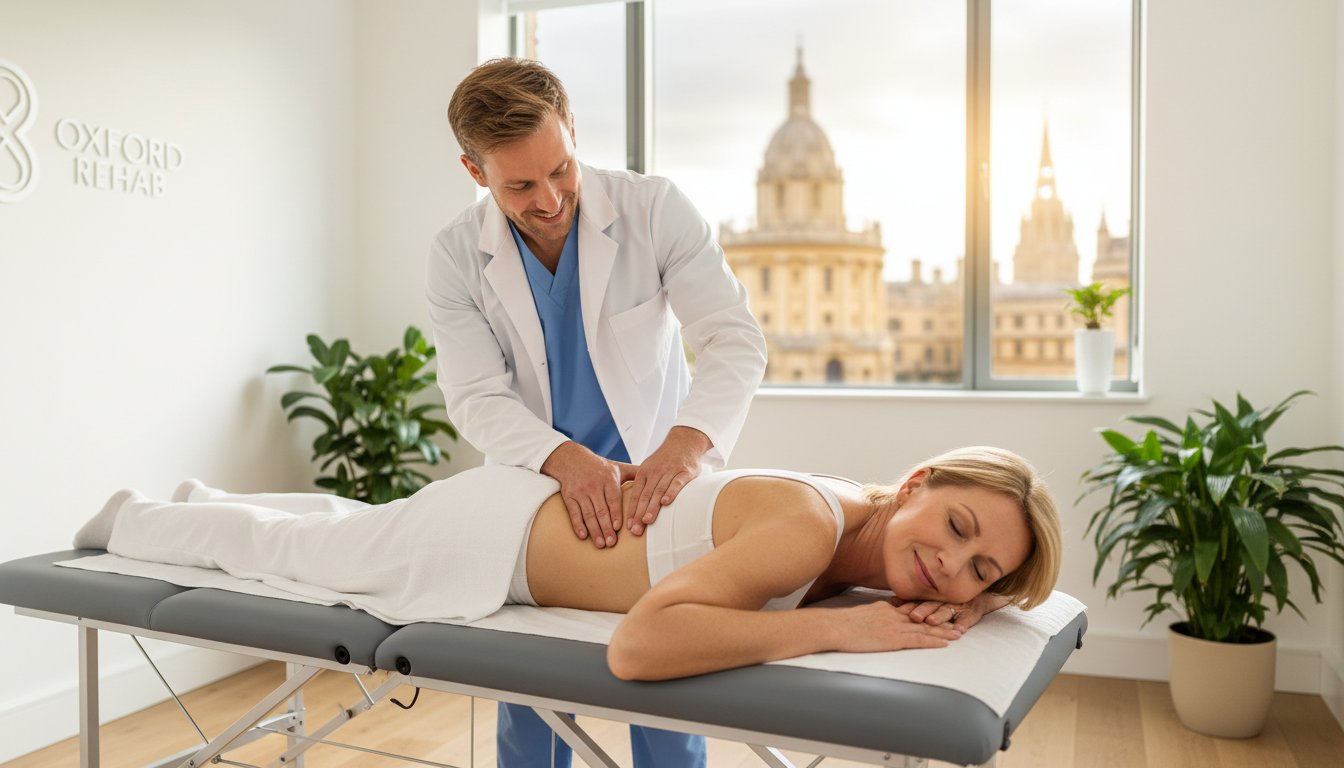
The primary objective of manual therapy for lower back pain is to restore restricted joint mobility and alleviate deep-seated soft tissue tension. Our expert practitioners use specific, graded movements to improve the range of motion in the lumbar spine. This clinical care is easily accessible for residents in central Oxford and surrounding areas like Summertown, Headington, and Kennington. By focusing on mechanical alignment and tissue health, we help patients move away from persistent discomfort and toward long-term physical function.
How Manual Therapy Works on the Lumbar Spine
Clinical manual therapy triggers several physiological responses that facilitate healing. When a therapist applies targeted pressure to the lumbar region, it stimulates neural pathways that modulate pain perception. This process increases local blood flow to restricted spinal tissues, which helps flush out inflammatory markers and delivers oxygenated blood to the site of the injury. The gate control theory of pain relief suggests that non-painful physical input, such as manual mobilisation, can effectively close the “neural gates” in the spinal cord to prevent pain signals from reaching the brain. These mechanisms work together to provide immediate symptomatic relief while supporting the body’s natural repair processes.
Who Can Benefit from Manual Back Therapy?
Our specialist services are designed for individuals across Oxfordshire, including those travelling from Abingdon, Witney, and Eynsham. Manual therapy for lower back pain is particularly effective for several groups:
- Patients suffering from acute muscle spasms that restrict daily movement.
- Individuals with chronic lumbar stiffness caused by sedentary office work or postural strain.
- Athletes recovering from sports injuries in Marcham or Faringdon who require rapid restoration of joint function.
It’s vital to consider manual therapy over passive rest, as prolonged inactivity often leads to muscle atrophy and increased joint stiffness. Clinical data indicates that patients who engage in early manual intervention return to work 25% faster than those who rely solely on bed rest. Whether you’re dealing with a recent strain or a long-standing ache, our expert-led care provides the clinical precision needed for a confident recovery.
Key Manual Therapy Techniques Used in MSK Physiotherapy
Expert manual therapy for lower back pain involves a range of evidence-based clinical interventions. At GB Clinics, our specialists use these techniques to restore movement and reduce discomfort through precise, hands-on contact. A 2024 academic review provides strong evidence for manual therapy as a primary intervention for musculoskeletal recovery. Our clinical approach focuses on four core methods:
- Spinal Mobilisation: This involves gentle, rhythmic oscillations applied to the vertebrae. It aims to increase joint range of motion without the high-force “crack” often associated with other treatments.
- Myofascial Release: This technique targets the fascia, which is the connective tissue surrounding muscles, to alleviate deep-seated tension that limits functional mobility.
- Trigger Point Therapy: Clinicians apply sustained pressure to hyper-irritable “knots” within the muscle fibres. This helps to release referred pain patterns that often mimic nerve issues.
- Passive Physiological Intervertebral Movements (PPIVMs): These are used as a targeted spinal assessment tool. They allow the therapist to feel the quality and quantity of movement at each individual spinal segment.
Joint Mobilisation vs. Manipulation
Patients often ask about the difference between a “push” and a “click.” We primarily utilise the Maitland scale, which categorises mobilisation into five distinct grades. Grades I and II are small-amplitude movements used for pain relief. Grades III and IV are larger movements designed to improve joint stiffness. Grade V is a high-velocity thrust, known as manipulation. Clinical data indicates that Grades I to IV offer a superior safety profile for patients with acute inflammation. Our therapists select the specific grade based on your irritability levels and clinical presentation. This ensures the treatment remains comfortable and effective for those travelling from nearby areas like Abingdon, Summertown, or Kennington.
Soft Tissue Techniques for Lower Back Support
Muscles often guard the spine when pain is present. We use therapeutic massage to prepare the quadratus lumborum and erector spinae muscles before joint work begins. Relaxing these tissues makes spinal mobilisation more effective and less provocative. These techniques are essential for achieving the long-term physiotherapy Oxford goals we set during your initial assessment. By addressing both the joints and the surrounding soft tissues, we provide a comprehensive solution for residents in Marcham, Headington, and Witney. Our clinic is also easily accessible for those in Faringdon and Eynsham, ensuring specialist care is within reach. This integrated care model helps patients return to daily activities faster. If you’re experiencing persistent stiffness, you might benefit from a professional MSK assessment to determine the right technique for your recovery.
Manual Therapy vs. Standard Exercise: Why a Combined Approach Wins
Many patients believe that a few stretches found online will resolve chronic discomfort. While activity is vital, exercise alone often fails during the acute phase because the body is in a state of high sensitivity. At GB Clinics, we find that manual therapy for lower back pain serves as the essential bridge between debilitating pain and active recovery. Clinical evidence, including a 2024 literature review, highlights the role of manual therapy in treating low back pain as a primary driver for improving range of motion and reducing immediate distress.
The National Institute for Health and Care Excellence (NICE) guidelines recommend multimodal care because it addresses both the symptoms and the underlying mechanics. Patients travelling to our Oxford practice from nearby Abingdon or Witney often present with fear-avoidance behaviour. This is a psychological barrier where the fear of pain prevents any movement, leading to muscle atrophy and stiffness. Hands-on clinical intervention breaks this cycle by providing immediate neurophysiological relief, proving to the patient that movement is possible without injury.
Our expert-led physiotherapy services ensure that every manual technique is followed by a clear, evidence-based plan. We serve a wide catchment area, making our specialist care easily accessible from Summertown, Kennington, Marcham, Headington, Faringdon, and Eynsham. By combining joint mobilisations with targeted loading, we achieve faster return-to-work rates than exercise-only programmes.
The Role of Manual Therapy in Early Recovery
Early intervention focuses on desensitising the nervous system. When you experience a “locked” back, your muscles enter a state of guarding to protect the spine. Our clinicians use precise manual therapy for lower back pain to reduce this protective tension and restore joint gliding. Movement is medicine, but effective rehabilitation often requires a pain-free starting point created by skilled hands-on intervention. This approach allows patients from central Oxford and surrounding villages to begin their recovery without the distress of sharp, stabbing sensations.
Transitioning to Exercise Rehabilitation
Once pain levels subside, the focus shifts to long-term resilience. Manual therapy provides a window of opportunity where we can correct biomechanical imbalances that originally caused the strain. We transition patients into bespoke strengthening routines designed to prevent the 60% recurrence rate often seen in untreated lower back episodes. These tailored programmes focus on the specific demands of your lifestyle, whether you’re commuting from Marcham or staying active in Headington, ensuring your spine remains supported and functional for years to come.
Accessing Specialist Back Pain Treatment in Oxford and Oxfordshire
Finding the right provider for musculoskeletal (MSK) issues in Oxfordshire requires a focus on clinical excellence. It’s essential to select HCPC-registered physiotherapists. This registration ensures your practitioner meets national standards for training and evidence-based practice. At GB Clinics, we provide a modern, one-stop setup that streamlines your recovery journey, ensuring you don’t face unnecessary delays in your care. Our team is recognised for being kind and considerate, which helps build trust during what can be a stressful period of physical discomfort.
Clinics Accessible from Oxfordshire Towns
Our specialist services are strategically positioned to serve the wider region. We provide expert care for patients in Abingdon, Witney, and Headington who require manual therapy for lower back pain. Residents in Summertown, Kennington, and Marcham find our MSK services convenient for managing acute or chronic discomfort. For those coming from Faringdon or Eynsham to central Oxford, the travel time is typically under 35 minutes via the A420 or A40. This accessibility ensures that high-quality MSK care is within reach for the entire Oxfordshire community.
Your First Appointment: Assessment to Treatment
Your path to recovery begins with a thorough 45-minute clinical assessment. We don’t just treat symptoms; we identify the root cause. This process includes:
- Clinical history-taking: Understanding your pain triggers, lifestyle, and previous injuries.
- Physical examination: Assessing joint mobility, muscle strength, and nerve function.
- Red flag screening: Identifying serious underlying conditions that require urgent investigation or a diagnostic ultrasound scan.
- Milestone setting: Establishing realistic goals, such as returning to work within 14 days or resuming sport.
We tailor every physiotherapy programme to your specific needs. An office-based professional might focus on postural correction to ease lumbar strain. Conversely, an athlete might need intensive manual therapy for lower back pain to restore explosive movement. We use a logical structure to ensure your treatment frequency matches your recovery speed. This usually starts with weekly sessions before tapering as symptoms improve. By focusing on your specific daily demands, we help you return to a pain-free life faster.
If you’re ready to resolve your discomfort and improve your mobility, you can book a professional consultation with our Oxford specialists today.
The GB Clinic Approach: Advanced Manual Therapy and MSK Diagnostics
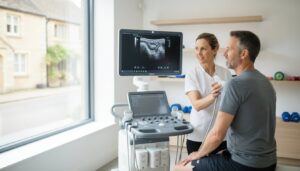
GB Clinic operates a one-stop diagnostic setup designed to eliminate the frustration of multiple appointments. We provide a seamless transition from initial assessment to active treatment. Our clinical team combines manual therapy for lower back pain with immediate access to diagnostic ultrasound scans. This technology allows us to visualize soft tissue structures and joint inflammation in real-time during your consultation. It’s a level of precision that ensures your recovery plan is based on clear evidence rather than guesswork. Patients visiting us from Abingdon, Summertown, or Headington benefit from this efficiency, often receiving a diagnosis and treatment plan in a single visit.
Our commitment to a professional and expert-led experience means you’re always seen by a specialist. We maintain a calm environment where clinical excellence is the priority. This approach has helped us become a trusted partner for musculoskeletal health across Oxfordshire. By integrating advanced diagnostics with hands-on care, we reduce the delays often associated with standard healthcare pathways, where waiting lists for scans can exceed 18 weeks in some UK regions.
Beyond Manual Therapy: When to Consider Injections
While manual therapy for lower back pain is highly effective for many, some patients present with acute inflammation that requires a different intervention. In these cases, we offer ultrasound-guided steroid injections to provide rapid relief. These targeted injections are specifically useful for:
- Reducing intense inflammation around the lumbar nerve roots.
- Calming acute facet joint pain to allow for physical rehabilitation.
- Breaking the cycle of chronic pain when manual techniques alone aren’t enough.
Manual therapy supports your recovery following an injection. Once the initial inflammation is reduced, our specialists use hands-on techniques to restore movement. We focus on creating a comprehensive plan for long-term joint health, ensuring you aren’t just masking symptoms but addressing the underlying mechanical issues. Our clinic is easily accessible from Kennington, Marcham, and central Oxford for those requiring these specialist procedures.
Advanced Recovery for Chronic Conditions
For persistent soft tissue issues that haven’t responded to traditional treatments, we integrate modern therapies like shockwave therapy. We also use hyaluronic acid injections for lumbar facet joint issues. This treatment is proven to ease pain for up to 6 months by providing lubrication and cushioning within the joint. It’s an excellent option for patients from Witney, Faringdon, or Eynsham who are looking for evidence-based alternatives to surgery.
Our multi-disciplinary approach leads to better patient outcomes because it addresses the condition from multiple angles. We combine the mechanical benefits of manual therapy with the biological benefits of advanced injections. This dual-action strategy helps to restore function and improve mobility faster than single-modality treatments. Every patient receives a bespoke programme tailored to their specific scan results and lifestyle goals.
Take Control of Your Recovery with Expert Oxford MSK Care
Effective recovery from spinal discomfort requires more than just rest. Clinical evidence shows that combining manual therapy for lower back pain with structured exercise leads to superior functional improvements compared to standard care alone. Our HCPC registered clinicians provide a one-stop diagnostic and treatment setup, specialising in ultrasound-guided recovery to ensure precision in every session. This evidence-based approach focuses on restoring mobility and reducing inflammation through targeted, expert-led interventions.
GB Clinic is designed for efficiency and patient outcomes, removing the need for multiple referrals. Our specialist facility is easily accessible for those travelling from Abingdon, Summertown, Kennington, Marcham, Headington, Witney, Faringdon, Eynsham, and central Oxford. You don’t have to manage persistent pain on your own when professional, clinical support is available locally. We’re here to help you return to a pain-free lifestyle with confidence.
Book your expert MSK consultation in Oxford today
Frequently Asked Questions
Is manual therapy for lower back pain safe for everyone?
Manual therapy is safe for the vast majority of patients following a comprehensive musculoskeletal screening. Our specialists at GB Clinics identify contraindications like acute fractures or severe osteoporosis in the 2% of cases where specific manipulations aren’t suitable. This ensures your treatment plan is both effective and secure.
How many sessions of manual therapy will I need to see results?
Most patients experience significant relief within 4 to 6 sessions at our Oxford facility. Clinical data suggests that 80% of individuals with mechanical issues see measurable improvement in mobility after their first three appointments. We monitor your progress at every stage to ensure the manual therapy for lower back pain is delivering the expected recovery milestones.
Will manual therapy hurt if my back is already very sore?
You might feel some mild pressure or a “stretching” sensation, but the treatment itself shouldn’t be painful. We use gentle mobilisation techniques to desensitise the area and restore movement carefully. If you’re travelling from Abingdon or Witney with acute pain, our clinical team adjusts the intensity to match your specific comfort levels.
Can manual therapy help with sciatica or referred leg pain?
Manual therapy for lower back pain is highly effective for managing sciatica and referred leg symptoms. By addressing spinal stiffness and reducing pressure on the sciatic nerve, we help alleviate the shooting pains felt in the lower limbs. Studies indicate that conservative manual treatments can resolve 90% of sciatica symptoms without the need for invasive surgery.
What is the difference between manual therapy and a sports massage?
Manual therapy is a clinical intervention focused on joint mobilisation and spinal alignment, whereas sports massage primarily targets soft tissue. While a massage relaxes muscles, our MSK specialists use targeted techniques to restore function to the underlying skeletal structures. This medical approach provides a long term solution for patients in Summertown and Headington rather than temporary relief.
Do I need a GP referral to book manual therapy in Oxford?
You don’t need a GP referral to book a specialist assessment at our clinic. We accept self-referrals from across Oxfordshire, including residents in Kennington, Marcham, and central Oxford. This direct access allows you to begin your recovery immediately and avoids the 12 week waiting lists often found in alternative care pathways.
Can manual therapy prevent the need for back surgery?
Clinical evidence shows that manual therapy can prevent the need for surgery in approximately 90% of patients with lumbar disc issues. By improving spinal mechanics and reducing inflammation, we create the right conditions for the body to heal naturally. This conservative approach is the recommended first line of treatment in UK national guidelines for musculoskeletal health.
What should I wear to my manual therapy appointment?
Wear loose, comfortable clothing such as shorts or a vest top that allows easy access to your lower back. This helps our clinicians perform accurate assessments and apply treatments effectively during your session. Our clinic is easily accessible from Faringdon and Eynsham, and we provide private changing facilities for your comfort and convenience.