

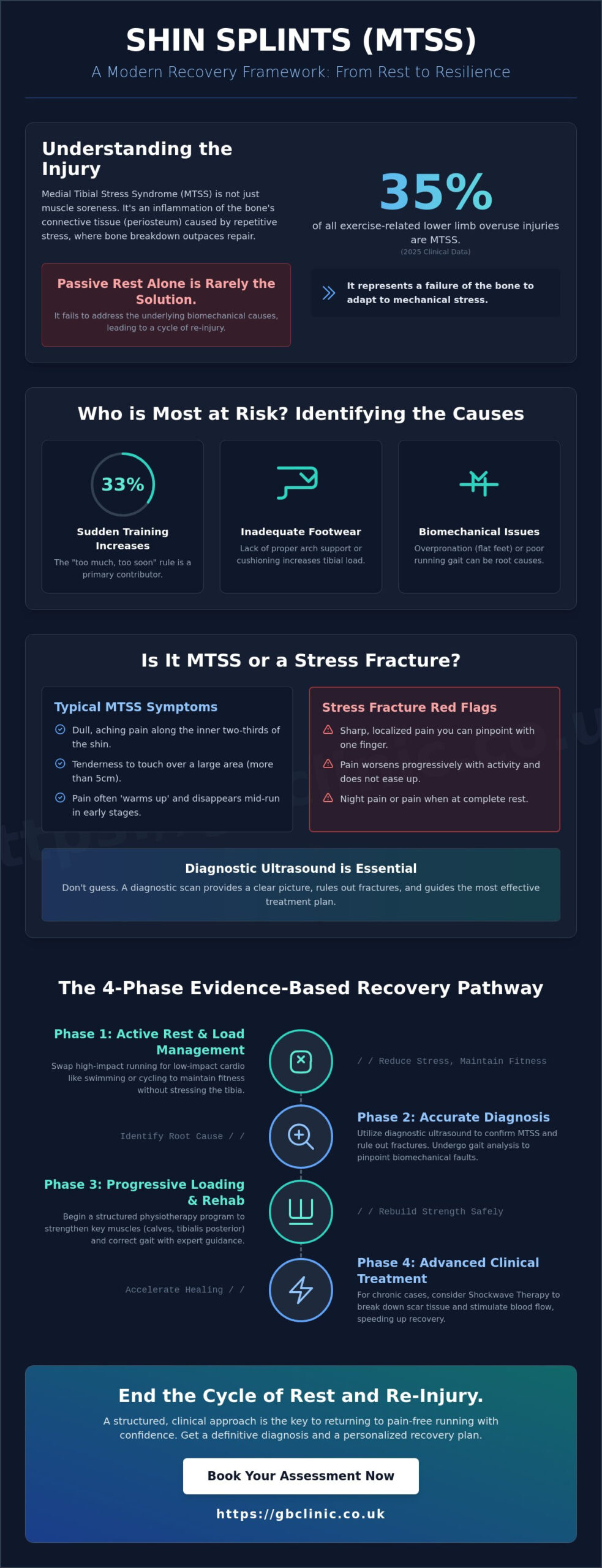
Recent 2025 clinical data reveals that Medial Tibial Stress Syndrome (MTSS) now accounts for up to 35% of all exercise-related overuse injuries in the lower limbs. If you’ve experienced that persistent, radiating ache during a morning run in Abingdon or after training in Summertown, you understand the frustration of a recovery that never seems to stick. Learning how to treat shin splints effectively is essential for many athletes in Headington and Kennington who find themselves trapped in a cycle of rest and re-injury. You deserve a path back to performance that’s built on evidence rather than guesswork.
This guide provides a comprehensive recovery framework by transitioning from passive rest to active, clinical rehabilitation. Whether you’re seeking care near Marcham, Farmoor, or Eynsham, our goal is to provide the clarity you need to distinguish between Load Induced Medial-Leg Pain and a serious stress fracture. We’ll preview a structured 2026 recovery plan that’s easily accessible for residents in Didcot, Witney, and Faringdon. By combining advanced diagnostics with progressive loading strategies, we help patients across Central Oxford and West Oxford return to pain-free running with total confidence.
Key Takeaways
- Learn how to treat shin splints effectively by transitioning from total rest to a structured, evidence-based loading program.
- Discover why a diagnostic ultrasound scan is essential to rule out stress fractures, with rapid clinic access for residents in Abingdon, Summertown, and Headington.
- Identify the biomechanical root causes of your pain through gait analysis and private MSK physiotherapy available near Kennington, Marcham, and Farmoor.
- Explore advanced clinical treatments like Shockwave Therapy to resolve chronic inflammation, serving athletes across Didcot, Witney, and Faringdon.
- Master the specific return-to-play criteria that ensure you’re truly ready for impact in Eynsham, Central Oxford, or West Oxford.
Understanding Medial Tibial Stress Syndrome (MTSS): Why Rest Isn’t Always Enough
MTSS is often misunderstood as simple muscle soreness. It’s actually a clinical inflammation of the periosteum, the specialized connective tissue covering the tibia. This occurs specifically where the lower leg muscles, such as the tibialis posterior, attach to the bone. Clinically known as Medial Tibial Stress Syndrome, it represents a failure of the bone to adapt to repetitive mechanical stress. For runners in Summertown or Central Oxford who train on rigid urban pavements, this condition is a frequent barrier to performance.
To better understand this concept, watch this helpful video:
The underlying mechanism is a physiological imbalance in bone remodeling. Under normal conditions, bone tissue breaks down and rebuilds to become stronger. When loading stress exceeds the rate of repair, micro-damage accumulates. Many individuals believe that simple rest is the solution. However, passive rest alone rarely addresses the structural weaknesses or gait abnormalities that caused the injury. Learning how to treat shin splints effectively requires a proactive approach that includes strengthening and biomechanical correction. Without this, the injury cycle often repeats as soon as you return to the trails in Headington or the roads in West Oxford.
Common Symptoms and Early Warning Signs
Early detection is vital for residents in Abingdon or Kennington to prevent progression toward a stress fracture. Symptoms typically present as a dull, aching pain along the inner two-thirds of the shin bone. You might notice tenderness to the touch or mild swelling in the lower leg. A classic sign of early-stage MTSS is pain that appears at the start of a run but seems to ‘warm up’ and disappear as you continue. This deceptive pattern often leads athletes to ignore the problem until the pain becomes persistent throughout the day.
The Risk Factors: Who is Most Susceptible?
Sudden increases in training volume, often called the ‘too much, too soon’ rule, contribute to 33.3% of cases according to 2025 research. Athletes in Didcot, Witney, and Faringdon are particularly at risk when transitioning from soft grass to hard surfaces. Other factors include:
- Inadequate footwear that lacks proper arch support or cushioning.
- Biomechanical issues like overpronation or flat feet that increase tibial load.
- Running on uneven terrain or hard pavements common in Central Oxford.
Addressing these factors through private MSK physiotherapy is the most reliable way to ensure a safe return to activity for patients in Marcham, Farmoor, and Eynsham. Correcting these issues is the first step in understanding how to treat shin splints effectively for the long term.
Immediate Management Strategies: How to Treat Shin Splints at Home
The first step in recovery is moving away from the “no pain, no gain” mentality. Complete rest is rarely the answer; instead, we recommend a relative rest approach. This involves temporarily replacing high-impact running with low-impact activities like swimming or cycling to maintain cardiovascular fitness without further stressing the tibia. For athletes in Didcot, Witney, or Faringdon, this shift is the most critical phase in learning how to treat shin splints effectively. It allows the bone remodeling process to catch up with the previous loading demands.
Reducing soft tissue tension is another priority. Tension in the calf muscles and the tibialis posterior often exerts a continuous pull on the already inflamed periosteum. Utilizing myofascial release techniques can help alleviate this mechanical pull. While simple foam rolling at home in Marcham or Farmoor provides some relief, it’s often a temporary fix for deeper structural issues. If you find your progress stalling, it may be time to consider how professional private MSK physiotherapy can address these underlying gait abnormalities.
The RICE Protocol Refined for 2026
Modern sports medicine has evolved the traditional RICE protocol to be more specific. Standard guidelines for shin splints diagnosis and treatment emphasize that while ice is effective for pain management, it must be applied correctly to avoid tissue damage. We suggest the following steps for residents in Eynsham and Headington:
- Apply ice packs for 15 to 20 minutes every 3 to 4 hours during the first 48 hours of acute pain.
- Use medical-grade compression sleeves during daily walking to support the soft tissues and reduce vibration.
- Prioritize gentle mobility over aggressive stretching. Over-stretching a tight calf in the acute phase can actually increase the stress on the tibial attachment.
Pain Relief and Topical Interventions
Managing inflammation often requires a multi-faceted approach. Short-term use of non-steroidal anti-inflammatory drugs (NSAIDs) like ibuprofen can reduce acute discomfort, though they shouldn’t be used to mask pain during exercise. For residents in Abingdon and Kennington, therapeutic massage is an excellent adjunct therapy to improve local circulation and reduce muscle guarding. This helps the lower leg return to a more relaxed, mobile state.
It’s important to recognize when home care isn’t enough. If you experience night pain, focal point tenderness on the bone, or pain that persists even when walking in Summertown or West Oxford, you’ve reached a clinical threshold. These are red flags that require a professional assessment to ensure you aren’t dealing with a stress fracture. Our specialists across Central Oxford can help you determine the exact nature of your injury and provide a clear path toward how to treat shin splints effectively through advanced clinical care.
Diagnostic Precision: Ruling Out Stress Fractures with Ultrasound
While a physical examination provides a strong baseline, relying solely on touch can be problematic. Differentiating between Medial Tibial Stress Syndrome and a more serious tibial stress fracture is difficult without imaging. For athletes in Headington or Summertown, a misdiagnosis often leads to prolonged pain and unnecessary time away from training. This is why we utilize diagnostic ultrasound scans at our Oxford clinic. This technology allows for an immediate, non-invasive assessment of the bone surface. It helps our specialists identify early signs of stress reactions that standard physical tests might miss, providing rapid answers for patients from Wheatley and the surrounding areas.
Our diagnostic process focuses on clinical precision. We look for cortical thickening or irregularities along the periosteum that indicate significant bone stress. These markers are essential when determining how to treat shin splints effectively. By providing rapid diagnostics, we ensure that patients from Kennington, Farmoor, and Eynsham don’t have to wait weeks for hospital appointments. An accurate scan provides the clarity needed to build a safe, evidence-led recovery plan from the very first visit.
MTSS vs. Stress Fractures: Key Differences
Distinguishing these two conditions is vital for long-term health. MTSS typically presents as diffuse pain along the inner shin. In contrast, a stress fracture usually involves point-specific tenderness where the pain is concentrated in one small area. If you feel pain while resting or during the night in Abingdon or West Oxford, it’s a significant indicator of potential bone damage. Ultrasound offers a real-time view of the injury site; it allows us to see the fluid or inflammation around the bone immediately. This level of detail is a cornerstone of modern Shin splints treatment and management.
The Importance of an Accurate Diagnosis for Recovery
A vague diagnosis is the primary cause of rehabilitation failure. If you’re treating a stress fracture as simple MTSS, you risk a complete bone break. Conversely, being too cautious with MTSS can lead to muscle atrophy and unnecessary delays. For residents in Didcot, Marcham, and Witney, getting the right answer on day one saves months of wasted effort. We tailor every loading programme based on the severity of the diagnostic findings. This ensures that individuals in Faringdon and Central Oxford receive a structured path back to running that actually works. We prioritize clinical evidence to help you understand how to treat shin splints effectively without the guesswork. If you’re concerned about persistent pain, our team is here to provide a comprehensive assessment to get you back on track.
Effective Rehabilitation: Correcting Biomechanics and Progressive Loading
Resting provides the bone with an opportunity to heal, but it doesn’t prepare the body for the return of impact forces. To understand how to treat shin splints effectively, we must shift focus toward active rehabilitation. This involves identifying why your shin bone reached its breaking point in the first place. For athletes in Witney and Faringdon, this often means looking beyond the leg to the way the entire body moves during a stride. Without addressing these mechanical failures, the risk of re-injury remains high once you return to the roads.
Our approach centers on private MSK physiotherapy to pinpoint specific gait abnormalities. Through detailed gait analysis, we identify issues such as overpronation or overstriding, which significantly increase the load on the medial tibia. Many runners in Summertown and Headington don’t realize that a slight change in cadence can reduce peak tibial acceleration. By strengthening the “foot core” and the calf complex, we improve your body’s natural ability to absorb shock, turning a vulnerable area into a resilient one.
Biomechanical Correction and Orthotics
Correcting your foot strike is a fundamental step for long-term recovery. We assess how your foot interacts with the ground to determine if your current footwear is providing adequate support. For some residents in Abingdon and Kennington, custom orthotics are a necessary intervention to stabilize the medial longitudinal arch. While off-the-shelf supports work for minor issues, custom devices provide the precise alignment needed to offload the tibia during high-intensity training. We also implement natural gait retraining techniques, teaching you how to land more softly and efficiently to minimize future stress.
The Progressive Loading Framework
Recent 2025 clinical guidelines emphasize a criteria-based return to activity rather than a time-based one. For patients in Didcot, Marcham, and Farmoor, we follow a structured three-phase framework to ensure the bone is ready for load. This process is essential for anyone learning how to treat shin splints effectively in a modern clinical setting.
- Phase 1: Focuses on achieving pain-free daily activities. We introduce isometric strengthening for the calf muscles to build foundational capacity without aggravating the periosteum.
- Phase 2: Once you can walk for 30 to 45 minutes without discomfort, we move to low-impact plyometrics and eccentric calf work. This begins to re-introduce the spring-like loading required for running.
- Phase 3: A controlled return to running on varied Oxfordshire terrains, such as the softer trails in Eynsham. We strictly follow the “10% rule,” ensuring training volume doesn’t increase too rapidly.
A successful recovery depends on moving through these stages only when your body meets specific strength and pain-free benchmarks. If you’re ready to stop the cycle of recurring shin pain, book a comprehensive biomechanical assessment with our specialist team in Central Oxford or West Oxford today.
Advanced Clinical Treatments: Shockwave Therapy and Specialist Care
When chronic pain persists despite proper rest and exercise, advanced clinical interventions become necessary to break the cycle of inflammation. For athletes in Eynsham, Farmoor, and West Oxford, we provide access to Extracorporeal Shockwave Therapy (ESWT). This modern, non-invasive treatment is specifically designed for recalcitrant periosteal inflammation that hasn’t responded to traditional home care. Understanding how to treat shin splints effectively in 2026 involves using these targeted technologies to stimulate healing at a cellular level where manual stretching alone cannot reach.
Shockwave therapy doesn’t just mask pain; it addresses the underlying pathology by sending high-energy acoustic pulses into the affected tibial tissue. This process creates a synergy with your existing rehabilitation plan, accelerating the transition from injury to performance. Residents in Abingdon and Kennington often find that this clinical approach provides the necessary stimulus to resolve long-standing discomfort that has previously limited their training volume.
How Shockwave Therapy Accelerates Recovery
The primary mechanism of ESWT is neovascularisation, which is the formation of new blood vessels in the treated area. This improves local blood flow and nutrient delivery to the damaged periosteum. It also disrupts chronic pain signals, providing a window of relief that allows you to perform your rehabilitation exercises more comfortably. Clinical evidence suggests that a full course typically requires 3 to 6 sessions for optimal results. During a session at our Oxfordshire clinic, you’ll experience a focused application of these pulses directly to the medial border of the tibia. It’s a precise, efficient process that helps patients from Didcot, Witney, and Faringdon avoid the frustration of stalled recovery.
Comprehensive Care Pathways at GB Clinic
We believe that technology works best when integrated into a broader clinical framework. By combining Manual Therapy with advanced shockwave protocols, we address both the symptoms and the biomechanical causes of your pain. This multi-disciplinary approach is highly effective for patients in Central Oxford who require a structured path back to high-impact sports. Our team ensures that every intervention is evidence-led and tailored to your specific diagnostic profile.
Patients from Marcham, Headington, and Summertown benefit from our streamlined care pathways that prioritize functional restoration. We don’t just aim for temporary relief; we focus on long-term resilience. If you’re ready to learn how to treat shin splints effectively and return to the activities you love, the next step is a professional evaluation. You can book an initial assessment at our clinic to receive a clear, diagnostic-led treatment plan that addresses your unique needs and helps you move forward with total confidence.
Take the Next Step Toward Pain-Free Performance
Resolving Medial Tibial Stress Syndrome requires a transition from passive waiting to active, evidence-based recovery. By utilizing diagnostic ultrasound to rule out stress fractures and implementing a progressive loading framework, you address the functional failures that lead to injury. We’ve detailed how advanced clinical treatments like shockwave therapy can resolve chronic inflammation when traditional methods fail. Understanding how to treat shin splints effectively is about building a body that’s resilient enough to handle the specific demands of your sport.
Our expert-led clinical team offers advanced diagnostics and specialist rehabilitation with convenient access for residents in Abingdon, Summertown, and Kennington. We provide local expertise for patients from Marcham, Headington, and Farmoor, ensuring high-quality care is never far away. Our services are easily reachable for those in Eynsham, Didcot, Witney, and Faringdon, as well as athletes across Central Oxford and West Oxford. Take control of your recovery today.
Book a Comprehensive MSK Assessment in Oxford Today
You don’t have to navigate this journey alone. We’re here to help you return to the roads with total confidence and lasting relief.
Frequently Asked Questions
How long do shin splints usually take to heal with effective treatment?
Recovery typically takes between 6 and 12 weeks when you follow a structured loading program. For residents in Abingdon or Summertown, the exact duration depends on the severity of the initial bone stress and how quickly biomechanical corrections are implemented. Pushing through pain can extend this period significantly. A gradual return to running ensures that the tissue remodeling process is complete before you resume high-intensity training.
Can I continue to walk or cycle if I have shin splints?
You can continue with low-impact activities like cycling, swimming, or using an elliptical trainer. These exercises allow patients in Kennington and Marcham to maintain their fitness without placing repetitive impact stress on the tibia. It’s important to monitor for any pain during these activities. If walking in your local neighborhood causes discomfort, you should reduce your volume until you can move pain-free for at least 30 minutes.
Are compression socks actually effective for treating shin splints?
Compression sleeves are effective tools for managing symptoms by reducing muscle oscillation and supporting soft tissues. While they provide comfort for runners in Headington and Farmoor, they’re an adjunct therapy rather than a primary cure. To resolve the condition long-term, you must address the underlying gait issues. Using compression during your daily routine can help manage the acute inflammatory response while you progress through your exercise rehabilitation.
What is the difference between shin splints and a stress fracture?
The primary difference lies in the distribution and nature of the pain. Medial Tibial Stress Syndrome (MTSS) causes diffuse discomfort along the inner edge of the shin bone. A stress fracture typically produces a sharp, localized pain that you can pinpoint with one finger. If you experience focal tenderness or pain that keeps you awake at night in Eynsham or Didcot, a clinical assessment is required to rule out bone damage.
When should I see a specialist physiotherapist in Oxford for my leg pain?
You should consult a specialist if your pain doesn’t improve with rest or if it returns immediately upon resuming exercise. Our clinics provide rapid access for individuals in Witney and Faringdon who require a clear diagnostic answer. Early intervention prevents a simple overuse injury from developing into a more serious stress fracture. A professional evaluation includes a thorough biomechanical assessment to identify the root cause of your discomfort.
Can poor running form in Central Oxford’s streets cause shin splints?
Running on the hard pavements of Central Oxford can increase the impact load on your shins if your form is inefficient. Overstriding and a low step rate are common biomechanical failures that lead to increased tibial stress. Learning how to treat shin splints effectively involves adjusting your gait to land more softly. This reduces the force transmitted through the lower leg and allows for a more comfortable running experience on urban surfaces.
Is shockwave therapy a safe treatment for lower leg pain?
Shockwave therapy is a highly safe and evidence-based clinical intervention for chronic lower leg pain. It uses acoustic pulses to stimulate blood flow and cellular repair in the periosteum. For patients in West Oxford, it offers a non-surgical path to recovery for cases that haven’t responded to traditional physiotherapy. The treatment is efficient and allows for a quicker return to active rehabilitation by disrupting persistent pain signals.
Will I need an ultrasound scan to diagnose my shin splints?
An ultrasound scan isn’t always mandatory but it’s highly recommended for a definitive diagnosis. It allows our clinicians to visualize the bone surface in real-time to check for inflammation or stress reactions. Providing this level of diagnostic precision helps patients understand how to treat shin splints effectively from the start. We offer these scans on-site to ensure you receive a tailored recovery plan without the delays of hospital waiting lists.