
The immediate relief of a steroid shot might actually be the less effective choice for long-term healing. While chemical blocks offer a quick fix, clinical data shows that PRP therapy for soft tissue injuries provides more significant and sustained functional improvement at the twelve month mark. If you’re managing persistent pain that prevents you from exercising or working, you’re likely searching for a solution that addresses the root cause rather than just masking symptoms. It’s natural to feel concerned about invasive surgery or the long-term impact of repetitive chemical injections.
This guide explains how Platelet-Rich Plasma accelerates recovery for tendon, ligament, and muscle injuries through evidence-based biological repair. We’ll preview the clinical roadmap for tissue regeneration and the reduction of inflammatory pain. Our clinics provide accessible, specialist care for residents throughout Oxfordshire. Whether you’re based in Abingdon, Summertown, Kennington, or Marcham, professional treatment is within easy reach. We serve the wider community including Headington, Farmoor, Eynsham, and Didcot, alongside our patients in Witney, Faringdon, Central Oxford, and West Oxford. Discover how a modern, patient-focused approach can help you return to full mobility with confidence.
Key Takeaways
- Understand how concentrated platelets act as a biological repair kit, showing clinically meaningful improvement in up to 70% of appropriately selected patients.
- Learn why PRP therapy for soft tissue injuries provides superior functional outcomes at 12 months compared to traditional corticosteroid treatments.
- Identify the specific clinical criteria required to transition from failed conservative management to advanced biological healing.
- Discover how integrated treatment plans combine PRP with specialist exercise rehabilitation for residents in Abingdon, Summertown, Kennington, Marcham, and Headington.
- Access professional MSK services within easy reach of Farmoor, Eynsham, Didcot, Witney, Faringdon, Central Oxford, and West Oxford.
What is PRP Therapy for Soft Tissue Injuries?
PRP therapy for soft tissue injuries is a modern clinical intervention that uses a patient’s own blood cells to stimulate healing. By concentrating platelets into a small volume of plasma, clinicians create a powerful biological solution targeted at tendons, ligaments, muscles, and fascia. This process is entirely non-surgical, making it a preferred option for active individuals in Abingdon, Kennington, and Marcham who want to avoid the downtime associated with invasive procedures. To understand the foundational science, one can research What is Platelet-Rich Plasma (PRP) to see how these cells act as primary responders to injury.
Our clinics provide a local, expert-led choice for patients throughout Oxfordshire, ensuring residents in Farmoor, Eynsham, and Didcot don’t have to manage persistent pain alone. Because the treatment uses your own biological material, it offers a safe path toward restoration. It’s a precise way to deliver a high concentration of growth factors directly to the site of damage, which is especially beneficial for those living in Summertown, Headington, and West Oxford who lead busy, active lives.
To better understand this concept, watch this helpful video:
The Components of Platelet-Rich Plasma
Platelets are much more than simple clotting agents. They act as reservoirs for essential growth factors that signal the body to repair damaged fibers. Plasma serves as the vital transport medium, allowing these concentrated healing cells to reach the specific site of an injury. Since the substance is autologous, meaning it’s derived from your own body, the risk of an allergic reaction or rejection is non-existent. This safety profile is a significant advantage for patients in Witney and Faringdon seeking reliable clinical outcomes without the need for synthetic chemicals.
Common Injuries Treated with PRP
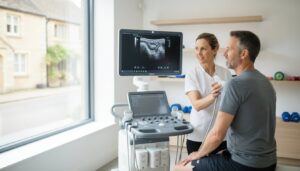
We focus on conditions that have often failed to respond to basic rest or standard conservative care. Chronic issues like Achilles tendinopathy, tennis elbow, and plantar fasciitis are primary targets for this biological approach. It’s also highly effective for acute ligament sprains and muscle tears sustained during sports or daily activities. For residents in Central Oxford or Headington, we often combine these injections with a diagnostic ultrasound scan to ensure precise delivery to the affected area. This targeted approach is especially helpful for early-stage joint wear and tear, providing a clear roadmap for returning to a mobile, active state.
The Science of Biological Healing: How Platelets Repair Tissue
Biological healing follows a predictable sequence: inflammation, proliferation, and remodelling. For many individuals in Kennington or Marcham, chronic pain occurs because this cycle has stalled. PRP therapy for soft tissue injuries serves as a biological reset. It delivers a concentrated burst of healing cells that forces the body out of a state of chronic inflammation and into active repair. This is essential for tissues with poor blood supply, like tendons and ligaments, which often lack the natural resources to complete the healing cycle on their own.
The preparation involves a precision centrifuge process. By spinning a small sample of your blood at high speeds, we separate the potent platelets from the heavier red blood cells. This creates a concentrated layer containing the highest density of healing factors. Concentration levels are vital here. Research indicates that the PRP treatment process is most effective when platelet counts are significantly elevated. This high-density solution ensures the biological signal is strong enough to trigger repair in patients from Abingdon to Summertown. Without this specific concentration, the body may not receive a clear enough signal to begin building new collagen fibers.
The Role of Growth Factors
Specific growth factors, such as Vascular Endothelial Growth Factor (VEGF) and Transforming Growth Factor-beta (TGF-beta), play central roles in the recovery journey. VEGF stimulates the growth of new blood vessels to nourish damaged tissue, which improves oxygen delivery to the injury site. TGF-beta signals local stem cells to migrate to the area, providing the raw materials needed for structural rebuilding. Growth factors reduce long-term inflammation by modulating the local environment while actively promoting structural repair.
From Blood Draw to Injection
The entire clinical process typically takes between 30 and 60 minutes. It begins with a standard blood draw, followed by the centrifuge cycle to isolate the platelets. For residents in Headington, Farmoor, or Eynsham, we prioritize needle accuracy to maximize the response from PRP therapy for soft tissue injuries. We use a diagnostic ultrasound scan to guide the injection directly into the damaged fibers. This minimally invasive approach is highly accessible for those in Didcot, Witney, and Faringdon. Whether you’re in Central Oxford or West Oxford, this procedure offers a clear path toward recovery without the need for surgery. If you’re ready to explore these options, you can view our full range of specialist services.
PRP vs. Steroid Injections: Addressing the Regeneration Myth
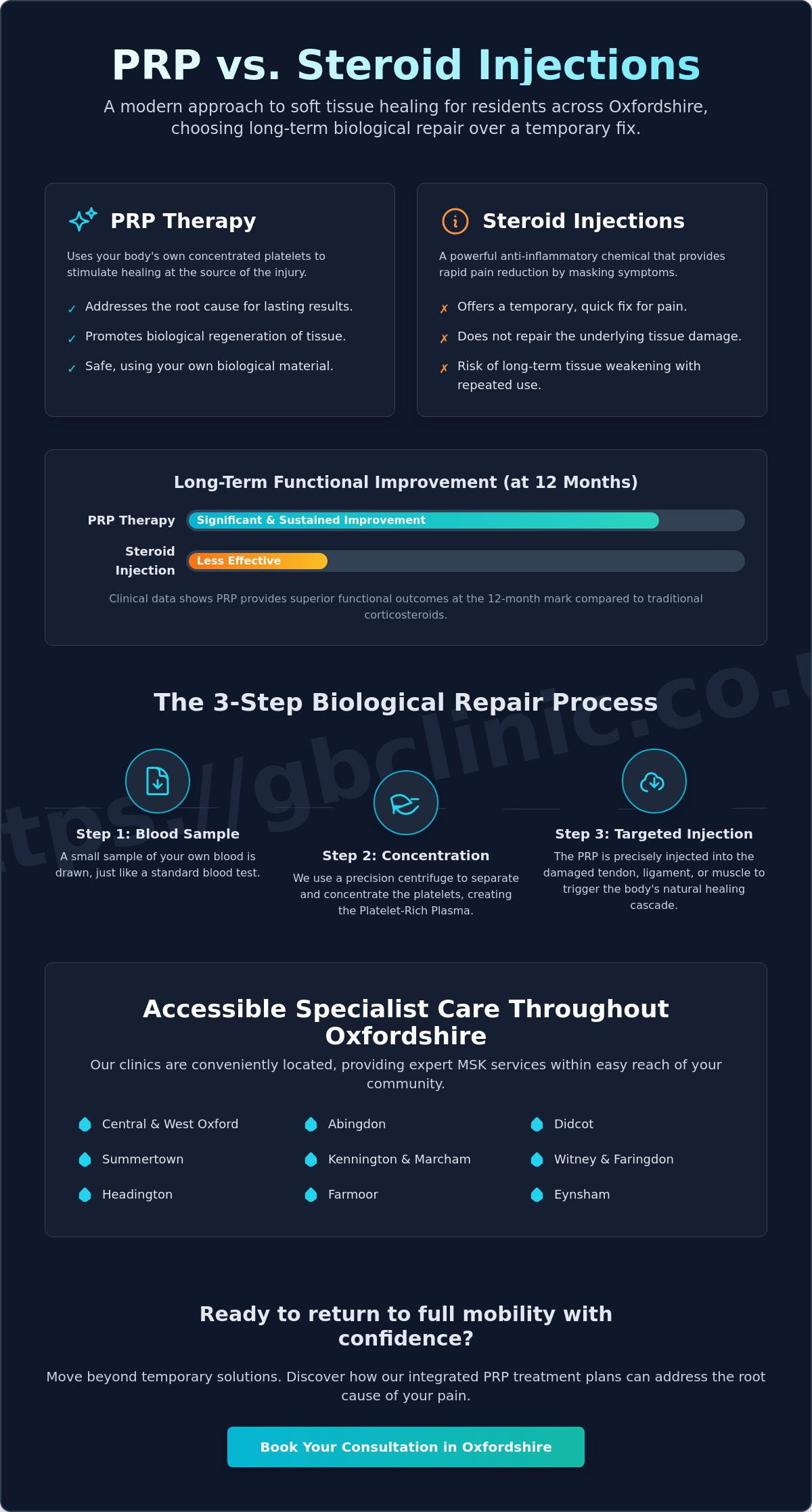
Choosing between a steroid and a biological treatment often depends on your long-term goals. Patients in Abingdon and Kennington often ask why they shouldn’t just opt for a standard cortisone shot. Steroids are powerful anti-inflammatories that provide rapid relief by suppressing the local immune response. While this stops pain quickly, it’s essentially a masking effect. In contrast, PRP therapy for soft tissue injuries targets the biological root of the discomfort. It facilitates the creation of new, healthy collagen fibers rather than just hiding the symptoms of damage.
Opting for a “quick fix” can be tempting for those in Marcham or Headington struggling with daily tasks, but it carries structural risks. Clinical evidence suggests that repeated steroid use can lead to tendon atrophy or even rupture, as the chemical can weaken the structural integrity of the tissue over time. For individuals seeking a permanent solution, biological repair offers a more sustainable path. Clinical studies hosted by the NIH on The Science of Biological Healing demonstrate that PRP provides superior functional outcomes at the twelve month mark compared to traditional steroids, making it the preferred choice for long-term tissue health.
When to Choose a Guided Steroid Injection
There are specific scenarios where a guided steroid injection is the most appropriate clinical choice. For residents in Farmoor and Eynsham experiencing acute, high-level inflammatory pain that prevents any form of sleep or movement, a steroid can provide a necessary window of relief. This intervention is often used as a clinical bridge. By cooling down an “angry” joint or tendon, it allows a patient to engage in early-stage rehabilitation without distress. Our specialists in Didcot and Witney use ultrasound guidance to ensure the medication is delivered precisely, which minimizes the risk to surrounding healthy structures.
The Regenerative Advantage of PRP
PRP offers a distinct advantage for athletes and active individuals in Summertown and Central Oxford. Instead of potentially weakening the tendon, it strengthens the biological foundation of the limb. This is a vital consideration for those in Faringdon and West Oxford who intend to return to high-impact sports or demanding physical work. You should understand that the timeline for results is different; while a steroid works in hours, PRP results develop over several weeks as the body physically rebuilds the tissue. This measured, natural process leads to a more resilient recovery and a significantly lower chance of injury recurrence.
Is PRP Right for You? Assessing Injuries Across Oxfordshire
Determining if you’re a suitable candidate for PRP therapy for soft tissue injuries requires a detailed clinical evaluation. It isn’t a universal solution; success depends heavily on selecting patients with mild-to-moderate chronic conditions who haven’t responded to initial conservative care. Meta-analyses from 2024 indicate that PRP provides meaningful improvement in 50-70% of appropriately selected patients. We provide this specialist assessment for residents in Witney, Didcot, and Abingdon, ensuring a local pathway to advanced biological healing.
You might be a candidate if you meet the following clinical criteria:
- Persistent pain that has lasted for three to six months.
- Diagnosed tendinopathy, ligament laxity, or muscle scarring.
- Failure of standard rest, ice, and basic loading protocols.
- A clear preference for non-surgical tissue regeneration over invasive operations.
We don’t rely on guesswork. Using a diagnostic ultrasound scan, we grade the severity of your soft tissue damage. This allows us to see the internal structure of the tendon or muscle in real-time. If there’s a full-thickness tear that requires a different clinical pathway, we identify it immediately. This diagnostic precision ensures that PRP therapy for soft tissue injuries is only applied when it has the highest probability of success.
Targeting Local Recovery in Oxfordshire
Our clinics are strategically positioned for easy access across the region. Patients in West Oxford, Headington, and Kennington find follow-up visits convenient and stress-free. For those living in Eynsham, Farmoor, or Summertown, we offer specialist care that removes the need for long-distance travel to London. We serve the broader community from Marcham to Faringdon and Central Oxford, providing a professional, modern environment for your recovery journey. We focus on getting you back to your routine without unnecessary delays.
The Importance of Accurate Diagnosis
A comprehensive physiotherapy assessment is the essential first step in your journey. During this session, we differentiate between a simple strain and a more complex structural tear. This distinction is vital because biological repair works best on tissues that have “stalled” during the natural healing cycle. We regularly accept patients from across the county for specialist second opinions, helping them find clarity when previous treatments haven’t delivered results. If you’re ready to identify the root cause of your pain, you can book a clinical MSK assessment today.
Personalised PRP Treatment at GB Clinic: Your Path to Recovery
Our clinical approach is built on a clear framework of Problem, Solution, and Benefit. When you present with chronic pain that hasn’t improved through standard rest, we identify the specific anatomical concern using high-resolution imaging. PRP therapy for soft tissue injuries acts as the biological solution, delivering concentrated growth factors to stimulate repair. The ultimate benefit is a return to a comfortable, mobile state with improved tissue resilience. We’re committed to providing expert-led care that follows the latest evidence-based protocols, ensuring every patient receives a treatment plan tailored to their unique recovery goals.
Biological healing is a journey rather than a single event. While the injection provides the necessary catalyst, the way you move and load the tissue in the following weeks determines the quality of the repair. We focus on transparency throughout this process, explaining the function of each step in plain language. This ensures you feel both informed about the advanced nature of your care and reassured about the positive results you can expect.
The Integrated Rehabilitation Protocol
Success doesn’t end with the injection. We believe that biological repair requires a structured environment to succeed. Following your procedure, we implement a “protection phase” for the first few days to allow the initial inflammatory response to settle. After this period, engaging in specialist physiotherapy in Oxford becomes vital. This phase focuses on progressive loading, which is necessary to align new collagen fibers correctly. Without this structured guidance, the regenerated tissue may lack the strength required for high-impact activities. We create a gradual return-to-sport plan that monitors your progress, ensuring you don’t return to full activity before the tissue is ready.
Booking Your Consultation in Oxford
We’ve designed our services to be the convenient, local choice for individuals throughout the region. Patients living or working in Central Oxford and Summertown can reach our clinical facilities with ease. We also provide accessible care for those driving from surrounding towns such as Abingdon, Witney, and Didcot. Our proximity to Kennington, Marcham, and Headington ensures that residents across Oxfordshire have access to modern therapeutic methods without unnecessary travel delays. Whether you’re coming from Farmoor, Eynsham, Faringdon, or West Oxford, our team is ready to guide your recovery.
If you’re managing a persistent injury that prevents you from enjoying your daily life, it’s time to explore a biological alternative. We invite you to book an initial clinical assessment to discuss your specific needs and receive a clear roadmap for your recovery. Our focus is on providing comprehensive care that addresses the root cause of your discomfort. Contact GB Clinic to discuss PRP therapy for your injury and take the first step toward long-term tissue regeneration.
Take the Next Step Toward Biological Recovery
Transitioning from chronic pain to functional mobility requires a shift from temporary symptom management to active biological repair. You’ve learned how PRP therapy for soft tissue injuries uses your own healing factors to restart stalled recovery cycles. By prioritizing tissue regeneration over the short-term masking effects of steroids, you’re investing in the long-term structural health of your tendons and muscles. It’s a modern approach that focuses on durability and resilience.
Our expert-led MSK specialists provide this advanced care with the precision of diagnostic ultrasound guidance to ensure every injection is accurately placed. We believe a successful outcome depends on a personalised post-injection rehabilitation plan that safely returns you to your peak activity level. Residents in Abingdon, Summertown, Kennington, and Marcham can access these specialist services without leaving the county. Whether you’re based in Headington, Farmoor, Eynsham, or Didcot, our clinics offer a professional and accessible pathway to recovery. We’re proud to serve the wider community from Witney and Faringdon to Central and West Oxford with care and clinical excellence.
Book Your Specialist PRP Assessment at GB Clinic Today
You don’t have to accept persistent discomfort as a permanent part of your life. We’re here to help you regain your mobility and return to the activities you love with confidence.
Frequently Asked Questions
Is PRP therapy for soft tissue injuries painful during or after the injection?
The procedure involves mild discomfort during the blood draw and the injection itself. We often use local anesthetic to numb the skin before the clinical application. It’s common to experience a temporary increase in soreness for 48 to 72 hours as the concentrated platelets trigger the initial inflammatory phase of healing. This reaction is a normal part of the biological repair process and settles quickly for patients in Summertown and Headington.
How many PRP injections will I need for a chronic tendon injury?
The number of treatments depends on the severity and duration of your condition. While some individuals find relief after a single session, a course of two to three injections spaced several weeks apart is often required for complex chronic cases. During your assessment, we use diagnostic ultrasound to monitor tissue changes. This helps us determine the optimal frequency of PRP therapy for soft tissue injuries for residents in Abingdon and Kennington.
Can I drive home after receiving a PRP injection at the Oxford clinic?
Most patients are able to drive themselves home following the procedure. If the injection is in a weight-bearing joint or your dominant driving limb, you might experience temporary stiffness or localized discomfort. We recommend that patients traveling from further towns like Witney, Didcot, or Faringdon consider having a friend or family member drive them if they’re concerned about post-treatment soreness. We’ll discuss your specific travel plans during your appointment.
What is the success rate of PRP for soft tissue healing?
Recent meta-analyses from 2024 and 2025 indicate that PRP provides clinically meaningful improvement in 50% to 70% of appropriately selected patients. Success is highly dependent on accurate diagnosis and the concentration of platelets used in the solution. We focus on treating individuals with mild-to-moderate chronic conditions who haven’t responded to initial conservative care. This targeted selection ensures the highest probability of a positive outcome for our Oxfordshire community.
How long does it take to see results from PRP therapy?
Biological repair is a gradual process that takes several weeks to develop. Unlike steroid injections that mask pain within hours, PRP works by physically rebuilding tissue. You’ll typically notice a reduction in symptoms and improved function between six and twelve weeks after the injection. Clinical data suggests that the most significant and sustained benefits often appear at the six to twelve month mark as the remodelling phase of healing completes.
Are there any side effects or risks associated with PRP injections?
The risks are minimal because the treatment is autologous, meaning it uses your own blood. This eliminates the possibility of an allergic reaction or rejection. The most common side effects include localized bruising, swelling, or temporary soreness at the injection site. Because we use ultrasound guidance for all procedures in West Oxford and Central Oxford, we minimize the risk of damage to surrounding nerves or blood vessels during the clinical application.
Will my health insurance cover PRP therapy for a sports injury?
Most private health insurance policies in the UK don’t currently cover PRP injections. It’s usually considered a self-pay treatment. We recommend that patients in Marcham, Farmoor, and Eynsham check directly with their provider before booking to confirm their specific level of coverage. We provide clear documentation of your clinical MSK assessment and treatment plan if you need to submit details to your insurer for their records.
Can I combine PRP with other treatments like shockwave therapy?
Yes, we often integrate different modalities to enhance the recovery process. Combining PRP therapy for soft tissue injuries with shockwave therapy can be particularly effective for stubborn chronic tendinopathies. While PRP provides the biological building blocks for repair, shockwave therapy can help break down calcifications and stimulate local blood flow. We also combine these interventions with a structured exercise rehabilitation program to ensure the new tissue is strong and resilient.