
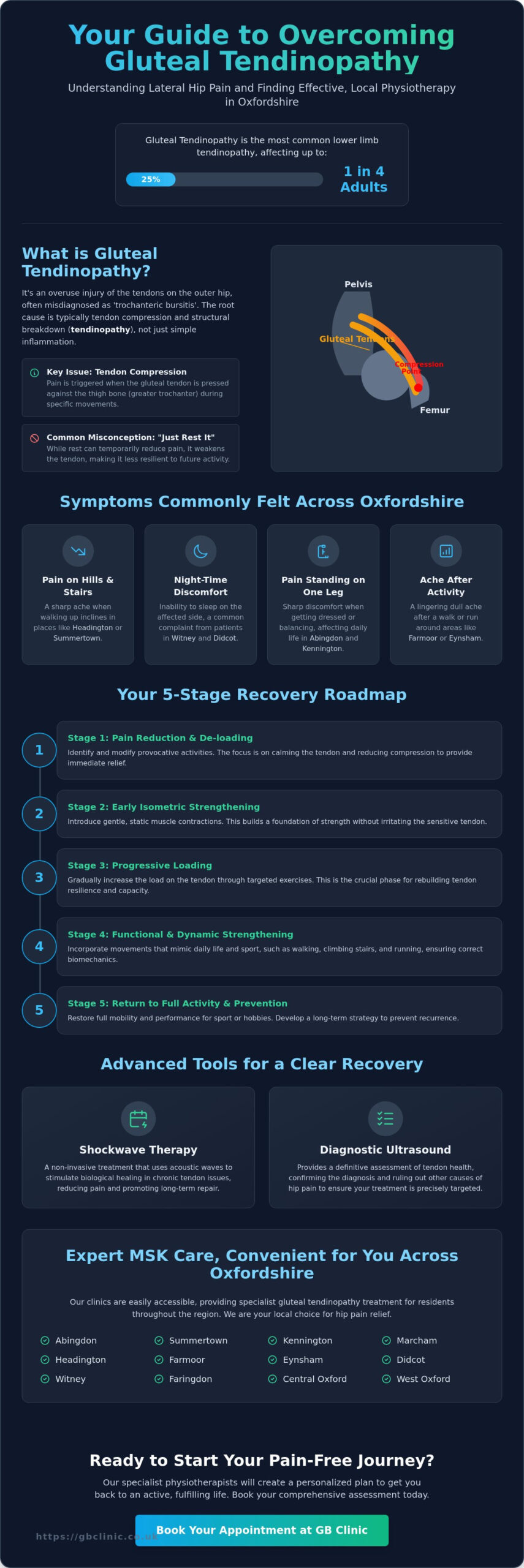
Research indicates that gluteal tendinopathy affects up to 25% of adults, making it the most common lower limb tendinopathy. Many patients in Oxfordshire struggle for months with lateral hip pain because they are misinformed about the cause or told to simply rest. Specialist physiotherapy for gluteal tendinopathy offers a more effective, evidence-based route to relief. If you find it nearly impossible to sleep on your affected side or feel a sharp ache when walking up hills in Abingdon or Summertown, you aren’t alone in your frustration.
We understand that persistent hip pain affects your daily quality of life, from your morning walk in Headington to your sleep quality in Witney. This guide explains how modern MSK interventions and progressive loading programs resolve symptoms and restore function. You’ll discover how our clinics, accessible from Kennington, Marcham, Farmoor, and Eynsham, use tools like diagnostic ultrasound and shockwave therapy to create a clear recovery timeline. Whether you’re based in Didcot, Faringdon, Central Oxford, or West Oxford, you can learn how to move from protecting your hip to strengthening it for a pain-free, active future.
Key Takeaways
- Learn why lateral hip pain is often misidentified as trochanteric bursitis and how a diagnostic ultrasound scan provides a definitive assessment of tendon health.
- Discover how specialist physiotherapy for gluteal tendinopathy utilizes progressive loading and exercise rehabilitation to strengthen tendons rather than relying on complete rest.
- Explore advanced non-invasive options such as Shockwave Therapy to address chronic discomfort and stimulate biological healing in the gluteal tendons.
- Understand the five essential stages of recovery, from initial pain reduction to the restoration of full mobility and athletic performance.
- Access expert MSK care conveniently located for residents across Oxfordshire, including those in Marcham, Kennington, and Central Oxford.
What is Gluteal Tendinopathy? Understanding Lateral Hip Pain
Gluteal tendinopathy is an overuse injury affecting the tendons on the outer side of the hip. It’s frequently mislabeled as “trochanteric bursitis,” but modern clinical research shows the tendon is usually the primary issue rather than the bursa. Specialist physiotherapy for gluteal tendinopathy focuses on restoring the tendon’s capacity to handle load. Many patients we see from Abingdon and Summertown describe a persistent, deep ache that makes daily life exhausting. Historically, this condition was often referred to as Gluteus medius tendonitis, but the medical community now recognizes it as a degenerative process rather than just simple inflammation.
To better understand how this condition develops and how to manage it, watch this helpful video:
The primary driver of pain in this condition is a “compression” mechanism. When the hip moves into specific positions, the tendon is pressed against the bone, causing irritation and discomfort. This is why certain activities are particularly provocative for those suffering in Oxfordshire. Common symptoms include:
- Pain when climbing stairs or walking up steep inclines.
- Sharp discomfort when standing on one leg, such as when getting dressed.
- Difficulty sleeping due to pain when lying on the affected side at night.
- A dull ache that lingers after a long walk or run.
The Anatomy of Your Hip Pain
The gluteus medius and gluteus minimus are the two primary muscles responsible for stabilizing your pelvis during movement. Their tendons attach to the greater trochanter, which is the prominent bony bump on the side of your thigh bone. In 2026, clinicians use the term “tendinopathy” because it accurately describes the structural breakdown of collagen fibers within the tendon. A diagnostic ultrasound scan is an excellent tool to confirm the severity of these changes and rule out other causes of lateral hip pain.
Common Triggers for Oxfordshire Residents
We observe distinct patterns of hip pain across our regional clinics. Residents in Witney or Eynsham often report symptoms after a sudden increase in walking across the local hills. Conversely, those working at desks in Central Oxford or West Oxford frequently suffer due to prolonged sitting, which can lead to hip muscle weakness. “Weekend warrior” runners from Headington or Farmoor often see flare-ups after intense sessions without sufficient recovery time. Whether you’re based in Didcot, Faringdon, Kennington, or Marcham, our approach identifies these specific lifestyle triggers to ensure a targeted recovery plan.
How Physiotherapy Targets the Root Cause of Tendon Pain
Effective recovery from lateral hip pain requires more than just resting. While avoiding activity might temporarily dull the ache, it doesn’t prepare the tendon for the demands of walking through Summertown or climbing stairs in a Headington townhouse. Modern physiotherapy for gluteal tendinopathy focuses on restoring the tendon’s resilience through progressive loading. Evidence from a systematic review of gluteal tendinopathy treatments highlights that active loading is significantly more effective than passive “wait and see” approaches.
Our clinicians begin with a comprehensive assessment to identify why the tendon is overloaded. We look for specific biomechanical markers like a “Trendelenburg gait,” where the pelvis drops on the opposite side during walking. This movement pattern increases compression on the gluteal tendons. By identifying these issues at our clinics in Central Oxford and West Oxford, our physiotherapist service creates a roadmap that addresses the root cause rather than just the symptoms.
Problem: Inconsistent exercise or complete rest often leads to a cycle of pain and weakness.
Solution: A structured rehabilitation programme provides clear, progressive stages of loading tailored to your specific needs.
Benefit: You gain a predictable recovery timeline and the confidence to return to your active life in Oxfordshire without fear of re-injury.
Load Management: The Foundation of Healing
Healing a tendon is a delicate balancing act. We follow the “Goldilocks” principle: applying enough load to stimulate repair without causing a flare-up. For residents in Abingdon, this might mean adjusting your walking routes. Instead of tackling the steeper inclines immediately, we might suggest flatter paths around the town until your tendon strength improves. This modification allows you to stay active in Farmoor, Kennington, or Eynsham without irritating the injury.
Manual Therapy and Myofascial Release
Problem: Many patients experience significant tightness in the Tensor Fasciae Latae (TFL) and gluteal muscles. This tension increases the compressive force on the underlying tendon, which can slow the recovery process for residents in Marcham or Didcot.
Solution: We incorporate manual therapy and myofascial release techniques to physically reduce muscle guarding and tension.
Benefit: This provides an immediate reduction in perceived pain. It’s much easier for you to perform your prescribed exercise rehabilitation when your hip feels more mobile and less restricted.
This structured approach is essential for those in Witney or Faringdon who want to return to running or long-distance walking. By combining hands-on care with progressive exercise, we help you regain your mobility. If you’re struggling to manage your symptoms, you can speak with our specialist team to begin your recovery journey.
Advanced Treatment Options for Stubborn Hip Pain in Oxford
Some cases of lateral hip pain persist despite consistent exercise. If you’ve been managing symptoms for over 12 weeks in Headington or Eynsham without significant relief, your recovery may require more than standard movement-based therapy. Specialist physiotherapy for gluteal tendinopathy at our clinic integrates advanced MSK interventions to restart the healing process for residents in Abingdon and the surrounding areas. These treatments are specifically designed for tendons that have failed to respond to initial conservative management.
Shockwave Therapy (ESWT) for Tendon Repair
- Problem: Chronic tendon pain that hasn’t responded to 3 months of structured exercise rehabilitation.
- Solution: We use Shockwave therapy to deliver targeted acoustic energy to the affected gluteal tendons. This non-invasive procedure stimulates blood flow and triggers cellular repair in tissues that have become degenerative or “stuck” in a painful cycle.
- Benefit: Patients often experience faster healing times and significant pain reduction without the need for surgical intervention. It’s an excellent option for active individuals in Witney or Farmoor who need to return to their routine quickly.
Precision Diagnostics and Injections
Accurate treatment starts with an accurate diagnosis. We use diagnostic ultrasound scans to confirm the severity of any tendon tears or associated inflammation. This high-resolution imaging allows our specialists to see exactly where the tissue is struggling. It provides a level of detail that a standard physical exam cannot match, ensuring your treatment plan is based on clear clinical evidence.
For patients in Summertown or Kennington experiencing high levels of pain that prevent them from sleeping or performing rehab exercises, a guided steroid injection can be a strategic tool. While research suggests that exercise is superior for long-term recovery, an ultrasound-guided injection can “break the cycle” of intense pain. This provides a vital window of relief that allows you to engage more effectively with your strengthening program.
If your hip pain is complicated by concurrent joint issues like osteoarthritis, we may recommend Hyaluronic Acid injections. This treatment acts as a lubricant and shock absorber within the joint. You can read more about this in our comprehensive guide to joint pain relief. These advanced tools are readily accessible to our patients in Marcham, Didcot, Faringdon, and across Central and West Oxford.
Your Recovery Roadmap: 5 Stages of Gluteal Rehab
Recovery from lateral hip pain is a structured process that requires patience and consistency. We guide our patients through a logical progression designed to build tendon resilience while managing daily discomfort. Specialist physiotherapy for gluteal tendinopathy is not about a single exercise; it’s about a phased increase in the tendon’s capacity to handle force. Whether you’re based in Didcot, Faringdon, or Eynsham, following these milestones ensures a safer return to your normal routine.
- Stage 1: Pain Reduction and Education. We focus on settling the initial irritation and teaching you how to move without provocative compression.
- Stage 2: Isometric Loading. This involves holding specific muscle contractions without moving the joint. It helps build strength and has a natural pain-relieving effect.
- Stage 3: Isotonic Loading. We introduce slow, heavy movements like squats or lunges to build structural strength in the gluteal muscles.
- Stage 4: Functional and Energy-Storage Exercises. These movements prepare the hip for higher-impact activities, such as brisk walking or light jogging.
- Stage 5: Return to Activity. The final phase focuses on your specific goals, such as long-distance walking in the Oxfordshire countryside or returning to sport.
Stage 1-2: Settling the Symptoms
A common mistake we see in patients from Marcham or Farmoor is the attempt to “stretch out” the tightness. You should avoid stretching the IT band or the side of your hip. This movement actually increases compression on the gluteal tendon and can significantly worsen your symptoms. Instead, focus on simple isometric holds at home to manage pain levels. We also recommend sleeping with a pillow between your knees at night. This prevents “hip adduction,” where the top leg crosses the midline, and keeps the tendon in a neutral, non-compressed position while you sleep.
Stage 3-5: Building a Resilient Hip
Tendons require high levels of tension to stimulate repair and remodeling. This is why “light” weights or high-repetition exercises are often ineffective for chronic hip pain. In Stage 3, we prioritize progressive resistance. It’s important to understand that noticeable tendon remodeling typically takes a minimum of 12 weeks of consistent, targeted loading. As you progress, we’ll help you safely return to running on the flat paths of West Oxford or the hills near Headington. Our objective is to ensure you feel confident and capable during your daily commutes in Central Oxford, Kennington, or Abingdon.
To begin your structured recovery journey and receive a personalized exercise plan, book your initial physiotherapy assessment with our specialist team today.
Expert Gluteal Tendinopathy Care at GB Clinic Oxford
GB Clinic serves as a primary destination for advanced musculoskeletal care in Oxfordshire. We recognize that finding specialized physiotherapy for gluteal tendinopathy shouldn’t be a struggle. Our facilities are strategically located to be accessible for residents in Didcot, Faringdon, and Central Oxford. By providing a comprehensive range of services in one location, we eliminate the need for multiple referrals and long delays. This “all-under-one-roof” model means your diagnostic ultrasound, shockwave therapy, and exercise rehabilitation are coordinated by a single expert team.
Why Oxfordshire Patients Choose GB Clinic
Our reputation is built on delivering high-quality private msk physiotherapy in Oxford. We combine clinical expertise with modern technology to ensure every patient receives an accurate diagnosis and an effective treatment plan. For chronic or stubborn cases that haven’t responded to traditional methods, we offer extracorporeal shockwave therapy. This integration of manual therapy and advanced medical technology is particularly beneficial for active individuals in Headington and West Oxford who need a faster return to their routine.
Patients often highlight the attentive and professional demeanor of our practitioners. We prioritize a patient-first approach, offering no-obligation initial assessments to help you understand your condition before committing to a full course of treatment. This efficient model ensures you start your recovery without the frustration of extended wait times often found with other providers in the region. We focus on providing clear answers and evidence-based solutions that lead to lasting physical restoration.
Start Your Recovery Journey Today
Accessing our specialist care is straightforward whether you’re traveling from Eynsham, Summertown, or Abingdon. We’ve designed our booking process to be simple and responsive to the needs of our local community. For those in Kennington, Marcham, or Farmoor, our clinics provide a convenient local choice for professional hip care. You don’t have to manage persistent lateral hip pain alone when expert help is available nearby.
When you arrive for your first session, we recommend bringing:
- Comfortable, loose-fitting clothing or shorts to allow for a thorough hip and pelvic assessment.
- A list of any current medications or previous hip interventions.
- Any prior scan reports if you’ve already had imaging elsewhere in Witney or Oxford.
It’s encouraging to note that conservative management has a very high success rate. Research published in the British Medical Journal found that targeted education and exercise resulted in a 77% improvement after just 8 weeks. Whether you’re a runner in Witney or someone managing daily life in Central Oxford, we’re committed to helping you achieve these results. Our goal is to provide the expert physiotherapy for gluteal tendinopathy you need to return to a mobile, pain-free life.
Restore Your Hip Mobility and Return to Action
Resolving persistent lateral hip pain requires a transition from passive rest to a structured, progressive loading program. By understanding the underlying mechanics of tendon compression and utilizing evidence-based physiotherapy for gluteal tendinopathy, you can reclaim your active lifestyle. Our expert MSK clinicians provide the precision and care needed to navigate each stage of recovery, from initial pain management to full functional restoration.
With advanced diagnostic ultrasound available on-site, we offer clear clinical insights for patients from Summertown, Kennington, and Marcham. Our clinics are conveniently positioned to serve residents in Headington, Farmoor, and Eynsham, ensuring that high-quality care is never far away. Whether you’re commuting from Didcot, Faringdon, or West Oxford, we provide a streamlined path to recovery that avoids unnecessary delays.
Book Your Specialist Hip Assessment in Oxford Today
You don’t have to tolerate sleepless nights or restricted movement. Our team in Witney, Abingdon, and Central Oxford is ready to support your journey back to a comfortable, mobile state. We look forward to helping you achieve your physical goals.
Frequently Asked Questions
Can I walk with gluteal tendinopathy?
Walking is generally encouraged but you must manage the volume and intensity to stay within comfortable pain limits. Movement helps maintain muscle strength and promotes blood flow to the hip area. It’s best to avoid very long distances or “power walking” if they cause your pain to rise above a mild ache. If you live in Abingdon or Summertown, we suggest choosing flatter routes initially to minimize unnecessary tendon compression.
How long does physiotherapy take for hip tendinopathy?
A typical recovery timeline for gluteal tendinopathy ranges from three months to a year depending on the severity. While many patients in Central Oxford or West Oxford notice significant pain reduction within 6 to 8 weeks, tendon remodeling is a slow biological process. Consistency with your prescribed exercise rehabilitation is the most important factor in achieving long-term relief and preventing future flare-ups.
Why does my hip pain get worse at night?
Hip pain often intensifies at night because lying on your side causes the top leg to drop across your body, which compresses the gluteal tendon against the bone. This position is known as hip adduction and it irritates the sensitive tendon fibers. We advise our patients in Headington or Kennington to sleep with a supportive pillow between their knees to keep the hip in a neutral, non-compressed position.
Is walking uphill bad for gluteal tendinopathy?
Walking uphill isn’t inherently bad, but it significantly increases the compressive load on your gluteal tendons. During the early stages of recovery, these inclines can aggravate your symptoms and increase inflammation. If you’re walking in the more undulating areas around Witney or Eynsham, try to stick to level ground until your specialist confirms your tendon is strong enough to handle steeper gradients.
Should I use heat or ice for outer hip pain?
Ice is usually the better choice for managing sharp flare-ups and reducing the sensitivity of the lateral hip. Applying a cold pack for 10 to 15 minutes can help dull the ache after a long day of activity. While heat might feel pleasant for relaxing tight muscles in the lower back, it won’t address the underlying tendon issue as effectively as ice and a structured loading program.
What exercises should I avoid with gluteal tendinopathy?
You should avoid deep “glute stretches” that involve pulling your knee across your chest or sitting in a “figure-four” position. These movements increase compression on the tendon and often make the condition worse. It’s also wise to avoid high-impact jumping or deep lunges until your foundation strength has improved. Our clinics in Didcot and Faringdon provide specific modifications to ensure your workout routine doesn’t hinder your healing.
Is a steroid injection better than physiotherapy?
A steroid injection offers faster short-term relief but research shows it’s less effective than exercise over a twelve-month period. Specialist physiotherapy for gluteal tendinopathy addresses the root cause by strengthening the tissue, whereas an injection only masks the symptoms. We typically use ultrasound-guided injections as a strategic tool to reduce intense pain, allowing you to engage more comfortably with your recovery exercises.
Can gluteal tendinopathy be cured completely?
Most individuals achieve a full return to their normal activities with a dedicated management plan. Data indicates that approximately 70% of people see their symptoms resolve within a year of starting evidence-based treatment. Whether you’re based in Marcham or Farmoor, you can expect to return to walking, running, and sleeping without pain by following a logical, progressive recovery roadmap tailored to your needs.