While many are told that arch supports are the only solution for fallen arches, clinical evidence suggests that targeted neuromuscular loading can actually rebuild functional stability. You’ve likely felt that persistent ache in your mid-foot after a short walk or noticed how your knee and hip alignment feels compromised during your daily routine. With research indicating that up to 26% of adults experience these symptoms, it’s vital to understand how to fix flat feet with exercise rather than relying solely on external supports. This guide provides a professional, clinical framework to strengthen your medial arch and reduce daily discomfort through specialized ‘Short Foot’ muscle activation and tendon-loading protocols.
Our GB Clinic provides accessible, expert-led care for residents across Oxfordshire, ensuring specialist MSK support is always within reach. We work closely with patients from Abingdon, Summertown, and Kennington to address the root causes of foot pain. Our practitioners also serve the communities of Marcham, Headington, and Farmoor with evidence-based exercise rehabilitation and manual therapy. If you live or work in Eynsham, Didcot, Witney, or Faringdon, or are searching for a local specialist in Central Oxford and West Oxford, we offer a clear path to recovery. You’ll learn how a combination of clinical exercise and modern diagnostics can restore your stability and return you to a comfortable, mobile state.
Key Takeaways
- Distinguish between flexible and rigid flat feet to ensure your rehabilitation plan targets the correct structural or functional cause of your arch collapse.
- Learn how to fix flat feet with exercise using a professional ‘Foot Core’ framework designed to strengthen intrinsic muscles and restore medial arch stability.
- Discover how clinical interventions like diagnostic ultrasound scans and Shockwave Therapy resolve chronic pain when traditional stretching routines don’t provide relief.
- Access expert care across Oxfordshire, with clinics easily reachable for those in Abingdon, Witney, Didcot, and Central Oxford.
- Connect with local specialists serving Summertown, Headington, Kennington, Marcham, Farmoor, Eynsham, and Faringdon for a clear path to recovery.
Understanding Flat Feet (Pes Planus) and Arch Collapse
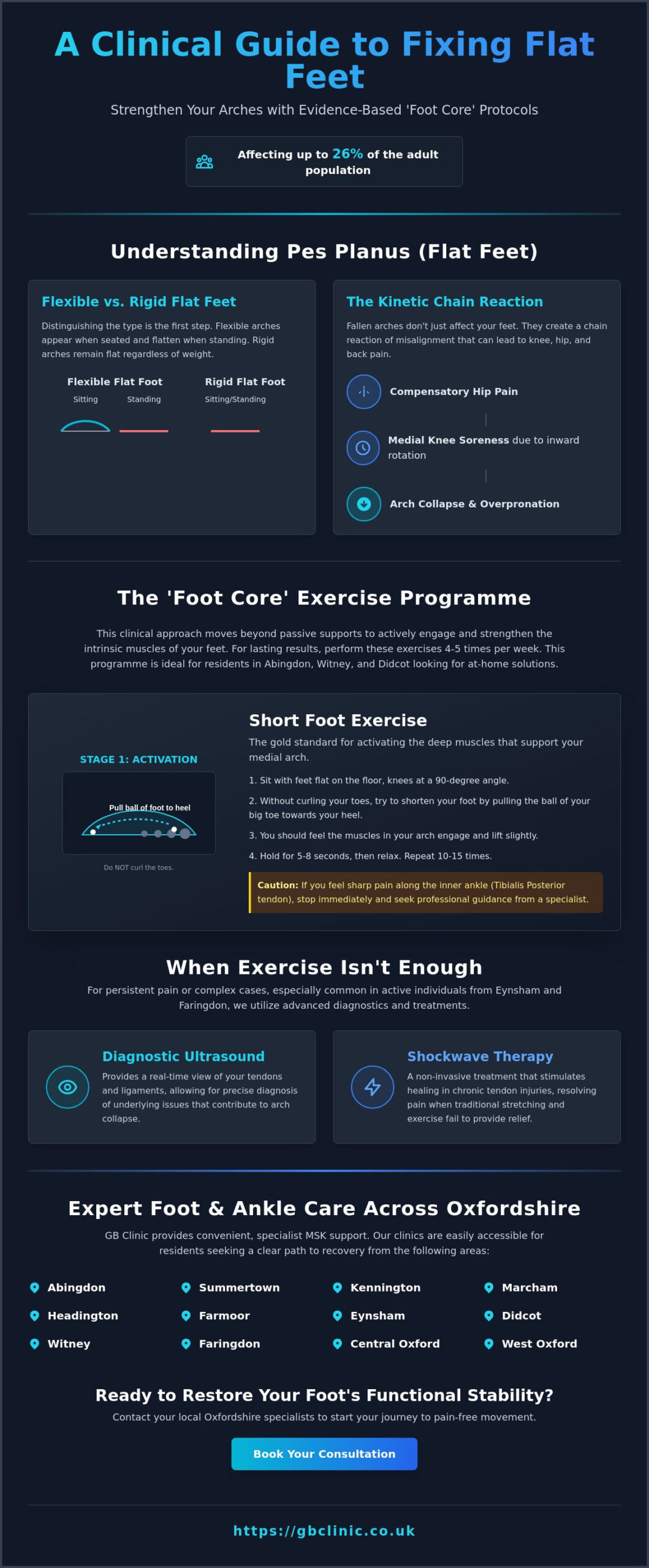
Flat feet, clinically termed Pes Planus, involve the partial or total collapse of the medial longitudinal arch. This structural change affects a significant portion of the adult population, with research indicating a prevalence between 10% and 26%. For individuals in Central Oxford or West Oxford, Understanding Flat Feet (Pes Planus) begins with identifying the type of collapse. Flexible flat feet present an arch when sitting that disappears upon standing, while rigid flat feet remain flat regardless of weight-bearing status. Distinguishing between these is the first step in determining how to fix flat feet with exercise effectively.
The collapse of the arch doesn’t just affect the foot; it impacts the entire kinetic chain. When the arch falls, the foot rolls inward, forcing the lower leg to rotate internally. This misalignment often leads to medial knee soreness and compensatory hip pain. Residents in Abingdon and Summertown often seek clinical support when these structural shifts begin to interfere with daily walking. Learning how to fix flat feet with exercise is essential for restoring the foundational stability that prevents these upward-reaching alignment issues.
To better understand this concept, watch this helpful video:
Why do arches collapse?
Arches can collapse due to genetic factors or as an adult-acquired condition. In communities like Headington, Kennington, and Didcot, sedentary lifestyles and unsupportive footwear often contribute to the weakening of intrinsic foot muscles. Other factors include pregnancy and aging, which increase ligament laxity and reduce the foot’s structural resilience. Patients from Marcham and Farmoor often report that these changes occur gradually, eventually leading to persistent arch aching and swelling along the inner ankle bone.
The impact on your daily mobility
Overpronation significantly alters your walking gait and reduces the foot’s ability to absorb shock. This often results in secondary issues such as shin splints, particularly for active individuals in Witney, Eynsham, and Faringdon. At GB Clinic, we emphasize that “fixing” flat feet is not about changing the foot’s appearance for aesthetic reasons. Instead, the focus is on developing functional stability so that the foot can support the body’s weight without causing pain or misalignment during dynamic movement.
The 3-Stage Exercise Programme to Fix Flat Feet
Strengthening the medial arch requires a shift in focus from passive support to active muscular engagement. This clinical approach centers on the “Foot Core” system, which targets the intrinsic muscles responsible for maintaining structural integrity. When learning how to fix flat feet with exercise, consistency is the primary driver of success. We recommend performing these movements four to five times weekly to achieve measurable improvements in arch height and stability. The objective is to create a functional arch that remains stable during dynamic movement. If you feel sharp pain in the Tibialis Posterior tendon along the inner ankle, stop immediately and seek professional guidance. Residents in Abingdon, Summertown, and Kennington can easily integrate these stages into their daily routines at home.
Stage 1: Activation and Mobility
The first stage focuses on waking up muscles that have become dormant due to unsupportive footwear. The Short Foot exercise is the gold standard for intrinsic muscle activation. To perform this, sit with your feet flat and attempt to “shorten” your foot by pulling the ball of the big toe toward the heel without curling your toes. You should feel the arch lift slightly. Combine this with tennis ball rolls under the foot to provide myofascial release for the plantar fascia. These exercises for fallen arches also include toe splaying, which improves the neurological connection to your foot. Patients from Marcham, Headington, and Farmoor often find that these activation drills provide immediate relief from mid-foot aching.
Stage 2: Strengthening the Arch
Once activation is achieved, the focus shifts to building muscle endurance. Towel curls are a classic starting point; use your toes to pull a weighted towel toward you while keeping your heel stationary on the floor. Learning how to fix flat feet with exercise requires progressing these movements into weight-bearing positions. Arch lifts in a standing position force the foot to maintain its structure under full body weight. Another effective movement is the calf raise with a tennis ball squeezed between your heels. This specific variation engages the Tibialis Posterior muscle, the primary dynamic stabilizer of the arch. Whether you’re in Eynsham, Didcot, or Witney, these strengthening exercises form the backbone of a successful recovery plan.
Stage 3: Functional Integration
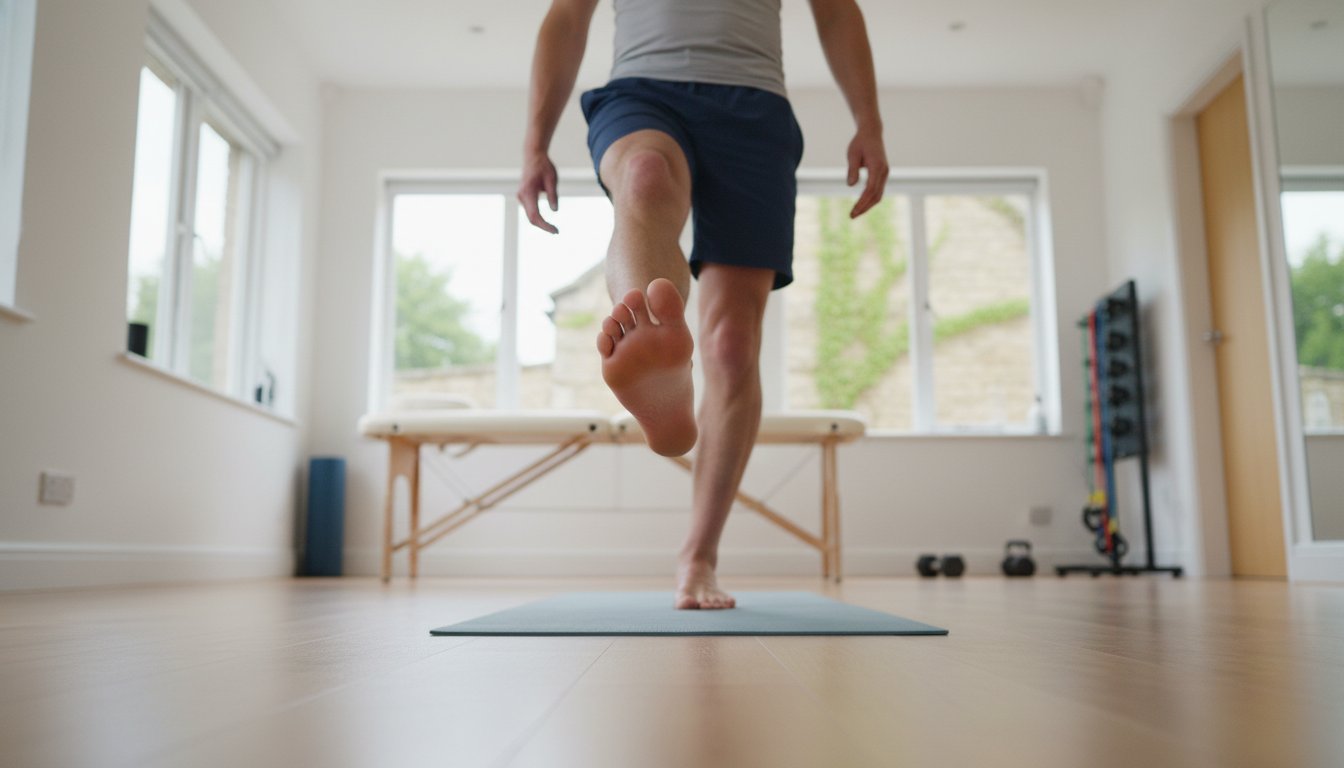
The final stage ensures your new arch stability translates to real-world activities like walking and running. Single-leg balance drills challenge the foot to maintain its “core” while dealing with instability. Step-downs are also vital, as they teach you to control the arch during eccentric loading, mimicking the stress of walking downstairs. Finally, integrate walking lunges with a strict focus on preventing arch collapse. For those near Faringdon, Central Oxford, and West Oxford, mastering these functional movements is key to long-term pain reduction. If you find these movements difficult to coordinate, a professional physiotherapy assessment can help refine your technique and accelerate your progress.
When Exercise Isn’t Enough: The Role of Diagnostics
Many individuals diligently research how to fix flat feet with exercise only to find that their symptoms persist or even worsen over time. This frustration often stems from an undiagnosed underlying condition known as Tibialis Posterior Tendon Dysfunction (TPTD). In these clinical cases, the issue isn’t simply a lack of muscle strength; it’s a structural failure of the primary tendon that supports the arch. For residents in Abingdon, Summertown, and Kennington, understanding that inflammation or micro-tears cannot be “exercised away” is a critical step toward recovery. Attempting to load a damaged tendon without clinical guidance can lead to further degeneration.
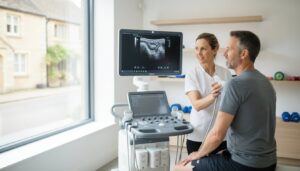
When conservative home routines fail to provide relief, a diagnostic ultrasound scan becomes essential. This imaging allows MSK experts to look beneath the surface and assess the health of the soft tissues in real-time. Without this clarity, you might be following a program that inadvertently places more stress on a damaged tendon. People in Marcham, Headington, and Farmoor can access these advanced diagnostics to ensure their rehabilitation plan is built on objective evidence rather than guesswork.
Visualising the problem
Using ultrasound technology helps differentiate between simple muscle weakness and structural tendon damage. It provides a clear picture of whether the tendon is thickened, inflamed, or partially torn. This distinction is vital because a tear requires a completely different clinical approach than simple flat feet. We also utilize gait analysis to identify subtle movement compensations that might be contributing to your pain. For those in Eynsham or Didcot, this comprehensive view prevents wasted time on ineffective exercise routines and focuses your recovery on the specific anatomical issue.
Clinical indicators for advanced care
The ‘Single Heel Raise Test’ is a primary clinical benchmark used to evaluate tendon health. If you’re unable to stand on one leg and rise onto your toes without significant pain or instability, it’s a strong indicator of TPTD. This test measures the functional capacity of the posterior tibial muscle to invert the heel and support the arch. Other signs that you may require more than just home stretches include:
- Persistent swelling along the inner ankle bone after walking.
- A visible change in foot shape where the heel tilts outward.
- Pain that increases during weight-bearing activities despite regular strengthening.
Structural changes in the foot often require professional MSK oversight to prevent long-term mobility issues. Residents in Witney, Faringdon, and both Central and West Oxford can find reassurance in a clinical environment that prioritizes accurate diagnosis before intervention. Learning how to fix flat feet with exercise is only effective when the underlying structure is healthy enough to handle the load.
Professional MSK Treatments for Fallen Arches
While the journey of learning how to fix flat feet with exercise is a vital part of recovery, clinical intervention often serves as the necessary catalyst for those with chronic symptoms. For residents in Abingdon, Summertown, or Kennington, simply performing home routines might not be enough if joint stiffness or tendon degeneration is present. Professional care bridges the gap between basic strengthening and a return to pain-free movement. Our practitioners focus on restoring the structural environment of the foot so that your exercises can be performed with maximum efficiency.
Shockwave Therapy offers a modern, non-surgical alternative for resolving persistent arch and heel pain. By delivering high-energy acoustic pulses to the affected area, it stimulates a healing response in the Tibialis Posterior tendon and the plantar fascia. Patients in Marcham, Headington, and Farmoor often choose this method to address chronic inflammation that has resisted conventional stretching. A typical session is efficient and focused on restoring cellular metabolism in damaged tissues, providing a clear path toward functional restoration.
In a clinical setting, Physiotherapy involves more than just oversight. Our specialists use Manual Therapy and Myofascial Release to physically restore mobility to the mid-foot joints. This creates the optimal environment for the “Foot Core” muscles to engage correctly. For individuals in Eynsham or Didcot, this hands-on approach ensures that the structural components of the foot are moving freely before we layer on advanced loading protocols. In cases where secondary joint inflammation prevents progress, Guided Steroid Injections or Hyaluronic Acid (HA) Injections can be utilized to reduce localized pain and improve joint lubrication.
Extracorporeal Shockwave Therapy (ESWT)
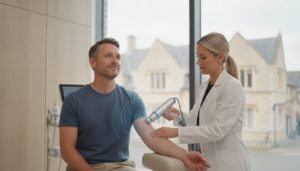
ESWT is specifically designed to treat chronic soft tissue injuries by triggering the body’s natural repair mechanisms. During a session, a handheld device is used to pass acoustic waves through the skin to the site of the tendon damage. It is a preferred option for residents in Witney and Faringdon who are seeking long-term relief from chronic flat foot symptoms without the need for invasive procedures. Most patients report a significant reduction in pain and improved mobility within a few sessions.
The GB Clinic Approach to Foot Rehabilitation
Our methodology combines manual techniques with bespoke exercise rehabilitation programmes. We focus on a multi-modal approach that integrates diagnostics, therapy, and active movement. This strategy is particularly beneficial for our patients in West Oxford and Central Oxford who want to avoid a long-term reliance on orthotics. By building a functional arch through clinical recruitment and strengthening, we aim to restore permanent stability. If you are struggling with persistent foot pain, book a clinical assessment to determine the most effective treatment pathway for your specific condition.
Expert Foot and Ankle Care Across Oxfordshire
Accessing professional support is the final step in moving from temporary relief to permanent stability. Residents in Central Oxford and West Oxford benefit from our specialized clinics, which are designed to provide efficient, expert-led care for complex foot conditions. Our reach extends across the region to Abingdon, Witney, and Didcot, ensuring that individuals in these surrounding towns can access modern MSK treatments without extensive travel. We maintain a strict no-delay policy for patients from Headington, Summertown, and Kennington, focusing on comprehensive assessments that identify why previous attempts at recovery may have failed.
While understanding how to fix flat feet with exercise is essential, a professional assessment ensures your effort is directed toward the correct anatomical structures. Many patients come to us after months of generic stretches that didn’t address their specific type of arch collapse. By visiting a local specialist, you receive a bespoke plan that accounts for your unique gait, lifestyle, and diagnostic findings. This clinical oversight is the most reliable way to restore your mobility and reduce the risk of secondary injuries in the knees and hips.
Serving the Oxfordshire Community
We provide convenient clinical locations for patients residing in Eynsham, Farmoor, and Marcham, offering a local alternative to long hospital waiting lists. Our expert MSK services are also highly accessible for those commuting from Faringdon or Bicester who require advanced diagnostic tools and evidence-based treatments. Local residents trust GB Clinic because we combine clinical excellence with a patient-focused demeanor. Our practitioners use a multi-modal approach, integrating manual therapy and modern technology to ensure every patient receives a clear path to recovery. We prioritize the restoration of function, helping you return to a mobile state as quickly as possible.
Start Your Recovery Journey Today
Your initial MSK assessment is a thorough process designed to identify the root cause of your fallen arches. During this first appointment at our Oxford clinic, we conduct a detailed physical examination and a functional gait analysis. We evaluate how to fix flat feet with exercise specifically for your foot structure, determining if you require adjunct therapies like Shockwave Therapy or manual mobilization to accelerate your progress. If structural damage is suspected, we may utilize a diagnostic ultrasound scan to visualize the tendons and ligaments in real-time. This level of detail ensures your treatment plan is both safe and effective.
- Physical examination of foot and ankle biomechanics.
- Gait analysis to identify compensatory movement patterns.
- Real-time diagnostic imaging if soft tissue damage is suspected.
- Bespoke exercise rehabilitation plans tailored to your recovery goals.
Book your professional MSK assessment at GB Clinic today to begin a structured, clinician-guided recovery plan that restores your arch stability and eliminates daily foot pain.
Take Control of Your Foot Health and Mobility
Restoring your arches is a progressive process that begins with understanding the specific mechanics of your foot. While learning how to fix flat feet with exercise through intrinsic muscle activation is a vital first step, achieving long-term relief often requires the precision of a clinical environment. Our expert clinicians specialize in foot and ankle health, ensuring that your rehabilitation plan is based on objective data rather than general advice.
We provide accessible care for residents throughout Oxfordshire, including Abingdon, Summertown, and Kennington. Whether you’re based in Headington, Marcham, or Farmoor, our clinics offer a professional pathway to recovery. Patients in Eynsham, Didcot, Witney, and Faringdon, as well as those in Central Oxford and West Oxford, can benefit from a patient-focused approach to MSK health.
With on-site diagnostic ultrasound for immediate answers and advanced Shockwave Therapy for chronic pain, we offer the modern tools necessary for effective restoration. You don’t have to manage persistent foot discomfort alone. Schedule a comprehensive MSK assessment in Oxford today to begin your journey toward stable, pain-free movement. We look forward to supporting your return to a mobile and active lifestyle.
Frequently Asked Questions
Can exercises really fix flat feet in adults?
Exercises can improve functional stability and arch height in flexible flat feet by strengthening the intrinsic muscles. While structural changes in rigid flat feet are more permanent, learning how to fix flat feet with exercise focuses on building muscular support to reduce pain and improve gait. This clinical approach is a primary focus for our specialists in Central Oxford who work with patients to restore foot core stability.
How long does it take to see results from flat feet exercises?
Measurable improvements in muscle recruitment and pain reduction typically appear within 6 to 12 weeks of consistent training. Consistency is vital; patients in Summertown and Headington find that performing exercises four to five times weekly yields the best results. Long term structural changes or permanent relief from chronic symptoms may require a longer commitment to a structured exercise rehabilitation programme tailored to your specific biomechanics.
Do I need to wear orthotics while doing these exercises?
Orthotics can provide temporary symptomatic relief, but they shouldn’t be the only solution. The goal of our Oxfordshire clinics is to build enough intrinsic strength so you don’t have to rely on external supports indefinitely. Residents in Abingdon or Kennington often use orthotics during the initial healing phase while simultaneously performing strengthening drills to restore natural arch function and reduce dependency on shoe inserts.
Is walking barefoot good or bad for flat feet?
Barefoot walking on varied, soft surfaces can help activate intrinsic muscles, but doing so on hard floors can exacerbate pain if you have significant arch collapse. For those in Witney or Didcot, we recommend a gradual approach. If you have acute inflammation or tendon dysfunction, supportive footwear is essential until clinical interventions like Shockwave Therapy have addressed the underlying tissue damage and improved your foot’s resilience.
Can flat feet cause pain in my knees and lower back?
Flat feet often lead to internal rotation of the legs, which places excessive stress on the knees and lower back. This kinetic chain reaction is a common complaint among patients in Marcham and Farmoor. By addressing the foot’s foundation, you can often alleviate secondary pain in the joints above. Our clinicians focus on restoring overall body alignment and mobility by strengthening the medial arch.
What happens if I ignore my fallen arches?
Ignoring fallen arches can lead to progressive conditions like Tibialis Posterior Tendon Dysfunction or chronic plantar fasciitis. Over time, this can result in rigid deformities that are much harder to treat conservatively. Residents in Eynsham or Faringdon should seek early intervention to avoid long term mobility issues. Professional diagnostics can identify early signs of tendon wear that simple home stretches might not address effectively.
When should I see a specialist for my flat feet?
You should see a specialist if you experience persistent mid-foot pain, swelling along the inner ankle, or if your arch collapse is affecting your walking gait. Our West Oxford clinic provides diagnostic ultrasound scans to provide immediate answers. If you can’t perform a single leg heel raise, it’s a clear indicator that you need professional MSK oversight beyond simple home routines.
Are flat feet exercises safe to do during pregnancy?
Arch strengthening exercises are safe and beneficial during pregnancy to counteract increased ligament laxity caused by hormonal changes. Many women in Central Oxford find that learning how to fix flat feet with exercise early in pregnancy helps manage the extra load on their feet. Our clinicians can tailor a rehabilitation program to ensure safety and comfort while addressing the specific physical shifts that occur during every trimester.