

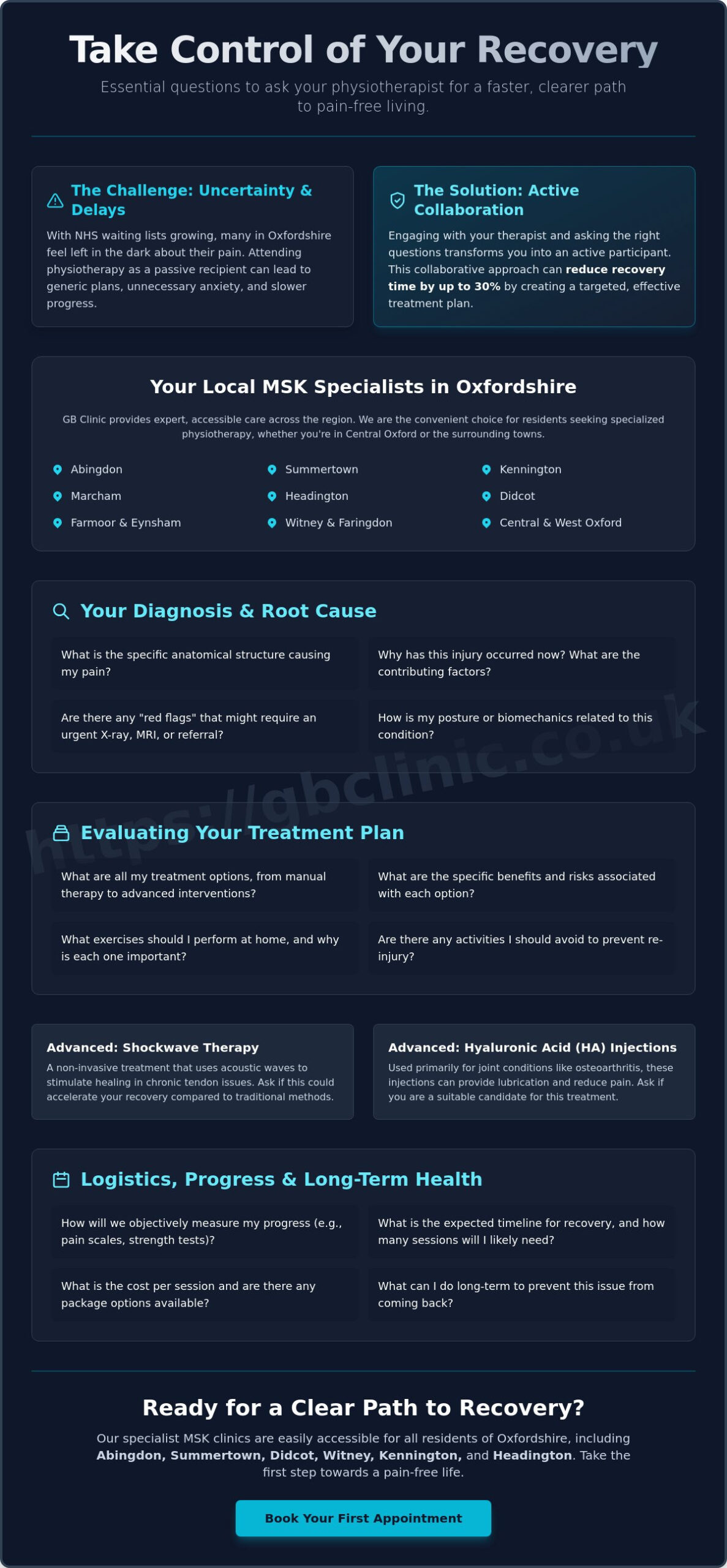
What if the secret to a faster recovery isn’t just the exercises you do, but the questions you ask during your first session? With NHS waiting lists reaching 7.11 million cases in early 2026, many Oxfordshire residents seek private care to avoid delays. Walking into a clinic in Abingdon or Summertown feeling uncertain about your treatment plan leads to unnecessary anxiety. Understanding the specific questions to ask your physiotherapist ensures you aren’t just a passive recipient of care, but an active participant in your rehabilitation.
It’s natural to feel concerned about the root cause of your pain or confused by treatments like Shockwave therapy or Hyaluronic Acid (HA) injections. You deserve a clear diagnosis and a defined recovery timeline rather than open ended appointments. This guide empowers you to take control by providing 30 essential questions to build confidence in your therapist’s expertise. Whether you’re visiting us from Kennington, Marcham, or Headington, we provide a direct path to restoration. Our clinicians serve patients across Central Oxford, West Oxford, Farmoor, Eynsham, Didcot, Witney, and Faringdon, ensuring expert MSK care is always accessible. We’ll preview the exact questions needed to secure a transparent treatment plan.
Key Takeaways
- Learn why active patient advocacy and a collaborative clinical approach can significantly reduce your total recovery time.
- Identify the specific questions to ask your physiotherapist to uncover the root cause of your pain and determine if diagnostic ultrasound or imaging is necessary.
- Discover the clinical benefits of advanced interventions like Shockwave Therapy and Hyaluronic Acid (HA) injections compared to traditional manual therapy.
- Establish a clear timeline for your rehabilitation by understanding how to track progress through objective strength tests and pain scales.
- Find out how residents across Oxfordshire, from Witney and Didcot to Summertown and Headington, can access specialist MSK care at our conveniently located clinics.
Why Preparing Questions for Your Physiotherapist Leads to Better Recovery
Effective recovery begins with a fundamental shift in mindset. Instead of attending an appointment as a passive recipient of care, patients who prepare specific questions to ask your physiotherapist often see results more quickly. Clinical studies into patient outcomes suggest that a collaborative relationship between the clinician and the individual can reduce recovery time by up to 30%. This occurs because active communication helps the therapist refine their clinical reasoning. It moves the treatment beyond a standard protocol toward a bespoke strategy that addresses your specific lifestyle, biomechanics, and daily challenges.
To understand the foundations of this clinical field, it’s helpful to explore What is Physiotherapy? and how it has evolved into a highly specialized medical discipline. For residents in Central Oxford and West Oxford, accessing this level of expertise is a vital step toward long term relief. Being curious about your treatment isn’t about being a difficult patient; it’s an essential part of patient advocacy. It ensures you receive a targeted MSK plan rather than a generic exercise sheet that might fail to address the root cause of your discomfort.
To better understand the value of this collaborative approach, watch this helpful video regarding the clinical dialogue:
The Shift from Passive to Active Patient
Patients who actively engage during their sessions are significantly more likely to adhere to their home exercise programmes. When you understand the clinical reason behind a specific movement, it reduces fear-avoidance behaviour, which is a common barrier to progress. Setting clear, measurable goals in your first session provides a logical roadmap for your journey. This approach is particularly valued by our clients in Abingdon and Summertown, who appreciate knowing exactly how each intervention brings them closer to their functional targets. Understanding the “why” transforms a routine exercise into a purposeful step toward restoration.
Setting the Stage for Your First Appointment
Preparation starts before you walk through the clinic doors. Keeping a brief pain diary for a few days provides your therapist with vital data regarding triggers and relief patterns. You should also feel confident asking about the clinician’s specific experience with your condition to build trust. At GB Clinic, we encourage a transparent dialogue from day one for all our patients, whether they are visiting from Kennington, Marcham, or Headington. Providing high quality physiotherapy means ensuring every resident from Farmoor to Eynsham feels heard and informed. Our specialists serving Didcot, Witney, and Faringdon are dedicated to providing evidence-based care that prioritizes your unique recovery timeline and physical goals.
Essential Questions Regarding Your Diagnosis and Root Cause
Establishing a clear diagnosis is the most critical step in your recovery journey. Without a precise understanding of the anatomical issue, any intervention is merely a guess. When considering the questions to ask your physiotherapist, start with the fundamentals of the injury itself. Ask: “What is the specific structure causing my pain, and why did it happen now?” This helps determine if the issue is a sudden tear from a weekend sport in Abingdon or a gradual repetitive strain developed during a daily commute from Witney. Understanding the mechanism of injury allows us to target the source rather than just the symptoms.
Safety is paramount in MSK care. You should always ask if there are any red flags or clinical reasons to consider further imaging, such as an X-ray or MRI. Understanding the role of biomechanics is also essential for long term relief. For instance, you might ask how your gait or posture contributes to medial knee soreness or foot pain. This is particularly relevant for individuals in Central Oxford, West Oxford, or Summertown who spend significant time walking or standing. Clinical reasoning is the systematic process where a therapist integrates clinical evidence and patient history to distinguish a minor muscle pull from a deeper, more complex musculoskeletal pathology. If you require absolute clarity on soft tissue conditions, you can book a diagnostic ultrasound scan at our specialized facilities to visualize the area in real time.
Probing the “Why” Behind the Pain
Pain often manifests far from its source. It’s vital to ask about referred pain, such as how a lumbar spine issue might be the true cause of leg discomfort. Clarifying whether an injury is acute or a chronic degenerative change allows for a more realistic and effective recovery plan. Patients from Kennington to Marcham find that understanding these distinctions reduces anxiety about the root cause of their symptoms. Our specialists are here to help you achieve a pain-free lifestyle through expert assessment and modern therapeutic methods.
Confirming Diagnostic Accuracy
A high-quality assessment should result in a clear clinical finding rather than just a “working hypothesis.” Ask your therapist to explain your diagnosis in plain English, avoiding confusing medical jargon. Instead of accepting a vague description, ask: “Can you explain my diagnosis using the diagnostic ultrasound scan results?” This ensures you leave the clinic in Headington, Farmoor, or Eynsham with total confidence in the next steps. Whether you are visiting from Didcot or Faringdon, we prioritize diagnostic precision to ensure your treatment is evidence-based and effective from the very first session.
Evaluating Treatment Options: Standard vs. Advanced Interventions
Selecting the right clinical pathway is the next step once you have a clear diagnosis. One of the most vital questions to ask your physiotherapist is whether the proposed plan targets your immediate symptoms or the underlying biomechanical cause. For residents in Abingdon and Didcot, this distinction is essential for preventing the recurrence of pain. Generic gym programmes often lack the specificity required for complex MSK issues. A bespoke exercise rehabilitation plan differs because it’s built around your unique functional deficits and movement patterns, ensuring every movement has a clinical purpose.
Our clinics serve individuals across Central Oxford and West Oxford, providing access to modern therapeutic methods that go beyond traditional stretching. You should feel comfortable asking about the pros and cons of manual therapy versus advanced options like shockwave therapy. Understanding these trade-offs ensures you receive the most effective, evidence-based care tailored to your specific condition. Whether you’re visiting from Marcham or Farmoor, our goal is to move you from a state of discomfort to a return to full mobility without unnecessary delays.
When to Consider Advanced MSK Treatments
If standard physiotherapy doesn’t yield measurable improvement within six weeks, it’s time to discuss the next clinical steps. For those in Witney and Faringdon dealing with chronic tendon issues, Extracorporeal Shockwave Therapy offers a non-invasive way to stimulate the body’s natural healing response. Additionally, patients in Eynsham or Summertown suffering from osteoarthritic knee pain should ask if they would benefit from Hyaluronic Acid Injections. These injections provide joint lubrication, which supports your rehabilitation by reducing friction and facilitating more comfortable movement during exercise.
Manual Therapy and Myofascial Release
Manual therapy is a powerful tool, but its application must be strategic. You might ask: “How will manual therapy help my specific range of motion?” This technique is often used to reduce pain levels temporarily, creating a window of opportunity for more effective corrective exercise. For our clients in Headington and Kennington, we use myofascial release to address specific soft tissue restrictions that may be limiting your progress. It’s also useful to clarify the frequency of therapeutic massage versus active rehabilitation. While massage provides symptomatic relief, long-term restoration usually requires improving structural integrity through progressive loading and targeted exercise.
Practical Questions About Logistics, Costs, and Long-Term Progress
Clear expectations are the foundation of a successful clinical outcome. Once the anatomical cause is identified, shift your focus to the logistical framework of your care. One of the most important questions to ask your physiotherapist involves the expected duration of treatment. You should ask: “How many sessions do you realistically expect it will take to see significant improvement?” This allows you to plan your schedule and budget effectively. These are the practical questions to ask your physiotherapist to ensure your recovery stays on track without unnecessary delays.
Tracking progress requires objective data rather than just subjective feelings of relief. Inquire about the specific metrics used, such as dynamometer strength tests or standardized pain scales. For residents in Abingdon or Witney, understanding what you can do at home is just as vital as the time spent in the clinic. Consistent application of prescribed movements accelerates tissue healing and improves functional capacity. If persistent inflammation hinders your progress, you should ask if the clinic provides guided steroid injections to manage symptoms and facilitate rehabilitation.
Defining the Recovery Timeline
Request a milestone map to visualize your progress clearly. This might include specific targets like being able to walk one mile pain-free by week three or returning to low-impact sport by week six. Patients from Kennington and Marcham often ask about the risks of over-training; doing too much too soon can set back your recovery. You must also establish an exit strategy. Ask: “What happens if my pain returns after we finish the course of treatment?” Knowing the protocol for flare-ups provides peace of mind and ensures long-term joint health.
Cost-Benefit and Private Care Advantages
The decision to choose private MSK physiotherapy in Oxford often comes down to the depth of care and speed of access. While standard care may involve long waiting times, private clinics offer immediate interventions and advanced diagnostic tools. Our facilities in Central Oxford and West Oxford are easily accessible for residents in Summertown, Headington, and Farmoor. We also provide comprehensive reports for GPs or insurance purposes, ensuring your entire medical team is informed. Whether you are coming from Eynsham, Didcot, or Faringdon, we offer package rates for advanced therapies like Shockwave to make high-quality care more accessible. To begin your journey with a specialist who prioritizes your recovery timeline, book your initial assessment today.
Choosing the Right Clinic in Oxfordshire for Your MSK Health
Finding a clinic that welcomes your inquiries is just as important as knowing the specific questions to ask your physiotherapist. At GB Clinic, we believe a professional environment should be built on transparency and clinical excellence. Our facilities are strategically located to be accessible from Central Oxford, Summertown, and Headington. We understand that residents in Didcot and Witney often travel to us specifically for our specialist expertise in advanced MSK care. By keeping diagnostics and treatment under one roof, we eliminate the fragmented care often found in traditional healthcare pathways.
Patients from Abingdon and West Oxford benefit from our streamlined approach. We ensure that your journey from initial pain to functional restoration is handled with clinical precision. Our practitioners are recognized for their professional demeanor, providing a calm and reassuring atmosphere for those seeking relief from chronic discomfort. Having the right questions to ask your physiotherapist only yields results when the clinic has the advanced technology and specialist knowledge to provide definitive answers.
Regional Expertise and Modern Facilities
Proximity is key to consistent rehabilitation. Our clinics are easy to reach for individuals in Eynsham, Farmoor, and Kennington. We prioritize comprehensive care without delays, which is vital given the current pressure on local healthcare services where median wait times can be significant. By providing immediate access to diagnostic ultrasound and advanced therapies, we serve as the convenient local choice for the Marcham and Faringdon communities. Our modern specialists stay at the forefront of the field, ensuring every patient from Bicester to Central Oxford receives up-to-date therapeutic methods.
- Specialist diagnostics and treatment delivered in a single location.
- Expert-led care designed to avoid the 18-week NHS waiting targets.
- Modern clinical settings that prioritize patient comfort and privacy.
- Easy travel links from surrounding Oxfordshire towns and neighborhoods.
The GB Clinic Promise
Our clinical model follows a structured “Problem/Solution/Benefit” framework. We identify the anatomical concern, apply a targeted intervention like Shockwave or HA injections, and focus on the functional benefits of your recovery. This methodical rhythm builds trust and ensures you’re never left wondering about the next step. To help you determine if our expertise matches your needs, we offer a complimentary initial assessment with no further obligation. This risk-free entry point allows you to present your concerns and receive direct, evidence-based answers. Don’t let physical discomfort dictate your lifestyle. Book your physiotherapy consultation in Oxford today and take the first step toward a faster, more effective recovery.
Take Control of Your Recovery Pathway
Empowerment through knowledge is the most effective tool in modern rehabilitation. We’ve explored how identifying the right questions to ask your physiotherapist transforms you from a passive patient into an active participant in your healing. By clarifying your diagnosis and exploring advanced interventions such as Shockwave therapy or HA injections, you ensure your path to restoration is efficient and evidence-based. You deserve a clear roadmap to health.
Our specialist MSK clinicians utilize advanced diagnostics, including ultrasound, to provide the clinical certainty you deserve. GB Clinic provides convenient access for residents across Oxfordshire, ensuring expert care is never out of reach. Our clinicians focus on restoration. Whether you’re traveling from Abingdon, Summertown, Kennington, or Marcham, our professional team is ready to support your return to mobility. We also serve Headington, Farmoor, Eynsham, and the wider regions of Didcot, Witney, and Faringdon. Residents in Central Oxford and West Oxford can rely on our modern facilities for comprehensive, delay-free treatment. Book Your Expert MSK Assessment in Oxford. Your journey to a pain-free life starts with a single clinical conversation.
Frequently Asked Questions
Do I need a GP referral to see a private physiotherapist in Oxford?
No, a GP referral is not required to access private physiotherapy at our clinics. Self-referral is the standard for private MSK care, allowing residents in Abingdon and Summertown to avoid the 11.3 week median NHS waiting lists reported in early 2026. We accept direct bookings from individuals across Kennington and Marcham seeking immediate clinical assessment and evidence-based treatment.
What should I wear to my first physiotherapy appointment?
You should wear loose, comfortable clothing that allows your clinician to easily access the area being treated. For instance, if you’re seeking help for a lower limb issue, wearing shorts is ideal. Patients visiting us from Headington or Farmoor often bring a change of clothes to ensure they can move freely during the physical assessment and exercise rehabilitation tests.
Is physiotherapy painful, and should I tell my therapist if it hurts?
Some therapeutic techniques may cause mild discomfort, but treatment should never result in sharp or unbearable pain. It’s essential to communicate with your clinician immediately if a movement or manual therapy technique feels distressing. This feedback is a vital part of the questions to ask your physiotherapist to ensure your treatment remains within a safe and effective therapeutic window.
How long does a typical physiotherapy session last at GB Clinic?
An initial assessment usually lasts between 45 and 60 minutes to allow for a comprehensive diagnostic review. Subsequent follow-up sessions are typically scheduled for 30 minutes, focusing on active rehabilitation and symptom management. Whether you’re traveling from Eynsham or Didcot, we ensure each session is structured to maximize your recovery time and provide clear functional benefits.
Can a physiotherapist prescribe medication or injections?
Physiotherapists do not prescribe general medications, but our specialists are qualified to perform targeted joint and soft tissue injections. We provide Hyaluronic Acid (HA) injections and guided steroid injections to manage inflammation and support the healing process. Residents in Witney and Faringdon can access these advanced clinical interventions directly to support their return to a mobile, comfortable state.
What is the difference between a sports massage and physiotherapy?
Sports massage focuses specifically on soft tissue manipulation to reduce muscle tension and improve circulation. Physiotherapy is a broader medical discipline that includes diagnostic ultrasound, clinical reasoning, and corrective exercise rehabilitation. While massage provides temporary relief, physiotherapy targets the underlying biomechanical cause of your pain to prevent future injury recurrence for patients in Central Oxford and West Oxford.
How soon can I return to sports after starting treatment?
Your return to sport depends on meeting specific clinical milestones rather than a fixed date. We use objective metrics, such as strength tests and range of motion scales, to determine when your tissues can safely handle athletic loads. Your therapist will provide a milestone map that outlines the gradual progression from low-impact movement back to full competitive activity.
Does health insurance cover advanced treatments like Shockwave or HA injections?
Most major health insurance providers cover advanced MSK treatments, though you should always verify your specific policy details. We recommend obtaining pre-authorisation from your insurer before starting Shockwave Therapy or receiving HA injections. Our team regularly assists patients across Oxfordshire by providing the detailed clinical reports required by insurance companies to facilitate smooth and efficient claims.