What if the sharp, “catching” pain that wakes you up at night isn’t a permanent fixture of your life, and doesn’t require a surgeon’s knife to resolve? For many residents across Central Oxford, Headington, and Summertown, the reality of calcific tendonitis is a constant struggle with restricted movement and sleep-depriving aches. Our specialist clinic provides advanced shockwave therapy for shoulder calcific tendonitis Oxford, offering a clinically proven pathway to break down calcium deposits without invasive procedures. We understand how frustrating it’s to lose your range of motion, especially when simple overhead tasks become agonizing.
You deserve a recovery plan that’s both expert-led and convenient to your daily life. Whether you’re traveling from Abingdon, Witney, Eynsham, or Didcot, our practitioners focus on precise diagnosis through specialist ultrasound scans to ensure the right intervention. By reading this guide, you’ll discover how we utilize non-surgical methods like shockwave therapy and barbotage to restore your shoulder’s function. We’ll explore how patients from Kennington, Marcham, Farmoor, Faringdon, and West Oxford can achieve complete resolution of calcium deposits and return to a mobile, comfortable state.
Key Takeaways
- Understand why calcific tendonitis causes sudden, intense pain during the resorptive phase and how non-surgical interventions provide a clear path to relief.
- Learn how shockwave therapy for shoulder calcific tendonitis Oxford uses acoustic energy to fragment calcium deposits and stimulate a natural biological healing response.
- Compare the benefits of mechanical fragmentation with ultrasound-guided barbotage to determine the most effective treatment for your specific stage of calcification.
- Discover how residents in areas like Abingdon, Witney, Didcot, and Headington can access expert-led MSK care and advanced diagnostics without the need for invasive surgery.
- See why a high-resolution diagnostic ultrasound is the essential first step for patients in Summertown or Central Oxford to confirm the presence and texture of calcium deposits.
Understanding Calcific Tendonitis and Non-Surgical Options in Oxford
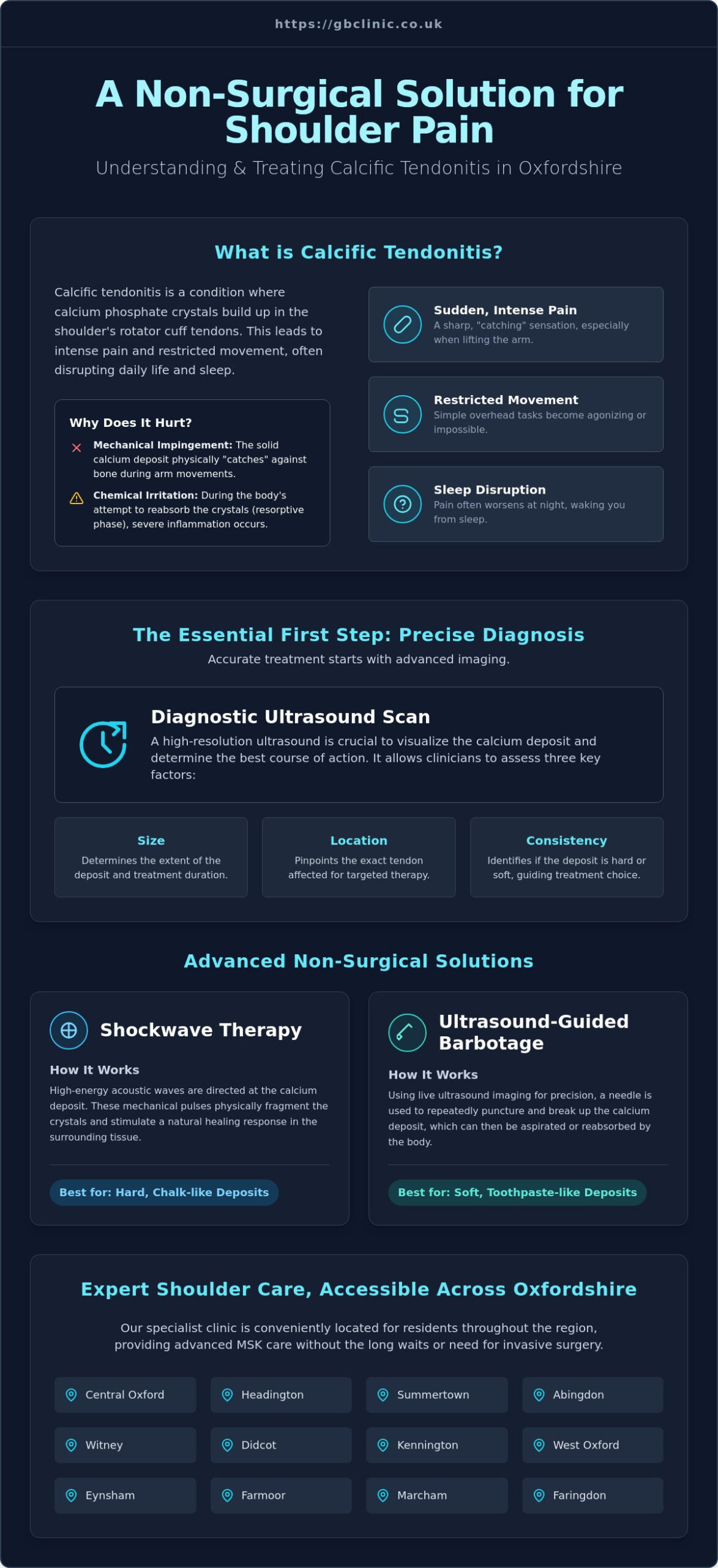
Calcific tendonitis occurs when hydroxyapatite crystals, a form of calcium phosphate, build up within the tendons of the rotator cuff. While some individuals remain asymptomatic for years, many residents across Central Oxford and West Oxford experience a sudden onset of intense pain that makes lifting the arm nearly impossible. This discomfort isn’t just a minor ache; it’s a significant clinical issue that often requires specialist intervention to resolve. Understanding Calcific Tendonitis involves recognizing that this pain isn’t just “wear and tear” but a specific chemical and mechanical reaction within the shoulder joint.
A critical stage in this condition is the resorptive phase. This is when the body attempts to reabsorb the calcium, leading to increased pressure and severe inflammation. It’s during this time that patients from Headington to Summertown often seek urgent help, as the pain becomes unbearable and disrupts sleep. Traditional physiotherapy is excellent for rehabilitation, but it often fails to resolve hard, established calcium deposits on its own. This is where specialized mechanical intervention becomes necessary.
To better understand this concept, watch this helpful video:
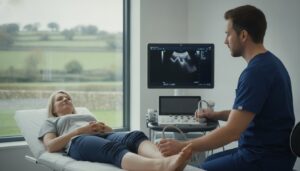
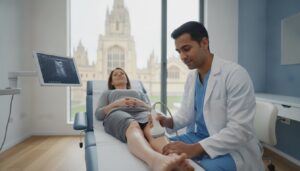
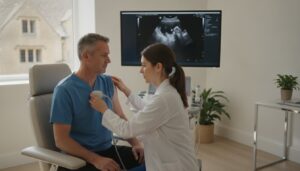
For those seeking shockwave therapy for shoulder calcific tendonitis Oxford, the process begins with a precise assessment. We use a diagnostic ultrasound scan to identify the exact size, location, and consistency of the deposit. This high-resolution imaging is essential for staging the condition correctly, whether you are visiting us from Witney, Abingdon, or Didcot. Without this visual confirmation, it’s difficult to determine if the calcium is hard and chalk-like or soft and toothpaste-like, which dictates the choice of treatment.
The Problem: Why Calcium Deposits Cause Shoulder Pain
The discomfort associated with calcific tendonitis stems from two primary sources. First, the physical presence of the deposit causes mechanical impingement, where the calcium catches against the acromion during arm elevation. Second, the crystals cause chemical irritation of the surrounding bursa, leading to acute inflammation. This dual impact explains why patients in Farmoor, Eynsham, and Kennington often report a sharp, stabbing sensation when reaching overhead. Calcific tendonitis is a treatable MSK condition that responds well to targeted, non-surgical care.
The Solution: Advanced MSK Services at GB Clinic
Our clinic in Central Oxford offers a specialized approach to managing these deposits without resorting to invasive surgery. We emphasize the importance of a specialist-led clinical assessment to ensure your treatment is tailored to the specific stage of your condition. Depending on the consistency of the calcium, we may recommend either shockwave therapy or barbotage. These options are highly accessible for those living in Marcham and Faringdon, providing a professional and expert-led alternative to long hospital waiting lists and surgical recovery times.
Shockwave Therapy for Shoulder Calcific Tendonitis: How It Works
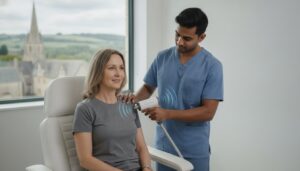
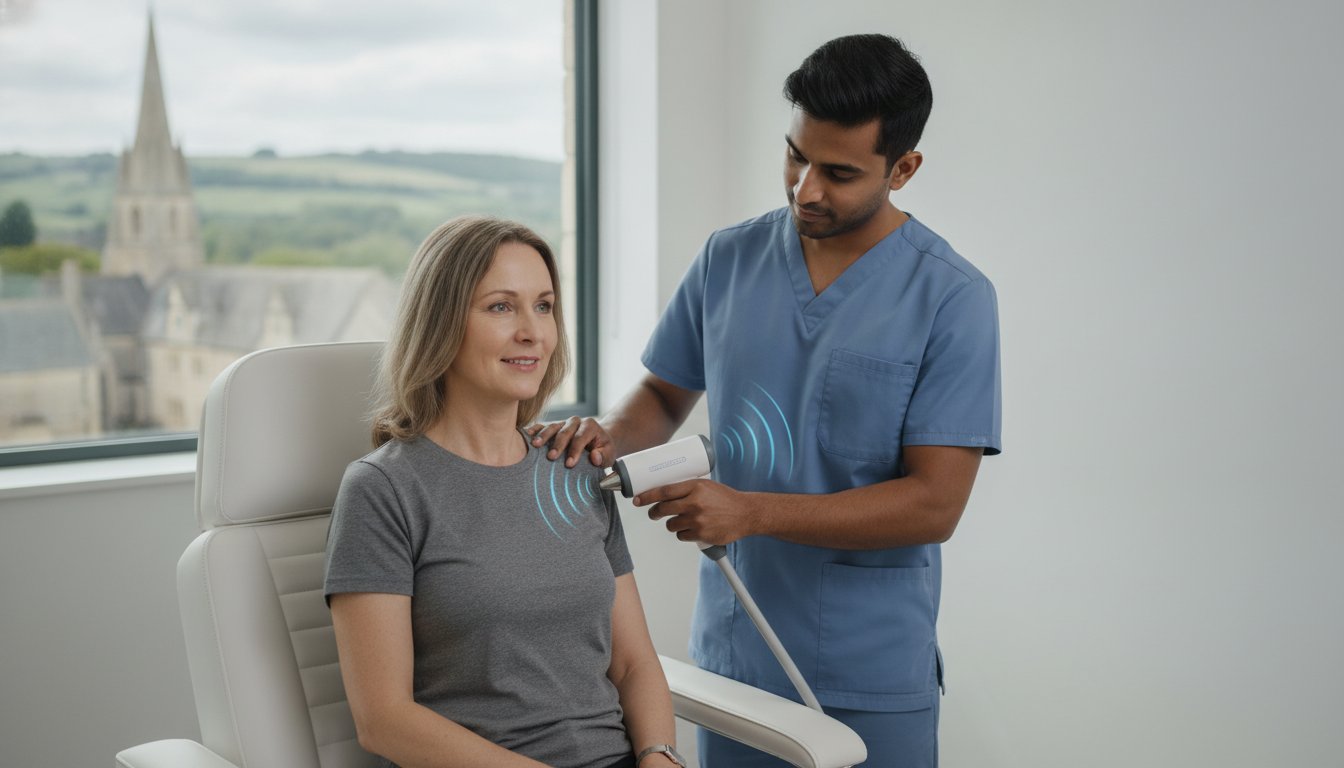
Shockwave therapy for shoulder calcific tendonitis Oxford utilizes high-energy acoustic waves to target precise areas of calcification within the rotator cuff. These waves aren’t electrical; they’re mechanical pulses that travel through the skin to reach the deep-seated crystals. This process, technically known as extracorporeal shockwave therapy, is a modern solution for patients in locations like Headington or Kennington who want to avoid the risks and recovery times of surgery. By focusing energy directly on the site of the build-up, we can address the root cause of the pain without damaging the surrounding healthy tissue.
The biological impact is two-fold. First, the acoustic energy creates “microtrauma” in the affected tendon. While this sounds counterintuitive, it’s actually the catalyst for a fresh healing response. It triggers increased blood flow and the release of growth factors to repair the damaged tissue. Second, the therapy provides immediate pain modulation by desensitising the nerve endings in the shoulder. This reduction in sensitivity often allows for a faster return to daily activities. Research indicates high efficacy for shockwave therapy for shoulder calcific tendonitis Oxford, with clinical studies showing up to an 86% success rate in significantly reducing or eliminating calcium deposits. This makes it a highly reliable option for residents in Witney, Didcot, and Abingdon seeking long-term relief. Even those in quieter areas like Marcham or Faringdon find the journey to our specialized facility worthwhile for this level of quality care.
The Mechanism of Radial Shockwave Therapy
Radial shockwave therapy relies on pneumatically generated waves that spread outwards from the application point. This specific type of wave is particularly effective at targeting the “stony” phase of a deposit, where the calcium has hardened into a solid mass. By delivering thousands of precise pulses, the treatment fragments these deposits into smaller pieces that the body can more easily reabsorb over time. ESWT is NICE-approved and non-invasive.
What to Expect During Your ESWT Session
A typical session at our clinic is efficient, usually lasting between 10 to 15 minutes. This makes it a convenient choice for those commuting from Summertown or Central Oxford. During the procedure, you’ll feel a repetitive tapping or pulsing sensation. While some find this slightly uncomfortable, it’s rarely described as painful. Our specialists monitor your comfort levels throughout, and we can adjust the intensity of the waves to ensure the treatment is tolerable while remaining effective. Most patients require a series of three to six sessions for optimal results. For a deeper look into the technology, you can read our Extracorporeal Shockwave Therapy pillar.
If you’re based in West Oxford, Farmoor, or Eynsham, our team is ready to help you begin your recovery journey today.
Shockwave vs. Shoulder Calcific Barbotage: Choosing the Right Path
Choosing the right clinical path is essential for a fast recovery. While shockwave therapy for shoulder calcific tendonitis Oxford is highly effective for many, some cases benefit more from a direct extraction method known as barbotage. This procedure involves an ultrasound-guided ‘lavage’ or washing out of the calcium deposit. It’s particularly useful for patients in West Oxford or Farmoor who are in the acute resorptive phase, where the calcium has a soft, toothpaste-like consistency. At this stage, the body is already trying to break down the crystals, and barbotage simply accelerates that process by physically removing the irritating material.
Conversely, shockwave therapy is the ideal choice for chronic, hard deposits that have been present for months or years. It’s also the preferred non-invasive option for individuals in Eynsham or Kennington who wish to avoid needles. For those suffering from extreme inflammation, our specialists often combine barbotage with a guided steroid injection. This combination provides rapid control over the inflammatory response while physically removing the source of the irritation. This dual approach is often what’s needed for residents in Didcot or Witney who have found that standard rest and ice haven’t provided enough relief.
Shoulder Calcific Barbotage: The Precision Approach
Using high-resolution ultrasound guidance, our specialists ensure 100% accuracy during the needle aspiration. This precision allows us to target the exact center of the deposit, providing immediate pressure relief as the material is extracted. Residents from Abingdon and Marcham often report a significant reduction in ‘catching’ pain almost immediately after the procedure. Recovery timelines for barbotage typically require a short period of relative rest for 48 to 72 hours, whereas shockwave therapy allows for higher activity levels between sessions.
Comparison Table: ESWT vs. Barbotage
Deciding which procedure is most suitable often depends on your lifestyle and how quickly you need to return to sport or work in Summertown or Headington. Our specialists in Central Oxford help you decide the best path during your initial diagnostic scan. Those visiting from Faringdon find that having both options available at one specialist clinic saves significant time and avoids unnecessary delays in their treatment journey.
| Feature | Shockwave (ESWT) | Barbotage |
|---|---|---|
| Invasiveness | Non-invasive (No needles) | Minimally invasive (Needle-based) |
| Sessions Required | 3-6 sessions | Typically a one-off procedure |
| Best For | Hard, stony deposits | Soft, ‘toothpaste’ deposits |
| Recovery Time | Immediate return to light activity | 2-3 days of relative rest |
Whether you’re visiting from Didcot, Witney, or Faringdon, our goal is to provide the most efficient route to pain-free movement. By identifying the specific stage of your calcification, we ensure you don’t waste time on treatments that aren’t perfectly suited to your pathology.
Your Recovery Journey: How to Get Treatment in Oxford
Embarking on a recovery journey requires a clear, structured pathway from diagnosis to full mobility. At our clinical facility, we’ve designed a streamlined process to ensure that residents from Central Oxford to Faringdon receive the highest standard of care without unnecessary delays. Seeking shockwave therapy for shoulder calcific tendonitis Oxford begins with understanding your specific pathology through advanced imaging rather than guesswork.
Our patient-centered journey follows four essential stages:
- Step 1: Initial Consultation and Diagnosis. Every journey starts with a specialist assessment. We perform a diagnostic ultrasound during your first visit to confirm the presence of calcification and evaluate its consistency. This is vital for those traveling from Headington or Summertown who need an immediate, accurate answer to their shoulder pain.
- Step 2: Customised Treatment Planning. Once the ultrasound confirms the stage of the condition, we develop a bespoke plan. This might involve a series of ESWT sessions for hard deposits or a one-off barbotage procedure for softer, acute calcifications.
- Step 3: Clinical Procedure. Your treatment is delivered by expert MSK clinicians in a professional, modern environment. Whether you are visiting from West Oxford or Kennington, you can expect a clinical setting focused on comfort and evidence-based protocols.
- Step 4: Post-treatment Rehabilitation. Recovery doesn’t end with the procedure. We integrate targeted physiotherapy to restore rotator cuff strength and ensure long-term joint health.
Preparing for Your Appointment
To ensure your assessment is as efficient as possible, we recommend wearing loose-fitting clothing that allows easy access to the shoulder joint. If you have previous imaging, such as X-rays or MRI scans from providers in Didcot or Witney, please bring them with you to help our specialists build a comprehensive clinical history. No GP referral is necessary for private MSK care at GB Clinic, allowing you to bypass long waiting lists and start your recovery sooner.
Post-Procedure Care and Exercises
After receiving shockwave therapy, it’s common to experience minor soreness or a dull ache in the treated area. This is a normal part of the biological healing response and can be managed with simple home care, such as relative rest for 24 hours. The ‘rehab’ phase is the most critical element for preventing a recurrence of shoulder pain. Our team provides specific exercise protocols tailored to your lifestyle in Abingdon, Marcham, or Eynsham. For a more detailed look at our comprehensive approach, visit our Specialist Shoulder Pain Clinic Oxford pillar.
If you are ready to resolve your shoulder pain and return to an active lifestyle, you can book your specialist assessment at our Oxford clinic today.
Specialist Shoulder Care Across Oxfordshire: Why Choose GB Clinic?
Choosing a provider for shockwave therapy for shoulder calcific tendonitis Oxford requires confidence in both clinical expertise and diagnostic accuracy. At GB Clinic, we prioritize a non-surgical approach that centers on restoring your quality of life without the risks associated with hospital-based operations. Our clinical environment is designed to be calm and professional, providing a space where patients feel heard and understood. We focus exclusively on evidence-based musculoskeletal treatments, ensuring that every intervention is backed by the latest clinical research and tailored to your specific recovery goals.
The foundation of our success lies in our expert-led care. All procedures are performed by highly skilled MSK specialists who possess deep experience in treating complex shoulder pathologies. We utilize state-of-the-art diagnostic tools, including high-resolution diagnostic ultrasound, for every initial assessment. This ensures that we don’t just treat the symptoms of shoulder pain but address the precise location and consistency of the calcium deposits. By choosing a specialist facility, you avoid the delays often found in general practice and gain immediate access to advanced therapeutic options.
Accessible MSK Care for Oxfordshire Residents
We’ve strategically positioned our services to be the convenient, local choice for communities throughout the region. Our clinic provides easy travel links for patients coming from Witney, Faringdon, and West Oxford, as well as those living in Central Oxford. We understand that physical discomfort makes long commutes difficult, which is why we emphasize accessibility for residents in:
- Headington and Summertown: Quick access for those working or living near the city’s main residential hubs.
- Abingdon and Kennington: Convenient routes for patients traveling from the south of the city.
- Didcot and Marcham: Reliable specialist care within easy reach of South Oxfordshire.
- Farmoor and Eynsham: Accessible MSK support for those in the western villages and surrounding areas.
The GB Clinic Promise: Fast, Effective Relief
Our commitment to your recovery is defined by efficiency and transparency. We don’t believe in long waiting lists; our goal is to get your diagnostic scan and treatment plan started immediately. This patient-first approach ensures that you receive clear communication regarding your prognosis and the expected duration of relief. We focus on physical restoration, helping you return to a mobile state where overhead reaching and sleeping are no longer sources of anxiety. If you’re ready to take the first step toward a pain-free shoulder, book your complimentary initial assessment at GB Clinic Oxford today.
Restore Your Shoulder Mobility in Oxfordshire
Effective recovery from calcific shoulder pain relies on a precise, diagnostic-led approach. By utilizing NICE-approved technology and expert ultrasound-guided procedures, we ensure that every patient receives a treatment plan tailored to the specific stage of their condition. Whether you require the mechanical fragmentation of shockwave therapy for shoulder calcific tendonitis Oxford or the precision extraction of barbotage, our specialists are here to guide you toward a pain-free lifestyle. We provide rapid access to advanced MSK care for residents across Headington, Summertown, and Central Oxford, as well as those in West Oxford, Farmoor, and Eynsham.
Our clinic remains the convenient, local choice for individuals seeking relief in Abingdon, Kennington, and Marcham, alongside patients traveling from Didcot, Witney, and Faringdon. We prioritize evidence-based results and a calm, clinical environment to help you regain your full range of motion without the need for invasive surgery. You don’t have to tolerate sleep disruption or restricted movement any longer. Book a Specialist Shoulder Consultation at GB Clinic Oxford today and take the first step toward lasting comfort. We look forward to supporting your return to full activity.
Frequently Asked Questions
Is shockwave therapy for shoulder calcific tendonitis painful?
Shockwave therapy is generally described as a repetitive tapping or pulsing sensation that can be slightly uncomfortable but is rarely painful. Our specialists monitor your comfort levels throughout the procedure and can adjust the intensity of the acoustic waves to ensure the treatment remains tolerable. Most patients from Headington or Summertown find they can resume their normal daily activities immediately after their session without needing downtime.
How many sessions of shockwave therapy will I need for my shoulder?
Most patients require a series of three to six sessions to achieve the best clinical outcomes. These appointments are typically spaced one week apart to allow the body’s natural healing response to activate between treatments. This structured approach is highly convenient for those commuting from Abingdon or Kennington, as each session lasts only about 15 minutes, ensuring minimal disruption to your weekly schedule.
What is the difference between barbotage and shockwave therapy?
The primary difference lies in the method of addressing the calcium: shockwave therapy for shoulder calcific tendonitis Oxford uses non-invasive acoustic energy to fragment hard deposits, while barbotage is a minimally invasive procedure that physically washes out softer, toothpaste-like deposits using a needle under ultrasound guidance. We determine the most effective path for you during your initial diagnostic scan at our Central Oxford clinic.
Can I drive home after a shoulder calcific barbotage procedure?
We advise patients to arrange for a friend or relative to drive them home or use local transport links after a barbotage procedure. Because we use a local anesthetic to ensure your comfort during the needle-based treatment, your shoulder may feel heavy or numb for several hours afterward. This is a standard safety precaution we recommend for all our patients visiting from Didcot or Witney.
Is shockwave therapy available on the NHS in Oxfordshire?
Availability on the NHS is often limited and may only be offered within specific clinical research frameworks. Choosing private care at our facility allows you to bypass long waiting lists and access specialist treatment immediately. We provide a direct route to recovery for residents in Faringdon and Marcham, ensuring that diagnostic imaging and therapeutic interventions happen without the common delays of the public health system.
How long does it take to see results after treating calcium deposits?
Many patients report an initial reduction in “catching” pain shortly after their first few sessions, though the complete biological reabsorption of the calcium fragments typically takes several weeks. Significant improvements in your range of motion and sleep quality often become apparent within a month of starting treatment. Residents in West Oxford and Farmoor find this phased recovery leads to long-term joint stability and comfort.
Do I need a GP referral to visit GB Clinic in Oxford?
You don’t need a GP referral to book an assessment with our musculoskeletal specialists. We accept self-referrals, which allows you to take immediate action as soon as symptoms arise. This direct access is particularly beneficial for individuals in Eynsham or Central Oxford who want a specialist opinion and high-resolution ultrasound scan without waiting for a general medical consultation first.
Is barbotage safe for older patients with shoulder arthritis?
Barbotage is a safe and effective option for older patients, provided a diagnostic ultrasound confirms that the pain is caused by calcium deposits rather than the arthritis itself. Our expert-led assessments in Summertown and Headington involve a thorough check of the joint’s condition to ensure the procedure is appropriate. We focus on providing gentle, precision-guided care that respects the underlying health of the shoulder tissues.